

Basketball
Box-Out to Break: 5v5 Rebounding & Outlet Drill
Teach players to win the rebound with legal contact, secure the ball under pressure and trigger a clean outlet into transition.
What you need
balls, cones
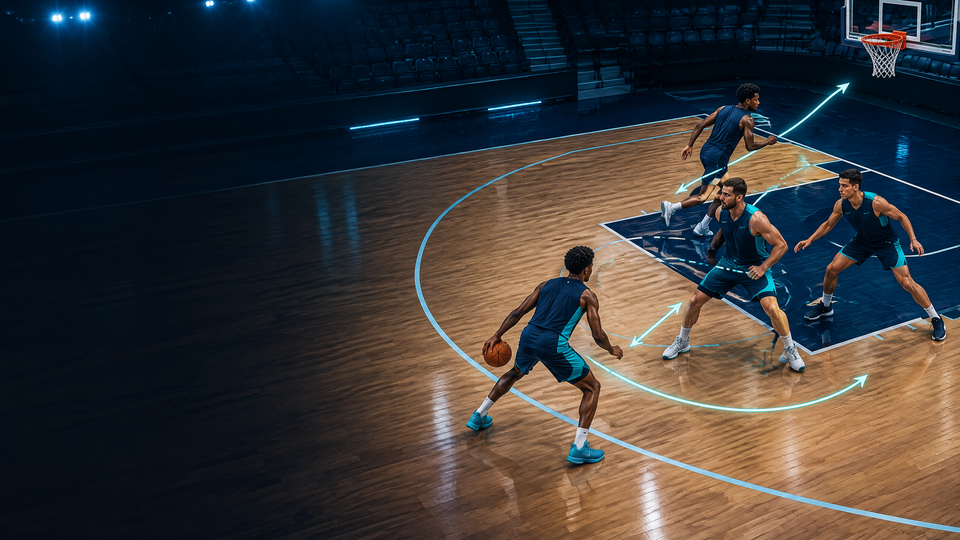
{{asset:header_image.png}}
Overview
This 20-minute Box-Out and Rebounding Drill teaches the defensive rebound as a complete possession: see the shot, find a body, make legal contact, pivot into a seal, pursue the ball, chin it and outlet. It begins at one attacking basket on a full FIBA court (28 m x 15 m), then finishes with a controlled first pass into transition. A rebound is not finished merely because a player touches the ball; it is finished when the team has secured it and can play.
Use one repeated cue throughout: “See ball. Find body. Hit. Pivot. Pursue. Chin. Outlet.” The aim is not to wrestle under the rim. It is to establish early legal contact, put the offensive player behind the defender and attack the ball at its highest reachable point.
Setup
Use the full 28 m x 15 m FIBA court, working at one basket to start. Divide 10 players into five defenders (D1-D5) and five attackers (O1-O5). O1 begins on the right wing with a ball. O2, O3 and O4 occupy high-post, weak-side lane-line and short-corner spots; O5 is beyond the opposite three-point line as safety. D1-D4 match the four rebound threats. D5 starts on the strong-side sideline, just above the free-throw-line extended, as the first outlet.
Place two cones on that sideline, 4 m apart, to create D5’s outlet window. A coach stands on the baseline with spare balls. Each live possession lasts 8 seconds, then players have 20 seconds to reset. The session is timed as 3 minutes teach/walk-through, 6 minutes guided box-out work, 3 minutes rebound-and-outlet work, 6 minutes competitive scoring and 2 minutes review.
{{asset:diagram_1.png}}
Step-by-Step Instructions
Teach the shape — 0:00-3:00. Freeze players in their starting positions. O1 shot-fakes, then releases a high perimeter shot on the whistle. Every defender calls “shot” as the ball leaves O1’s hand. Walk D1-D4 through the first action: locate the ball, turn head and shoulders to find the nearest offensive player, then step into that player’s path.
Find and hit — 3:00-5:00. Run two 45-second non-live blocks. O1 shoots; O2-O4 crash their lane. Defenders must make body contact before pursuing the ball: drop hips, widen the base and meet the attacker with the torso/upper forearm area. Contact is legal only when it is controlled: no extended arms, holding, displacement or push in the back. Blow the rep dead after two seconds and correct any player who chases before the hit.
Pivot and seal — 5:00-9:00. Run four live sequences of 35 seconds, with 20 seconds recovery. After contact, defenders pivot on the inside foot and place back and hips on the line between attacker and basket. Their chest stays tall enough to see the ball; the lower body does the sealing. Attackers can use realistic spin and swim-through attempts but cannot dislodge a defender. Award the defence one point only if every attacker is behind a defender when the ball reaches the rim.
Pursue, chin and outlet — 9:00-12:00. Make the finish live. The closest defender attacks the ball with two hands, lands in balance and pulls it to the chin with elbows tight. D5 moves to the cone window, calls the rebounder’s name and shows target hands. The rebounder has two seconds from landing to pivot away from pressure and make the outlet; no dribble is allowed.
{{asset:diagram_2.png}}
Competitive finish — 12:00-18:00. Play three rounds of 90 seconds, with 30 seconds to change roles. A clean defensive rebound plus completed outlet is worth two points. An offensive rebound is one point; a put-back from that possession is three. A foul, one-handed rebound, exposed ball, or outlet outside the cone window scores zero. Keep score visibly and demand the full communication chain.
Review and progression — 18:00-20:00. Allow O1 to drive or shoot, forcing defenders to box out from help-side positions rather than a static match-up. Finish in a 20-second huddle: players recite the sequence, then identify whether a lost rebound came from poor contact, poor seal or poor pursuit.
Key Coaching Points
Coach the first two steps after the shot. Defenders should step toward their player—not retreat toward the rim. Demand flexed knees, feet wider than shoulders and contact through hips and torso. A straight-legged, static box-out is easy to spin around.
Teach a pivot rather than a player simply standing with their back to the opponent. Hands stay visible and elbows inside the frame, reinforcing legal contact. Once sealed, mindset changes from block to ball: track the bounce, jump vertically, secure with two hands and land balanced.
Coach possession after the catch. “Chin” means ball under the face, eyes up and body between ball and pressure. The outlet is a pass to space, not a hopeful throw. D5 moves early, talks early and creates a clear 45-degree passing lane.
Common Mistakes
First, defenders turn to the rim and chase before making contact. Reset the pair and praise a correct box-out even when the rebound is lost. Second, players extend arms into an attacker’s back; reinforce “hips and chest, not hands.” Third, rebounders land narrow, leave the ball at waist height or dribble before finding the outlet. Demand a two-foot landing, chin position and pivot before passing.
Variations & Progressions
For a simpler variation, use 2v2 in each lane with a coach toss from the wing, then stop after the first rebound. To build decision-making, call “middle” or “sideline” as the rebounder lands, changing D5’s outlet angle. For an advanced progression, use 4v4 plus an outlet guard and permit perimeter crashes, screens and split cuts; defenders must communicate switch or stay before the shot. Make the outlet live by allowing O5 to pressure D5 and requiring the defence to cross half-court in four seconds.
Age Adaptations
For under-10s, shrink the work to the lane, use a soft coach toss, remove live put-backs and award a point for a correct “find-hit-pivot” shape. Keep blocks to 20 seconds and use walking-pace contact only. Under-12 and under-14 groups can play 3v3 with one outlet and a contested rebound. Under-16 and open groups should use the full scoring system, realistic perimeter crashes and the four-second transition outlet. At every age, add intensity only after players show balance, safe contact and two-handed ball security.
