

Football
Mastering the Build-Up: Playing Out from the Back
A comprehensive guide to teaching your team how to confidently retain possession and progress the ball from the goalkeeper through the thirds.

What you need
Full-size goal, 10-15 footballs, Training bibs (2 colors), Marker cones
1. Overview
Building out from the back is a fundamental tactical approach in modern football. Instead of the goalkeeper launching the ball long and creating a 50/50 aerial duel, this strategy focuses on retaining possession, drawing the opposition's press, and methodically progressing the ball through the defensive and middle thirds. When executed correctly, it creates numerical advantages and allows your team to attack disorganized defensive structures.
This set play resource is designed to give your squad a structured framework for the initial phase of possession. It emphasizes positional discipline, sharp passing, and the crucial concept of the 'third-man run' to bypass pressing forwards. Use this when facing teams that press high, as breaking their first line of pressure often leads to high-quality attacking transitions.
2. Setup

Pitch Area: Use half to two-thirds of a standard pitch (approx. 70m x 68m) to ensure realistic distances.
Players: 11 players (1 GK, 4 Defenders, 3 Midfielders, 3 Attackers) setup in a 4-3-3 formation.
Equipment: Full-size goal, 10-15 balls positioned with the Goalkeeper or coach, bibs for opposition players if running opposed, and cones to mark reference zones (defensive third, middle third).
Initial Shape:
- The Goalkeeper (GK) starts with the ball in the 6-yard box.
- The Centre-Backs (CBs) split wide to the edges of the penalty area.
- The Full-Backs (LB/RB) push high and wide, almost touching the touchlines.
- The Defensive Midfielder (DM) drops centrally, acting as the pivot just outside the penalty arc.
- The Central Midfielders (CMs) position themselves in the half-spaces, ready to drop or advance.

3. Step-by-Step Instructions
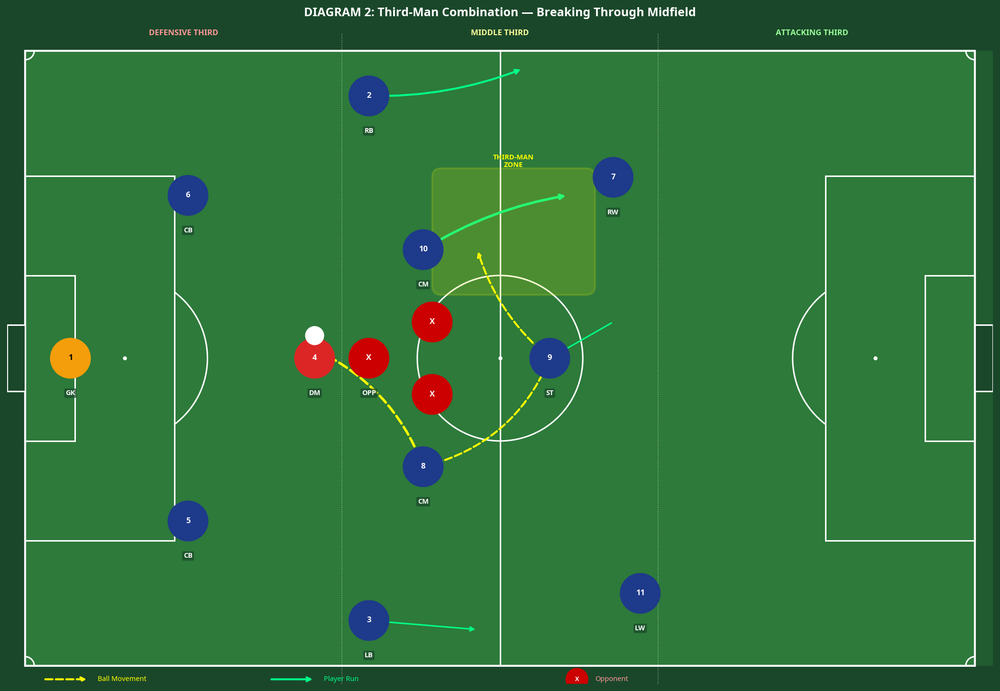
Phase 1: The Initial Distribution
- The GK places the ball on the ground, signaling the start of the build-up.
- The CBs split wide, creating an immediate passing option on either side.
- The GK plays a firm, accurate pass to the left CB (5).
- As the ball travels, the DM (4) checks their shoulder and adjusts their angle to offer a central passing lane.
Phase 2: Breaking the First Line (The Third-Man Concept)
5. The CB (5) receives on the half-turn, taking their first touch forward to invite pressure.
6. Recognizing the pressing forward, the CB (5) plays a crisp pass into the feet of the dropping DM (4).
7. Simultaneously, the left CM (8) drops slightly to receive a one-touch pass from the DM (4).
8. The right CM (10) anticipates this sequence and makes a forward run into the space vacated by the opposition's midfield.

Phase 3: Progressing and Creating the Overload
9. The CM (8) plays a forward pass into the feet of the advancing striker (9), who has dropped deep to link play.
10. The striker (9) lays the ball off first-time to the forward-running CM (10).
11. The Right Winger (7) tucks inside, dragging the opposition full-back with them and opening the wide channel.
12. The Right-Back (2) makes a high-speed overlapping run into the attacking third to receive a through ball from the CM (10).
13. The RB (2) delivers a cross or cut-back into the penalty area for the arriving attackers.

4. Key Coaching Points

- Body Shape and First Touch: Players must receive the ball on the half-turn (open body shape) so they can see both the ball and their next passing option. The first touch should take them away from pressure.
- Scanning: Encourage players, especially the pivot (DM) and midfielders, to continuously scan their surroundings before receiving the ball. They need a picture of where the space and opponents are.
- Patience and Provocation: Do not force passes. The CBs should hold the ball to provoke the opposition press, which inherently leaves space behind them. Pass the ball to eliminate defenders.
- Weight and Accuracy of Pass: Passes must be played with purpose. A soft pass invites pressure and interceptions; a firm pass to the correct foot (the one furthest from the defender) ensures the receiver has time.
- Triangles and Support: Always ensure the player on the ball has at least two passing options, forming triangles across the pitch.
5. Common Mistakes

- Hiding Behind Defenders: Midfielders failing to move out of the opponent's cover shadow, making themselves unplayable.
- Panic Under Pressure: Defenders clearing the ball aimlessly when pressed instead of trusting the structure and playing the simple pass.
- Static Positioning: Players waiting for the ball to arrive rather than moving to meet it or adjusting their angle as the ball travels.
- Goalkeeper Hesitancy: The GK taking too long to distribute, allowing the opposition to set their pressing trap.
6. Variations & Progressions

- Progression 1: Adding Active Opposition: Start with passive opposition (shadow play) and gradually increase to full-pressure (e.g., a front three pressing the back four and DM).
- Progression 2: The 'Bounce' Pass: If the DM is tightly marked, the CB can bypass them by playing directly to a dropping CM, who then bounces the ball back to the DM facing forward.
- Variation: Build-up via Full-Backs: If the center is completely blocked, the GK can distribute directly to the high Full-Backs, triggering a different combination pattern involving the winger and CM.
7. Age Adaptations

- Under 8 - Under 10: Focus purely on the GK rolling the ball out to defenders and encouraging players to spread out. Emphasize taking a good first touch and looking up. Do not introduce complex third-man runs.
- Under 12 - Under 14: Introduce the concept of the pivot (DM) and the importance of body shape. Begin working on passing sequences involving 3-4 players before crossing the halfway line.
- Under 16 - Open: Implement the full pattern with high-intensity pressing from the opposition. Focus on the speed of play, precise timing of runs, and recognizing tactical triggers (e.g., when to play long if the press is too aggressive).
