

Football
Goal Kick Build-Up Play: Transition to Attack
Master the art of building from a goal kick, turning defense into attack with structured passing and movement.
What you need
Cones, Balls
Setup
- Area: Use half of a standard pitch (approx. 60x40 yards). Mark a goal at one end with cones or use a real goal. Place a goalkeeper in the goal.
- Players: 8 outfield players split into two teams of 4 (plus goalkeeper for the defending team). Adjust numbers if more players available (e.g., 5v5).
- Equipment: Cones, balls, bibs, goalkeeper gloves (if available).
- Instructions:
- The defending team starts with a goal kick. The goalkeeper plays the ball to one of the defenders.
- The attacking team (defending team) aims to build up play and score in the opposition's goal (placed at the halfway line or use a small goal).
- The opposition team presses to win the ball and score in the main goal.
- Restart with a goal kick after each goal or out of play.
- Duration: 20 minutes (4 x 4-minute blocks with 1-minute rest).
Step-by-Step Instructions
- Initial Positioning: The goalkeeper places the ball on the edge of the 6-yard box. Defenders split wide to the edges of the penalty area, and midfielders push up to the halfway line, creating passing lanes.
- Goal Kick Execution: The goalkeeper plays a short pass to a defender (or midfielder if pressed). The objective is to invite the opposition press and then play through it.
- Building Out: The defender receiving the ball has three options: pass to the other defender, pass to a midfielder, or dribble forward if space allows. The key is to move the ball quickly and accurately.
- Midfield Rotation: Midfielders should create angles by moving into space, either dropping deep to receive or pushing wide to stretch the opposition.
- Progression to Attack: Once the ball reaches midfield, the team should look to switch play or play a through ball to a forward. The aim is to advance the ball into the opposition half and create a scoring opportunity.
- Opposition Press: The opposition team should press high to force errors. They can press with two forwards, with midfielders supporting to cut off passing lanes.
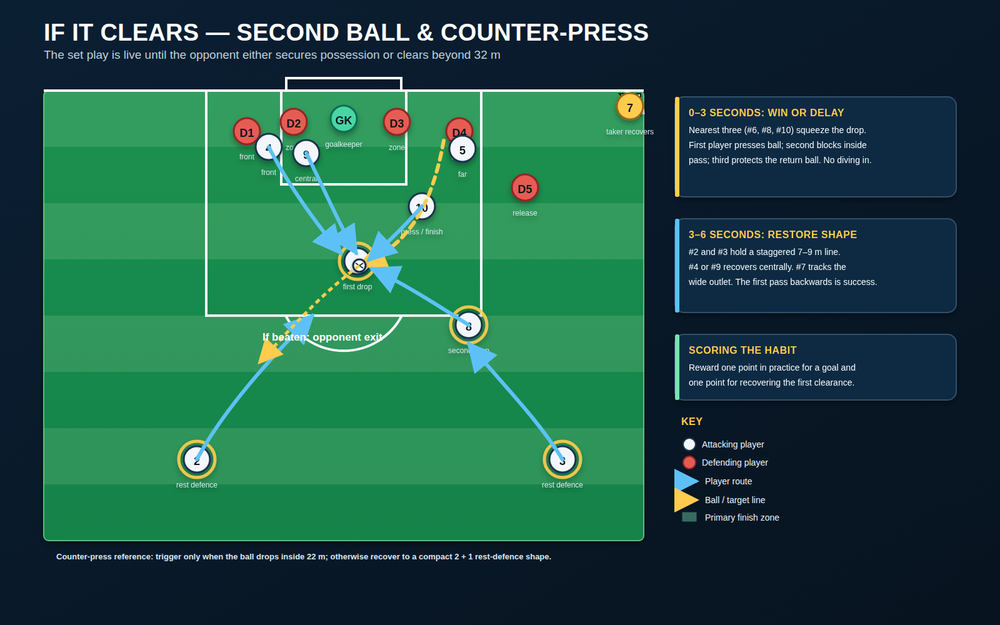
- Transition Moment: Upon winning the ball, the opposition immediately transitions to attack, looking to score quickly in the main goal. The defending team must react quickly to counter-press or recover defensively.
- Scoring: The defending team scores by passing into the opposition's goal (or small goal). The opposition scores in the main goal.
- Restarts: After a goal or ball out of play, restart with a goal kick for the defending team. Rotate teams after each 4-minute block.
Coaching Points
- Create Passing Angles: Defenders should position themselves so that the goalkeeper always has at least two passing options. This stretches the opposition press.
- Body Orientation: When receiving the ball, players should open their body to face up the pitch, allowing them to play forward quickly.
- Timing of Movements: Midfielders must time their runs to receive the ball in space, not static. Movement off the ball is crucial to break lines.
- Decision Making: Players should recognize when to play short and when to play long. If the opposition presses high, playing long to a forward might be the best option.
- Communication: Constant communication between goalkeeper and defenders is essential to avoid mistakes and coordinate the build-up.
- Transition Awareness: As soon as possession is lost, the nearest players must press immediately to win the ball back or delay the opposition attack.
Common Mistakes
- Telegraphing Passes: Players often stare at their intended target, allowing the opposition to intercept. Encourage scanning and disguising passes.
- Poor First Touch: A heavy first touch gives the opposition time to press and win the ball. Emphasize a soft, directional first touch.
- Lack of Movement: Static players are easy to mark. Midfielders and forwards must constantly move to create space and options.
- Forcing the Pass: Trying to play through a crowded area instead of switching play or playing long. Encourage players to recognize when to go direct.
- Slow Transition: After losing the ball, players must react quickly. Delay allows the opposition to counter-attack effectively.
- Goalkeeper Isolation: The goalkeeper should be involved as an extra outfield player, not just a distributor. They should move to offer an angle and support play.
Progressions & Variations
- Progression 1: Add a neutral player (e.g., a midfielder) who plays for the team in possession, creating an overload (5v4). This encourages better build-up play and creates more passing options.
- Progression 2: Limit the number of touches for the defending team (e.g., two-touch maximum) to speed up play and improve decision-making.
- Progression 3: Introduce a time limit to score after a goal kick (e.g., 20 seconds) to simulate game-like urgency.
- Variation 1: Instead of a goal kick, start with a throw-in or free kick in the defensive third to practice different build-up scenarios.
- Variation 2: If the opposition wins the ball, they must score within 10 seconds to encourage quick transitions.
- Variation 3: Use a larger goal for the opposition to make scoring easier, or smaller goals for the defending team to focus on accurate passing.
Coaching Points:
- Create passing angles and always offer two options.
- Receive with an open body to play forward quickly.
- React immediately after losing possession to counter-press.
Common Mistakes:
- Telegraphing passes and poor first touch.
- Lack of movement and slow transition after losing the ball.
Progressions:
- Add a neutral player to create overload.
- Limit touches to two to increase speed of play.
Variations:
- Start from throw-ins or free kicks in defensive third.
- Impose time limits to simulate game urgency.
