

Football
Coordinated High Press: Backward Pass Trigger & Wide Recovery
Train your front line to execute a devastating high press on a backward pass trigger, while teaching the midfield unit how to recover rapidly if the press is broken.

What you need
1 full-size goal, 8+ footballs, 12-15 cones or flat markers, 2 sets of colored bibs
1. Overview
This pressing trigger and recovery drill is designed to train the front and middle units to recognize a specific trigger—the backward pass—and execute a coordinated high press. It simultaneously trains the defensive unit to slide, cover, and prepare for a potential switch of play if the press is bypassed. Use this drill during the tactical phase of a session to ingrain aggressive pressing behaviors while maintaining structural integrity and preventing easy central progression.
2. Setup
| Element | Coach instruction |
|---|---|
| Full-pitch reference | On an adult pitch of 100-110m x 64-75m, work in a 42m x 36m block extending from one penalty area toward the halfway line. This preserves realistic running distances while increasing repetitions. |
| Working area | Mark a 42m-long x 36m-wide rectangle. Use the main goal at one end and a 4m-wide counter-goal or dribble gate at the far end. Mark an 8m-wide outside trap lane down the possession team's right side. |
| Players | 9 players: Red #9 Striker, #10 Attacking Midfielder, #8 Box-to-Box Midfielder, #6 Defensive Midfielder and #2 Fullback against Blue GK, #4 and #5 Centre-Backs, and #3 Fullback. Rotate players every two rounds. |
| Equipment | 1 full-size goal, 1 counter-goal or two cones, 8+ balls, 12-15 cones or flat markers, and two bib colours. |
| Timing | Run 4 x 3-minute blocks with 75 seconds' coaching/recovery between blocks. Each restart should occur within 8 seconds; cap each live repetition at 20 seconds. |
Position the Blue GK and two centre-backs as if building from the back. The Red #9 begins 6-8m from Blue #4, with #10 and #8 8-10m behind #9. Red #6 starts 6m behind the midfield line and Red #2 begins near the far-side recovery lane. The distances are deliberate: they make the initial press achievable without allowing the defending group to lose central protection.
3. Step-by-Step Instructions
Phase 1: The Pressing Trigger
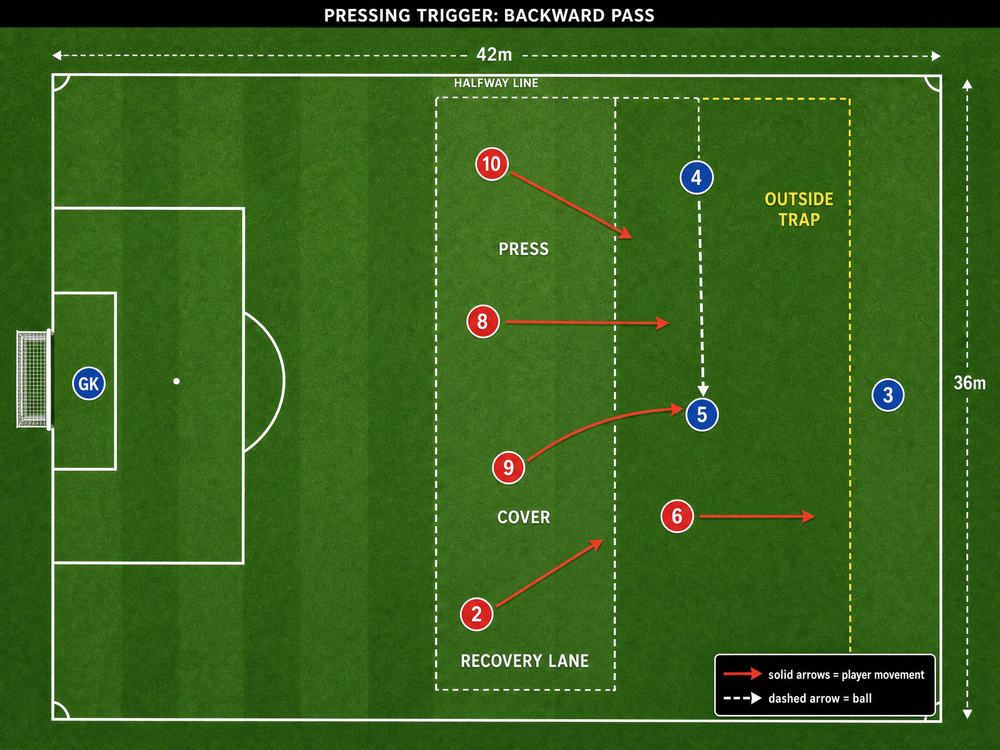
- The drill begins with the Blue GK distributing the ball to Blue 4.
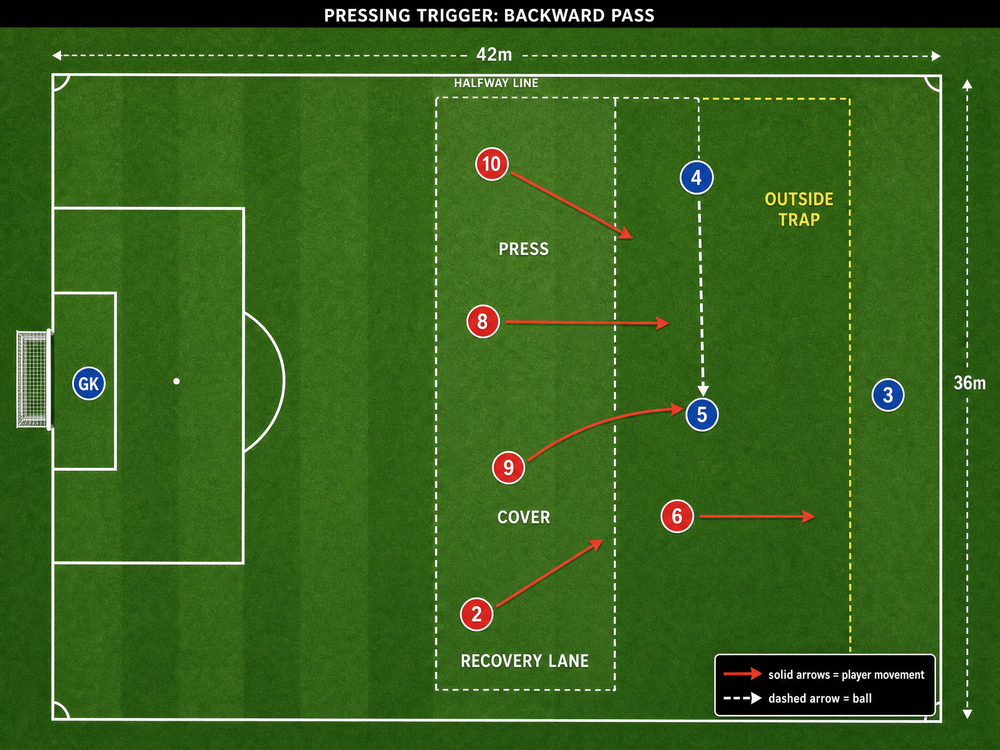
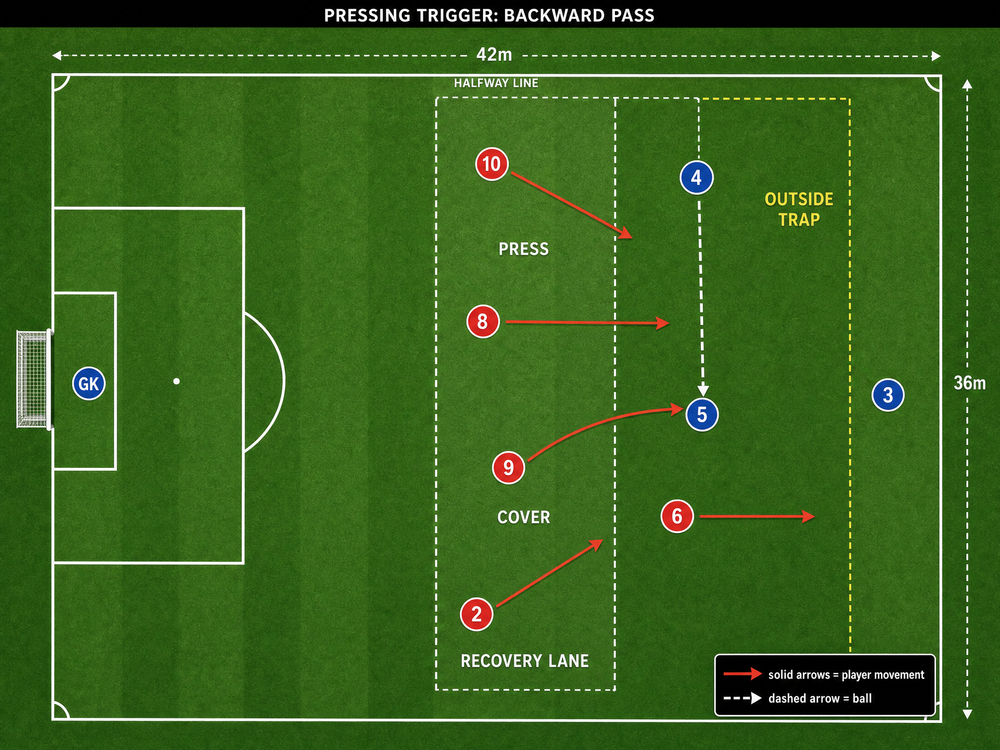
- Blue 4 receives the ball and is instructed to play a square or slightly backward pass to Blue 5. This backward pass is the designated pressing trigger.
- As the ball travels toward Blue 5, Red 9 immediately initiates a curved pressing run to cut off the passing lane back to the GK, forcing Blue 5 toward the touchline.
- Simultaneously, Red 10 and Red 8 step up aggressively to man-mark or block passing lanes to any central options.
- Red 6 slides across to provide secondary cover, and Red 2 steps into the recovery lane to anticipate a forced wide pass.

Phase 2: Recovery and Re-organization
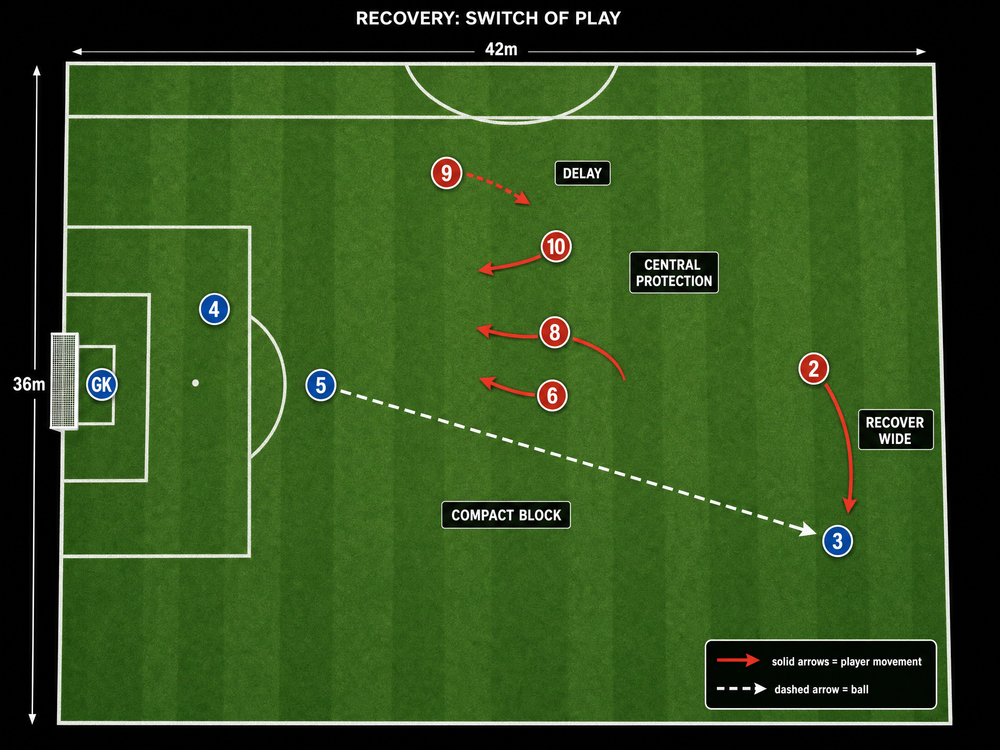
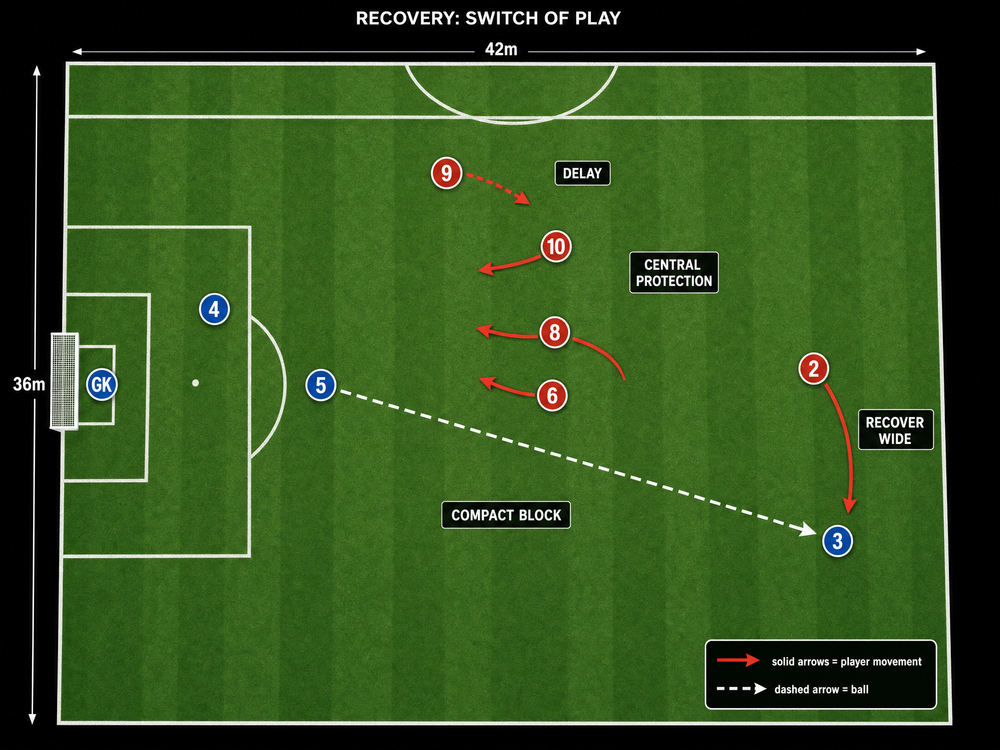
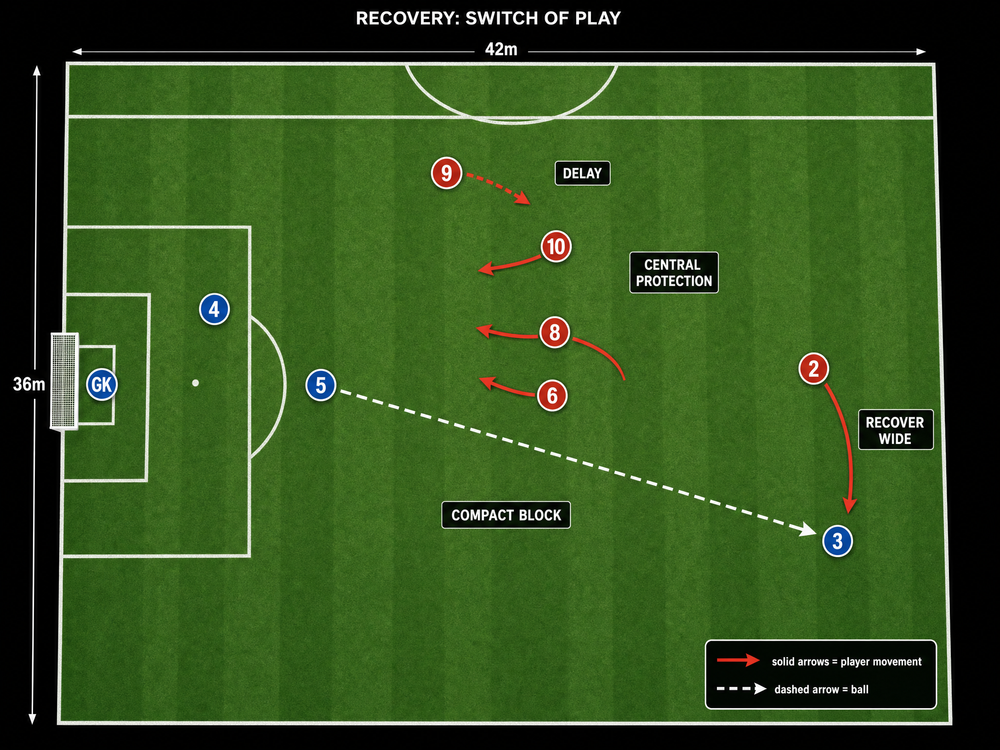
- If Blue 5 manages to bypass the initial press by playing a long diagonal switch to Blue 3 on the opposite flank, the pressing team must immediately transition into recovery mode.
- Red 9 must slow the play if possible, acting as a temporary screen.
- Red 10, Red 8, and Red 6 must sprint back centrally (curved recovery runs) to form a compact block and protect the vital central areas just outside the penalty box.
- Red 2, on the far side, must recover diagonally outward to press or delay Blue 3, preventing an uncontested cross or entry into the box.
- Play continues until the Blue team scores in a counter-goal (or dribbles across a designated end line), the Red team wins the ball and scores on the main goal, or the ball goes out of bounds.
4. Key Coaching Points
- Intensity on the Trigger: The press must be initiated the moment the ball leaves Blue 4's foot. Hesitation allows the receiving centre-back time to scan and pick a forward pass.
- Curved Pressing Runs: The first presser (Red 9) must arc their run to eliminate the back-pass option, making play predictable and forcing the opponent into the "outside trap."
- Unit Cohesion: The midfield line (Red 10, 8, 6) must step up in unison with the forward. If the forward presses alone, they will be easily bypassed.
- Sprint to Recover: When the press is broken via a switch of play, recovery runs must be immediate, central, and at maximum speed to protect the goal.
- Communication: The deepest midfielder or recovering defender must dictate the shifting of the block with clear, loud instructions (e.g., "Slide left!", "Hold!").
5. Common Mistakes
- Pressing Too Early or Late: Pressing before the backward pass is played allows the opponent to easily adjust; pressing after the ball is controlled gives the opponent too much time.
- Straight-Line Pressing: Approaching the ball carrier in a straight line fails to cut off passing angles, allowing the centre-back to easily pass back to the goalkeeper.
- Lack of Compactness: Midfielders failing to step up behind the pressing forward leaves massive gaps between the lines for the opponent to exploit.
- Jogging During Recovery: Players jogging back after the press is broken, leaving the defense exposed to a quick numerical disadvantage on the switch.
6. Variations & Progressions
- Progression 1 (Add Midfielders): Introduce a Blue #6 and #8 to increase the difficulty for the pressing team, requiring tighter man-marking and better spatial awareness.
- Progression 2 (Time Limit): Give the Red team a strict 6-second window to win the ball back after the trigger, simulating high-intensity counter-pressing rules.
- Variation (Different Trigger): Change the pressing trigger from a backward pass to a heavy touch or a pass played to a player facing their own goal.
7. Age Adaptations
- Under-10 / Under-12: Focus purely on the concept of the "trigger" and the curved run of the first attacker. Reduce the pitch size slightly and remove the complex recovery phase.
- Under-14 / Under-16: Introduce the synchronized movement of the midfield unit. Emphasize communication and the speed of the transition from pressing to recovery.
- Open / Senior: Run the drill at full match intensity. Demand perfection in the timing of the press, the angle of approach, and the tactical discipline of the recovery block.
