

Football
Elite Goalkeeper Shot-Stopping & Recovery Drill
A high-intensity drill designed to improve a goalkeeper's shot-stopping ability, footwork, and rapid recovery from multiple angles.
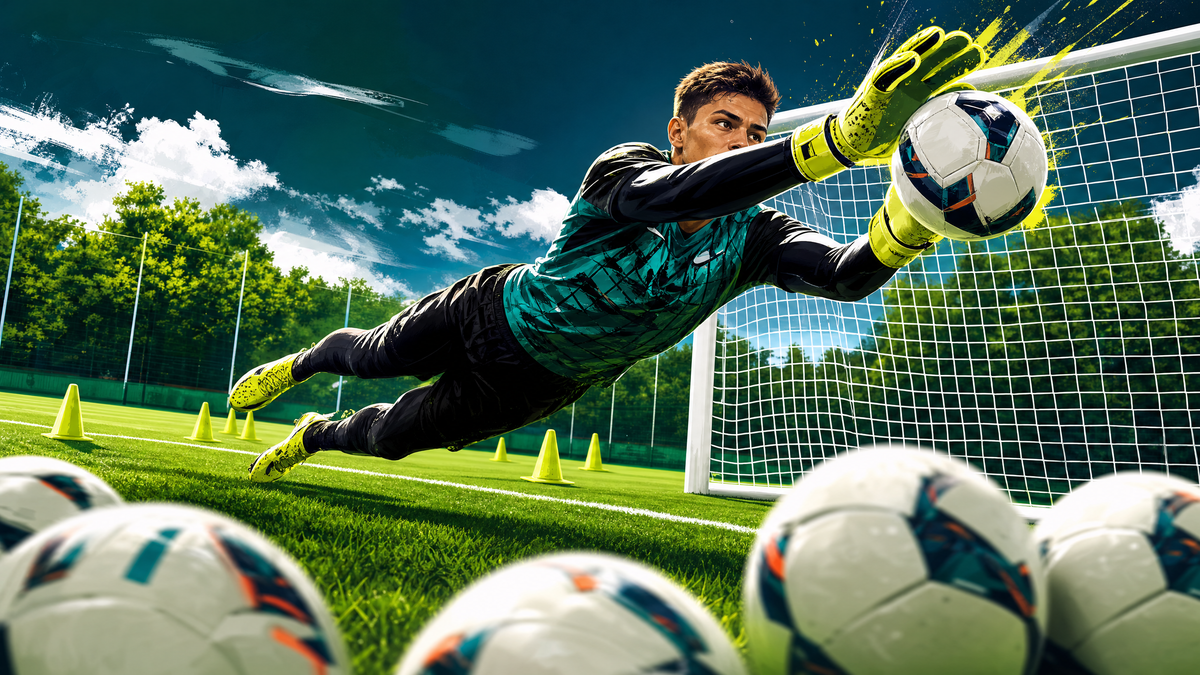
What you need
1 Full-size goal, 10-15 Footballs, 3-5 Training cones
1. Overview
This high-intensity shot-stopping drill is designed to test and develop a goalkeeper's reflexes, footwork, and recovery speed under pressure. In modern football, a goalkeeper must not only make the initial save but also quickly recover to defend against secondary opportunities. This drill simulates realistic match scenarios where shots come from different angles and distances, requiring the goalkeeper to adjust their set position rapidly. It is ideal for the main technical phase of a goalkeeper training session, preparing them for the chaotic nature of penalty box action.
2. Setup
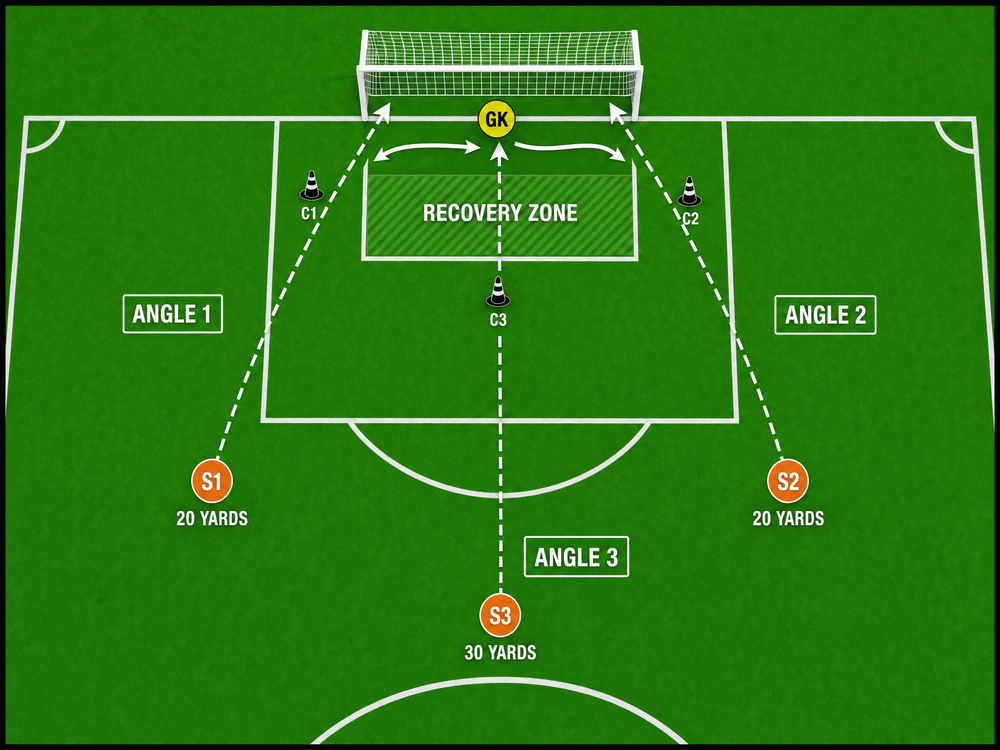
- Pitch Area: Penalty area (18-yard box) of a standard football pitch.
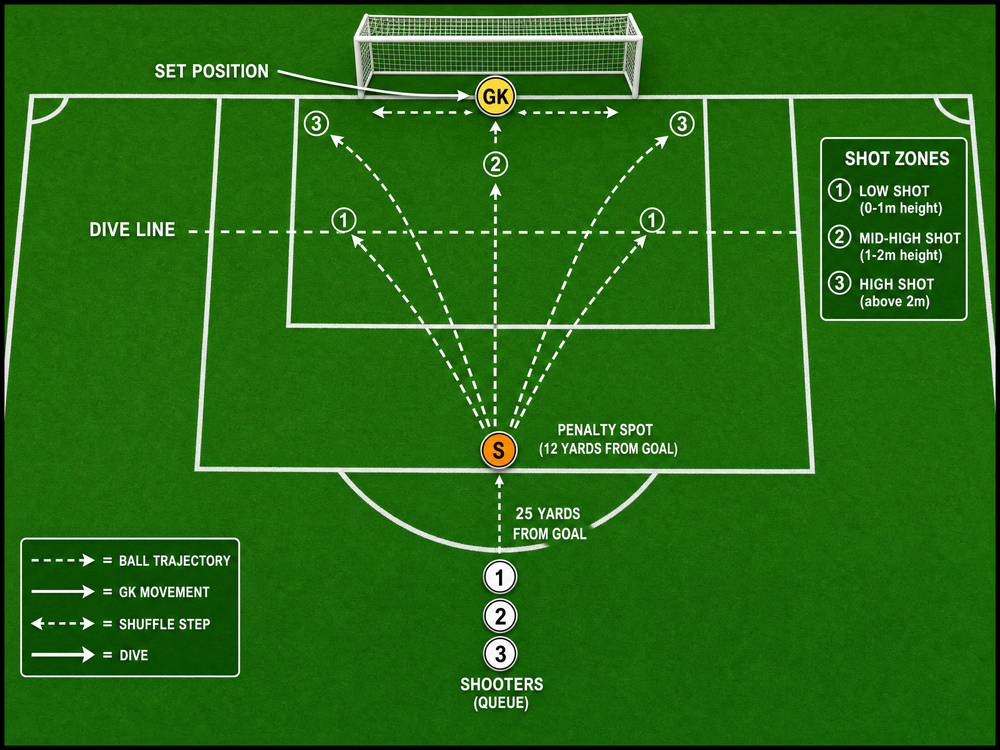
- Players: 1 Goalkeeper (GK), 1 Server/Coach (S), 3 Shooters (or additional servers for progression).
- Equipment: 1 full-size goal, 10-15 footballs, 3-5 training cones.
- Positions:
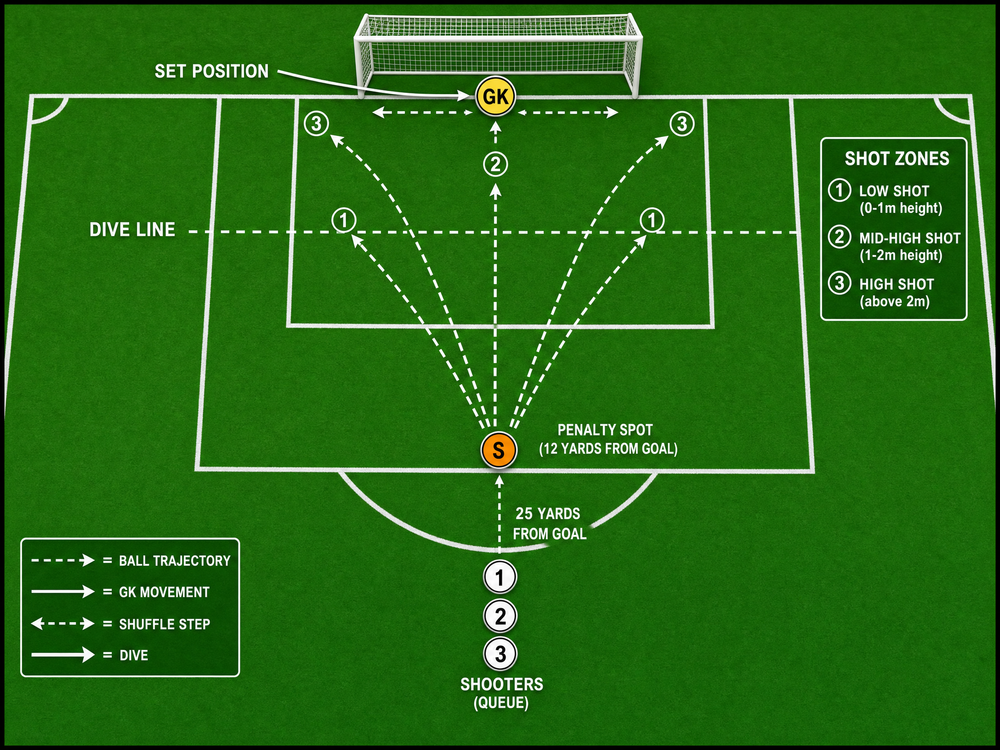
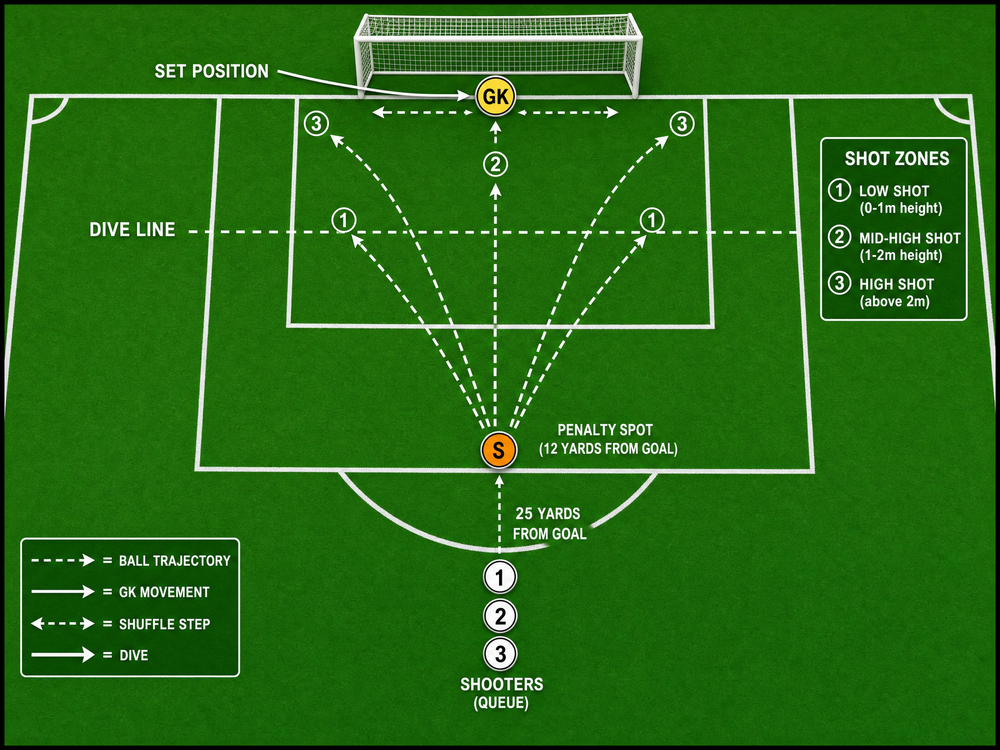
- The Goalkeeper starts on the goal line, central to the goal.
- The main Server (S) is positioned around the penalty spot (12 yards from goal) or slightly further back at 15 yards.
- Shooters queue up centrally, roughly 25 yards from the goal.
3. Step-by-Step Instructions
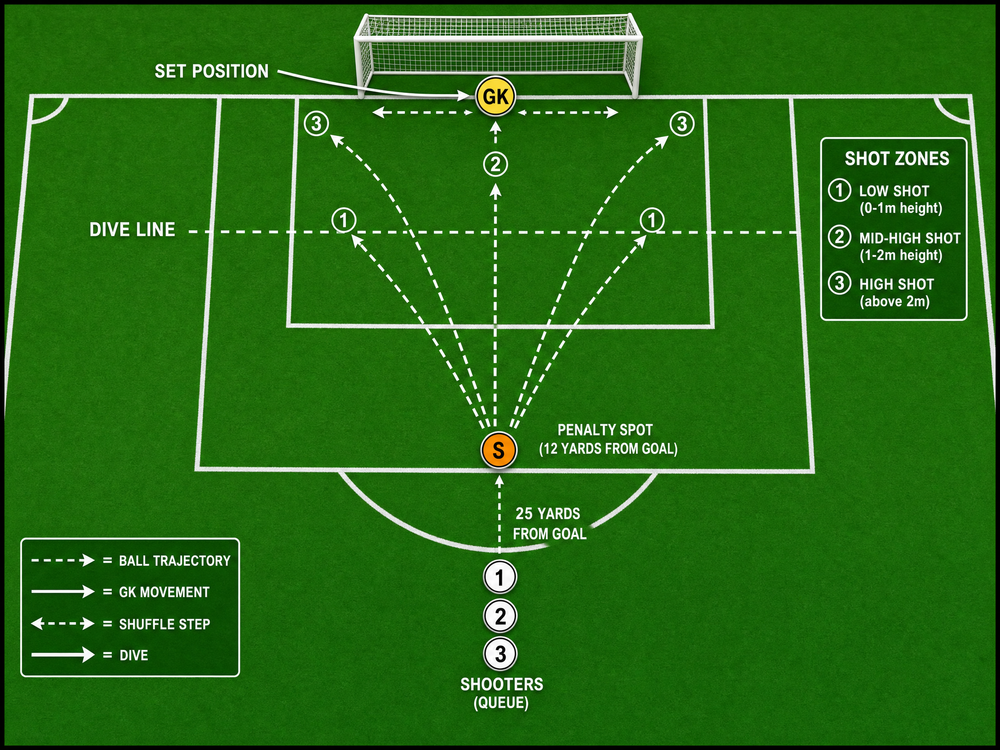
Phase 1: Fundamental Shot-Stopping
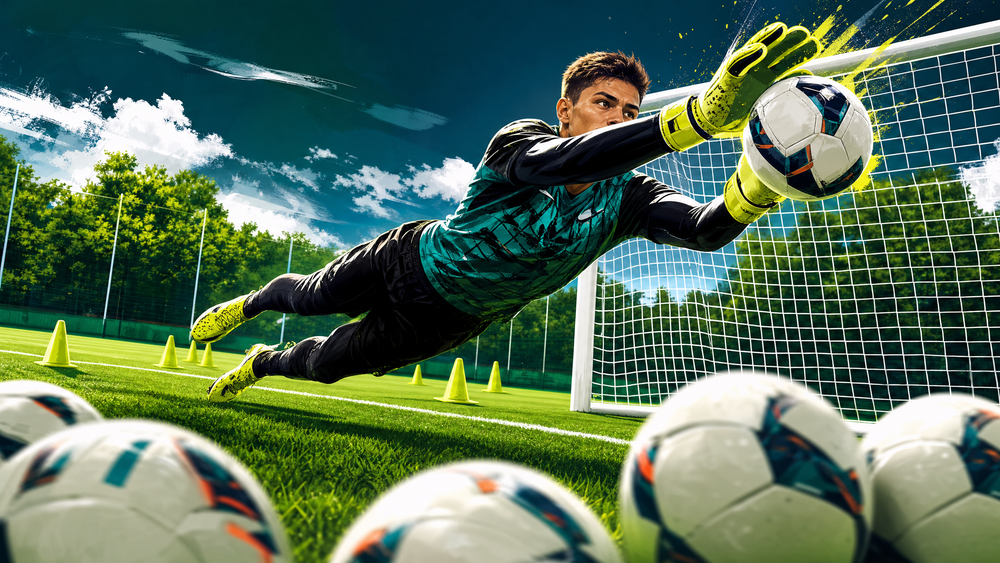
- Starting Position: The goalkeeper begins in a strong set position on the goal line, knees slightly bent, weight on the balls of the feet, and hands ready.
- The Service: The Server (S) delivers a variety of shots from the penalty spot area. These should vary between low drives, mid-height shots, and high balls.
- The Save: The goalkeeper must react, execute the appropriate footwork (shuffle step or crossover), and make the save.
- Distribution/Reset: After securing the ball, the goalkeeper rolls it back to the server and immediately resets to the set position. If the ball is parried, the goalkeeper must quickly recover to their feet.
- Rotation: Perform 6-8 repetitions before resting or rotating goalkeepers.
Phase 2: Multi-Angle Recovery
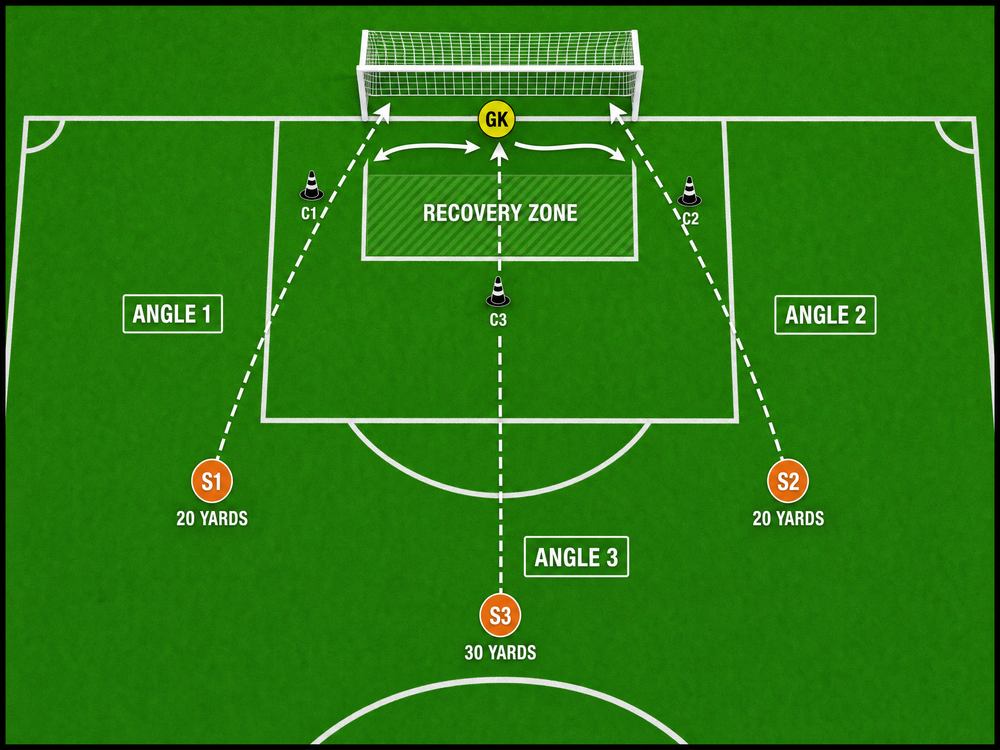
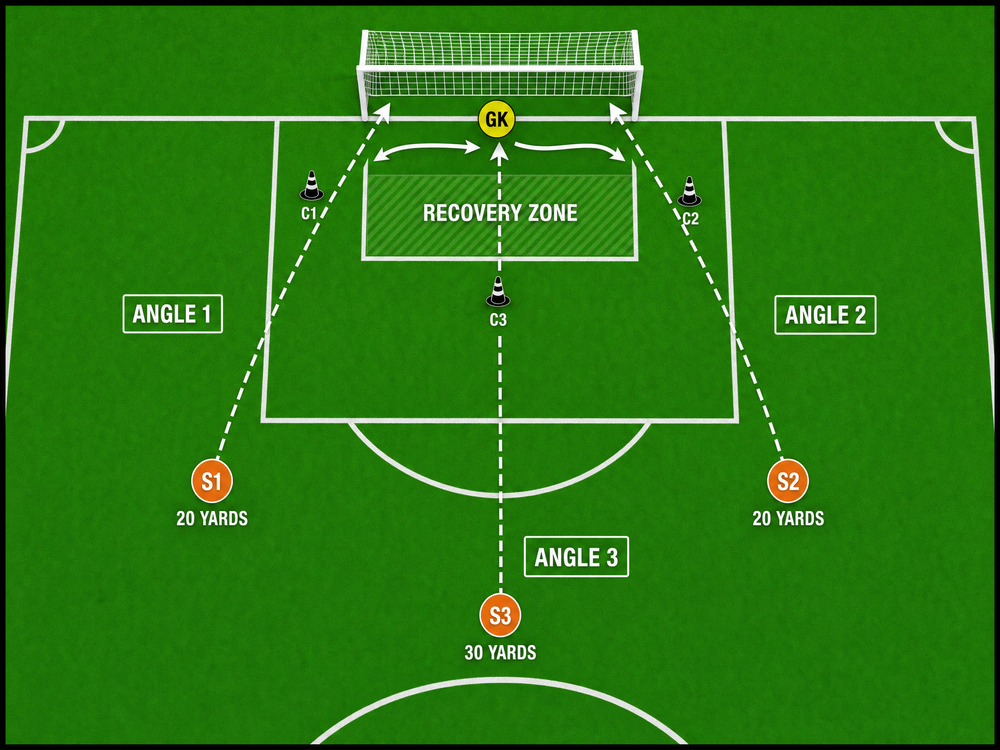
- Adjusted Setup: Introduce three servers (S1, S2, S3) positioned at different angles. S1 at 20 yards left of centre, S2 at 20 yards right of centre, and S3 at 30 yards centrally. Place cones to mark a 'Recovery Zone' just outside the 6-yard box.
- First Action: S1 strikes a shot towards the goal. The goalkeeper makes the save.
- The Recovery: Immediately after the first save (whether caught or parried), the goalkeeper must quickly get to their feet and adjust their angle to face S2.
- Second Action: S2 delivers the second shot as soon as the goalkeeper is set (or slightly before to increase difficulty).
- Final Action: The goalkeeper recovers again, finds the central position, and faces a longer-range shot from S3.
- Rest: This is a highly demanding sequence. Allow adequate rest (at least 1-2 minutes) between sets.
4. Key Coaching Points
- The Set Position: Ensure the goalkeeper is perfectly still and balanced just before the striker makes contact with the ball. Moving while the ball is struck severely limits reaction time.
- Footwork Before the Dive: Emphasise quick, small steps to get the body behind the ball whenever possible, rather than relying solely on diving from a static position.
- Handling and Parrying: Encourage catching the ball cleanly. If a catch is impossible, instruct the goalkeeper to parry the ball wide and away from the 'danger zone' (the central area in front of the goal).
- Speed of Recovery: The focus of the progression is getting back to the feet quickly. Teach the technique of using the momentum of the dive to spring back up, rather than rolling onto the stomach.
- Angle Play: Constantly remind the goalkeeper to adjust their position relative to the ball, moving along the imaginary arc between the posts to narrow the shooter's angle.
5. Common Mistakes
- Being 'Caught on the Heels': Weight resting on the heels rather than the balls of the feet, resulting in slow reaction times and an inability to spring towards the ball.
- Diving Backwards: Collapsing backwards rather than attacking the ball diagonally forward. This reduces the goalkeeper's reach and increases the chance of the ball deflecting into the net.
- Parrying Back into the Danger Area: Pushing the ball straight back out into the middle of the penalty box, setting up an easy rebound for an attacking player.
- Slow Recovery: Staying on the ground too long after a save, admiring the work, rather than instantly preparing for a secondary shot.
6. Variations & Progressions
- Introduce Rebounders: Have a player positioned specifically to follow up on any spilled balls. This forces the goalkeeper to secure the catch or parry safely away.
- Obstructed View: Place a couple of mannequins or passive players between the server and the goalkeeper to simulate a crowded penalty area, forcing the goalkeeper to track the ball late.
- Movement into the Set: Instead of starting static on the line, have the goalkeeper start on the 6-yard line, backpedal to the goal line, and then set as the server strikes the ball.
7. Age Adaptations
- Under 8 - Under 10: Focus purely on Phase 1. Keep the service gentle and focus on the correct set position and basic handling (the 'W' grip). Reduce the distance of the server to 8-10 yards.
- Under 12 - Under 14: Introduce Phase 2 but with only two servers. Focus on the footwork required to change angles. The service should be challenging but manageable to build confidence.
- Under 16 - Open: Run the full drill at match intensity. Demand explosive dives, immediate recoveries, and perfect handling. Introduce the variations (rebounders, obstructed views) to increase cognitive load.
