

Football
The Near-Post Bullet: A High-Percentage Corner Kick Routine
Master this highly effective near-post corner kick routine designed to exploit zonal marking systems with a low, driven delivery and coordinated decoy runs.
What you need
Football pitch with penalty area markings, Corner flags, Footballs (multiple for repetition), Training bibs (two colors)
1. Overview
The 'Near-Post Bullet' is a highly effective attacking corner kick set play designed to exploit the space directly in front of the near post. In modern football, many teams employ a zonal or mixed marking system on corners, often leaving a small pocket of space between the near-post defender and the edge of the six-yard box.
This routine uses a combination of a low, driven delivery and a coordinated screen run to isolate your most aggressive aerial attacker in that exact pocket. It is particularly effective against teams that set up with a high defensive line on corners or those whose near-post zonal defender is slow to react. When executed correctly, a slight flick-on can either score directly at the far post or cause chaos in the six-yard box for secondary runners to finish.
2. Setup
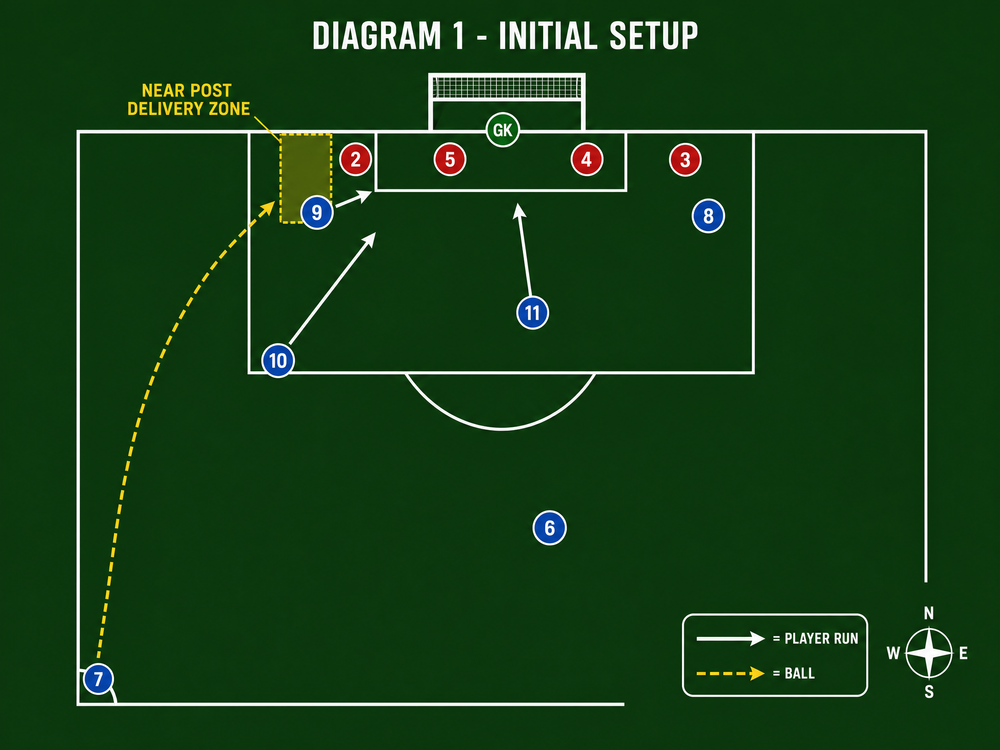
Pitch Setup: Standard full-size pitch (100-110m x 64-75m). The play requires the full penalty area and corner arc.
Player Roles & Positions:
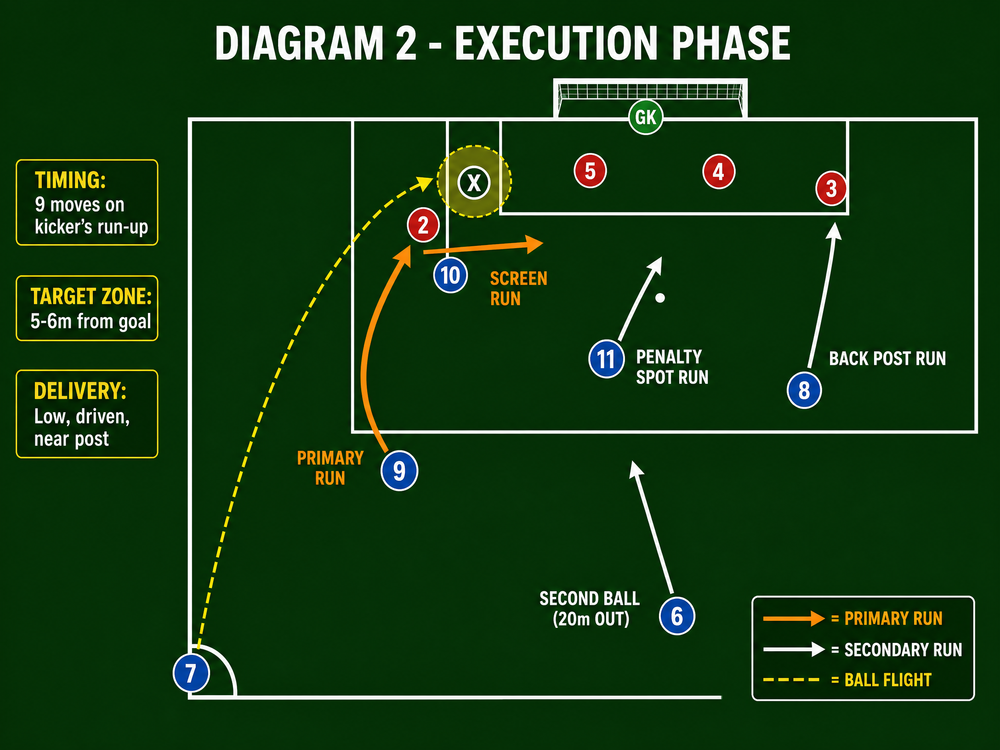
- 7 (Corner Taker): Positioned at the corner arc. Needs the ability to deliver a low, driven, in-swinging or out-swinging ball with pace.
- 9 (Primary Target): Positioned initially on the edge of the penalty area, about 12-15 meters out, aligned with the near post. This should be an aggressive player with excellent timing and aerial ability.
- 10 (Screener): Positioned 10 meters from goal at the near post angle. Their job is to block or drag the near-post zonal defender out of position.
- 11 (Penalty Spot Runner): Positioned centrally, ready to attack the penalty spot area for any rebounds or pull-backs.
- 8 (Back Post Runner): Positioned deep, ready to attack the back post if the ball is flicked on by the primary target.
- 6 (Second Ball): Positioned 20 meters from goal, central, to recycle possession or take a long-range shot if the ball is cleared.
3. Step-by-Step Instructions
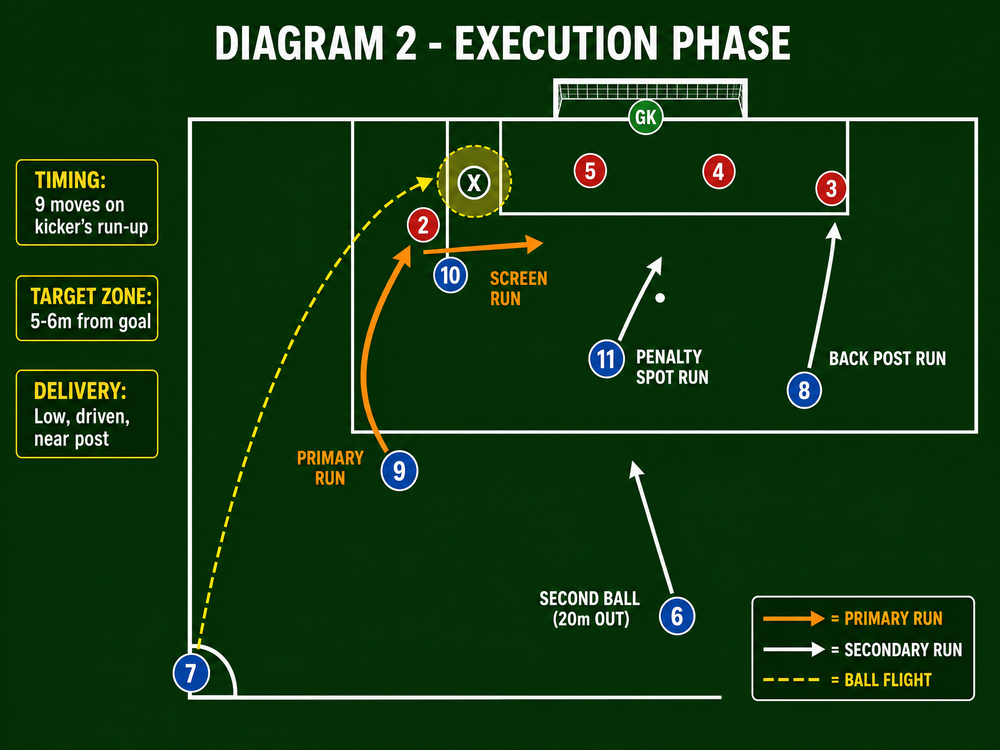
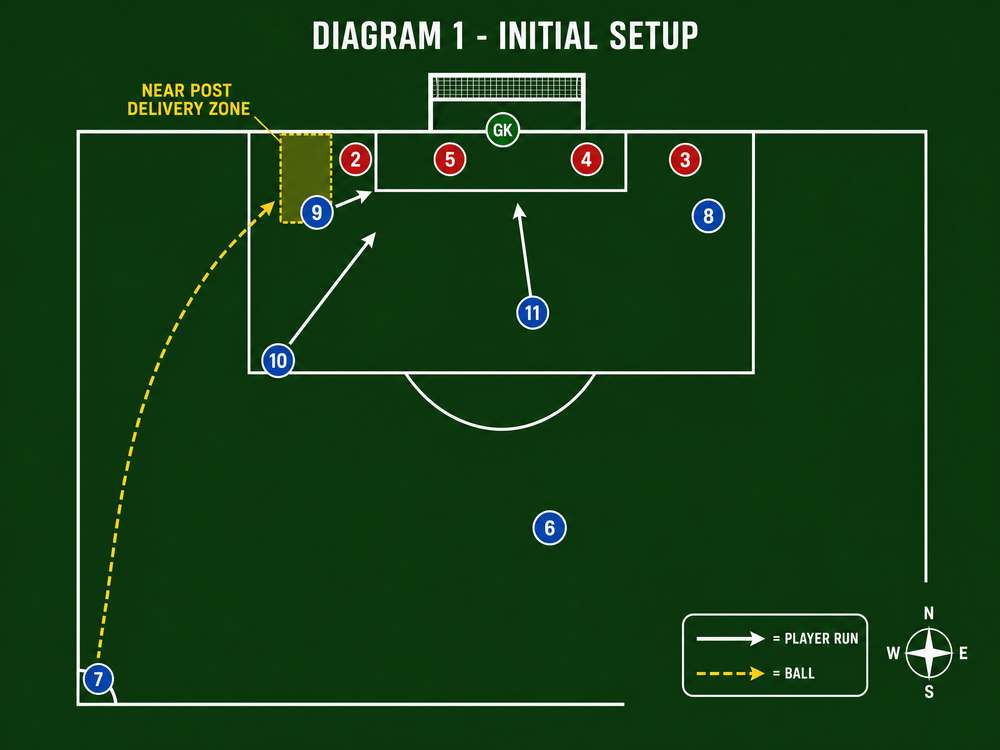
- The Trigger: The corner taker (7) places the ball and raises one arm to signal the 'Near-Post Bullet' routine. They then begin their run-up.
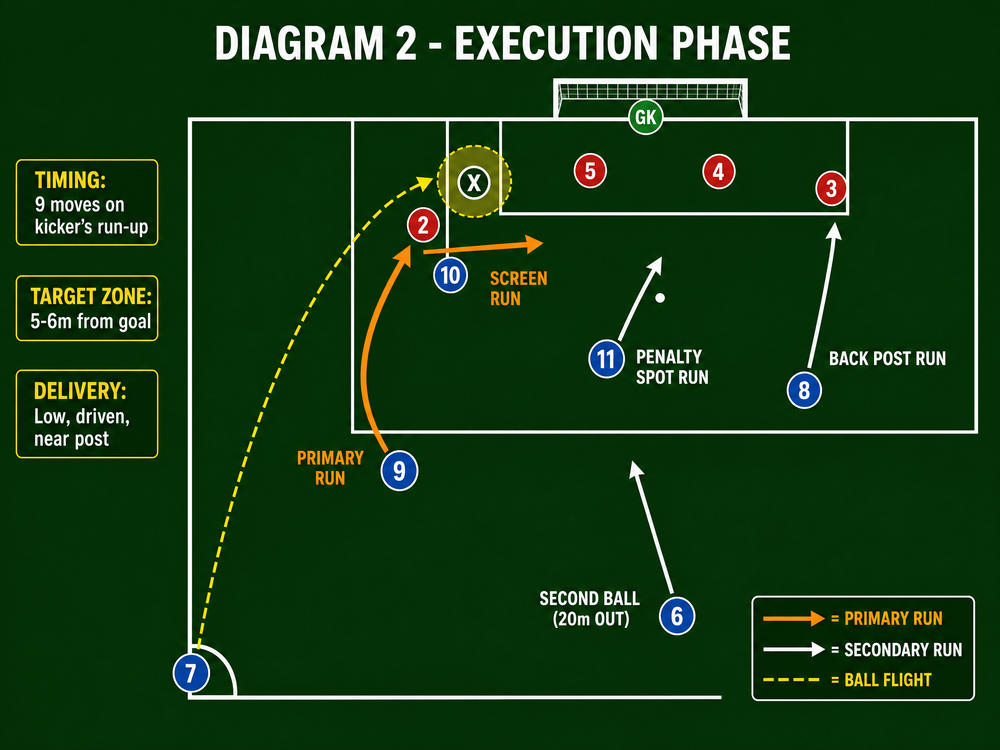
- The Screen: As the taker begins their run-up, the screener (10) makes a sharp, diagonal run directly toward the near-post zonal defender (usually the defender positioned just outside the six-yard box). The goal is to legally impede their forward movement or drag them wider, creating a gap.
- The Primary Run: Simultaneously, the primary target (9) sprints aggressively from the edge of the penalty area into the space created by the screener. The target zone is approximately 5-6 meters from the goal line, just outside the near post.
- The Delivery: The corner taker (7) delivers a low, driven cross aimed exactly at the target zone. The ball must have pace and a relatively flat trajectory.
- The Contact: The primary target (9) attacks the ball. The objective is usually a glancing header or a first-time volley directed toward the far post, rather than trying to generate all the power themselves.
- Secondary Movements: As the ball is delivered, the back post runner (8) attacks the far post area, anticipating a flick-on. The penalty spot runner (11) moves into the central area of the box, ready for any knock-downs. The second ball player (6) stays alert on the edge of the box.
4. Key Coaching Points
- Delivery is Everything: The success of this play hinges entirely on the quality of the delivery. A floated or high cross will allow the goalkeeper or central defenders to claim it. The ball must be driven low and hard.
- Timing of the Run: The primary target (9) must not arrive too early. They should time their run to meet the ball exactly as it arrives in the target zone, carrying forward momentum.
- The Legal Screen: The screener (10) must be careful not to commit an obvious foul. They should focus on holding their ground or making a run that naturally obstructs the defender's path to the ball, rather than actively pushing or holding.
- Aggression at the Contact Point: The primary target must be brave and fully commit to the challenge. They will often be attacking the ball in a congested area with defenders closing in.
- Anticipate the Flick-On: The back post runner (8) is crucial. A near-post flick-on often bypasses the entire defense and goalkeeper, leaving an easy tap-in at the far post if the runner is alert.
5. Common Mistakes
- Poor Delivery: The most common error is a cross that is too high, too slow, or misses the target zone entirely, rendering the entire routine useless.
- Arriving Too Early: If the primary target (9) arrives in the target zone before the ball, they lose their momentum and are easily marked out of the play.
- Obvious Fouling by the Screener: If the screener (10) blatantly pushes or holds the defender, the referee will blow for a foul, wasting the attacking opportunity.
- Static Secondary Runners: If the players at the back post and penalty spot do not anticipate the flick-on or rebound, a successful near-post contact will not result in a goal.
6. Variations & Progressions
- The Short Option Decoy: Have a player run short to offer a short corner option. This can pull an extra defender out of the penalty area, creating more space for the near-post run.
- The Dummy Run: The primary target (9) makes the near-post run but intentionally ducks under or dummies the ball, allowing it to travel through to the penalty spot runner (11) arriving late.
- Out-Swinging Delivery: While usually an in-swinger, using an out-swinging delivery can make it harder for the goalkeeper to come out and claim the ball, although it requires more power from the primary target to redirect it on goal.
7. Age Adaptations
- Under 10s / Under 12s: Focus primarily on the delivery technique and the timing of the single near-post run. Complex screening runs may be too difficult to coordinate and often lead to fouls at this age.
- Under 14s / Under 16s: Introduce the screening concept. Emphasize the importance of the secondary runners anticipating the flick-on, as goalkeepers at this age will start to struggle with fast, redirected balls.
- Open / Adult: Full implementation of the routine. Focus heavily on the subtle details of the screen to avoid giving away cheap fouls, and ensure the delivery is consistently driven with high pace.
