

Football
Near-Post Corner Kick: The Decoy and Strike
Master the near-post corner kick with this comprehensive set play designed to draw defenders away and create a high-percentage scoring opportunity.

What you need
6+ Footballs, Full-sized goal, Cones/Markers
1. Overview
The near-post corner kick is a highly effective set play designed to exploit the space between the six-yard box and the near post. By utilizing coordinated decoy runs, the attacking team creates a clear channel for a designated target player to attack the ball aggressively. This routine is particularly useful against teams employing a zonal marking system or those susceptible to quick, decisive movements inside the penalty area.
2. Setup
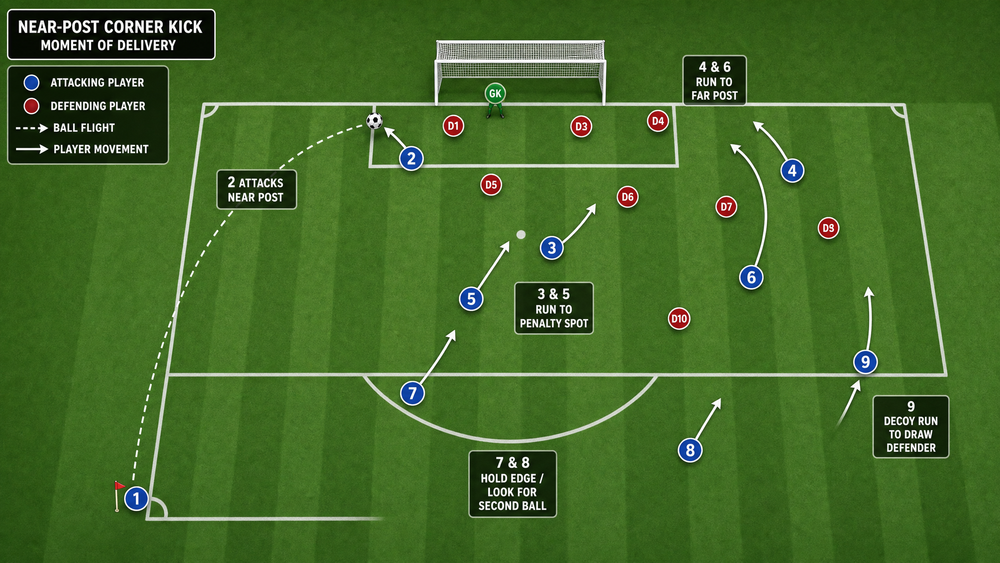
Pitch Dimensions: Standard football pitch (100-110m x 64-75m).
Equipment Needed: Minimum of 6 balls, full-sized goal, cones or markers for positioning.
Player Positions:
- Corner Taker (W/FB): An out-swinging delivery (right-footed from the right corner, left-footed from the left corner) is preferred for a better angle, though an in-swinger can also be effective if delivered with pace.
- Target Player (CB/ST): Typically a strong header of the ball, positioned centrally or slightly towards the far post initially.
- Decoy Runners (CB, CM, W): 3-4 players positioned in a cluster around the penalty spot or far post.
- Edge of Box Support (CM/FB): 1-2 players positioned just outside the penalty area to secure second balls and prevent counter-attacks.

3. Step-by-Step Instructions
- The Signal: The corner taker signals the play (e.g., raising one arm) to ensure all players are synchronized.
- The Setup: The attacking players form a cluster around the penalty spot, creating confusion for the defending team.
- The Trigger: As the corner taker begins their run-up, the movement initiates.
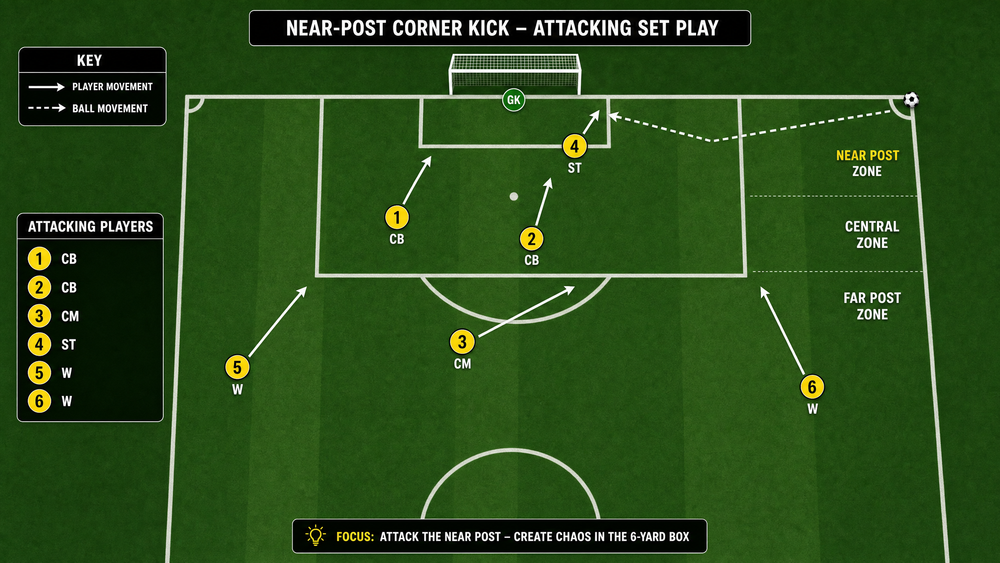
- The Decoy Runs: The decoy runners (Players 3, 4, 5) make explosive runs towards the far post and the center of the six-yard box, dragging defenders with them and vacating the near-post zone.
- The Target Run: Simultaneously, the Target Player (Player 2) breaks aggressively towards the near post, timing their run to meet the ball just outside the six-yard box.
- The Delivery: The corner taker delivers a driven, flat cross to the near-post area, aiming for a height between the chest and head.
- The Finish: The Target Player attacks the ball, aiming to either flick it towards the far post or power a header directly on goal.
- The Second Phase: Players on the edge of the box (Players 6, 7) must be ready to react instantly to any clearances or rebounds.
4. Key Coaching Points
- Timing is Everything: The Target Player must not arrive too early; they should be attacking the ball at pace, not waiting for it.
- Quality of Delivery: The cross must be driven and flat. A loopy, high cross allows the goalkeeper or defenders to react and clear the danger.
- Commitment to Decoy Runs: The decoy runners must sprint as if they are the intended target to genuinely pull defenders out of position.
- Aggressive Finishing: The Target Player must be fully committed to winning the header, showing bravery and determination.
5. Common Mistakes
- Poor Delivery: Overhitting the cross past the near post or failing to clear the first defender.
- Static Movement: Players standing still before the kick, making it easy for defenders to track them.
- Arriving Too Early: The Target Player reaching the near post before the ball, losing their momentum and advantage.
- Lack of Edge Support: Failing to position players outside the box, leaving the team vulnerable to a quick counter-attack if the ball is cleared.
6. Variations & Progressions
- The Flick-On: Instead of shooting, the Target Player flicks the ball across the face of the goal for a teammate arriving at the far post.
- Short Corner Option: Start with a short pass to draw out a defender, changing the angle of the delivery and disrupting the defensive setup before executing the near-post run.
- Double Target: Have two players make staggered runs to the near post to increase the chances of winning the first contact.
7. Age Adaptations
- Under 10s / Under 12s: Focus primarily on the quality of the delivery and basic movement. Simplify the decoy runs to just one or two players.
- Under 14s / Under 16s: Introduce more complex timing and the flick-on variation. Emphasize the importance of aggressive, committed runs.
- Open / Senior: Execute the full routine with precise timing, incorporating variations based on pre-match scouting of the opponent's defensive setup.
