

Football
Defensive Heading & Clearing: Win the First Contact, Own the Second Ball
A game-realistic penalty-area practice that teaches defenders to attack aerial service, clear with purpose and secure the second ball under pressure.
What you need
balls, cones
{{asset:header_image.png}}
Overview
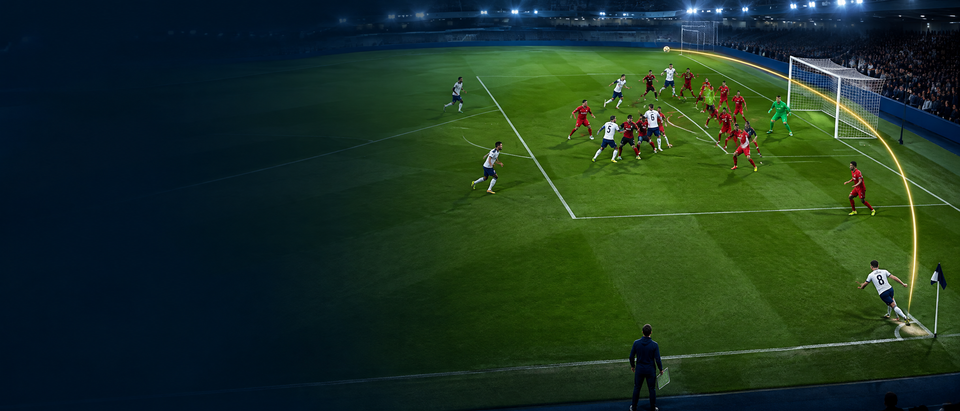
This 20-minute practice develops the habits behind a reliable team clearance: organisation, first contact, a clear target and an immediate reaction to the second ball. It is designed for 10 players on a full-size pitch, using the penalty area and an outside clearance channel. The defending unit works with a goalkeeper, a back four and a screening midfielder against four attackers. The aim is not simply to head the ball away. The unit must head it away from danger, step out together and make the next action secure.
Use the language players hear in the match: “set”, “find your man”, “attack it”, “clear wide”, “squeeze” and “second ball”. The coach should demand a realistic contest while protecting players from unsafe contact. This suits an Under-14 or older group that can head with sound technique.
Setup
{{asset:diagram_1.png}}
Use one end of a regulation pitch (100–110m x 64–75m), with the penalty area and a full-size goal. The working area is approximately 44m deep by 36m wide. Mark a 12m-wide outside clearance channel from the edge of the box towards the touchline. Place a goalkeeper (1), back four (2–5) and holding midfielder (6) in defensive positions. Four attackers work as the wide server (7), central target (9), secondary runner (10) and edge-of-box player (11). The attacking server starts near the corner of the area; rotate the service from both sides.
The goalkeeper begins two metres from goal, able to see the ball and organise. Centre-backs start goal-side and touch-tight to 9 and 10. Full-backs protect the far-post and cut-back zones, while 6 starts around the penalty-spot line, ready to screen and hunt the second ball. Keep a supply of balls with the coach beside the server. Use the timed phases below: 2 minutes of organisation, 6 minutes of first-contact work, 6 minutes of second-ball work and a 6-minute competitive finish.
Step-by-Step Instructions
1. Organise before the service — 2 minutes. Freeze the ball initially. The goalkeeper names the first-contact defender and the back line checks distances: close enough to feel the attacker, but not square behind them. Defenders must open their body so they can see both ball and opponent. Rehearse three deliveries from each side at reduced speed.
2. Deliver and compete — 6 minutes. On the server’s first touch, attackers make live movements. 7 drives an inswinging or clipped cross into the central corridor. 4 or 5 calls “mine”, creates a yard with legal body position and attacks the ball at its highest practical point. The header must clear the penalty area and land in the marked outside channel. Award the defenders one point for a headed clearance that reaches the channel; attackers score one point if they secure the first ball or force a save. Restart immediately after every outcome.
3. Add the second ball — 6 minutes. {{asset:diagram_2.png}} The first clearance remains live. As the ball travels, 6 breaks forward to meet the drop, while 2 or 3 supports on an angle. The back line steps to the edge of the box together only after the ball is clearly travelling away from goal. Defenders earn a second point when they secure the clearance and complete one controlled pass out of the area. Attackers have six seconds to regain and shoot.
4. Competitive finish — 6 minutes. Run three 90-second games, alternating service sides each game. The attackers choose the type of delivery: early cross, hanging far-post cross or driven cut-back. Defenders begin with one score for every successful clear-and-connect sequence; attackers begin with one score for every goal. The losing unit completes a simple ball-retrieval task, not a physical punishment. This keeps quality and decision-making high.
Key Coaching Points
The first detail is early information. The goalkeeper should give one loud, specific instruction—“away”, “keeper” or the defender’s name—rather than a late stream of calls. Outfield players scan ball, attacker and space before the cross is struck. A defender who only watches the flight usually loses body position before the jump.
Teach a strong aerial action. Players approach on a short, balanced line, plant the take-off foot, drive the knee and lift through the trunk. Eyes stay open to the ball. Contact is made with the forehead, not the crown, and the neck is firm. The arms provide balance and protection but must not push. The cue is: “meet it, do not wait for it.”
The heading target matters. Under pressure, clear diagonally and wide rather than centrally. Distance is useful only if the ball leaves the scoring zone. On a clean contact, guide the ball into the outside channel; on a poor or crowded contact, prioritise height and width. The holding midfielder reads the likely landing zone early, not the original service line.
Finally, coach collective recovery. Once the ball is cleared, the nearest player attacks it, the next player gives a simple support angle and the line moves out together. Do not let the line retreat while 6 is competing for the second ball; that creates a large, unprotected gap at the top of the box.
Common Mistakes
A frequent error is defenders starting too deep and trying to jump from a flat-footed position. Move them one step higher, establish contact before the cross and rehearse the approach without opposition. Another is a soft, central clearance caused by heading while falling backwards. Correct this by setting a visible channel target and rewarding direction as well as distance.
The other major failure is admiration of the first header. Players clear, stop and leave the second ball to chance. Use the rule that the practice is not over until the defenders either complete a pass or the attackers shoot. If the goalkeeper comes, players must still cover the line and protect the rebound.
Variations & Progressions
For a simpler variation, use a coach-fed underarm throw or a floated, uncontested service. Defenders then focus on technique and direction without the distraction of movement in the box. Alternatively, work 3v3 plus goalkeeper in a narrowed area and allow the defender to catch and throw the ball into the channel after an initial heading rehearsal.
Progress to an 11v11 set-piece phase by adding a second server, a late runner at the edge of the area and a counter-attacking target near halfway. Restrict the defending team to two passes after the clearance before they must find the target player. This makes the transition realistic and tests whether players can clear with enough quality to launch an attack.
Age Adaptations
For Under-10s, do not use contested heading. Replace the aerial contact with a bounce, catch or volley-clear action, and reward players who move their body between ball and goal. For Under-12s, introduce light, coached heading from a soft service, using a reduced box and a no-challenge zone around the jumper. Keep the focus on posture, eyes open and clearing to space.
For Under-14s and Under-16s, use the full practice with controlled, legal aerial competition. Increase the quality and variety of service, require the second-ball connection and hold the defenders accountable for stepping out as a line. With open-age players, add live counter-pressing after the clearance and demand player-led goalkeeper communication throughout.
