

Football
Three-Lane Penalty-Box Movement for Crosses
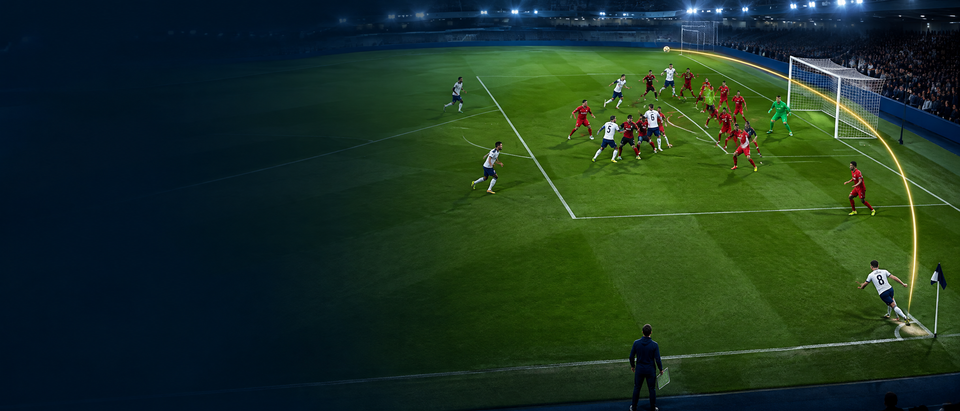
Coach a timed three-lane movement pattern that turns a wide delivery into near-post, penalty-spot and far-post finishing options.
What you need
balls, cones
Overview
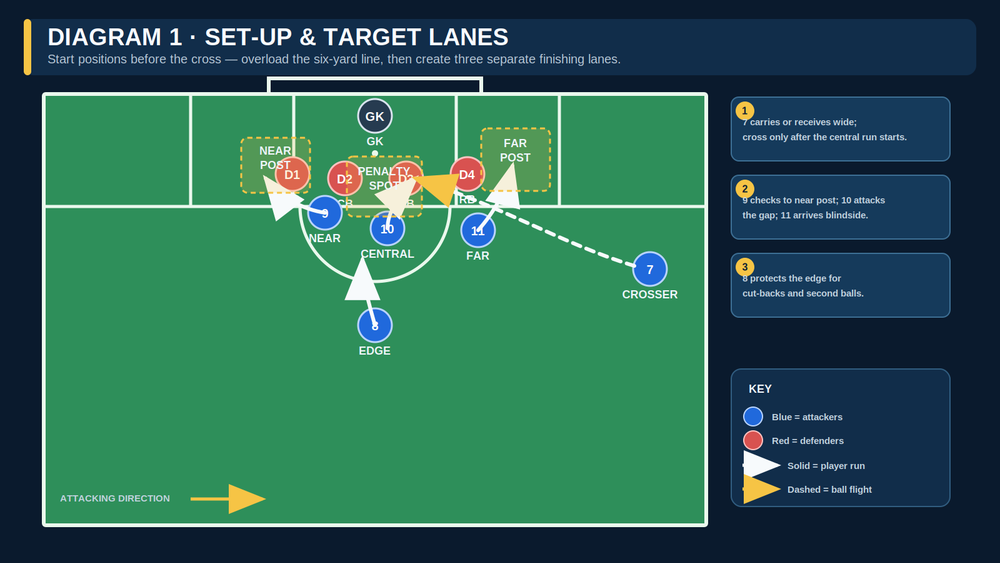
This 20-minute attacking practice teaches a coordinated penalty-box movement play for a cross from the right channel. Player 9 pulls the defensive line towards the near post, Player 10 attacks the space opened around the penalty spot, and Player 11 arrives late at the far post. Player 8 holds the edge for cut-backs and second balls. The crosser, Player 7, is the trigger: runners move on their final touch, not on an early call.
Use five attackers (7, 8, 9, 10 and 11), four defenders and a goalkeeper. Work in the attacking third of a full 100–110m x 64–75m pitch, or mark out the box and a wide channel for repetitions. Rehearse unopposed first, then add recovering defenders. The aim is not to force one finish; it is to create three separate finishing pictures from one delivery.
Setup
Place Player 7 in the right half-space, 5–7m outside the box and level with its corner. Player 9 starts just outside the six-yard line; Player 10 begins 2–3m behind 9 on the penalty-spot line; Player 11 is beyond the far-post shoulder of the full-back; and Player 8 waits 5–8m outside the area, central to goal. Set a compact back four and a normally positioned goalkeeper.
Restart through 7 after every attempt. The attack has 10 seconds to finish once the ball enters the wide channel. Rotate the crosser every four balls and the box runners after each block. Once the pattern is understood, defenders must track, communicate and clear properly rather than act as mannequins.

Step-by-Step Instructions
Create the crossing picture. Player 7 receives facing forward and takes the first touch down the line or across the defender. On the final preparation touch, 7 scans goalkeeper, nearest defender and target lanes. The cross must come from a stable body position, not a bouncing ball.
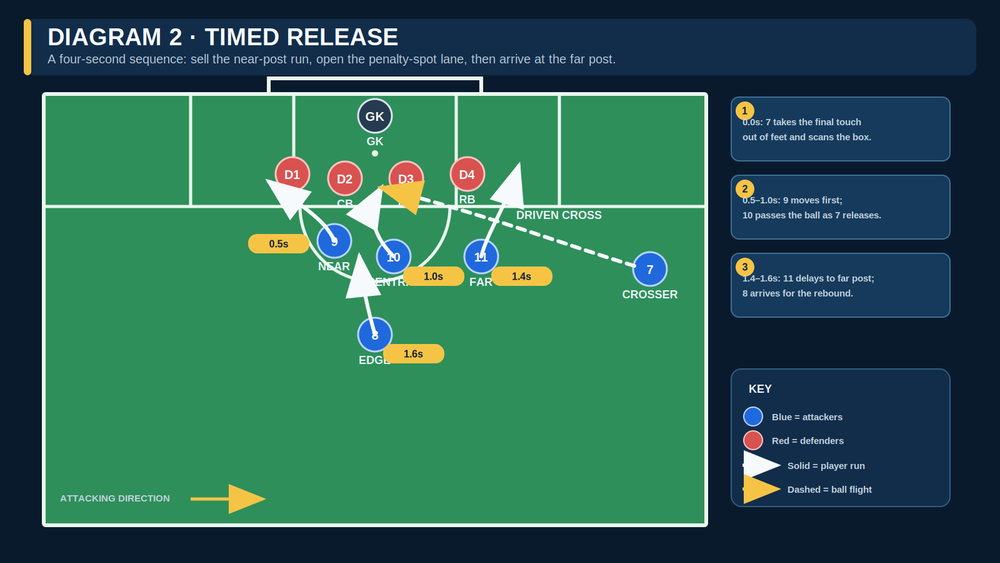
Release the near-post runner first. At 0.5 seconds after 7’s final touch, Player 9 makes a double movement: one small step away from goal, then a curved sprint across D1/D2 into the near-post lane. 9 must show a clear angle for a skimming ball rather than run straight into the defender. This should draw a centre-back and the goalkeeper’s attention.
Attack the gap, not the ball. At 0.8–1.0 seconds, Player 10 starts from behind 9 and bends across the central defender’s blind side towards the penalty spot. The first three steps are patient; acceleration comes as the ball leaves 7’s foot. The target is the gap created by 9, roughly 8–11m from goal, not the near-post corridor.
Delay to the far post. At 1.4 seconds, Player 11 holds for one extra beat, then curves behind the far-side defender. If 11 runs early, the full-back can see and pass them on. Arrive 1–2m beyond the far post, body open to finish first time back across goal.
Secure the second phase. At 1.6 seconds, Player 8 advances to the top of the box and stays balanced. 8 is not another target in the six-yard crowd; their job is a clearance, cut-back or immediate recycle. On a blocked shot, 8 squeezes up.
Deliver with a clear target. Player 7 releases the cross between 1.0 and 1.2 seconds after the preparation touch. Use a driven inswinger into the penalty-spot lane when 10 wins separation, a flatter near-post ball if 9 crosses the defender, or a far-post ball if the line collapses centrally. Ball flight should arrive 0.6–0.9 seconds after release so runners meet it rather than wait. Finish in one or two touches.
Key Coaching Points
Coach the trigger, spacing and disguise. Runners react to 7’s final touch, not the pass into 7; this disguises the move and prevents attackers standing offside. Keep at least 3m between 9, 10 and 11 at delivery. Demand curved runs across a defender’s eye-line, with players checking both ball and goal.
Delivery quality matters as much as movement. Encourage a firm, low-to-mid-height ball across the goalkeeper for the penalty-spot option. It should travel away from the goalkeeper where possible, but not so wide that 10 must stop. 9 redirects, 10 strikes through it or heads down, and 11 opens the body to guide it across goal. Praise correct lane creation even when the delivery misses.
Common Mistakes
The most common error is an early run. When 9, 10 and 11 leave before 7’s final touch, the line simply drops together. Reset the timing: 9 moves first, 10 second and 11 last. A second error is 10 chasing the ball into the near-post lane; freeze the practice and show the central gap. A floated delivery is the third error, giving the goalkeeper and centre-backs time to recover. Ask 7 to strike through the lower half of the ball and choose a target lane.
Variations & Progressions
Vary the service: start with a dead ball to 7, then add a bouncing pass, an overlapping full-back or a byline cut-back. Next, allow the full-back to press 7, forcing a choice between an early cross and the line. Award two goals for a first-time finish by 9, 10 or 11 and one for a recycled second phase from 8.
Progress to live 5v4+GK transition. If defenders clear beyond the marked edge, they score by passing to a target near halfway; this forces 8 and the covering attackers to react. On the opposite flank, mirror the roles for a left-foot inswinger or an outswinging delivery.
Age Adaptations
For Under-8 and Under-10, use three attackers, two defenders and a goalkeeper. Remove exact clock language: ‘first runner near, second middle, third far.’ Start unopposed, shorten delivery to 12–16m and reward arrival in a separate lane.
For Under-12 and Under-14, use three runners with semi-opposed defenders. Introduce the 0.5-second near-post trigger and delayed far-post run, then let players identify the open lane. For Under-16 and open age, make it fully opposed, enforce the 10-second attack window and add transition consequences. At every age, coach controlled deceleration, safe heading technique and awareness of the goalkeeper’s space.
