Football
High-Intensity 4v2 and 5v3 Rondo Possession Drill
A coach-ready 20-minute rondo progression that teaches players to scan, receive side-on, play through a central pivot, and press collectively after loss.
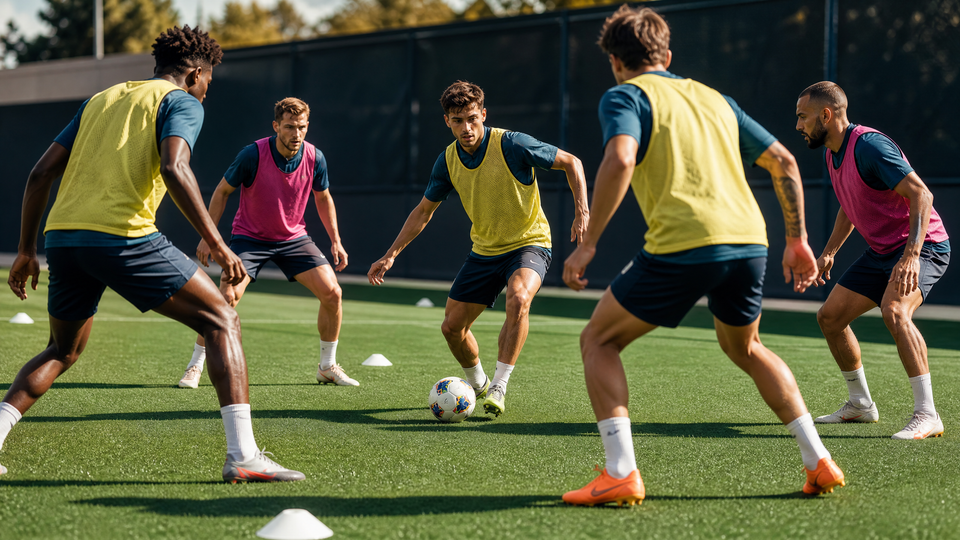
What you need
8-10 flat cones, 4 footballs (including two live spare balls), 2 sets of coloured bibs, 1 stopwatch or session timer, 2 mini-goals for the transition progression (optional)
High-Intensity 4v2 and 5v3 Rondo Possession Drill
Overview
This coach-ready block starts with a classic 4v2 rondo and builds into a 5v3 rondo with a central #6 pivot. It develops scanning, receiving on the half-turn, purposeful passing, and collective pressing after loss. Use it after the dynamic warm-up or before a positional game that requires play through midfield.
Keep the block short and demanding. Each repetition should resemble a game moment: the ball carrier is pressed, teammates create angles, and players know the next action before receiving. Set the station in the central third of a 105 m x 68 m pitch, within the 100–110 m x 64–75 m international range permitted by the Laws of the Game.1
| Session outcome | Base format | Recommended workload | Coach’s non-negotiable |
|---|---|---|---|
| Retain and progress under pressure | 4v2, then 5v3 | 3 x 90 seconds, then 3 x 2 minutes; 30–45 seconds between bouts | High tempo, immediate restart, no passive defenders |
Setup
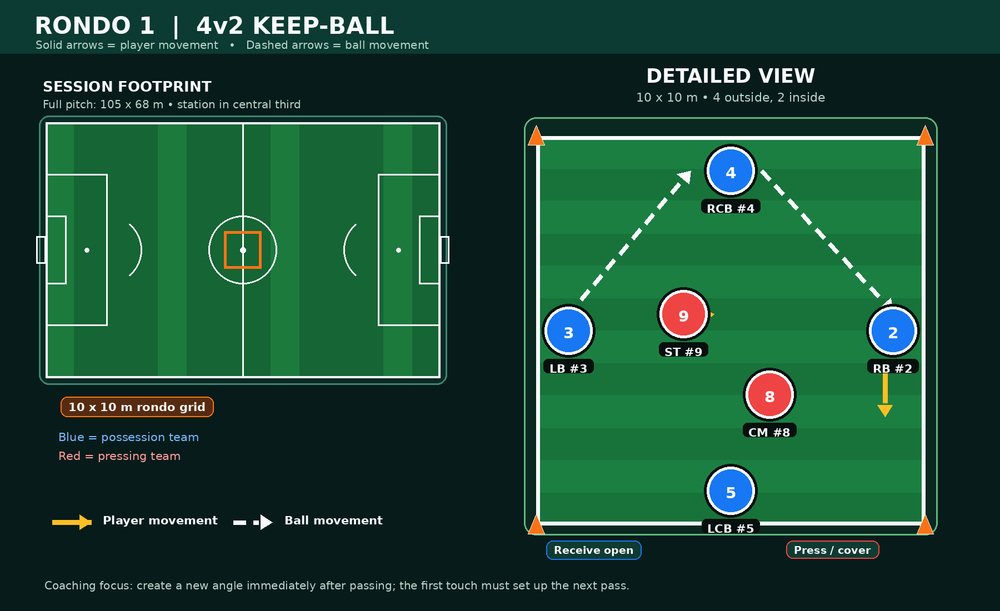
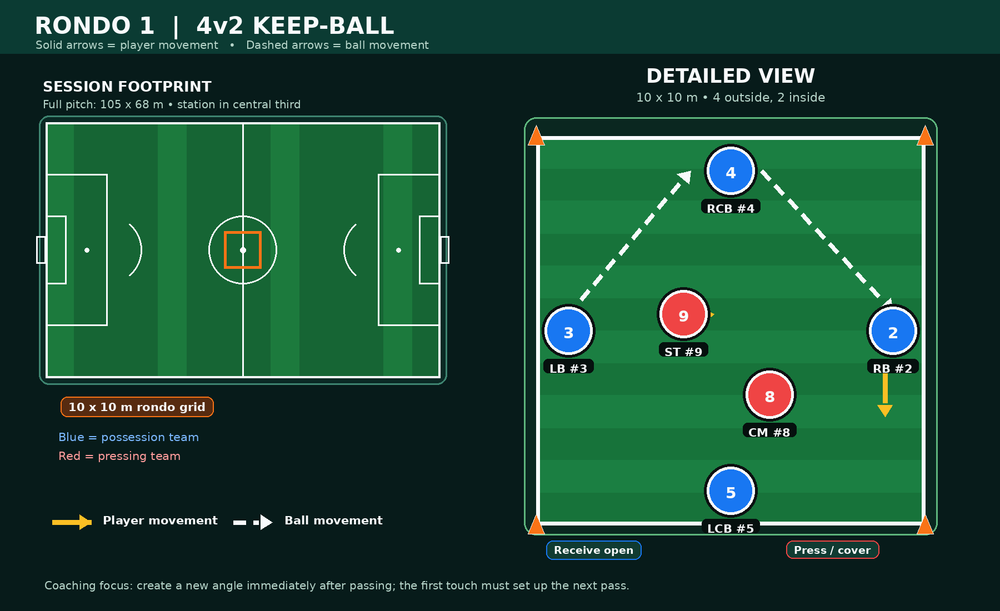
Mark a 10 m x 10 m square for the first phase. Use four flat cones at the corners and place a spare ball just outside two opposite corners so that a new ball can enter immediately. The blue possession team begins with #4 right centre-back at the top, #2 right-back on the right, #5 left centre-back at the bottom, and #3 left-back on the left. The red pressing pair are #9 centre-forward and #8 central midfielder. These are functional reference positions: use the shirt numbers to reinforce the picture of building possession through a realistic back line.
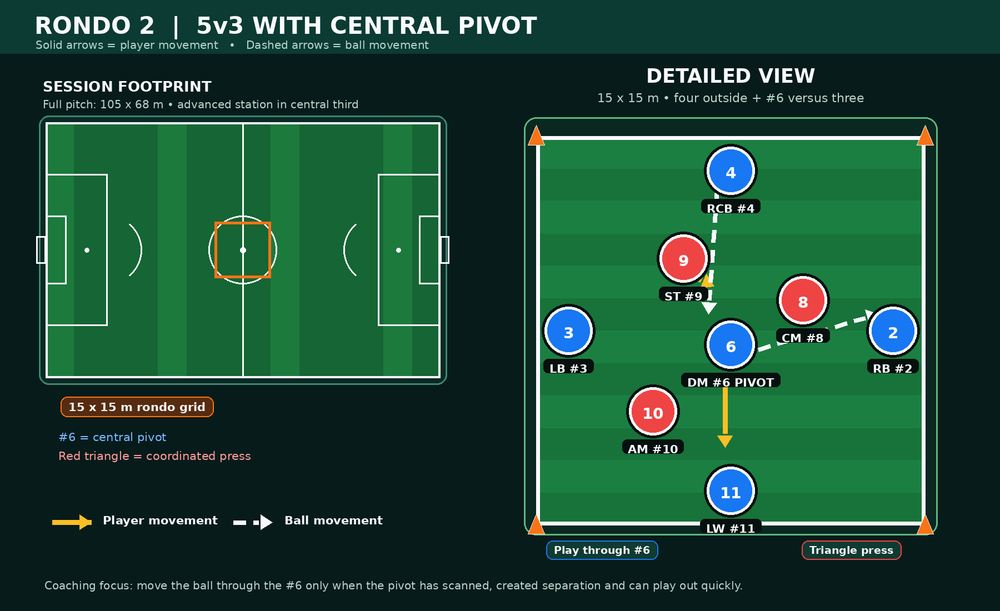
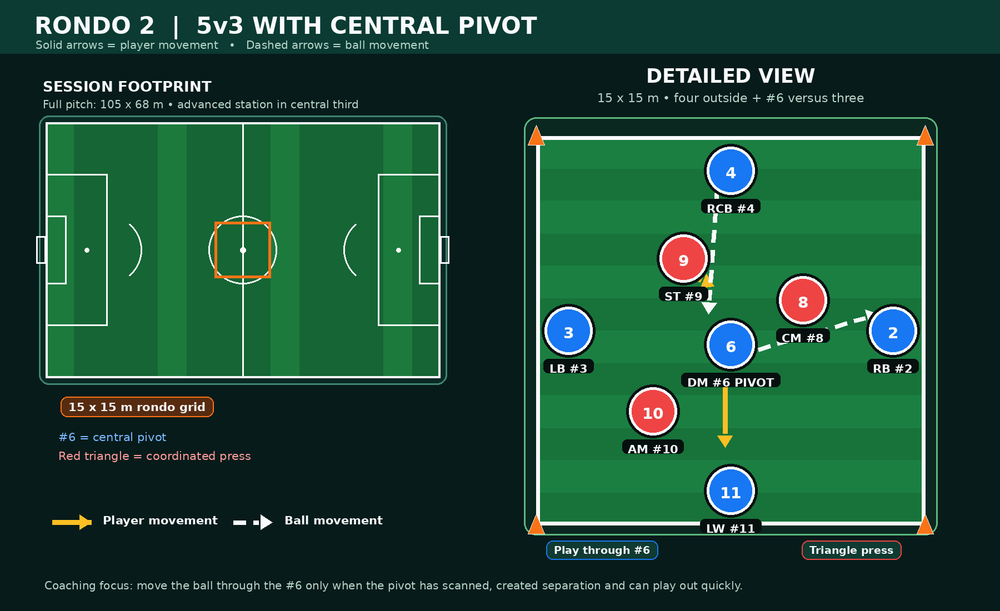
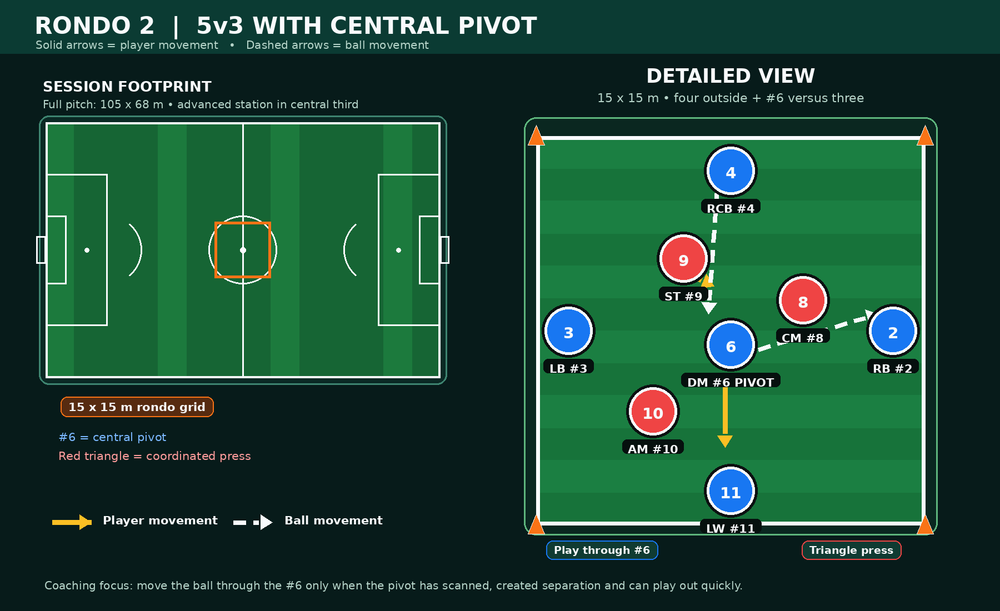
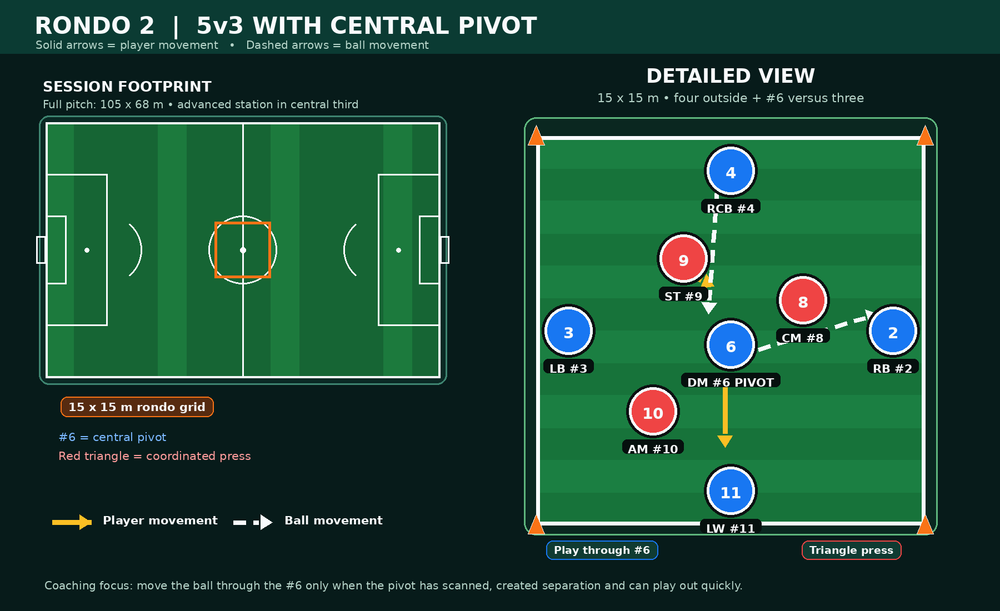
For phase two, expand to 15 m x 15 m. Keep #4, #2 and #3 outside, replace #5 with #11 left winger, and add #6 defensive midfielder in the centre. The red unit is #9, #8 and #10 attacking midfielder. Start players on or just outside the grid line to stretch the press. Have two bib colours, eight to ten cones, and four balls ready; with more than eight players, run a second box rather than a queue.
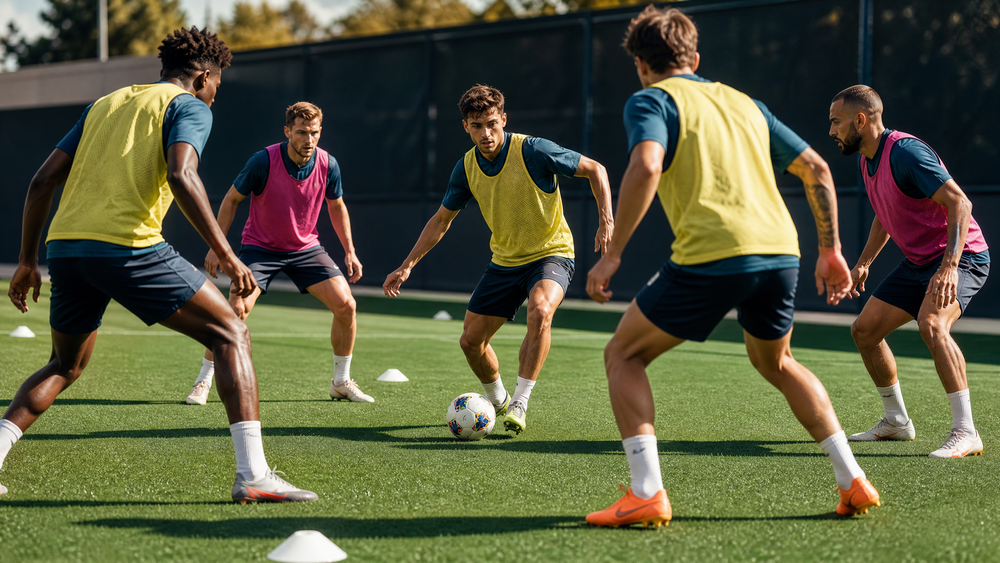
Diagram key: Blue circles are the possession team; red circles are the pressing team. Solid yellow arrows show player movement, while dashed white arrows show the intended ball route.
Step-by-Step Instructions
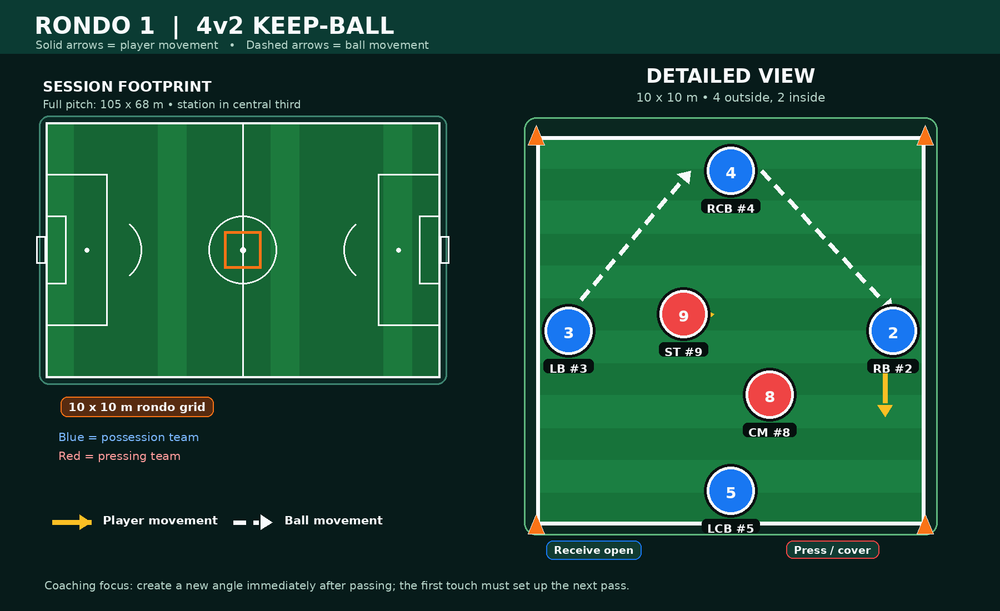
Set the picture. Walk the 4v2 positions before the first ball. #4 shows an open body, #2 and #3 create angles, and the red pair agree who presses and covers. Set the standard: “Make the next pass visible before you receive.”
Rehearse for 30 seconds. Play without defenders, two touches maximum: receive across the body, then pass firmly to the back foot. Correct the first touch before pressure arrives.
Run the 4v2. Feed #4 and play 3 x 90 seconds, with 30 seconds’ recovery. Blue has two touches. Red scores by intercepting, forcing the ball out, or forcing a touch-limit breach. The first defender presses on an angle; the second screens the escape route.
Apply the turnover rule. The player responsible enters as a defender; the ball-winner rotates out after 20–30 seconds or the next turnover. A spare ball is live within two seconds whenever the ball leaves the grid.
Coach the split pass. Award one point for a completed pass between the red defenders, but never reward a forced ball. Freeze only for a missed clear lane; otherwise coach live: “Fix him,” “Back foot,” and “Away from cover.”
Progress to 5v3. Expand to 15 m x 15 m and add #6 centrally. Play 3 x 2 minutes, with 45 seconds’ recovery. The outer four have two touches; #6 has one or two. Award two points for outside-to-#6-to-outside without a red touch. Find #6 only when the next pass out is available.
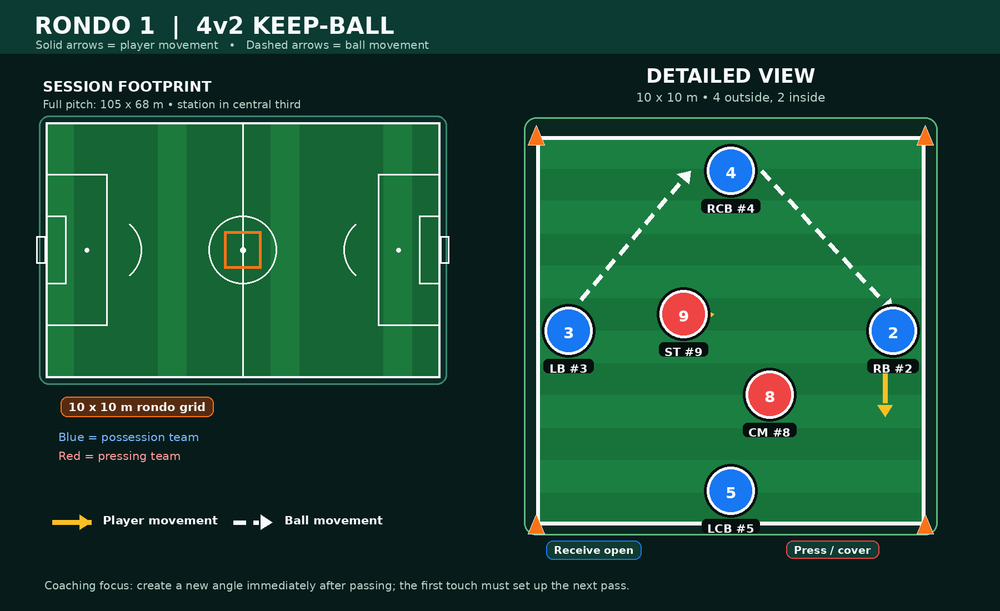
Organise the press. #9 curves the press, #8 closes the inside option, and #10 balances behind to deny #6. Cue “press, cover, balance.” If red wins it, award one point for three controlled passes before restart.
Transfer the learning. In the final 60 seconds, players call “turn,” “set,” “man on,” or “time” before a teammate receives. Finish by asking: “What told you the pivot was safe?” Look for defender shape, an open lane, or #6 receiving side-on.
Key Coaching Points
- Scan twice, not once. The first shoulder check happens while the ball travels to the previous player; the second happens just before the receiver’s first touch. Players who scan late receive square and play blind.
- Receive with an exit. The first touch should move the ball away from the pressing line and prepare the next pass. Insist on a half-turned stance with the front foot available to play quickly.
- Pass to the back foot with purpose. A firm ground pass to the receiver’s back foot keeps the body open and makes the defender travel further. Soft passes and passes into the front foot close the player down.
- Support at different heights. The two nearest support players must not stand on the same passing line. One should offer short and one should stretch away, creating a triangle rather than a flat line.
- Fix the first defender before releasing. The ball carrier should draw the first presser one step closer before playing. This creates the extra fraction of a second that makes the next receiver free.
- Press as a unit. The defender nearest the ball arrives fast but under control; the second defender protects the split pass; the third defender in the 5v3 protects the far-side recovery route.
Common Mistakes and Immediate Corrections
| Mistake | What you will see | Coach correction |
|---|---|---|
| Square receiving shape | The player needs an extra touch and is trapped | Rehearse the half-turn; point the front hip toward the next target before the ball arrives. |
| Flat, static support | Both options stand behind the same defender | Stop the picture for five seconds and reset the nearest two players at different angles. |
| Soft or inaccurate pass | The defender can attack the ball rather than chase it | Demand a firm pass along the ground to the back foot; reduce the distance only if technique breaks down. |
| Forced ball into #6 | The pivot receives with a defender on their back | Tell the outside player to recycle; #6 earns the ball by scanning, moving off the cover shadow, and showing an exit. |
| Individual pressing | One red player runs while the others watch | Give the press a three-word trigger: “press, cover, balance.” Restart the bout if the unit does not react together. |
Variations and Progressions
Begin with a 5v1 version in a 12 m x 12 m square. Give unlimited touches for one minute, then move to two. This lets less secure groups experience success while you coach basic support angles.
For a harder directional escape variation, place one-metre gates on opposite sides. After five passes, blue scores by playing through either gate to a teammate outside the grid. This rewards a well-timed switch.
For an advanced transition progression, allow the red team to break to a mini-goal placed five metres outside the grid after an interception. The blue player who loses the ball must make the first recovery run. This creates an honest transition moment and stops players treating turnovers as a mere rotation signal.
Age Adaptations
| Age group | Format and area | Work period | Main emphasis |
|---|---|---|---|
| Under 8 | 5v1 in 12 m x 12 m | 4 x 45 seconds | Enjoyment, passing with either foot, and finding space; allow unlimited touches. |
| Under 10 | 4v1 or 5v2 in 12 m x 12 m | 3 x 60 seconds | First touch away from pressure and simple communication; begin a two-touch challenge only when successful. |
| Under 12 / Under 14 | 4v2 in 10 m x 10 m | 3 x 90 seconds | Scan before receiving, use the back foot, and understand press-cover roles. |
| Under 16 / Open | 5v3 in 13–15 m x 13–15 m | 3 x 2 minutes | Play through #6, recognise cover shadows, and counter-press instantly after loss. |
Coach’s Finish
Finish with one clear standard rather than five different messages. For this drill, make it: “Your first touch must create the next pass.” If the team can consistently receive side-on, draw the press, and play out through the free player, the rondo has transferred beyond the square and into the match.
References