

Football
Mastering the Rondo: A Comprehensive Guide to Possession and Passing Drills
Learn how to set up and execute the classic Rondo drill to improve your team's passing accuracy, decision-making under pressure, and possession retention.

What you need
Footballs, Cones, Training Bibs (2 colors)
Overview
The Rondo is arguably the most fundamental and universally utilized possession drill in modern football. Popularized by Johan Cruyff at FC Barcelona and later perfected by Pep Guardiola, the Rondo is designed to improve quick decision-making, precise passing, spatial awareness, and composure under pressure. In a standard Rondo, a group of attacking players forms a circle or polygon, attempting to maintain possession of the ball while one or more defending players in the center attempt to intercept it. This drill replicates the exact passing triangles and numerical advantages players will face in a real match.
By running this drill consistently, coaches can develop players who are comfortable receiving the ball in tight spaces, understand the importance of body shape, and can execute one-touch or two-touch passes with high accuracy. It also serves as an excellent warm-up exercise to get players mentally and physically engaged before transitioning into more complex tactical work.
Setup
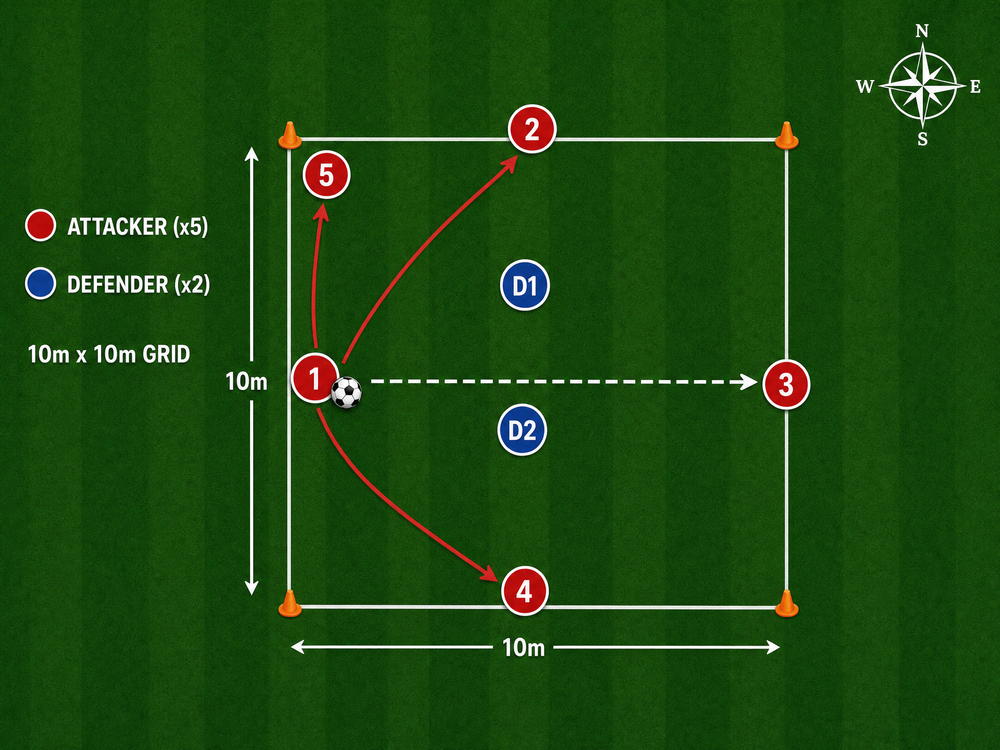
To set up a standard 5v2 Rondo, you will need the following:
- Equipment: 4 cones to mark the grid, training bibs in two different colors (e.g., 5 red, 2 blue), and an adequate supply of footballs.
- Pitch Setup: Create a 10m x 10m square grid using the cones. Adjust the size based on the skill level of your players (larger grid for beginners, smaller grid for advanced players).
- Player Positions: Position the 5 attacking players (in red bibs) along the perimeter of the grid. Place the 2 defending players (in blue bibs) inside the grid.

Step-by-Step Instructions
- Initiate Play: The coach or one of the attacking players starts the drill by passing the ball to another attacking player on the perimeter.
- Maintain Possession: The attacking players must pass the ball among themselves, aiming to keep possession away from the defenders in the center.
- Defensive Pressure: The two defending players must work together to press the ball, cut off passing lanes, and attempt to intercept or tackle the ball out of bounds.
- Touch Restrictions: Instruct the attacking players to play with a maximum of two touches. As they become more proficient, progress to one-touch passing to increase the speed of play.
- Transition: If a defender intercepts the ball or forces an error (e.g., the ball goes out of bounds), the attacking player who made the mistake switches roles with the defender who won the ball. Alternatively, rotate defenders after a set time (e.g., 60 seconds).
Key Coaching Points
- Body Shape and First Touch: Players must receive the ball with an open body shape, allowing them to see the entire grid and their passing options before the ball arrives. The first touch should set up the next pass immediately.
- Speed of Play: Emphasize crisp, firm passes. Slow passes allow the defenders to close the distance. The ball should move faster than the defenders can run.
- Movement off the Ball: Attacking players must not remain static. They should constantly adjust their positioning along the perimeter to create clear passing lanes and support the player with the ball.
- Defensive Coordination: The defenders must work as a unit. One defender should apply direct pressure to the ball carrier, while the second defender covers the passing lanes to intercept the ball.
- Communication: Encourage constant verbal and non-verbal communication among the attacking players to direct passes and alert teammates to defensive pressure.
Common Mistakes
- Standing Still: Attacking players often stand flat-footed on their lines, making it easy for defenders to block passing lanes. Correct this by demanding constant micro-adjustments in positioning.
- Poor Weight of Pass: Passes that are too soft get intercepted, while passes that are too hard are difficult to control. Focus on firm, accurate passes to the teammate's preferred foot.
- Looking Down: Players who look down at the ball cannot see the defenders or their passing options. Encourage players to scan the grid before receiving the ball.
- Defenders Chasing Blindly: Defenders who chase the ball individually will quickly tire and be easily bypassed. Teach them to press together, with one pressing the ball and the other covering the space behind.
Variations & Progressions
Once your players have mastered the basic 5v2 Rondo, introduce these progressions to increase the challenge and tactical relevance:
6v3 Progression with Target Zone
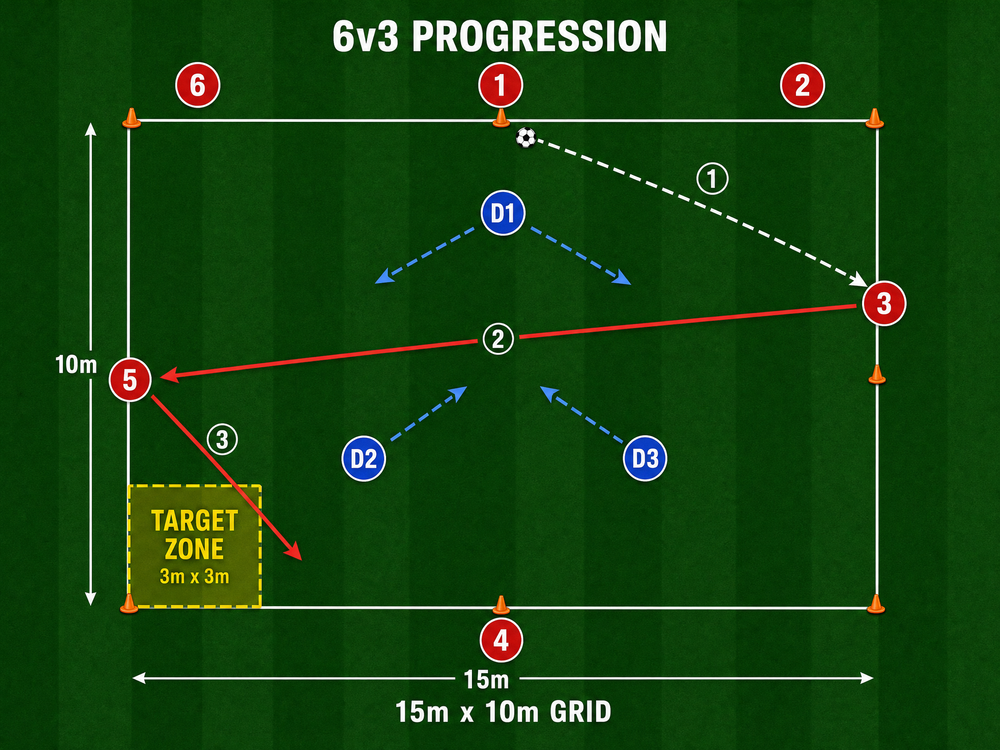
Expand the grid to 15m x 10m and increase the numbers to 6 attackers and 3 defenders. Designate a 3m x 3m target zone in one corner of the grid. The attacking team must string together a specific number of passes (e.g., 5 passes) before attempting to play a penetrating pass into the target zone for a point.
Switch of Play Rondo
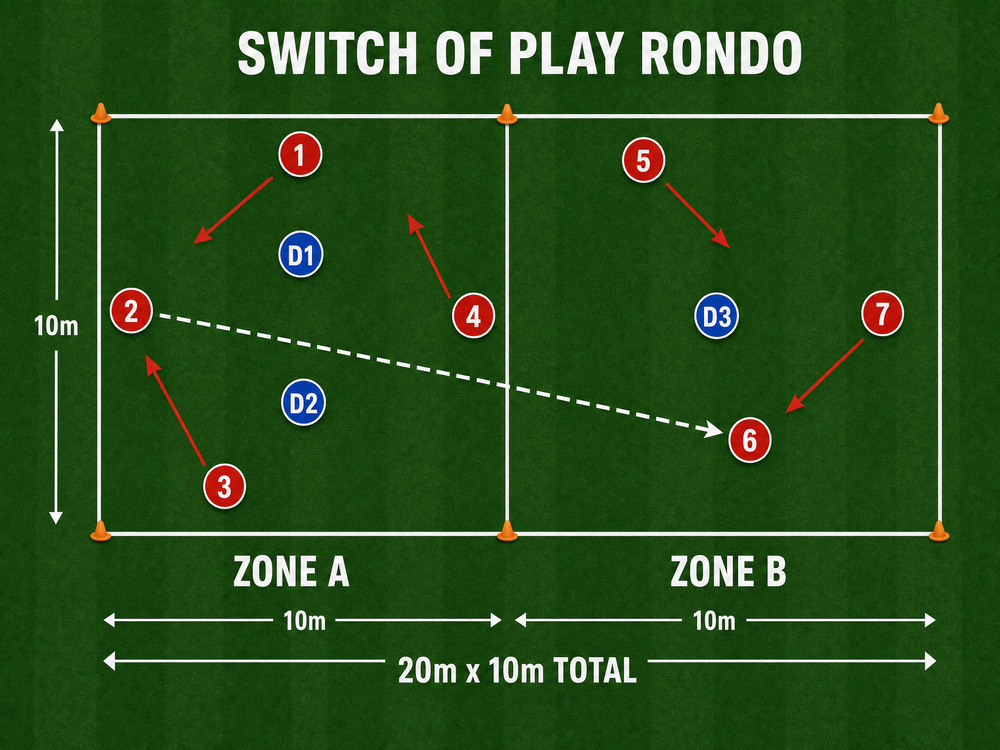
Create two connected 10m x 10m grids (total 20m x 10m). Place 4 attackers and 2 defenders in Zone A, and 3 attackers and 1 defender in Zone B. The objective is to complete 4-5 passes in Zone A before executing a long, diagonal switch of play to Zone B. Once the ball is switched, the players transition to support the play in the new zone.
Age Adaptations
- Under 8 - Under 10: Increase the grid size to 15m x 15m to give players more time and space. Remove touch restrictions and focus purely on the mechanics of passing and receiving. Use a 4v1 or 5v1 setup to ensure high success rates for the attacking team.
- Under 12 - Under 14: Implement the standard 10m x 10m grid with a strict two-touch limit. Introduce the concept of defensive shape and coordinated pressing.
- Under 16 - Open: Decrease the grid size to 8m x 8m and enforce one-touch passing where possible. Implement complex variations like the Switch of Play Rondo to replicate match-specific tactical scenarios.
