Football
Drill
advanced
High-Intensity Pressing Trigger & Recovery Drill
Master the art of coordinated pressing, identifying triggers, and executing rapid defensive recovery transitions to dominate the game out of possession.
Jul 5, 20265 min read25 min drill18 players

Equipment Needed
1 full-size goal
2 mini-goals
Bibs (2 colours)
Cones
Footballs
1. Overview
Modern football demands teams to be proactive out of possession. This Pressing Trigger and Recovery Drill is designed to teach players how to identify specific cues to initiate a high press, execute a coordinated team press to win the ball high up the pitch, and—crucially—how to react and recover their defensive shape when the initial press is bypassed.
By running this session, coaches will instil a high-intensity defensive mindset, improve communication, and ensure the team remains compact and difficult to break down, even in transition.
2. Setup
- Pitch Dimensions: 105m x 68m (Full Pitch) or adapt to half-pitch for smaller numbers.
- Players: 16–22 players (11v11 or 8v8 format depending on squad size).
- Equipment: 1 full-size goal, 2 mini-goals (or target zones), bibs (2 colours), cones to mark zones, and an adequate supply of footballs.
- Player Positions: Use standard 11-a-side positions (e.g., 4-3-3 vs 4-2-3-1). The pressing team (orange) sets up in a 4-3-3 shape, while the attacking team (white) builds out from the back.
3. Step-by-Step Instructions
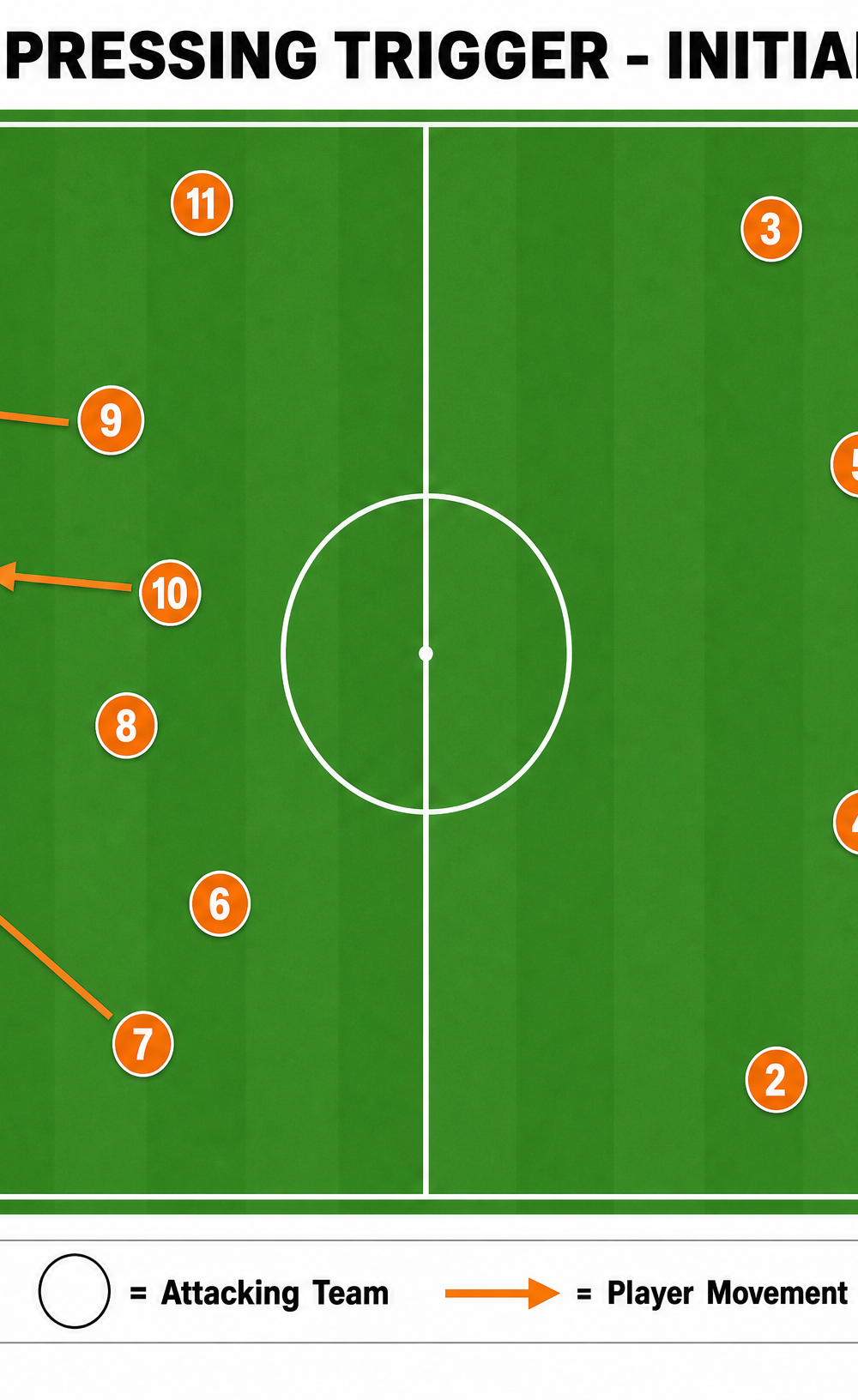
Phase 1: Identifying the Pressing Trigger
- Starting Position: The drill begins with the defending team's Goalkeeper (1) playing a pass out to their Centre Back (5).
- The Trigger: The pressing team waits for a specific trigger. This could be a poorly weighted pass, a player receiving facing their own goal, or a pass played out to the touchline.
- The Initial Press: Once the trigger occurs, the Striker (9) initiates the press, sprinting aggressively to close down the ball carrier, curving their run to cut off the switch of play.
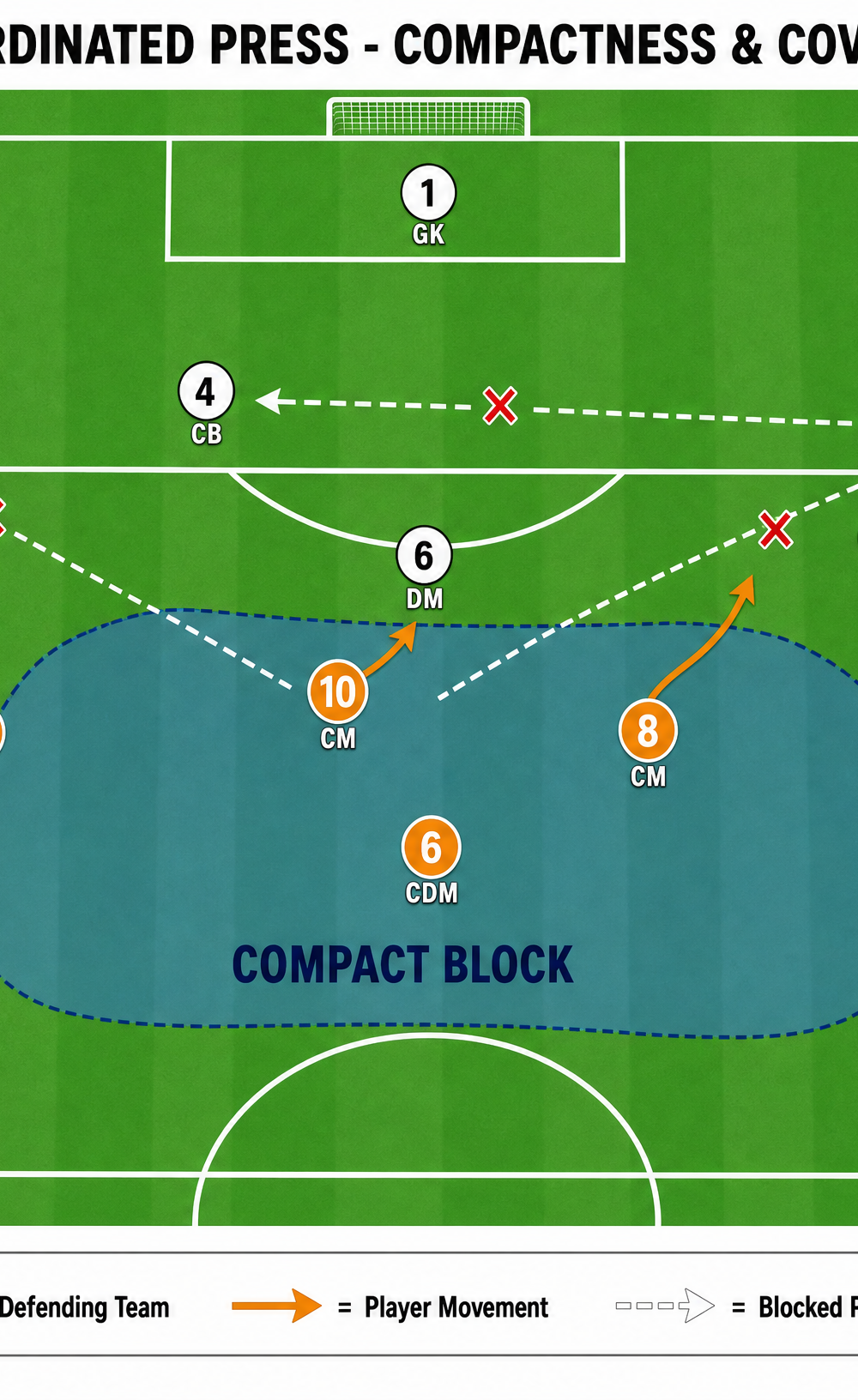
Phase 2: Coordinated Press and Compactness
- Supporting the Press: As the Striker (9) presses, the Right Winger (7) and Central Midfielder (10) push up to close off passing lanes to the full-back and pivot.
- Squeezing the Space: The entire team must shift laterally. The Defensive Midfielder (6) steps up to remain compact, ensuring the distance between the defensive and midfield lines is no more than 12–15 metres.
- The Trap: The goal is to force the ball carrier into a 'Press Trap Zone' near the touchline, using the sideline as an extra defender to win possession.
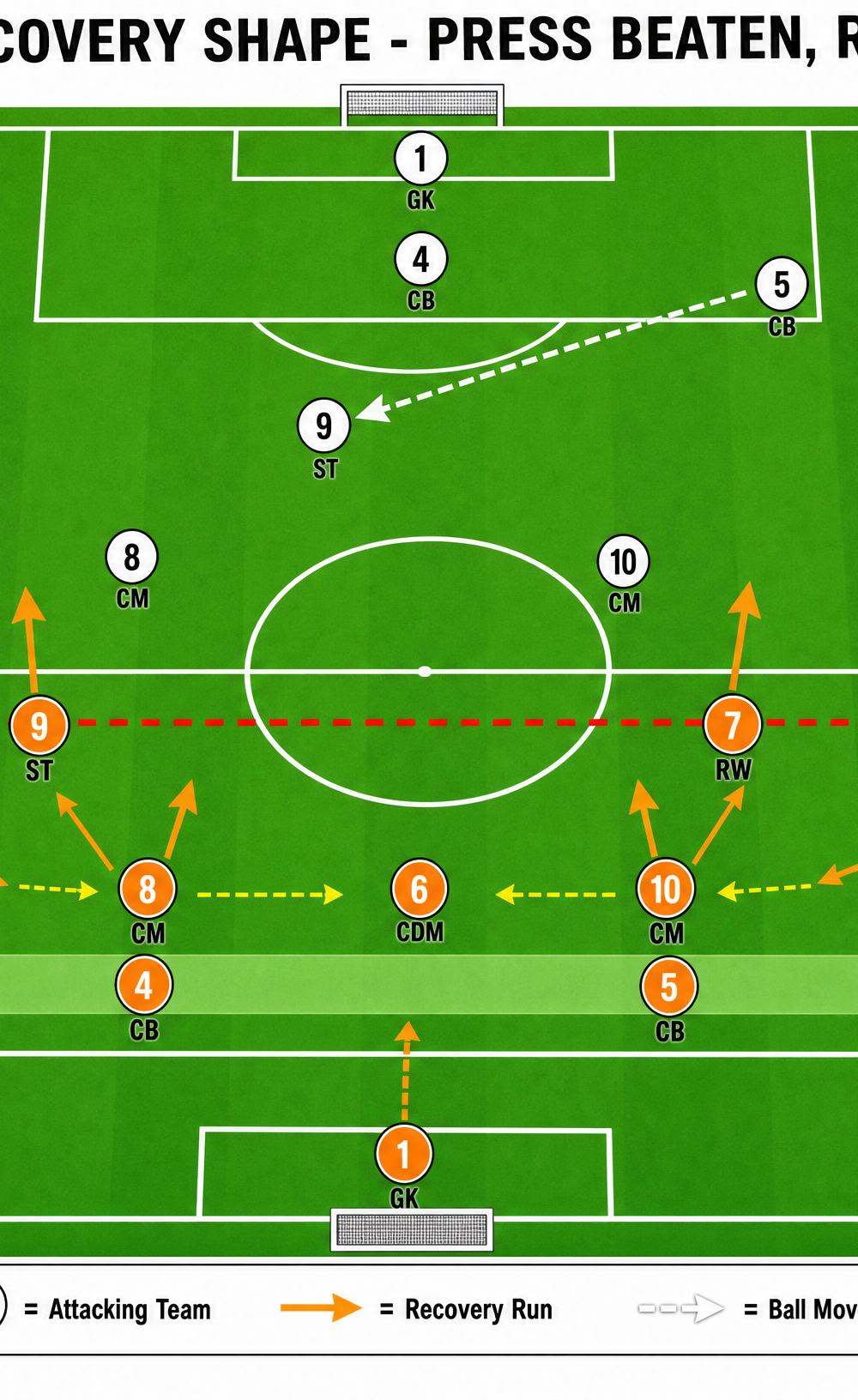
Phase 3: Recovery Shape
- The Bypass: The coach plays a long ball over the press, or the attacking team successfully plays out, bypassing the initial pressing wave.
- Immediate Reaction: The pressing team must instantly transition into recovery mode. The front line (9, 7, 11) must make high-intensity recovery sprints back towards their own goal.
- Reorganising the Block: The midfield and defensive lines drop and narrow, reforming a compact mid-block (e.g., 4-4-2 or 4-5-1) behind the ball, re-establishing a solid defensive line approximately 35 metres from goal.
4. Key Coaching Points
- Aggressive but Controlled Triggers: Players must recognise the trigger instantly and press with high intensity, but remain balanced on approach to avoid being easily beaten 1v1.
- Body Shape and Cover Shadows: The pressing player must use their body shape to dictate the direction of play, using their 'cover shadow' to block passes to dangerous central areas.
- Team Cohesion: A press only works if the whole team moves together. If the front line presses but the midfield stays deep, the press will be broken easily.
- Reaction to Being Beaten: The most critical moment is the transition. Players must react instantly when the press fails, prioritising a rapid sprint back into a compact defensive shape over frustration.
5. Common Mistakes
- Pressing Alone: One player pressing aggressively without support from teammates, leaving gaps that are easily exploited.
- Straight-Line Pressing: Approaching the ball carrier in a straight line, which allows the attacker to pass in any direction. Pressing runs must be curved to cut off passing options.
- Slow Recovery: Jogging back into position after the press is beaten. Recovery runs must be full sprints to get back behind the ball.
- Lack of Communication: Failing to call out triggers or instruct teammates to step up, leading to a disjointed pressing effort.
6. Variations & Progressions
- Progression 1 — Time Limit on Recovery: Introduce a 6-second rule. If the pressing team is beaten, they have exactly 6 seconds to recover all players behind the ball line.
- Progression 2 — Multi-Ball Transition: The coach holds multiple balls. As soon as the attacking team plays out, the coach immediately feeds a new ball to a different area of the pitch, forcing rapid re-adjustment and continuous pressing/recovery cycles.
- Variation 1 — Change the Trigger: Adjust the drill to focus on different pressing triggers, such as a throw-in, a specific player receiving the ball, or a backwards pass.
7. Age Adaptations
- Under-8 to Under-10: Focus primarily on the individual pressing technique (speed of approach, slowing down, body shape). Keep the drill small-sided (4v4 or 5v5) to ensure high involvement.
- Under-12 to Under-14: Introduce the concept of cover shadows and small group pressing (2 or 3 players working together). Emphasise the importance of the immediate reaction upon losing the ball.
- Under-16 to Open Age: Implement the full 11v11 tactical drill as described. Focus on the nuances of team shape, distances between lines, specific pressing traps, and high-intensity recovery sprints.