Mastering the High Ball: Kick Chase and Catch Drill
A comprehensive drill designed to improve kicking accuracy, coordinated chase lines, and aerial contest skills under pressure.

Equipment Needed
1. Overview
The "Kick Chase and Catch" drill is a fundamental exercise for developing a cohesive kicking game. A well-executed kick is only as good as the chase that follows it. This drill focuses on the vital connection between the kicker (usually the 9 or 10), the primary chasers (wingers and outside backs), and the player receiving the high ball. It simulates match-like pressure, teaching attackers how to apply coordinated pressure and defenders how to safely defuse aerial threats.
Use this drill during the transition phase of your sessions to bridge the gap between individual skills and team phase play. It is particularly effective when preparing for opponents known for a strong kicking game or when looking to improve your team's counter-attacking structure.
2. Setup
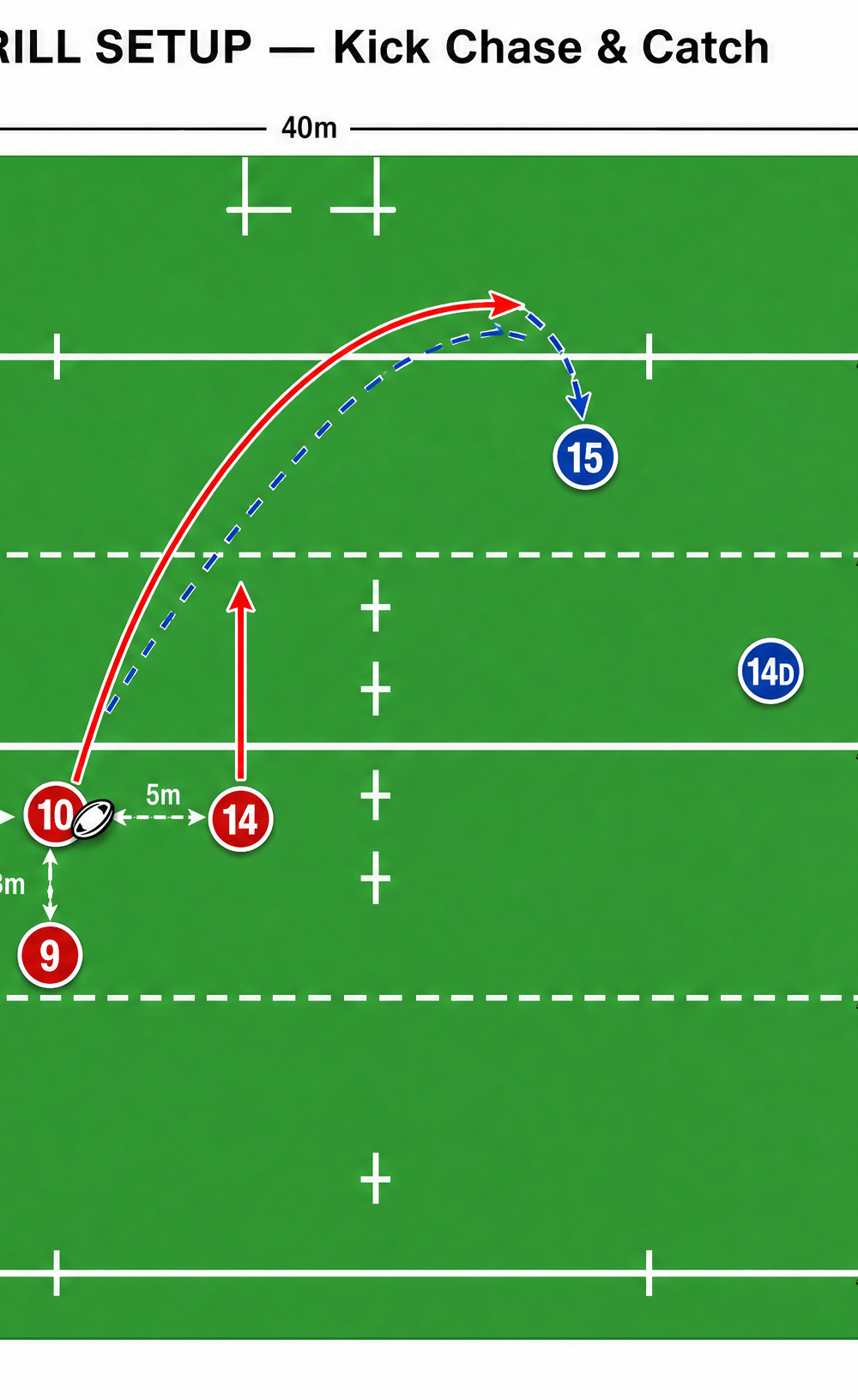
Pitch Setup:
- Create a grid 40m wide and 50m long, using the halfway line and the 22-metre line as key markers.
- Use cones to clearly mark the boundaries and the target landing zones for the kicks.
Player Positions:
- Attacking Team (Red): Position a Fly-half (10) near the halfway line with the ball. Position Wingers (11 and 14) 5m on either side of the 10. A Scrum-half (9) can start 3m behind the 10 to simulate a pass from the base.
- Defending Team (Blue): Position a Fullback (15) 25m ahead near the 22-metre line. Place a Defending Winger (14D) 10m to the side of the 15 to offer support.

3. Step-by-Step Instructions
- The Initiation: The drill begins with the Scrum-half (9) passing the ball to the Fly-half (10). The 10 takes a step to balance and executes a high, hanging kick (up-and-under or box kick) targeting the space near the 22-metre line.
- The Chase: As soon as the ball leaves the kicker's boot, the Wingers (11 and 14) sprint forward in straight, disciplined chase lanes. They must communicate to ensure they don't bunch up, maintaining a wide net to trap the catcher.
- The Tracking: The defending Fullback (15) tracks the flight of the ball, calling "Mine!" early and loud to claim the catch.
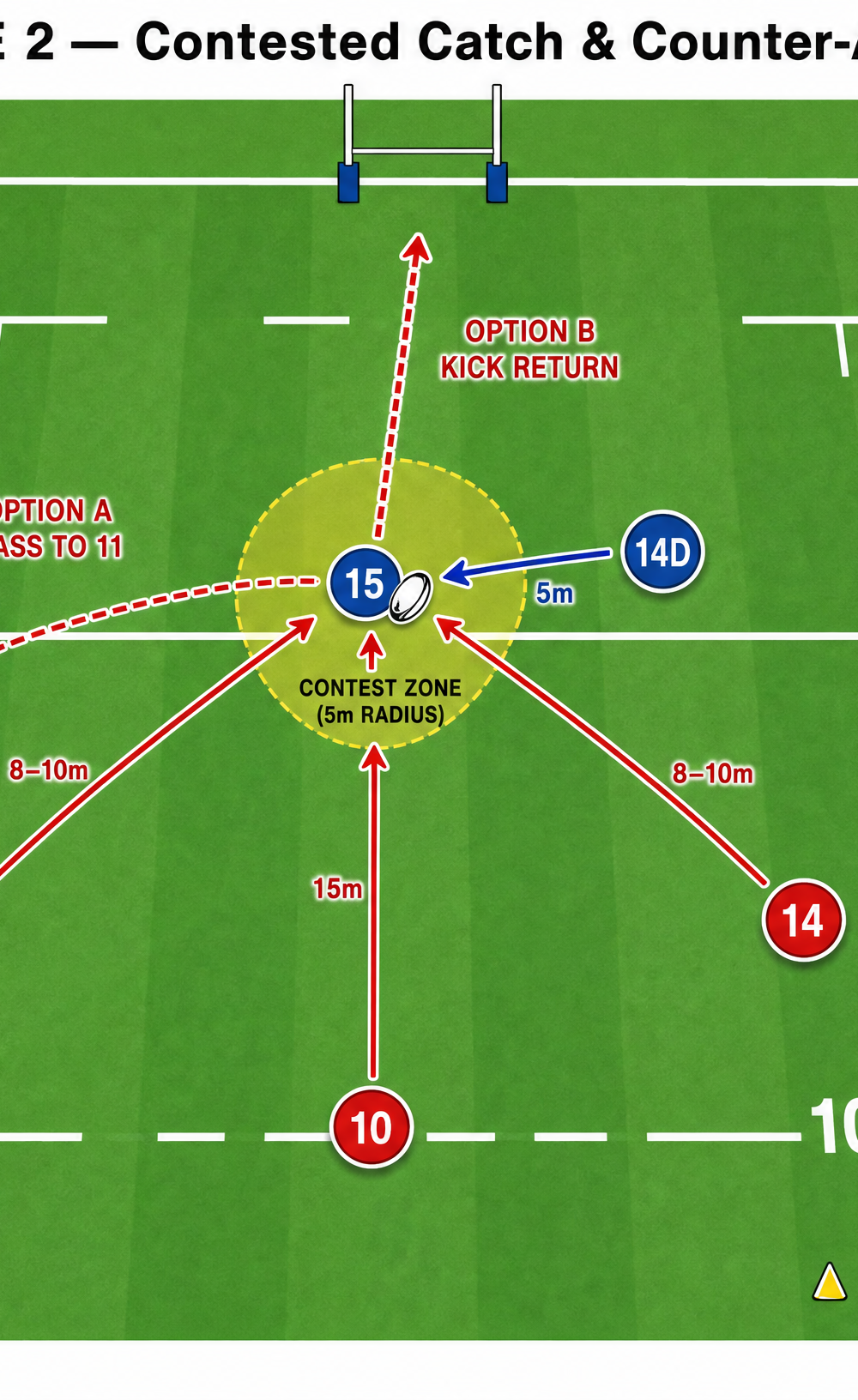
- The Contest: The chasers arrive at the landing zone simultaneously with the ball. They must legally contest the catch in the air or immediately tackle the catcher upon landing if a clean catch is made.
- The Counter-Attack: If the Fullback (15) successfully catches the ball, they immediately initiate a counter-attack. They can either pass to the supporting Winger (14D) or attempt a kick return to relieve pressure.
4. Key Coaching Points
- Hang Time is King: The kicker must prioritize height over distance. A kick that hangs in the air for 3-4 seconds allows the chasers to arrive exactly as the ball comes down, maximizing pressure.
- Stay Onside: Chasers must hold their run until the kicker's foot strikes the ball. An early start results in a penalty in a match situation.
- Dominate the Airspace: The catcher must jump towards the ball, leading with the knee for protection and catching the ball at the highest possible point. Eyes must remain on the ball at all times.
- The 'V' Formation Chase: Chasers should form a 'V' shape, with the primary chaser aiming directly for the catcher and the supporting chasers slightly behind and wide to cut off escape routes.
- Immediate Transition: Whether the ball is caught or dropped, all players must instantly transition to the next phase—either securing the ruck, attacking the space, or reorganizing the defensive line.
5. Common Mistakes
- Kicking Too Long: A low, driving kick gives the catcher time to secure the ball and assess options before the chasers arrive, defeating the purpose of the drill.
- Bunches in the Chase: Chasers running in a single file line or bunching together allow the catcher easy avenues to step and counter-attack.
- Waiting for the Bounce: The catcher allowing the ball to bounce instead of attacking it in the air creates chaos and often leads to knock-ons or lost possession.
- Lack of Communication: Silence from the defending team leads to collisions between teammates attempting to catch the same ball.
6. Variations & Progressions
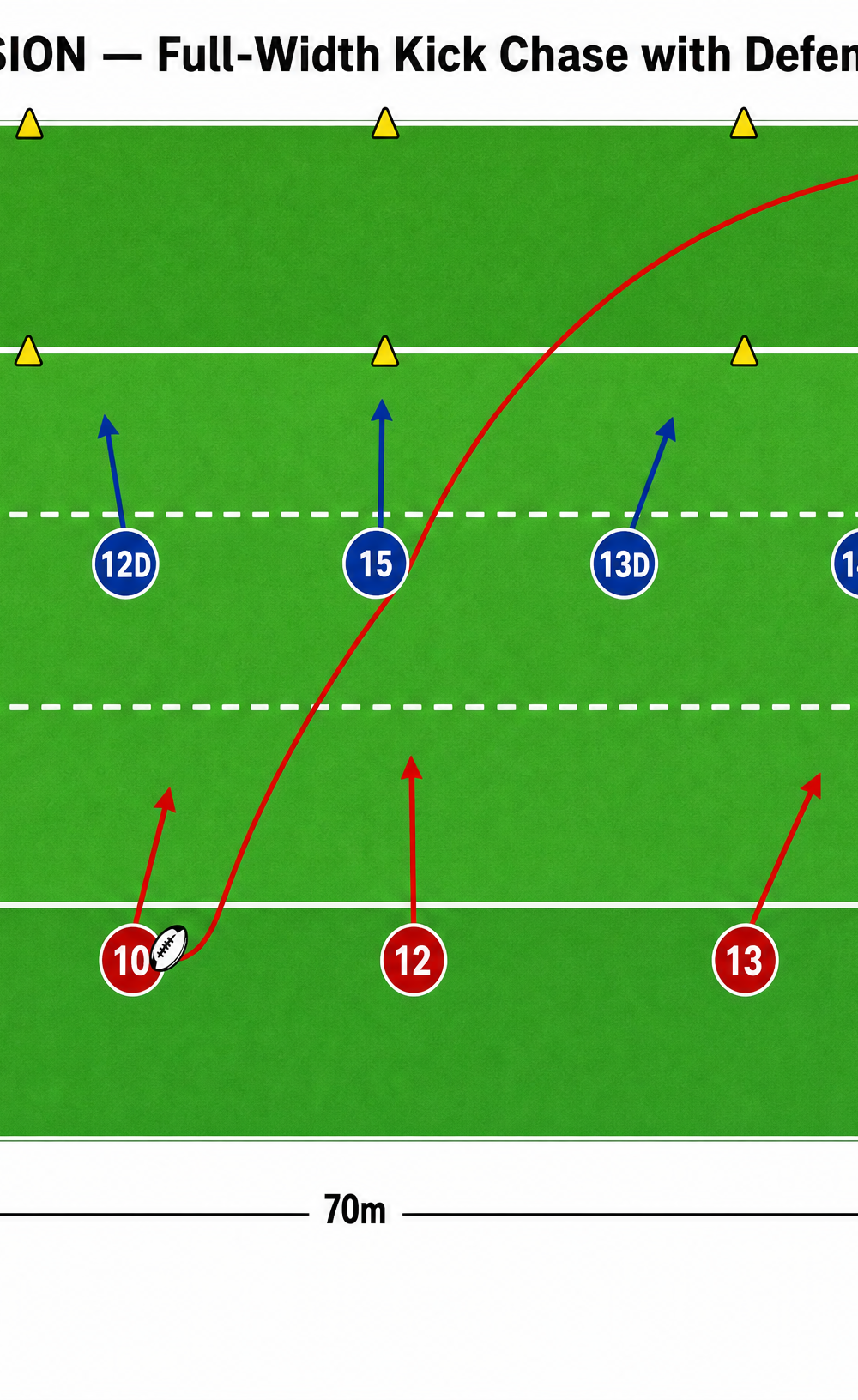
- Full-Width Chase: Expand the drill to the full 70m width of the pitch. Involve the entire backline in the chase and a full back three in defense. This requires greater coordination and stamina.
- Add Scenarios: Introduce specific scenarios, such as the catcher being forced to kick out on the full, or the chasers having to secure a turnover ruck immediately upon contact.
- Fatigue Factor: Run this drill at the end of a demanding conditioning session to test players' ability to execute precision kicks and catches under physical and mental fatigue.
7. Age Adaptations
- Under 8 - Under 10: Focus solely on the mechanics of catching a high ball. Use softer balls if necessary. Remove the chasing element initially to build confidence. Introduce gentle, unopposed kicks.
- Under 12 - Under 14: Introduce the chase, but emphasize safe, legal tackling techniques. Ensure the kicker is focusing on technique rather than sheer distance. Introduce the concept of calling for the ball.
- Under 16 - Open: Full contact, full speed. Emphasize the tactical decision-making of the counter-attack and the precision of the 'V' formation chase. Introduce complex variations and game-like pressure.