

Netball
Mastering the Two-Foot Landing: Essential Netball Footwork Drill
A fundamental drill designed to help coaches teach and refine the two-foot landing technique, improving player balance, control, and reducing the risk of stepping calls.
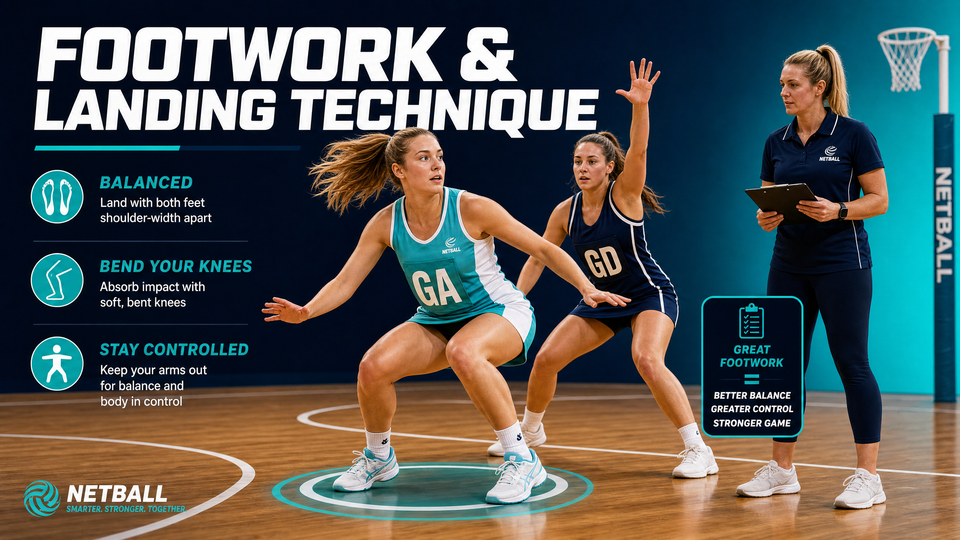
What you need
Netballs (1 per group of 3-4), Flat marker cones (5 per group)
Overview
Footwork is the foundation of Netball. Without a solid, balanced landing, players are prone to stepping calls, poor passing execution, and even injury. This drill focuses specifically on the two-foot landing — the most fundamental footwork skill in the game — teaching players to absorb the impact of the catch safely, establish a strong base of support, and maintain complete body control before executing their next pass.
This drill is ideal as a warm-up activity or as a core skill development station in your weekly training session. It is suitable for all levels, from beginners learning the rules of footwork for the first time to advanced players refining technique under defensive pressure.
Setup
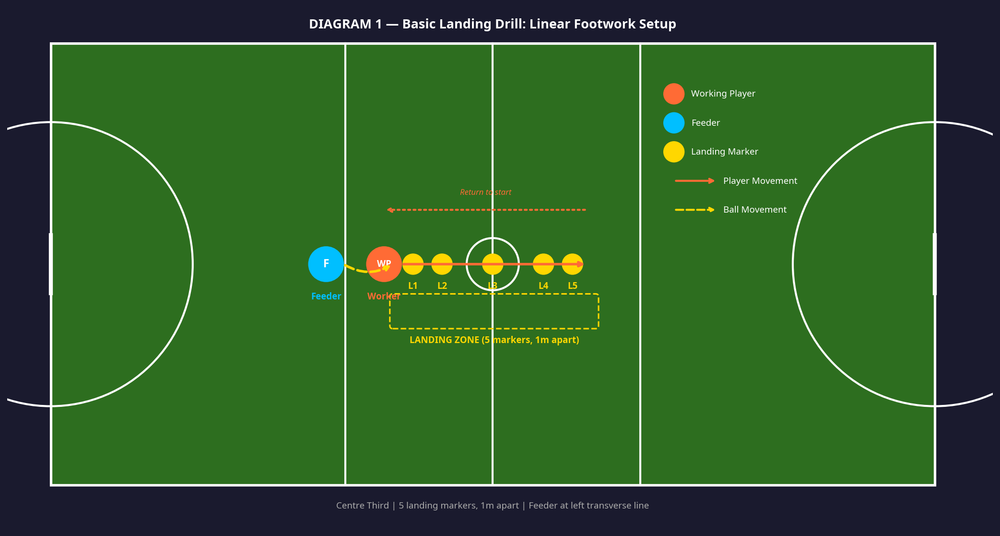
Court Area: Centre Third (approximately 10.17m x 15.25m section of the full 30.5m x 15.25m court).
Equipment Needed:
- 1 netball per group
- 5 flat marker cones per group
Players: Groups of 3–4 players, with one player acting as the Feeder and one as the Working Player. Remaining players queue behind the Working Player.
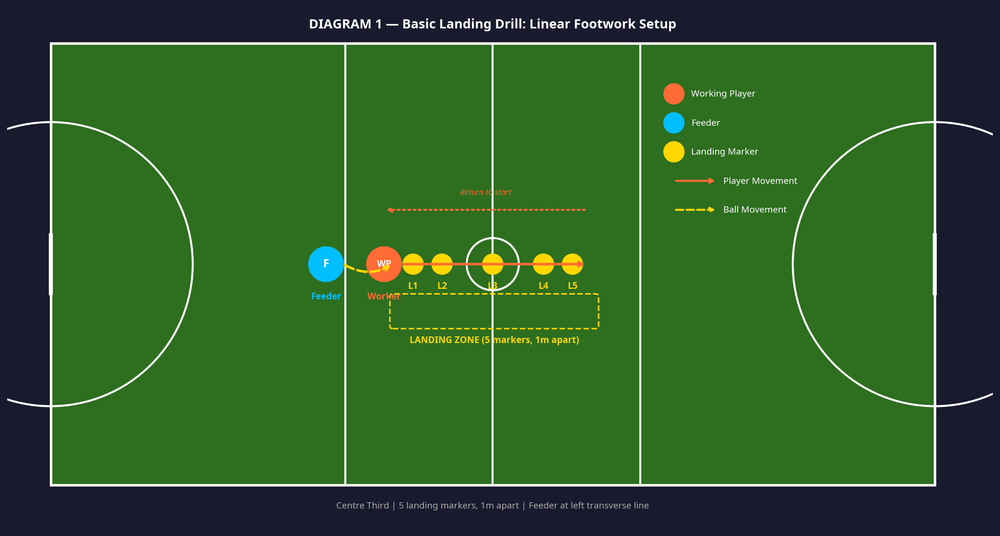
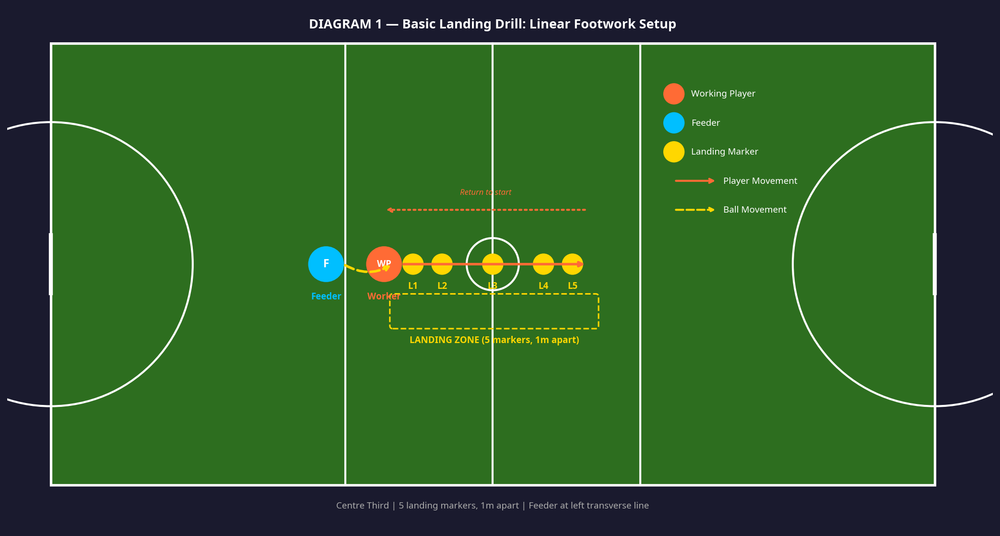
Configuration: Place 5 marker cones in a straight line across the width of the centre third, spaced 1 metre apart. The Feeder stands 2–3 metres away from the line of cones, perpendicular to it. The Working Player begins at the first cone.
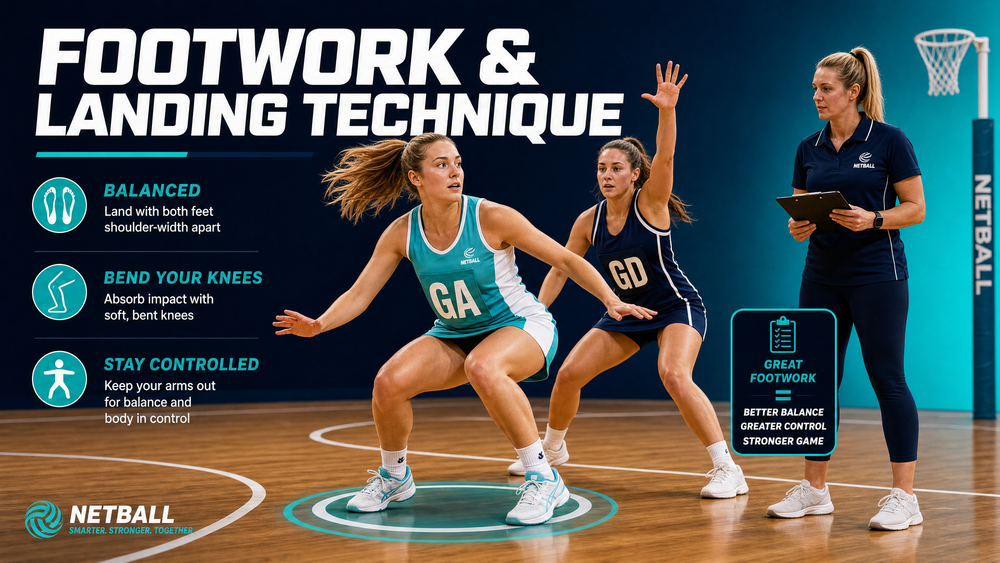
Diagram 1: Basic setup showing the Feeder (F), Working Player (WP), and five landing markers (L1–L5) across the centre third. Solid arrows indicate player movement; dashed arrows indicate ball movement.
Step-by-Step Instructions
Starting Position. The Working Player (WP) stands at the first marker cone (L1), facing the Feeder (F). Feet are shoulder-width apart, knees slightly bent, weight on the balls of the feet — ready to move.
The Drive. On the Feeder's signal (a raised ball or verbal cue), WP drives hard toward the second marker cone (L2). The movement should be a sharp, explosive 1–2 step acceleration.
The Pass and Catch. As WP approaches L2, the Feeder delivers a firm chest pass timed so WP catches the ball while still in the air — before the feet touch the ground.
The Two-Foot Landing. WP lands simultaneously on both feet at the marker cone. The landing should be quiet, with knees bent to approximately 90 degrees, feet shoulder-width apart, chest up, and arms extended holding the ball. The player must be completely stationary — no shuffle, no drag, no pivot.
Hold and Check. WP holds the landing position for a full count of one second. This is the most important coaching moment. Use this pause to check technique before the player moves on.
Return Pass. WP passes the ball back to the Feeder with a clean chest pass, maintaining their landing position until the ball is released.
Move to Next Marker. WP side-steps or jogs to the next cone (L3) and repeats the sequence. Continue through all five markers.
Rotate. Once WP has completed all five landings, they jog back behind the queue. The next player in line becomes the Working Player. After two full rotations, the Feeder also rotates.
Key Coaching Points
| Coaching Cue | What to Look For | Common Correction |
|---|---|---|
| "Eyes on the ball" | Player tracks the ball into hands before looking up | Remind players to watch the ball all the way in |
| "Soft knees" | Knees bend on impact; landing is quiet | Tap knees to remind; demonstrate the difference between a hard and soft landing |
| "Shoulder-width base" | Feet land parallel, hip-width to shoulder-width apart | Use cones to mark correct foot position |
| "Strong core, chest up" | Upright posture; no leaning forward | Ask players to imagine a string pulling the top of their head to the ceiling |
| "Freeze like a statue" | Complete stillness after landing | Use a whistle — blow once when they land; they must not move until you blow again |
| "Ball in, feet down" | Ball is caught before feet land | Slow the feeder's pass to allow players to time the jump correctly |
Common Mistakes
Watching for these errors will save you significant time in correcting footwork issues during games:
1. Landing with straight legs. This is the most common error at beginner level. Straight-legged landings jar the joints, cause the player to bounce forward off the landing, and almost always result in a step. Cue: "Pretend you are landing on a fragile floor — absorb the landing."
2. Feet too close together. A narrow base makes the player unstable and easy to knock off balance. Cue: "Land with your feet as wide as your shoulders."
3. Catching after landing. The ball must be caught while the player is still airborne. If the feet land before the hands have the ball, the player has already established a landing foot and any subsequent movement is a step. Cue: "Catch it in the sky, land with it in your hands."
4. The shuffle step. Players often do a small corrective shuffle after landing to regain balance. This is a stepping infringement. The cure is to slow the drill down and insist on the one-second hold before any movement.
5. Pivoting without intent. Once a landing foot is established, players sometimes pivot unnecessarily, losing their passing angle. Teach players to land with intention — already knowing where the next pass is going.
Variations & Progressions
Progression 1: The Split Landing (1-2 Step)
Once the simultaneous two-foot landing is mastered, introduce the split landing. The player lands on the outside foot first (the leading foot), then grounds the second foot to establish a pivot. This is the more game-realistic landing for players who are cutting at pace and need to immediately pivot and pass in a new direction. Repeat the same cone-line drill but cue players to land outside foot first.
Progression 2: Receive Under Pressure
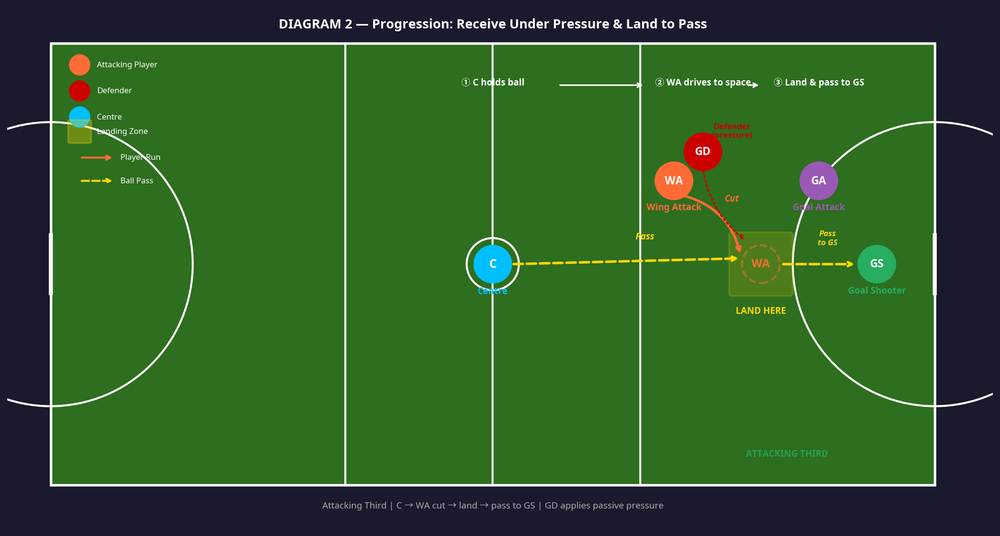
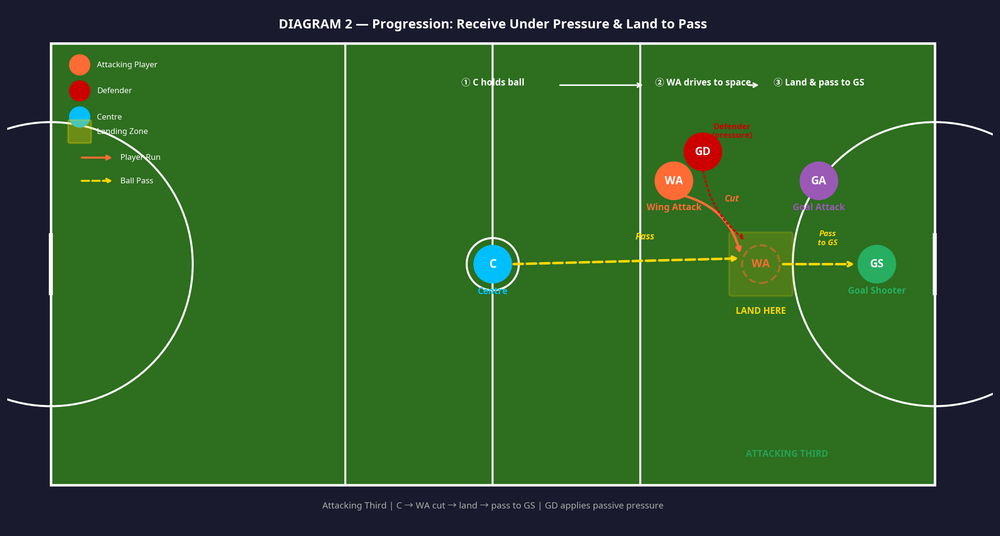
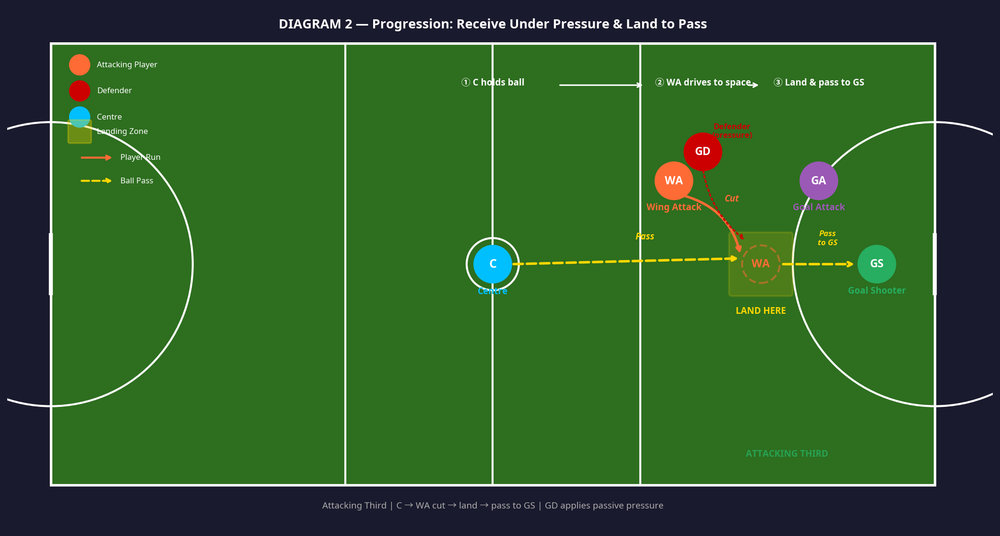
Introduce a passive defender (GD or GK role) who shadows the Working Player's cut. The defender does not intercept but applies spatial pressure, forcing the Working Player to make a sharper cut, land cleanly despite the distraction, and make a quick decision on release. This bridges the gap between isolated skill work and game-realistic execution.
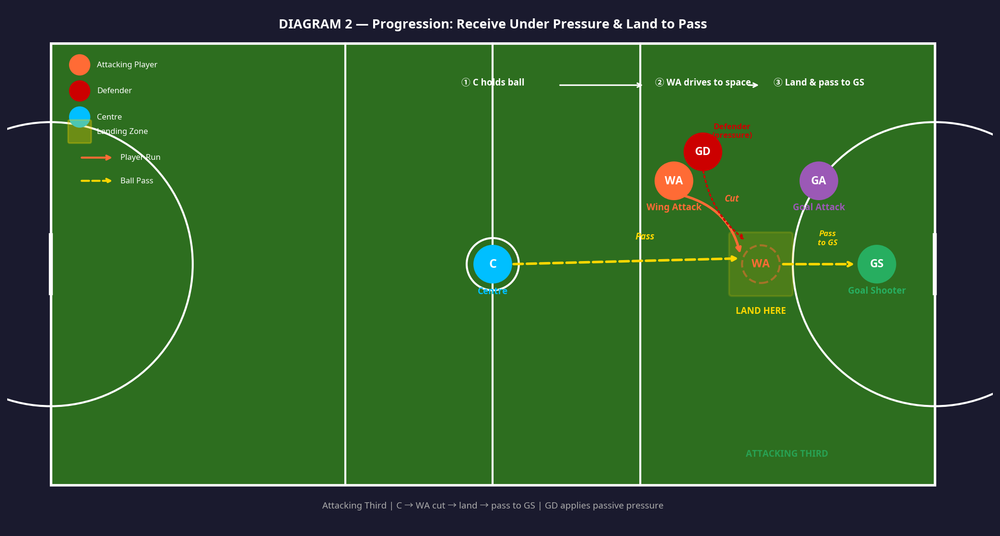
Diagram 2: Progression drill showing Centre (C) passing to Wing Attack (WA) who cuts into the attacking third, lands in the designated zone under pressure from Goal Defence (GD), then passes to Goal Shooter (GS).
Variation: Change the Pass Type
The Feeder can vary the delivery — lob pass, bounce pass, or overhead pass — to force the Working Player to adjust their jump height and landing mechanics. This develops adaptability and prevents players from becoming robotic in their movement patterns.
Age Adaptations
| Age Group | Adaptation |
|---|---|
| Under 8 / Under 10 | Remove the ball entirely. Players run and jump to a stop on the coach's whistle. Focus only on "soft knees" and "freeze like a statue". Introduce the ball only once the stopping technique is consistent. |
| Under 12 | Introduce the simultaneous two-foot landing with the ball. Use slow, soft passes to allow players to time the jump. Emphasise the one-second hold. |
| Under 14 | Introduce the split landing (1-2 step). Begin adding passive defensive pressure. Require a pivot and second pass after landing. |
| Under 16 / Open | Full defensive pressure. Require the Working Player to pivot, scan, and pass to a third player in a game-realistic position within 3 seconds of landing. |
