

Netball
Centre Pass Quick Goal: The Front-Space Split
Coach a high-tempo, two-phase centre pass that opens the central channel, isolates the Goal Attack, and feeds the Goal Shooter in front of the post before the defence can recover.

What you need
Regulation netball court (30.5m x 15.25m), Standard netball, Positional bibs (C, WA, GA, GS, WD, GD, GK), Eight flat markers or cones, Stopwatch or phone timer
Overview
The Front-Space Split is a centre-pass set play built for a rapid, high-percentage shot. It uses the Wing Attack's (WA) hard wide clearance to empty the central lane, then sends the Goal Attack (GA) back into that lane on a sharp, goal-side re-offer. Once the GA catches cleanly in the centre third, the Goal Shooter (GS) breaks from a deep hold into the front space for the finish.
Use this on your own centre passes when the opposition is squeezing a flat zone, the Wing Defence (WD) is over-helping through the middle, or the Goal Defence (GD) is sitting too high on your GA. It is not a slow build-up pattern. Coach it as a six-second strike: create width, win the centre-third catch, then feed the circle before the defence resets. The court geometry used here follows the World Netball court dimensions of 30.5m x 15.25m.1
Setup

You need one standard netball, seven positional bibs, eight flat markers, and access to a full court. Mark a 2–3m-wide receiving gate on the WA side of the centre circle, then mark a second gate 1–1.5m inside the centre third for the GA's re-offer. In the attacking goal third, place a cone 2–3m in front of the post to cue the GS's finishing space. The goal circle has a 4.9m radius; keep the cone well inside it but not underneath the ring.
Set the attack left-to-right. 1. Centre (C) starts in the centre circle with the ball. 2. Wing Attack (WA) starts just inside the centre third near the transverse line, able to clear toward the sideline. 3. Goal Attack (GA) starts goal-side of the transverse line, ready to fake depth and drive back into the centre third. 4. Goal Shooter (GS) begins deep in the goal circle, shoulder-to-shoulder with the Goal Keeper (GK). Use a live WD on WA, a live GD on GA, and a live GK on GS. The Centre must take the pass legally with at least one foot wholly inside the centre circle.1
| Player | Start point | Non-negotiable job |
|---|---|---|
| C | Centre circle | See the split early and pass flat to the first free target. |
| WA | WA-side transverse line | Clear hard and wide, taking the WD out of the central lane. |
| GA | Goal-side of transverse line | Sell depth, then cut back explosively to win the centre-third catch. |
| GS | Deep in goal circle | Hold the GK deep, then dodge sharply into the front space only after GA secures possession. |
Step-by-Step Instructions


Phase 1: Create the Split
Set the picture before the whistle. The WA checks that there is room to clear into the sideline channel. The GA stands goal-side of the transverse line, keeping their hips pointed toward goal so the GD expects a deep drive. The GS pins the GK close to the post; do not let the GS drift toward the centre third.
Clear the WA wide. On the whistle, the WA drives hard toward the sideline and slightly down-court. Demand a complete 2–3m clearance from the centre-circle lane. The WA's first job is not necessarily to receive; it is to pull the WD and their cover defender out of the GA's route.
Release the GA into the channel. As the WA clears, the GA makes a short goal-side feint, plants the outside foot, and cuts back 1–1.5m over the transverse line into the centre third. The cut must be straight and explosive, not a rounded arc. C delivers a flat, leading pass as GA arrives in the channel. The first catch must be controlled in the centre third, with the GA landing balanced and eyes already looking into the circle.

Phase 2: Feed the Front Space
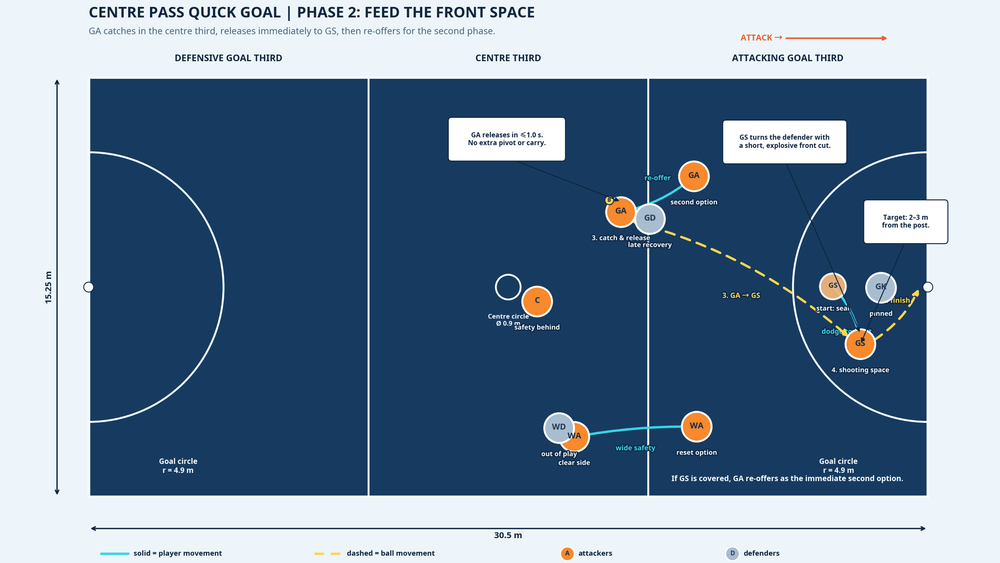
Trigger the GS dodge. The moment the GA has the ball under control, the GS comes off the deep hold. They use a short, sharp dodge to the front space, turning the GK rather than racing away in a long lead. Target the receiving cone 2–3m from the post so the GS has room to land, turn, and shoot.
Feed in one second. GA has a one-second coaching target from catch to release. They should turn the shoulders toward the GS, use a firm chest or shoulder pass, and place the ball in front of the GS's hands. No extra pivot, no unnecessary carry, and no blind lob unless the GK has clearly committed under the ball.
Finish or take the second option. GS lands, stabilises, and shoots. If the GK wins the front space or the GD recovers across the passing line, GA re-offers immediately as the second circle option. At the same time, WA drops wide to a safety position and C trails behind the ball. Train the read: front-space feed first, GA re-offer second, WA safety reset third.
Key Coaching Points
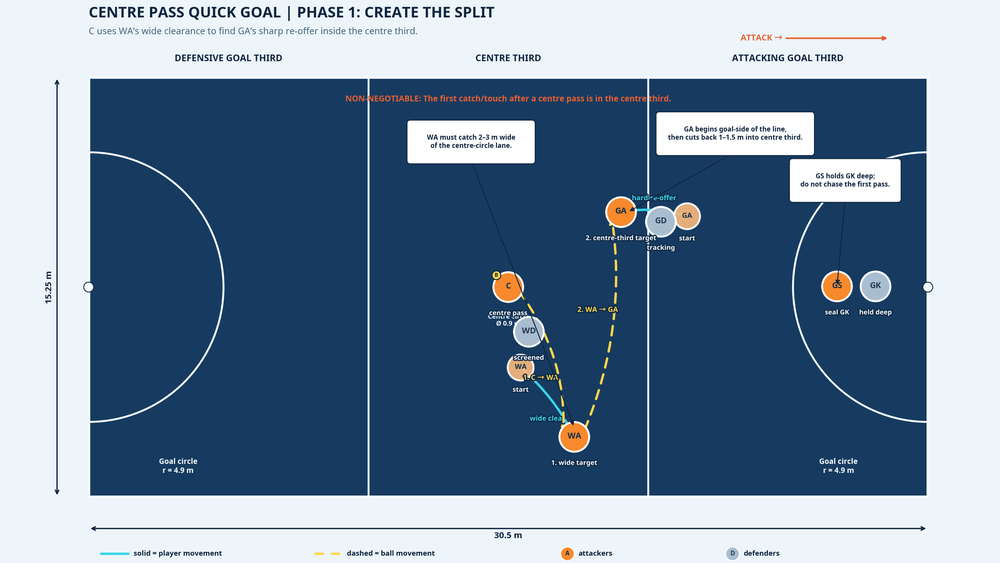
Coach the WA's clearance as a defender-moving action. The drill fails if the WA merely jogs toward the sideline. Use the cue: clear it, then show it. The WA must gain width first and only then re-present as a safety option.
Make GA's first three steps decisive. GA must sell the deep threat, plant hard, and attack the marked centre-third gate. A curved cut brings the GD back into the line of the ball; a direct cut leaves the defender on the wrong side.
Coach C to pass to space, not to the bib. C should release as GA accelerates, putting the ball out in front of GA's run. A pass behind GA creates a stop, gives the GD time to close, and destroys the quick-goal window.
Build the GS's patience. The GS holds deep until GA has possession. The trigger is the secure catch, not the whistle and not GA's movement. A premature GS lead lets the GK occupy the front space before the pass can be delivered.
Measure the tempo. Time the sequence from whistle to shot. Begin with an eight-second target, then work down to six seconds once the shape is reliable. Coach speed of decision rather than uncontrolled speed of running.
Common Mistakes
| Error | What you will see | Immediate correction |
|---|---|---|
| WA clearance is too shallow | WD remains between C and GA. | Reset the WA's marker 2–3m wider and require a full sprint through it. |
| GA cuts too early or too round | GD stays goal-side and contests the first pass. | Rehearse the fake, plant, and straight re-offer without a ball before adding defenders. |
| C passes behind GA | GA stops, pivots, or drifts back toward the line. | Cue C to release at GA's third acceleration step and lead the outside hand. |
| GS leads before GA catches | GK follows into the front space and the lane disappears. | Use a verbal trigger in practice: GS moves only on GA's secure catch. |
Variations & Progressions
Easier: guided pattern. Start without defenders and freeze each player at the receiving gate. Give GA up to two seconds to pivot and feed the GS. This lets younger or newer players learn spacing before timing pressure is added.
Harder: live recovery defence. Add live WD, GD, and GK, then award the defence a point for every interception, tip, or forced reset. The attack only scores the point if the shot is taken within six seconds of the whistle.
Game-like: read the overplay. Instruct the GD to sometimes jump the GA's centre-third cut. When GA is denied, C hits WA on the wide clearance, and WA immediately feeds GA driving deeper into the attacking third. This teaches the group that the pattern creates an advantage, not a pre-decided pass.
Age Adaptations
For Under-8, shorten the court to a half-court teaching area, use no defenders, and work only on C-to-WA-or-GA timing. Do not impose the one-second release rule; praise a balanced catch, correct footwork, and a clear call.
For Under-10 and Under-12, retain the full sequence but use passive defenders and a wider GA receiving gate. Let GA take up to two seconds to turn and feed. The learning outcome is recognising the wide clearance and delivering an accurate ball into the front space.
For Under-14 and Under-16, use live defenders and enforce the six-to-eight-second shot clock. Add a scoring consequence for a GA catch outside the centre-third gate or an early GS lead.
For Open-level teams, vary the defensive look on every rep: switch between a flat zone, a hard WD denial, and a GD who hunts the intercept. Require C and GA to verbalise the first, second, and safety options before the whistle, then execute the live read.
