

Netball
Centre Pass Quick Goal: WA–GA Split Set Play
A timed three-pass centre-pass pattern that uses a Wing Attack lead and Goal Attack decoy to create a clean Goal Shooter finish before the defence can set.
What you need
4–6 regulation netballs, 8–12 marker discs or flat cones, Two sets of position bibs, Whistle, Stopwatch or session timer, Full Netball court with goalposts
1. Overview
The WA–GA Split is a three-pass centre-pass pattern designed to create a shooting chance before the defence builds its circle shape. It wins space through a sharp Wing Attack (WA) lead back into the centre third, a Goal Attack (GA) decoy wide, and a timed GA cut to the goal-circle edge. The Goal Shooter (GS) stays post-side to occupy the Goal Keeper and present a simple finishing target.
Use it after a goal, at the start of a quarter, or when the Wing Defence is overplaying the obvious first-pass lane. The objective is a balanced shot in four to six seconds from Centre (C) → WA → GA → GS. A quality rep is not merely a completed pattern: reward a clean first catch, the correct second-pass decision and a receiver who can shoot without falling away.
Session target: Create four clean shooting opportunities from six live centre-pass reps. Score the decision before the goal: a safe reset is better coaching than a forced pass.
A regulation court is 30.5 m by 15.25 m; its centre circle is 0.9 m in diameter and each goal circle has a 4.9 m radius [1]. At a centre pass, C starts with at least one foot wholly within the centre circle. Every player must start in the correct third, non-Centres may only enter the centre third after the whistle, C must release within three seconds, and the first catch must be wholly in the centre third [2]. This is why WA and GA start in the attacking goal third before the whistle.
2. Setup
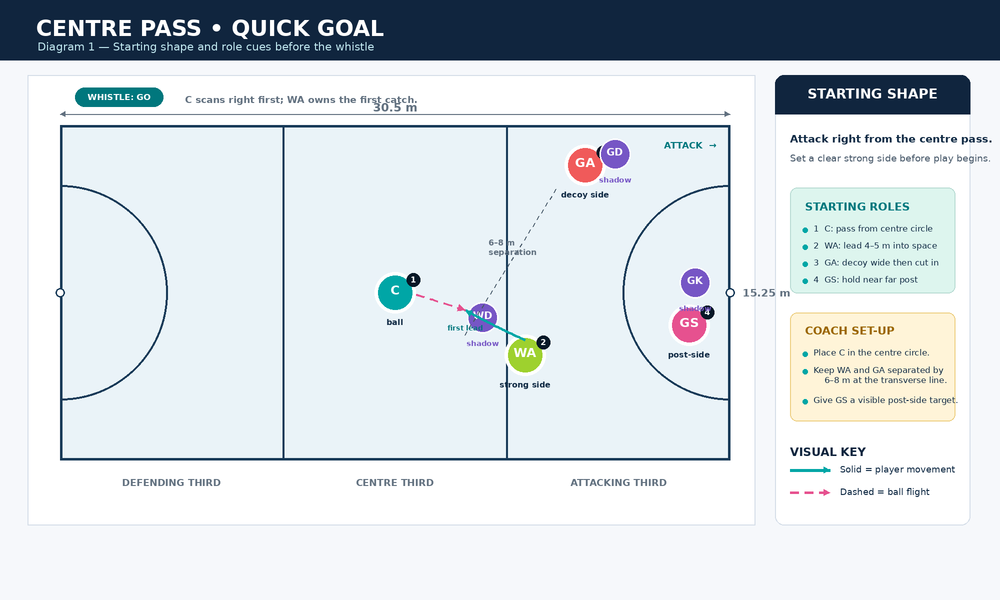
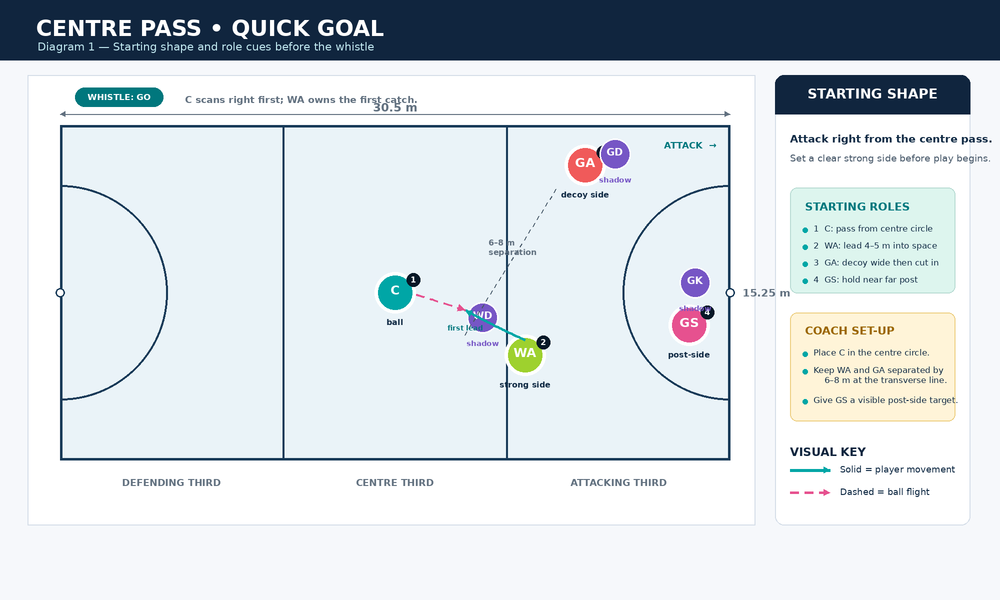
Set the play toward the right-hand goal end first, then mirror it left. Use four attackers against four defenders: C, WA, GA and GS versus the opposing C, WD, GD and GK. Begin with 4 v 0 if your group needs the route, then add the defenders as live pressure.
| Item | Set-up detail | Coaching purpose |
|---|---|---|
| Court | Full 30.5 m × 15.25 m court; transverse lines and circles clearly visible. | Builds real-distance awareness and legal starting habits. |
| C (1) | Centre circle, body half-open to the called strong side. | Delivers the first pass, then supports as the reset. |
| WA (2) | Attacking goal third, 1.5–2 m behind the transverse line and 2–3 m in from the sideline. | Leads 4–5 m back into the centre third. |
| GA (3) | Attacking goal third, 6–8 m from WA and higher or wider. | Decoys wide, then cuts to circle edge. |
| GS (4) | Goal circle, post-side, 1–2 m from the post. | Holds GK and becomes the final target. |
Use 10–12 flat cones for the WA start point, WA catch point, GA decoy lane and GA finish point for the first six reps. Give the group a short pre-whistle call: C calls right or left, WA echoes the side, GA replies split, and GS says hold. Clear language prevents late movement.
3. Step-by-Step Instructions
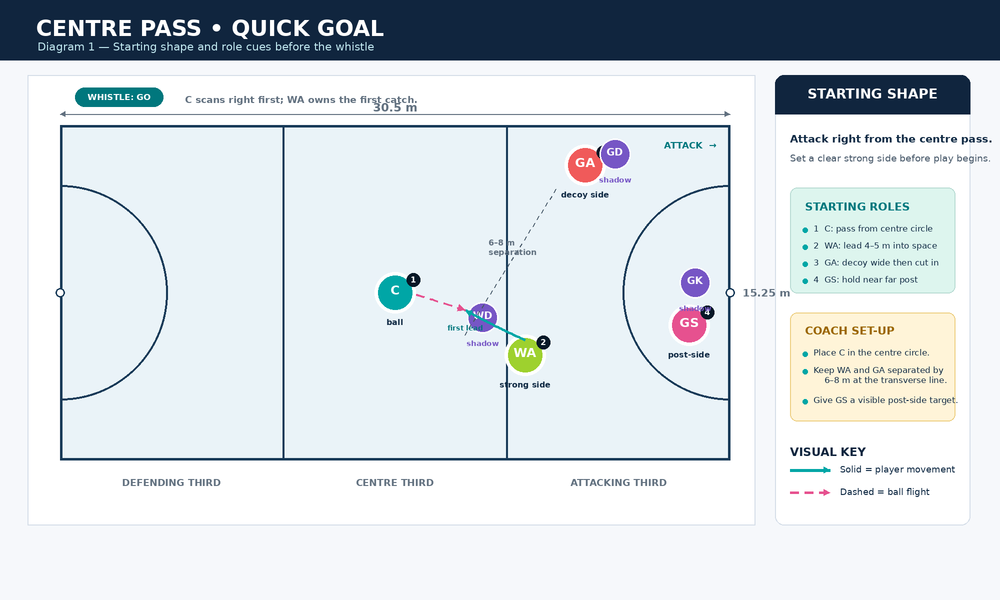
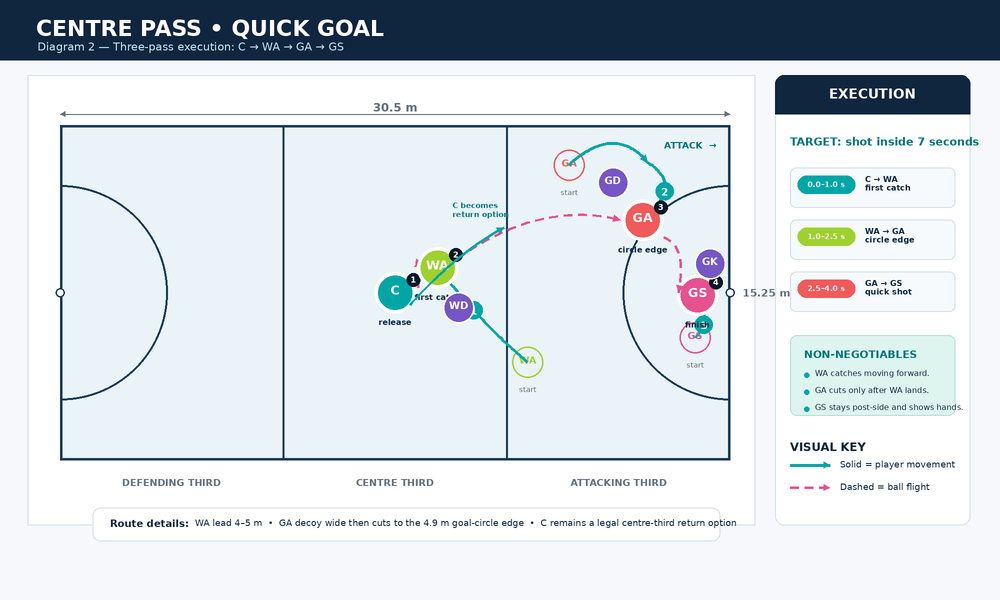
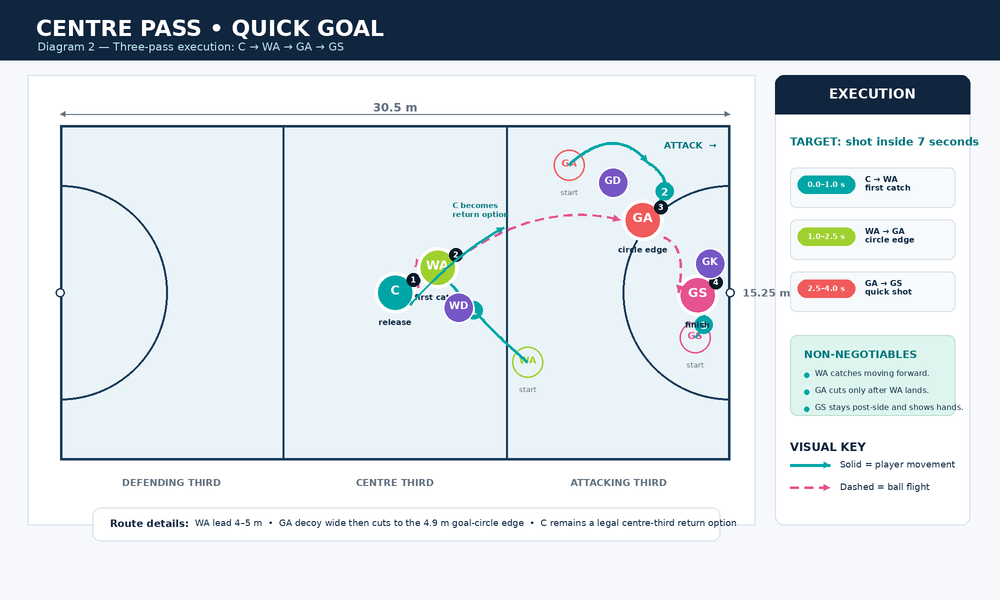
Pre-whistle shape — 0.0 seconds. C (1) stands in the centre circle. WA (2) and GA (3) remain in the attacking goal third; WA is closer to the transverse line, while GA is 6–8 m away on a higher lane. GS (4) is post-side and still. Check that C can see both WA and GA with one scan.
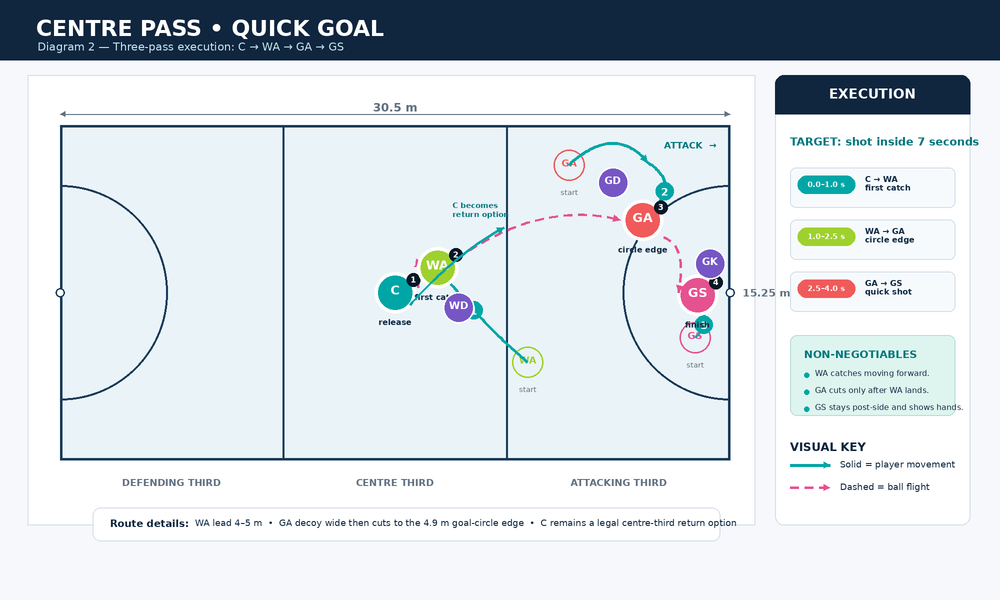
WA first lead — 0.0–0.9 seconds. On the whistle, WA sells one short step deeper, then drives 4–5 m diagonally back into the outside half of the centre third. It must be a change of pace, not a flat jog. C releases a firm chest-height pass into WA’s path, ideally in under 1.3 seconds.
GA decoy and cut — 0.3–1.7 seconds. As WA leads, GA takes two quick steps wider toward the sideline to pull GD away from the central corridor. GA then plants the outside foot and cuts back to the edge of the 4.9 m goal circle. GA waits until WA has secured the first pass; an early cut lets GD sit in the lane.
WA catch and scan — 0.9–1.8 seconds. WA lands side-on with hips and eyes to the goal end. C immediately drives forward inside the centre third as the safe return option. Coach the cue: catch moving, eyes early, pass before the defender sets. WA should not square up, double-pump or wait for GA to stop.
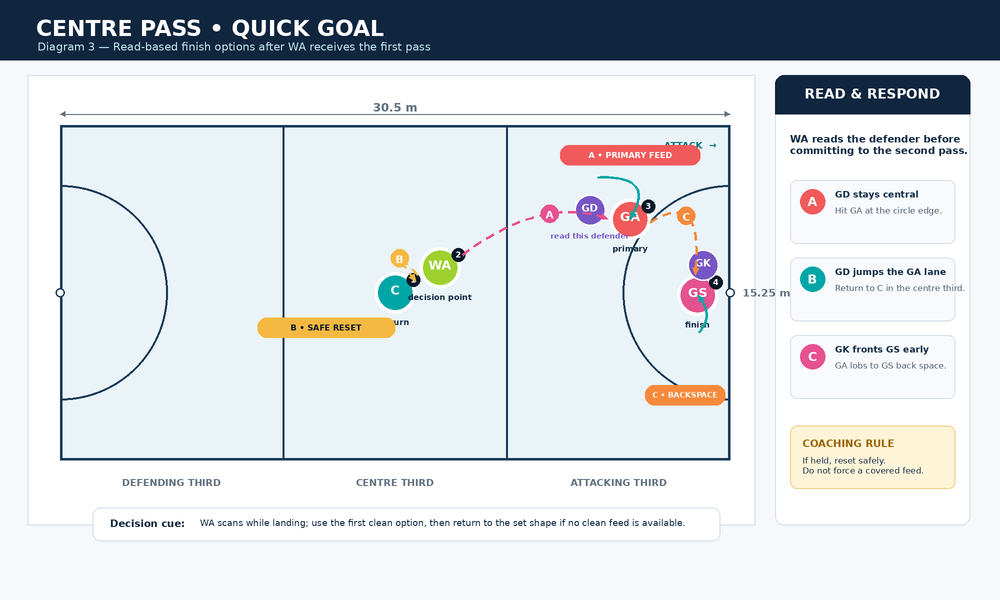
Second pass — 1.5–2.8 seconds. WA throws a flat leading pass one metre in front of GA’s inside shoulder at the circle edge. A hanging pass gives GD time to recover; a pass behind GA produces a backward catch. If GD jumps the lane, WA returns the ball to C rather than forcing the set play.
Circle finish — 2.5–5.0 seconds. GA feeds GS on the post-side shoulder. GS shoots or steps one metre across GK for the safer finish. Only GA or GS may shoot, and the shot must be taken from within the goal circle [2]. If the circle is crowded, reset through C or WA and rebuild.
4. Key Coaching Points
| Point | What the coach should see | Cue |
|---|---|---|
| Legal start | WA and GA outside the centre third until the whistle. | Start outside, win inside. |
| WA lead | A 4–5 m diagonal with a sharp pace change. | Sell away, snap back. |
| C release | Firm ball into WA’s forward path, before WD closes. | Pass to space. |
| GA timing | Wide decoy first; circle cut only after WA lands. | Wide first, circle second. |
| WA body shape | Side-on landing, eyes already on GA. | Land open. |
| GS discipline | Holds post-side until GA receives. | Hold the keeper, show late. |
5. Common Mistakes
| Error | Why it fails | Correction |
|---|---|---|
| WA starts in centre third | Risks a breaking call and removes the surprise lead. | Reset behind the transverse line. |
| WA runs flat | WD stays goal-side and C has no forward lane. | Set a cone 4 m inside the centre third. |
| GA cuts early | GD waits on the circle edge. | GA moves only after WA lands. |
| WA holds or double-pumps | The defence recovers. | Use catch, scan, release in first practice blocks. |
| GS chases the ball | GK follows and the post-side target vanishes. | Keep GS at the post until GA receives. |
6. Variations & Progressions
Progress from scripted 4 v 0, to 4 v 2 with WD and GD live, then to full 4 v 4. In live play, award one point for a balanced shot inside seven seconds and a second point when WA correctly rejects a covered GA lane.
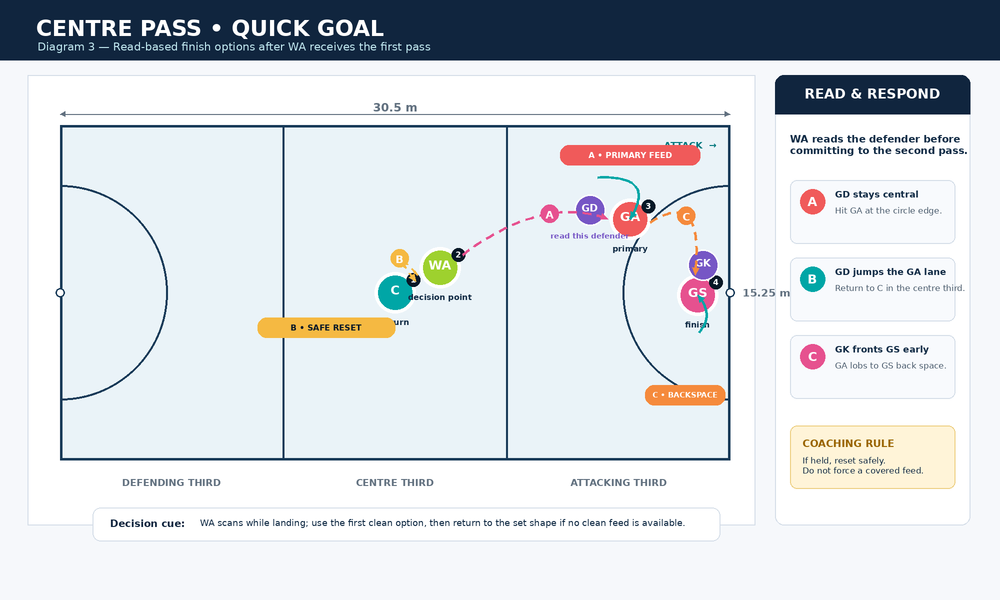
Teach three reads. Option A: GD stays central, so WA feeds GA at the circle edge. Option B: GD jumps the GA lane, so WA returns to C in the centre third and C re-angles the attack. Option C: GK fronts GS early, so GA lobs into GS back space. Option C is a read, not the default.
For advanced players, call central, jump or front immediately before the whistle. WA names the intended second option while landing. This adds genuine perception and decision-making without changing the core route.
7. Age Adaptations
| Age group | Adaptation | Main coaching focus |
|---|---|---|
| Under 8 | Reduce the space; use four attackers and cone defenders. Remove GA’s decoy. | Safe catch, stop and simple spacing. |
| Under 10–12 | Use 4 v 2 with passive WD and GD, then add the GA cut. | Legal positions and leading into space. |
| Under 14–16 | Use full court 4 v 4 and time the sequence. Reward correct resets. | Footwork, timing and WA’s first read. |
| Open | Scout WD body angle, GD deny position and GK front/back preference. Mirror both sides. | Fast decisions and repeatable circle connection. |
Finish with three live centre passes, alternating sides. Film one sideline rep and review only: Did WA start legally? Did GA wait for WA to land? Did the final feed create a balanced shot? Tight feedback on those behaviours improves the set play faster than adding another pattern.
References
[1]: World Netball, Facilities and Equipment
[2]: World Netball, Rules of Netball 2024 — Rule 8: Centre Pass and Rule 9: Scoring a Goal
