

Netball
Netball Dodging & Leading Drill: V-Cut to Re-Offer
A progressive attacking drill that teaches Centres, Wing Attacks and Goal Attacks to create separation, time a lead, and re-offer when the first option is denied.
What you need
2 netballs, 6 flat cones, 5 bibs, stopwatch, whistle
Overview
This Dodging and Leading: V-Cut to Re-Offer Drill gives attackers a repeatable answer to tight, fronting defence. It develops the movement that separates effective attacking units from players who simply run at the ball: clear the defender first, plant decisively, then lead into a passing lane at the moment the ball carrier can release. Coach timing and body position: create a passing lane, arrive side-on, and play on quickly.
Use this as a 20-minute attacking-skill block before a half-court possession game, especially when WA and GA are held, fronted, or standing still. The drill uses C #1, WA #2, GA #3, WD #4, and GD #5; adapt it to your numbers. Keep efforts sharp—12–15 seconds—then reset, coach, and rotate.
Setup
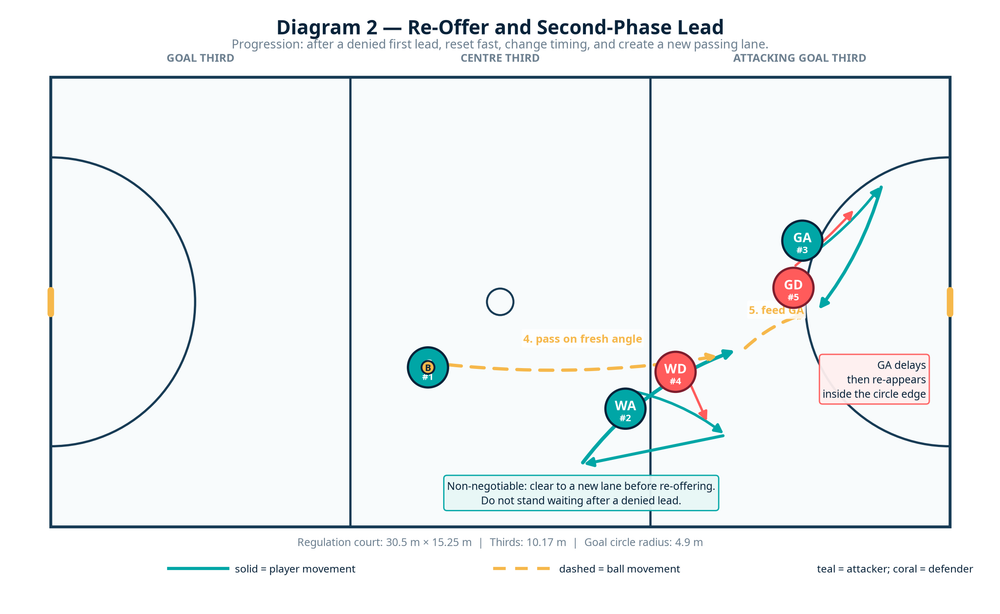
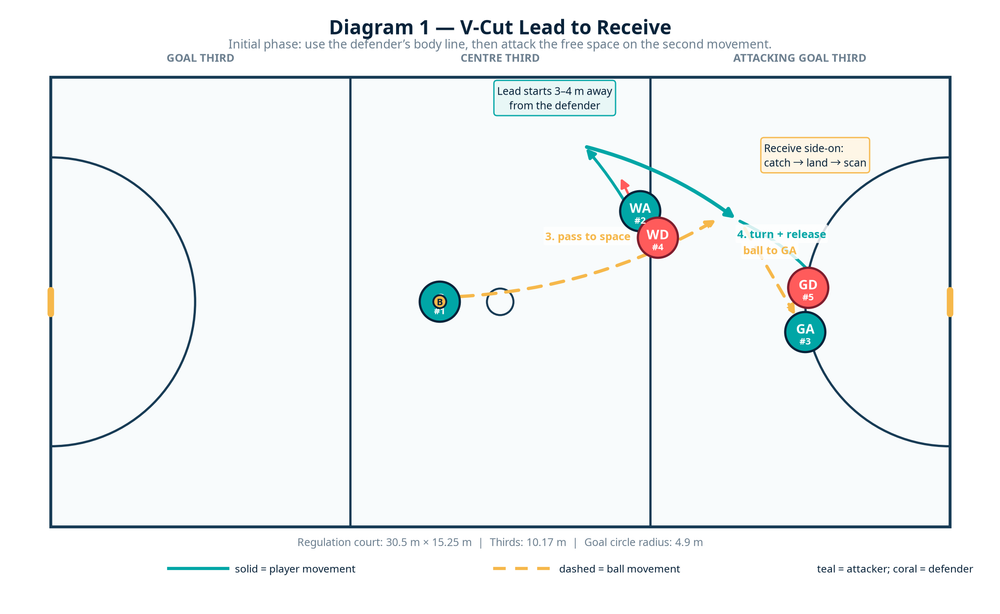
Set up on a full regulation court so players read realistic space. The court is 30.5 m long by 15.25 m wide, with three equal thirds and 4.9 m-radius goal circles.1 Place a cone gate 3–4 m from WA’s start and a second gate near the attacking edge of the centre third. Work one side, then mirror it to train both landing and turning sides.
| Item | Coach instruction |
|---|---|
| Players | 5 active players per station: C #1, WA #2, GA #3, WD #4, GD #5. Add a spare feeder or rotate every 3 repetitions. |
| Equipment | 2 netballs, 6 flat cones, 5 bibs, stopwatch and whistle. |
| Space | Full court preferred; minimum working area is the centre third plus one attacking goal third. |
| Work block | 3 sets of 4 repetitions each. Each rep lasts 12–15 seconds; allow 20–25 seconds for reset and feedback. |
| Starting picture | C starts in the centre third with the ball. WA begins just over the attacking transverse line, 3–4 m from WD. GA holds near the goal-circle edge with GD goal-side. |
Coach’s standard: a lead is not complete when the player gets free. It is complete when the ball arrives into a safe catching window and the receiver can land balanced, scan, and connect the next pass.
Step-by-Step Instructions
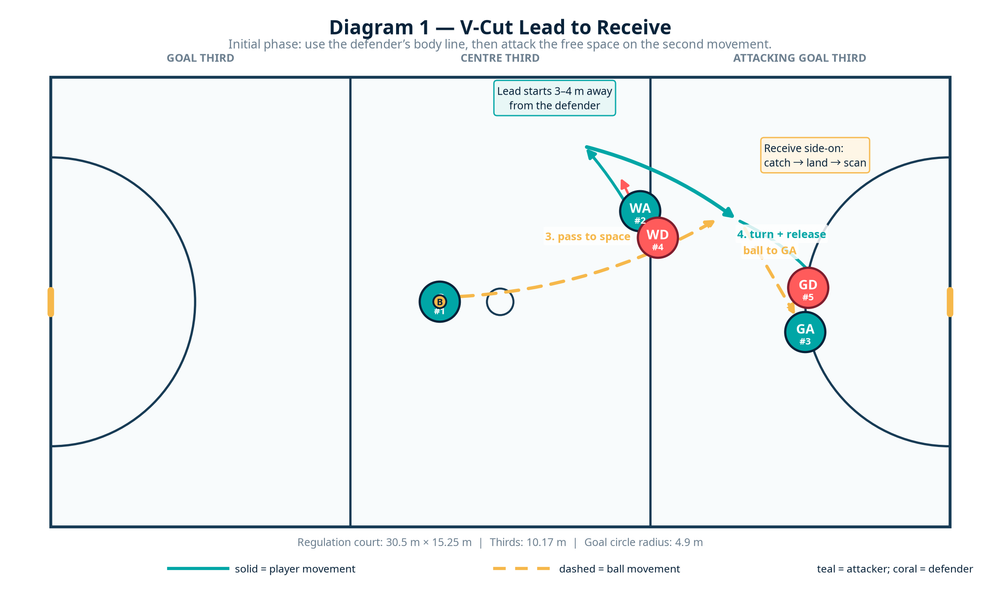
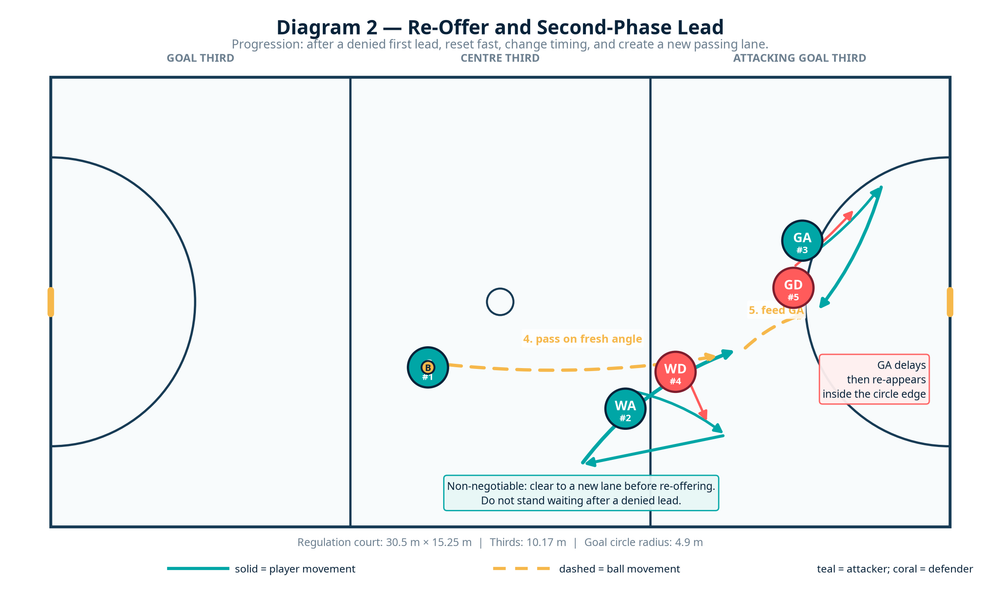
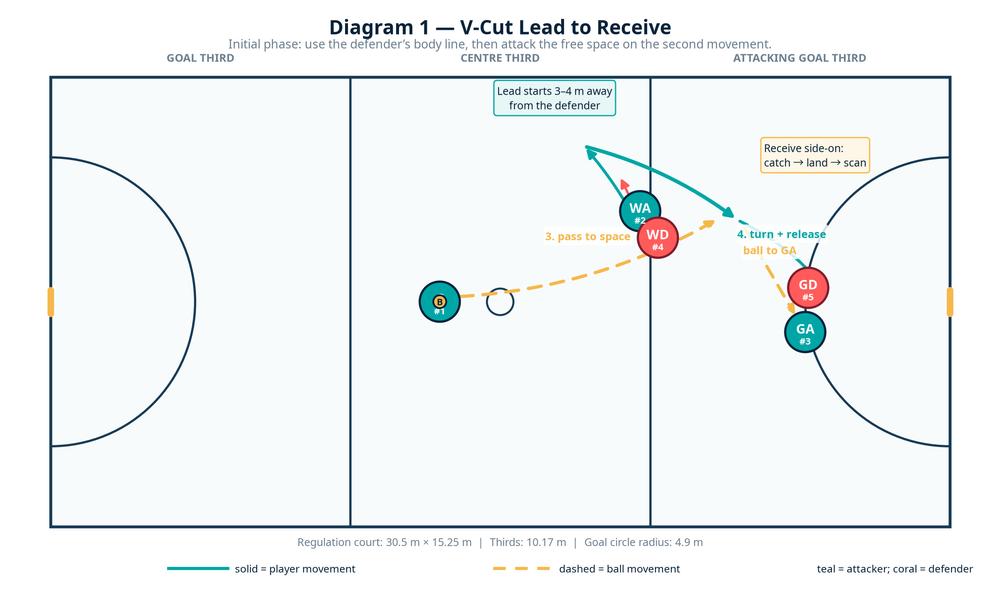
Show the starting picture. Place C #1 in the centre third with the ball and instruct them to stand side-on, already looking through the WA to the GA. Set WA #2 on the outside shoulder of WD #4, not directly behind them. GA #3 begins near the top of the goal circle, with GD #5 between GA and the post. Tell defenders to apply realistic pressure but no reckless contact.
Cue the clear movement. On the coach’s whistle, WA clears away from the intended receiving lane for two to three quick steps. The clear should take WD with them. WA’s eyes stay on C only after the first movement; looking at the ball too early often telegraphs the lead.
Plant and V-cut. WA plants the outside foot, drops the hips, and explodes back across the defender’s front shoulder into the cone gate. Demand a change of pace and angle, not a gentle curve. C should delay the pass until WA has won half a metre of separation; the pass is delivered to space ahead of the lead, not at the player’s back shoulder.
Receive and release. WA catches side-on, lands in control, and uses the first second after the catch to see GA. GA times a small decoy movement away from the circle before re-offering inside it. WA then feeds GA with a firm, catchable pass. If GA is not free, WA must pivot safely and return the ball to C rather than force a low-percentage feed.
Rotate immediately. After the release, C becomes WA, WA becomes WD, WD becomes GA, GA becomes GD, and GD collects/restarts as C. Run four quick repetitions before stopping the group.
Coach the first lead, not just the catch
Stand on the C-to-WA passing line and ask: did WA create a lane before asking for the ball? If they run straight at C, reset the starting distance. Cue, “Clear, plant, punch through.” The plant must be low and decisive.
Key Coaching Points
| Coaching point | What to look and listen for |
|---|---|
| Sell the clear | WA moves 3–4 m away first with genuine intent; the defender must feel compelled to go with them. |
| Attack the defender’s blind side | The return lead crosses the defender’s front shoulder or outside hip, never into their chest. |
| Time the pass | C waits for the change of direction, then passes early enough for WA to run onto the ball. |
| Land to play on | WA receives side-on with a stable one- or two-foot landing and scans before choosing the next pass. |
| Connect the next lead | GA does not watch WA receive; they use a decoy then re-offer as the second attacking option. |
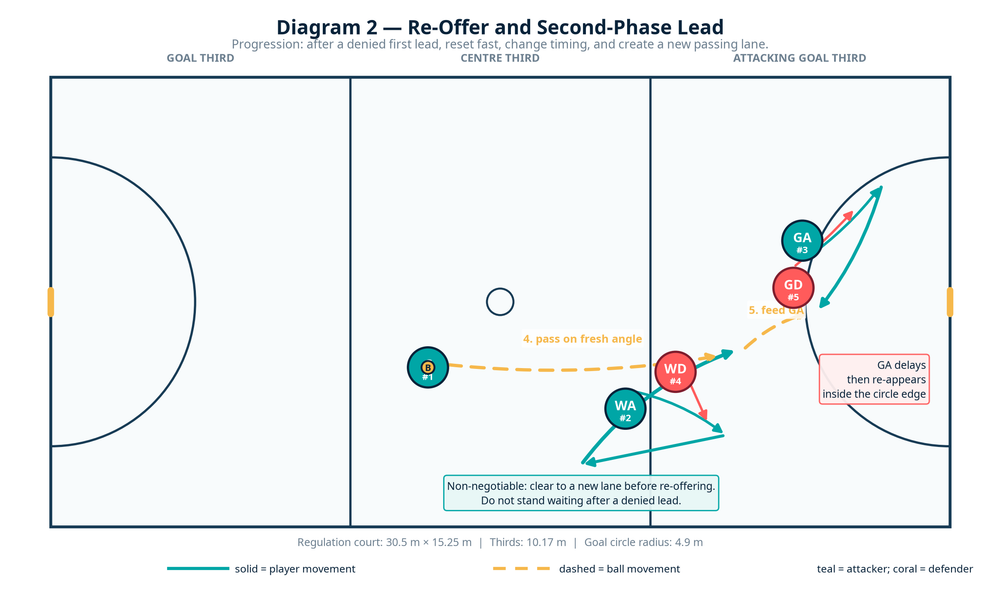
| Demand a reset | A denied lead is information, not failure. Clear to a new lane immediately and offer again with fresh timing. |
Common Mistakes
The first common error is leading too close to the defender. When WA begins within arm’s reach, the V-cut has no space to work. Move the start point back by a metre and insist on the initial clear. The second is running before C is ready. If the ball carrier is still off balance or looking elsewhere, the lead is wasted; coach a simple eye-contact or voice cue before the plant.
A third error is passing to the player instead of the space. Freeze C after a late or behind-the-body pass and show the receiving window: roughly one metre ahead of WA’s running line, chest-height where possible. Fourth, watch for ball watching after a denied lead. Attackers must clear, turn their head late, and re-offer; standing near the defender blocks the next option. Finally, correct GA players who drift into the same lane as WA. Their job is to hold width or depth, then appear as the second pass—not to compress the attacking shape.
Variations & Progressions
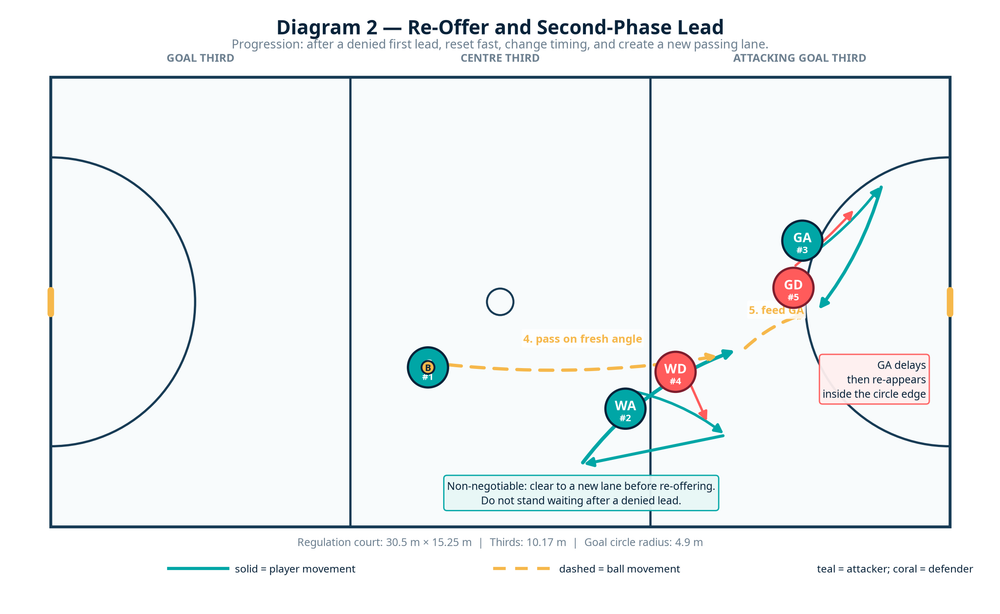
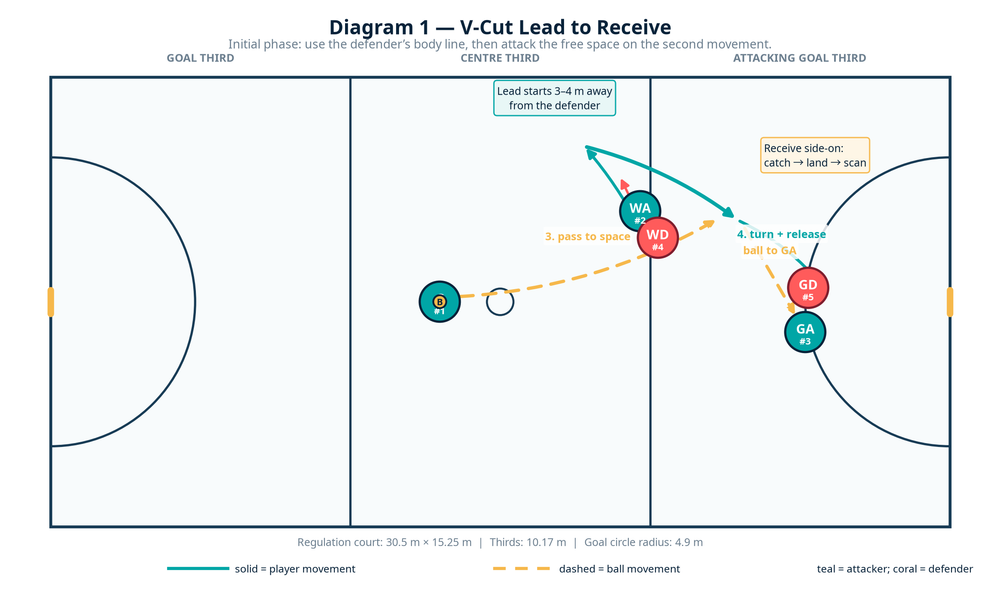
Begin with a guided variation: remove GD, have WD trail rather than front, and allow C to call “now” for the pass. This lets less experienced attackers feel the clear-plant-drive rhythm without fear of immediate interception. In the next variation, keep both defenders live but make the first pass compulsory to WA; the unit learns to protect the primary lead and finish with the GA feed.
For the main progression, play the sequence live: if WD denies the first lead, WA must clear and make a second lead within three seconds, while GA provides a decoy and re-offers in the goal third. Award one point for a clean WA receive and a second point only when GA receives in a balanced shooting position. The final advanced progression is a 3 v 3 live possession of C, WA and GA against WD, GD and a floating intercept defender. Limit the attacking unit to six seconds from the whistle to a GA catch inside the goal circle. This forces accurate timing without rewarding endless movement.
Age Adaptations
| Age group | Adaptation | Coach language |
|---|---|---|
| Under 8–Under 10 | Use three attackers with passive shadow defenders. Shorten the working lane to 8–10 m and allow C to feed from a stationary start. | “Run away, stop low, then run into the empty space.” |
| Under 12 | Use the full centre-third-to-goal-third picture, but leave a 1.5 m safety buffer between attacker and defender. Focus on safe landing and a clear catch target before adding pressure. | “Show me your outside foot plant and your hands early.” |
| Under 14–Under 16 | Introduce live WD and GD, the three-second re-offer expectation, and the score-based progression. | “Win the first metre, then make the next pass simple.” |
| Open | Add scout-led constraints: fronting WD, sagging GD, or a floating intercept defender. Video one set and review timing, spacing, and pass selection. | “Read the defender’s hips; choose the lane they cannot close.” |
Coach’s Close-Out
Finish with two uninterrupted “best reps” per unit. Ask each trio to name the trigger that created separation, then repeat it. Measure success by their ability to create a safe, purposeful option under realistic pressure—not just by pass count.
