

Netball
Penalty Pass Advantage Play: High Percentage Circle Entry
A structured, high-percentage attacking set play designed to exploit a penalty pass at the top of the goal circle and secure an uncontested shot.
What you need
Netball court, Size 5 netball, Positional bibs
Overview
The Penalty Pass Advantage Play is a highly effective, structured attacking sequence designed to capitalize on a penalty awarded near the top of the goal circle. When a defender is penalized and sent out of play (standing 0.9m away), the attacking team gains a significant, albeit brief, numerical advantage. This set play uses calculated movement, decoy runs, and precise timing to isolate a shooter near the post, ensuring a high-percentage scoring opportunity before the defense can reset.
Coaches should implement this play when the team struggles to convert penalties into goals, or when facing a tight, physical defense that easily shuts down predictable passes. By creating multiple leading options and utilizing a strong screen, this play forces the remaining circle defender (GK) into a difficult decision, ultimately opening up space for either the Goal Attack (GA) or Goal Shooter (GS).
Setup
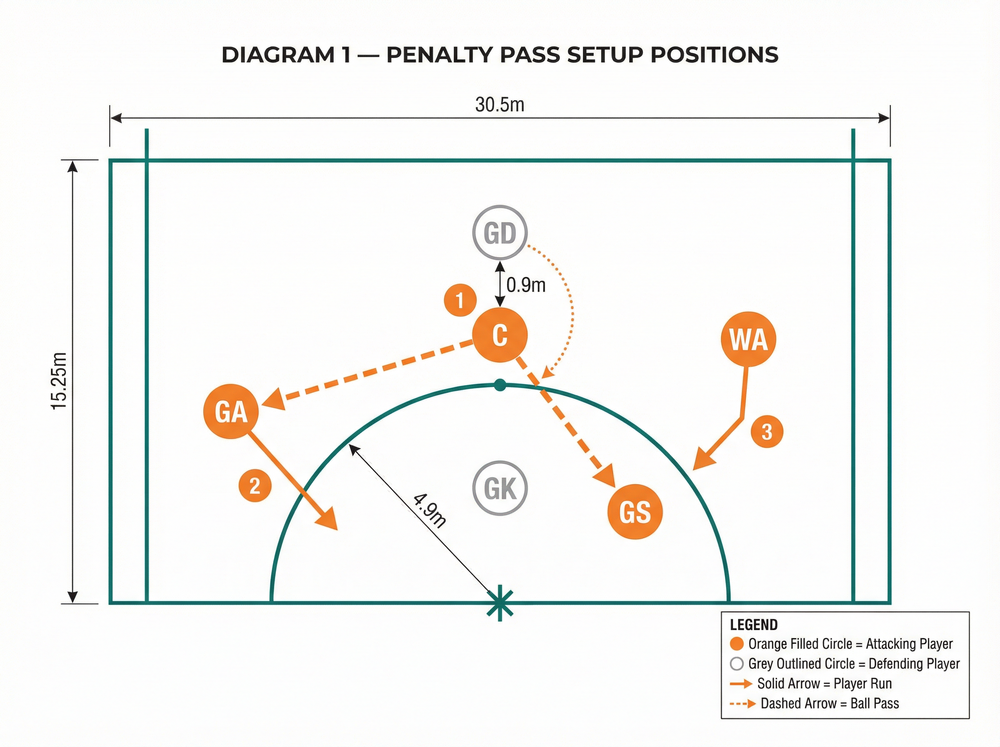
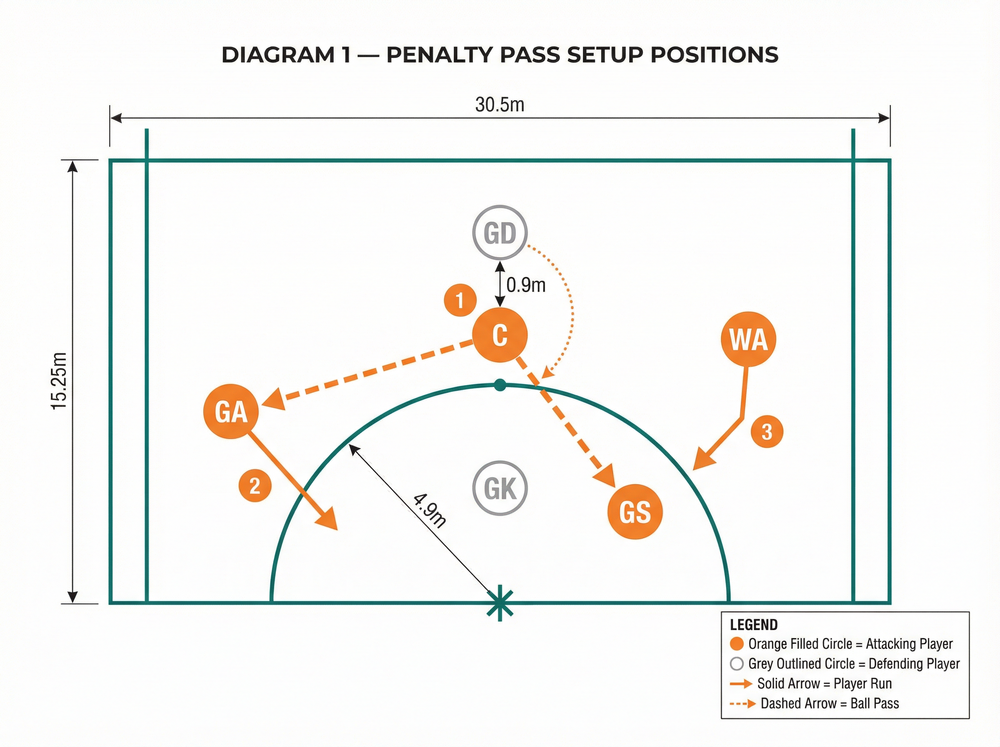
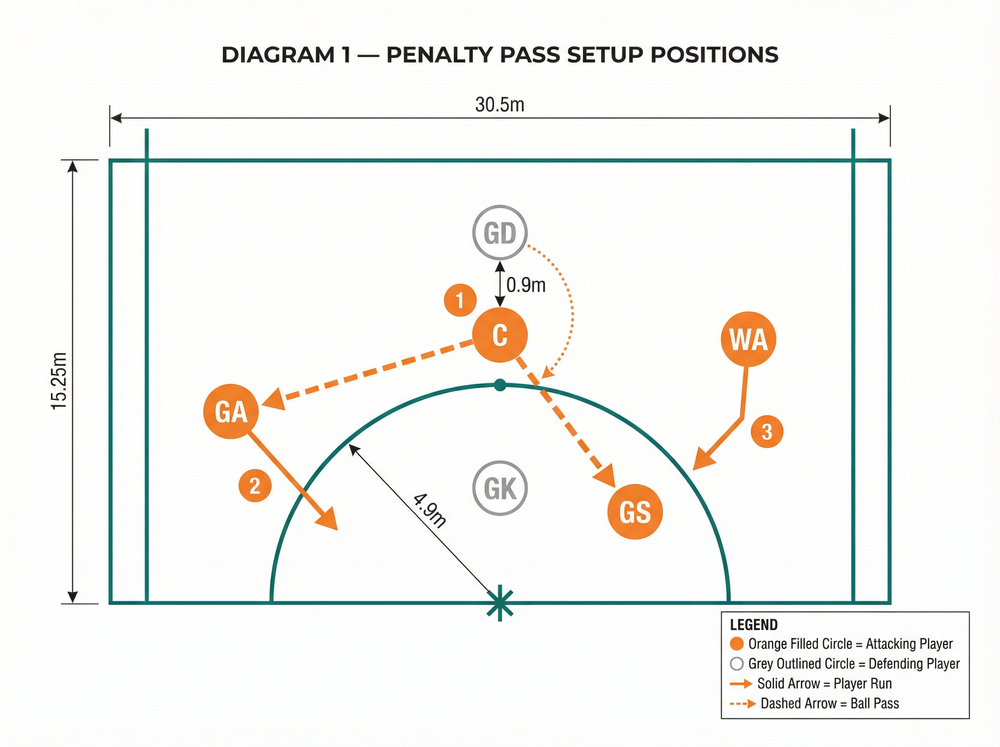
To execute this set play effectively, you need a full attacking third of a standard Netball court (30.5m x 15.25m) and a standard size 5 netball.
Player Positions:
- Centre (C): Takes the penalty pass at the top of the goal circle.
- Goal Attack (GA): Positioned wide left, near the sideline, creating width.
- Goal Shooter (GS): Positioned deep inside the goal circle on the right side.
- Wing Attack (WA): Positioned in the mid-court right side, ready to offer a safety option.
- Defenders (GD & GK): The Goal Defence (GD) is out of play, standing exactly 0.9m behind the Centre. The Goal Keeper (GK) is positioned inside the goal circle, typically marking the GS or guarding the post.
Step-by-Step Instructions
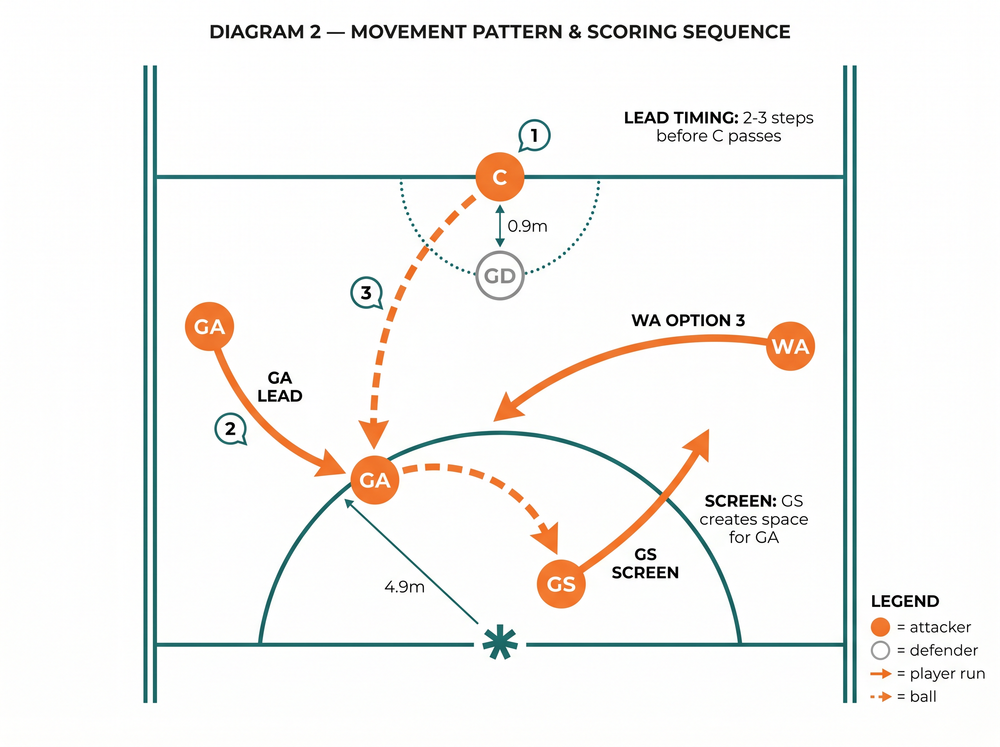
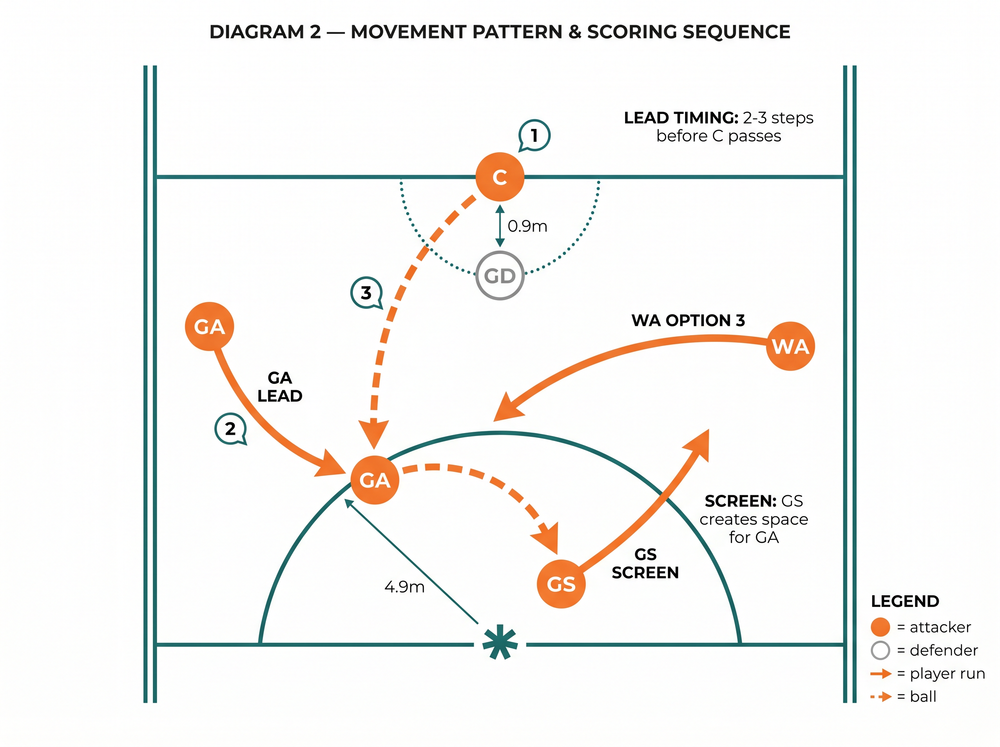
- The Set Up: The Centre (C) takes a strong, balanced stance at the penalty mark. The GD is positioned 0.9m away. The C must wait for the umpire's whistle before initiating the play.
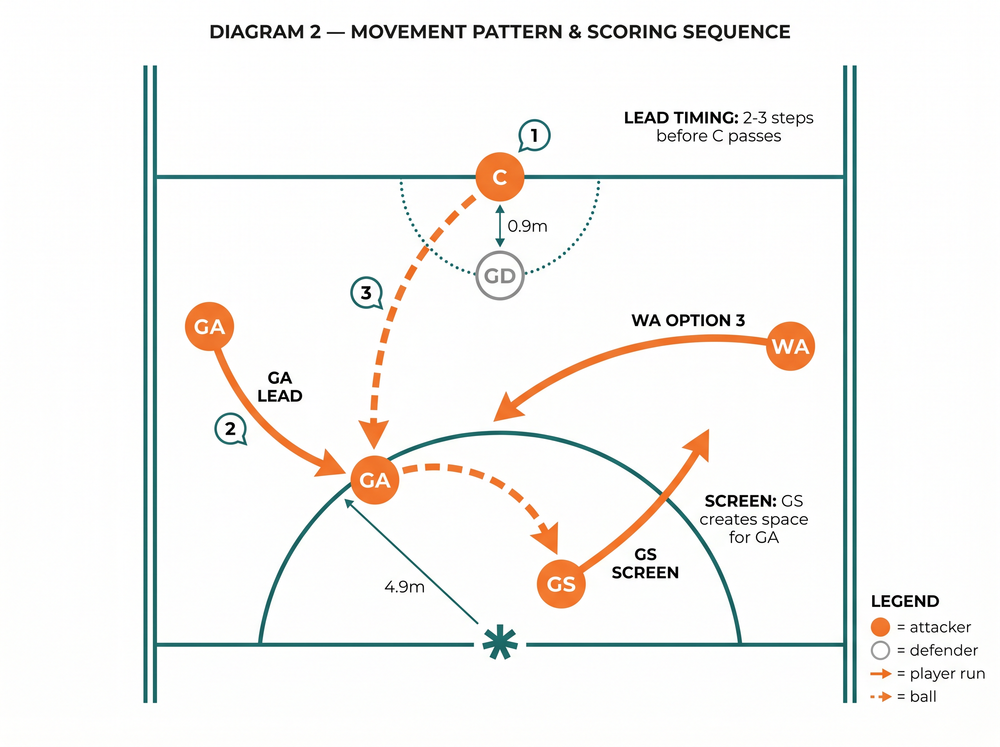
- The Initial Drive (Decoy): As the whistle blows, the Goal Attack (GA) makes a sharp, aggressive diagonal cut from the left sideline toward the top edge of the goal circle. This movement is designed to draw the attention of the Goal Keeper (GK) and any covering mid-court defenders.
- The Screen: Simultaneously, the Goal Shooter (GS) drives from the right side of the circle toward the back post, positioning themselves to screen the GK or hold space deep in the circle.
- The Pass (Option 1): If the GA's lead successfully loses their defender and the GK stays deep, the C delivers a sharp, flat chest pass to the GA right at the circle edge. The GA can then immediately turn and shoot, or feed the GS.
- The Pass (Option 2): If the GK steps up to challenge the GA's drive, the GS will be left isolated near the post. The C reads this defensive shift and delivers a quick, high release lob or a precise bounce pass directly to the GS for an uncontested shot.
- The Safety Outlet: If both primary options are heavily defended, the Wing Attack (WA) cuts inward toward the top of the circle to provide a safe reset option, maintaining possession and allowing the team to set up a new attack.
Key Coaching Points
- Timing is Everything: The GA and GS must not move before the umpire's whistle. Their leads must be explosive and synchronized. If they move too early, the space will close; if they move too late, the GD will re-enter play.
- Eye Contact: The C must make clear eye contact with the intended receiver before releasing the ball to ensure they are ready for the pass.
- Strong Holds: The GS must establish a strong, physical hold against the GK to maintain their position near the post and create a clear passing lane.
- Decisive Passing: The C must execute a firm, accurate pass. A weak or floating pass will allow the defense time to recover and intercept.
- Read the Defense: The C must be able to quickly read the GK's movement. If the GK steps up, pass to the GS. If the GK stays back, hit the GA on the drive.
Common Mistakes
- Moving Too Early: Attackers initiating their runs before the whistle, resulting in a cramped circle and limited options.
- Telegraphing the Pass: The Centre staring down their intended target, allowing the defense to anticipate and intercept the ball.
- Weak Decoy Runs: The GA jogging through their lead instead of sprinting, failing to draw the GK's attention and leaving the GS double-teamed.
- Ignoring the Safety Option: The C forcing a high-risk pass into a crowded circle instead of utilizing the WA for a safe reset.
Variations & Progressions
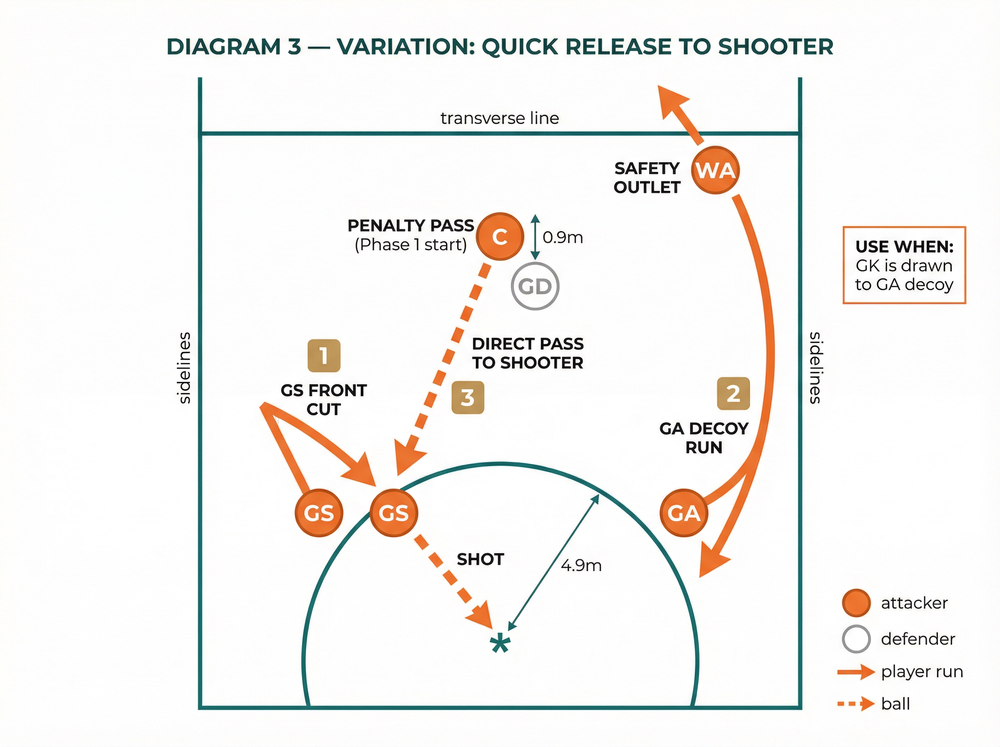
Progression 1: Quick Release to Shooter
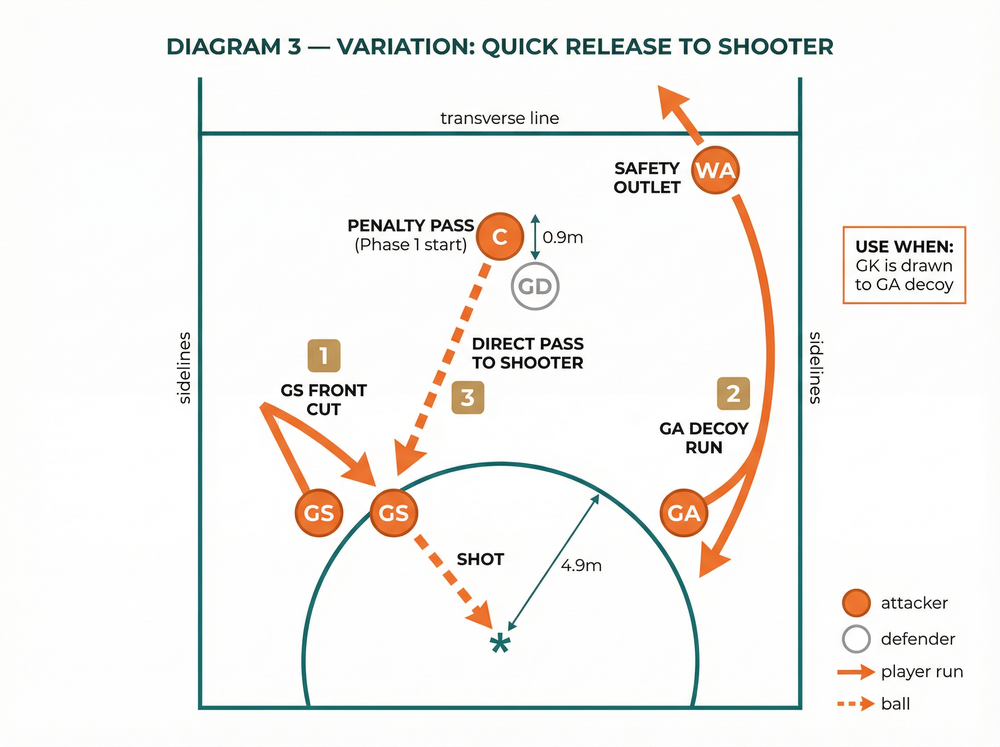
In this advanced variation, the GS starts on the left edge of the circle and the GA starts wide right. The GS makes a hard, direct cut to the front of the circle, while the GA makes a wide looping decoy run to the back. The C delivers a direct, fast pass to the GS for a quick shot. This is highly effective when the GK tends to follow the GA's deep runs.
Progression 2: The Double Screen
If the defense is playing a tight zone, have the WA set a screen for the GA on the edge of the circle, allowing the GA a free run into the shooting zone.
Age Adaptations
- Under 10s: Focus primarily on the basic setup and the Centre making a clean pass to the first available option. Simplify the movements to basic straight leads.
- Under 12s/14s: Introduce the concept of the decoy run and reading the GK's movement. Emphasize the importance of strong holds by the GS.
- Under 16s/Open: Execute the full play with high speed and precision. Introduce complex variations and focus on exploiting specific defensive weaknesses.
