

Netball
Shooting Circle Movement Drill: Front-Cut, Clear-and-Replace Finish
Build a connected GA–GS shooting-circle partnership through timed front cuts, late re-offers, and live finishing decisions.
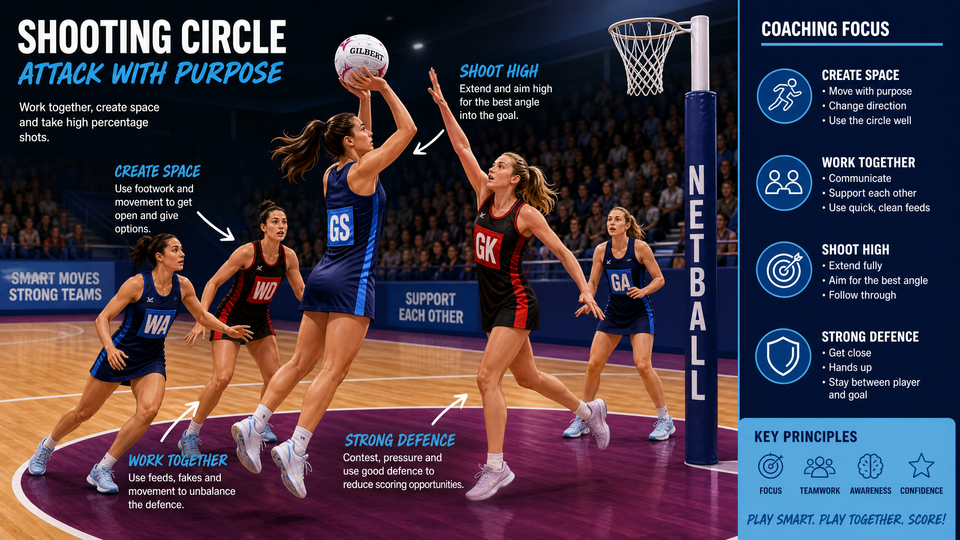
What you need
4-6 Netballs, 12 flat cones or markers, Two sets of coloured bibs, Stopwatch or visible 6-second possession timer, Whistle, Full Netball court or clearly marked attacking third
Shooting Circle Movement Drill: Front-Cut, Clear-and-Replace Finish
Session aim: Develop the timing, communication and re-offer habits that let a Goal Attack (GA) and Goal Shooter (GS) create a clean, balanced shooting opportunity against a Goal Defence (GD) and Goal Keeper (GK).
Overview
This is a 24-minute attacking drill for coaches who want their shooters to move as a connected unit rather than make isolated leads. It teaches a reliable circle sequence: the Wing Attack (WA) stretches the outside defender, the GA wins front space, and the GS delays before re-angling to the post. The crucial lesson is that the second movement must be triggered by the first catch. When GA and GS leave together, they compress the circle; when they move in sequence, they create a true passing window.
Run this after passing warm-up and before full-court attack. Use a full court where possible: 30.5 m x 15.25 m, divided into three equal thirds with a 4.9 m goal circle at each end.1 2 Standard initials are used throughout.1
Setup
Set up at one attacking end with C, WA, GA, GS, GD and GK active; two waiting players or coach-feeders rotate every three balls. Use contrasting bibs.
| Item | Exact setup | Coach’s purpose |
|---|---|---|
| Working area | The attacking third plus the nearest 3 m of centre third | Gives C and WA room to create the feed without turning it into a full-court drill. |
| WA cone | 2 m inside the transverse line and 2 m in from the sideline | Establishes a wide starting picture that stretches WD or GD. |
| C cone | 1.5 m inside the attacking third, central lane | Gives C a stable first feed and a view of both circle options. |
| GA start | At the top edge of the goal circle, roughly 2 m from the arc | Creates space for a sharp front cut across GD’s body line. |
| GS start | Inside the circle, 1 m off the goal line and one step baseline-side of the post | Encourages a late re-angle instead of a static post hold. |
| Defenders | GD starts goal-side of GA; GK starts goal-side of GS | Enables realistic body positioning without overloading the first rep. |
Mark the goal-circle arc clearly: it has a 4.9 m radius and is centred on the outside midpoint of the goal line.1 Keep two spare balls outside court and use a rebounder to maintain a 1:1.5 work-to-rest ratio.
Step-by-Step Instructions
Frame the picture. Set the six active players. GA states, “I create first space”; GS states, “I offer second.” Begin with GD and GK at 60% pressure for two minutes.
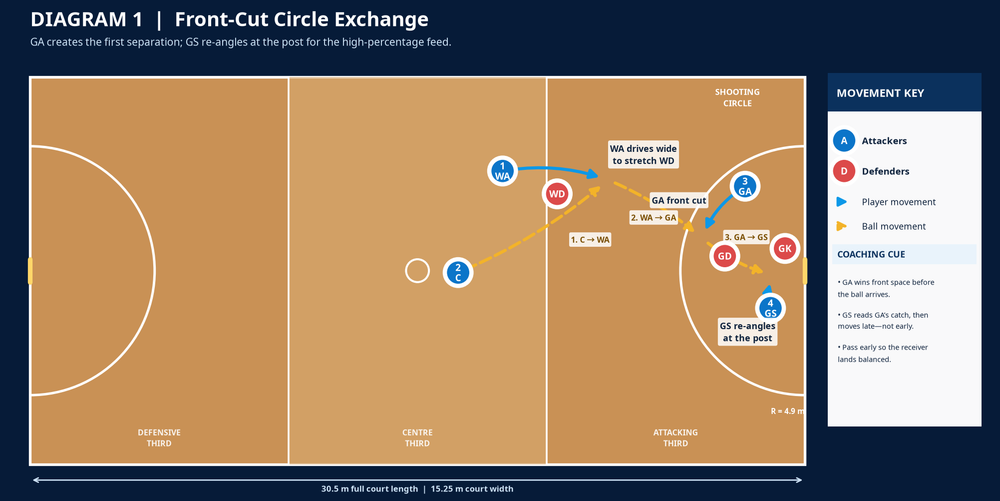
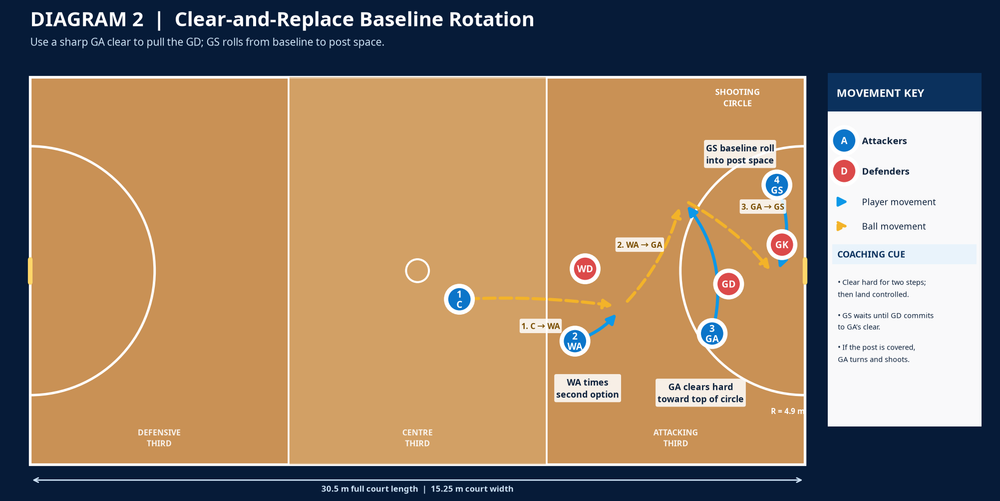
Trigger the WA lead. C holds the ball on the attacking-side transverse line. On the coach’s “go,” WA drives wide and forward for two strong steps, then presents outside shoulder and hands. C feeds WA at chest height. Insist that C releases within three seconds of receiving the ball.
Send GA through the front space. The moment WA lands, GA plants the outside foot, changes pace and front-cuts across GD’s line toward the inside shoulder. GA calls the ball only when the body is ahead of the defender, not when merely running beside them. WA’s first look is the clean GA catch.
Delay the GS re-offer. GS does not mirror GA’s movement. GS watches GA’s catch, then takes two controlled steps to re-angle toward the post, using a small baseline-to-post roll. That late movement makes GK choose between holding post and intercepting the next pass.
Finish the sequence. GA lands balanced, pivots to see GS and feeds the receiver’s leading hand. GS catches in shooting posture, checks the landing foot, and shoots. If GS is covered, GA turns to the circle and shoots instead. Keep the ball moving: the target is a shot inside six seconds from WA’s first catch.
Reset deliberately. Rebounder returns to the next C. Rotate every three balls: C to WA, WA to GA, GA to GS, GS to the defender queue, so all attackers experience the timing problem.
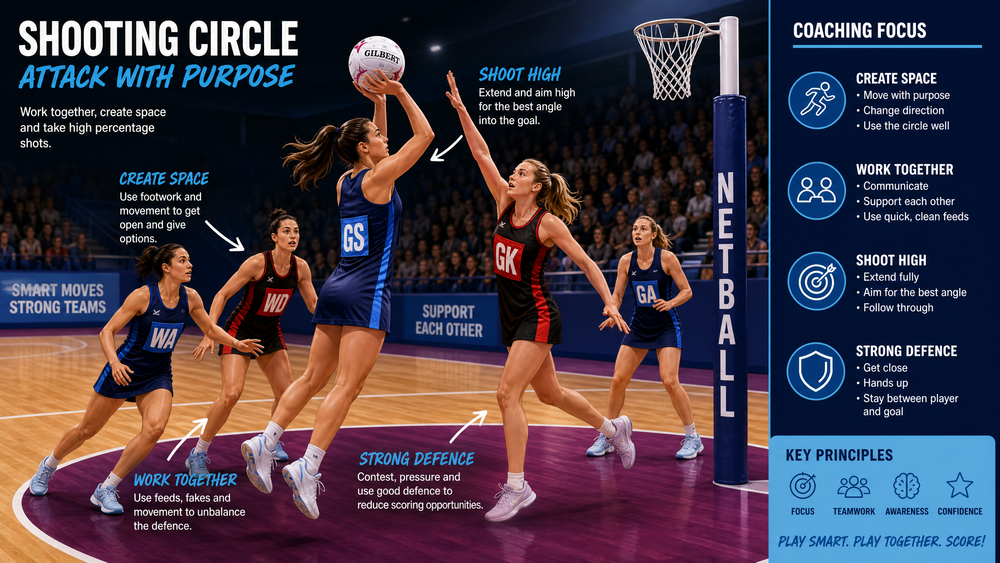
Diagram 1 coaching read: blue arrows show movement; dashed gold arrows show ball travel. After GA catches, ask, “Where is the space now?” Look for GS’s late post lane.
Key Coaching Points
| Focus | Coach language | Non-negotiable outcome |
|---|---|---|
| Change of pace | “Sell the first step, then go.” | GA accelerates through the defender’s front shoulder rather than drifting. |
| Sequential movement | “One catches; one moves.” | GS waits for the GA catch before re-offering. |
| Receiving picture | “Show hands late, land strong.” | WA and GA receive with balance and sight of the next pass. |
| Passing weight | “Pass to the space, not to the badge.” | Ball arrives in front of the moving receiver, at chest height. |
| Circle balance | “Keep a post option and a front option.” | GA and GS occupy different depths and angles. |
| Decision ownership | “Read the defender, do not run the diagram.” | GA shoots if GK protects GS; GS shoots if GA draws GK. |
Common Mistakes
| Error to spot | Why it fails | Immediate correction |
|---|---|---|
| GA and GS lead on the same count | Their defenders stay compact and the ball has no clean line. | Freeze the drill; make GS clap once after GA’s catch before moving. |
| WA cuts in too early | The outside channel collapses and WD can help GD. | Re-mark WA’s starting cone and require two wide steps before the feed. |
| GA runs sideways across GD | The defender can stay shoulder-to-shoulder and contest the pass. | Rehearse a plant-and-go front cut, attacking the defender’s front shoulder. |
| GS stands under the post | GK dictates the contest and GA has no second target. | Set a temporary baseline marker; GS must start off it and re-angle late. |
| Passer watches the original option | The ball is forced into pressure despite a better second look. | Coach a verbal scan: “GA, GS, shot” before the release. |
Variations & Progressions
1. Guided to live 2v2. Start with shadow defence, progress to live defence after GA’s catch, then allow live defence from C’s first pass.
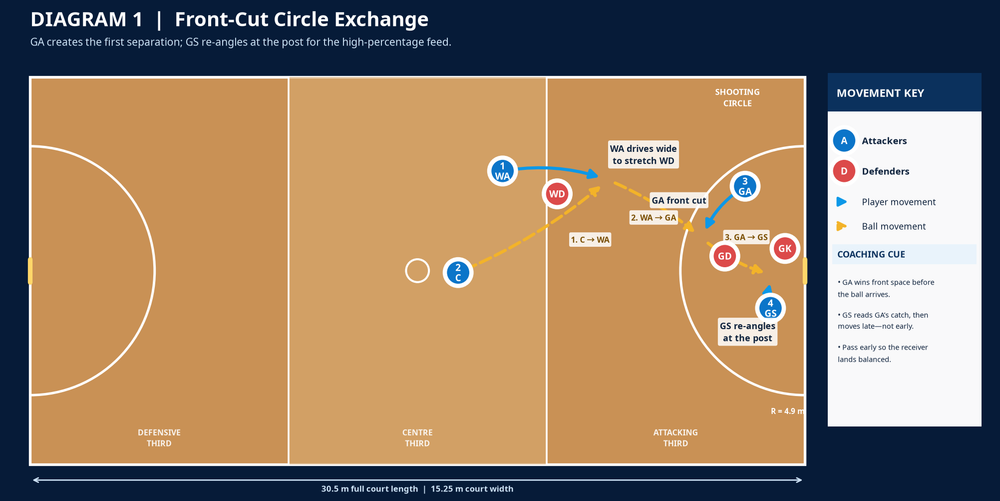
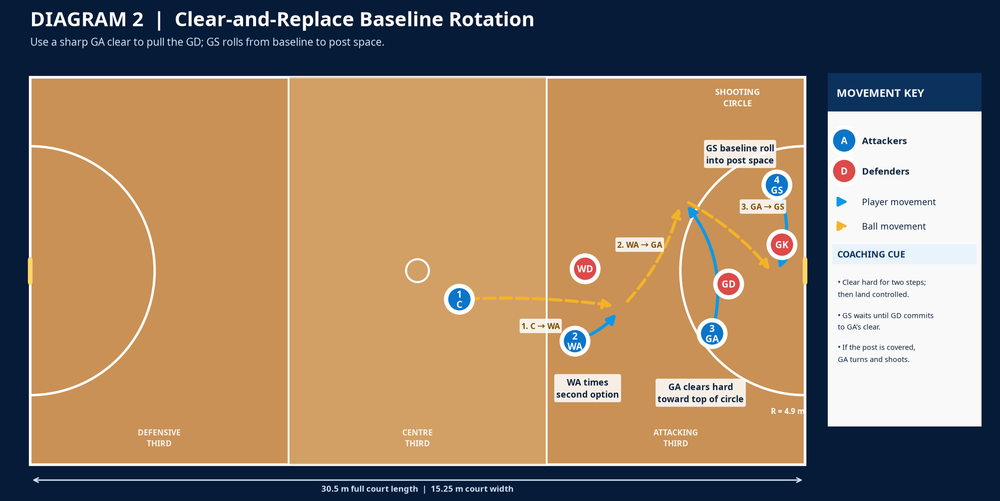
2. Clear-and-replace rotation. GA clears to the top of the circle, taking GD; GS rolls baseline-to-post. WA feeds GA, who returns the ball to GS. Use it when GS is fronted.
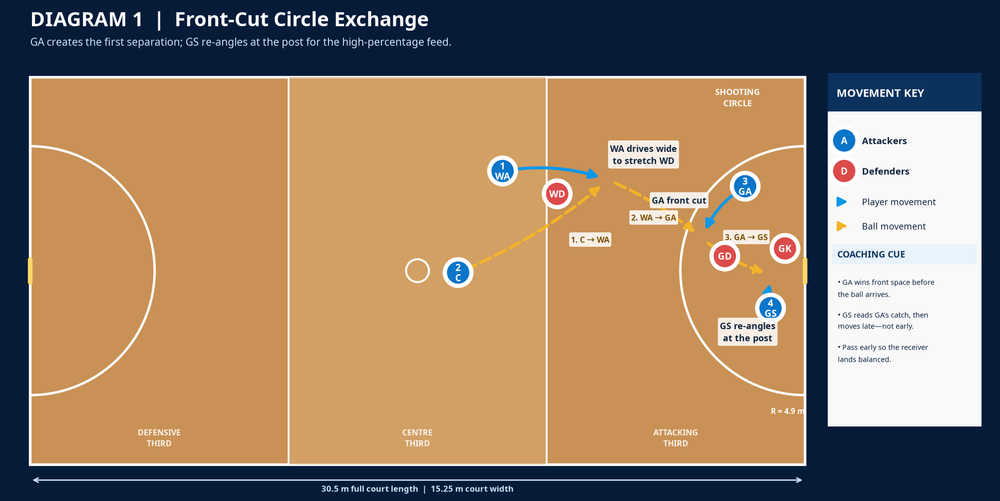
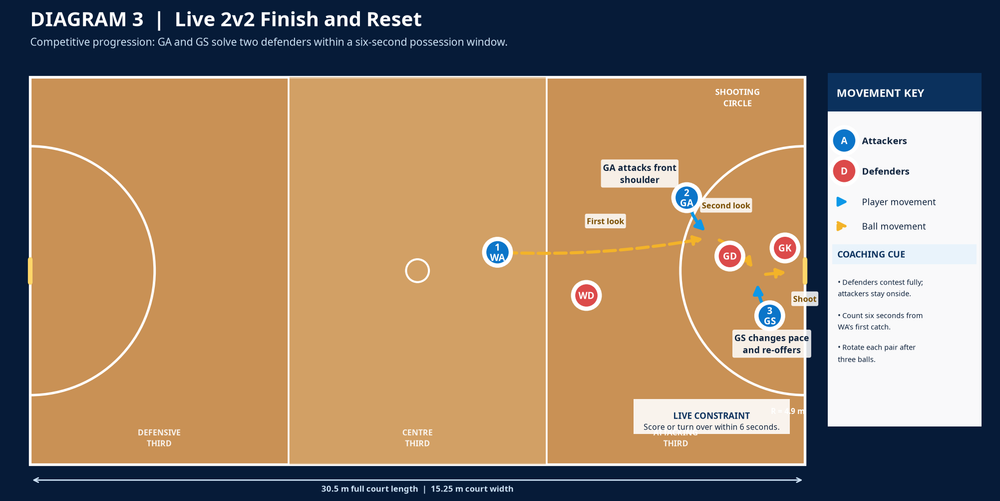
3. Six-second competitive finish. Give each attacking pair three possessions against live GD and GK. Start the six-second count from WA’s catch. Award one point for a shot, two for a goal, and one point to defenders for an intercept or forced held-ball. Rotate attackers and defenders after three balls. The time constraint encourages purposeful movement, not rushed passing.
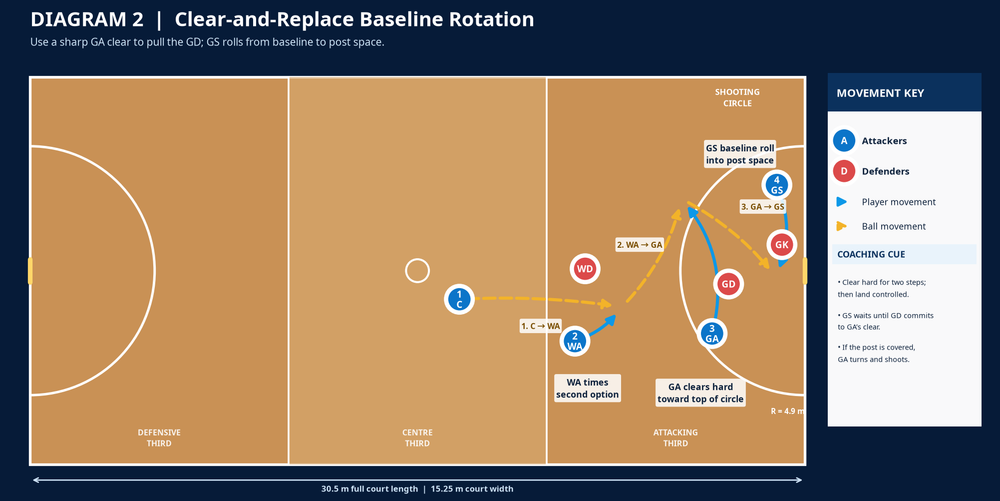
Diagram 3 coaching read: WA’s first feed creates two options: GA attacks front space while GS re-offers at the post. Defenders are live, so choose the cleanest option.
Age Adaptations
| Group | Modification | Coaching emphasis |
|---|---|---|
| Under 8 | Work in a 10 m x 8 m marked space with a coach-feeder, GA and GS only; remove defenders and allow an extra settling pass. | Stop, balance, look and pass into open space. |
| Under 10 | Use WA, GA and GS with one passive defender; shorten the sequence to WA-to-GA-to-shot. | Wide lead, two hands to receive, safe landing. |
| Under 12–14 | Run the full base drill at 70% defence, then introduce the delayed GS re-offer. | Timing, front shoulder and passing to the leading hand. |
| Under 16 / Open | Use live 2v2, six-second possessions and a defender who may hunt the intercept from the first feed. | Scanning, deception and selecting the best shooter. |
Finish with a two-minute reflection: each GA–GS pair names one space-creating movement and one shooting-or-passing cue. That debrief turns a pattern into a game decision.
