

Netball
Zone Defence Set-Up Play: Centre-Third Funnel and Sideline Trap
A coach-ready defensive set play that funnels centre-third attack wide, springs a coordinated sideline trap, and converts pressure into turnover ball.
What you need
2 netballs, 14 position bibs, 8-12 flat cones, whistle, stopwatch
Zone Defence Set-Up Play: Centre-Third Funnel and Sideline Trap
Overview
The Centre-Third Funnel and Sideline Trap gives your defensive unit a repeatable way to disrupt quick central transitions. Rather than chasing every pass, the defence removes the middle corridor, invites a pass into a low-value wide channel, and then closes the receiver with a connected three-player trap. It is particularly effective against teams that use their Centre (C) and Wing Attack (WA) to move the ball directly through the centre third.
Use this structure from a centre pass, after a turnover, or whenever your back three have time to organise. The team call is “Wall—Wide—Lock.” “Wall” means protect the middle; “Wide” means angle the attack toward the sideline; “Lock” is the trigger to squeeze the wide receiver and own the next pass.
Coach cue: The trap is a reward for patience. Keep the wall while the ball is central; lock together when it lands wide.
| Play-at-a-glance | Coaching detail |
|---|---|
| Objective | Force the first or second centre-third pass into a 1.5–3 m sideline channel, then win a deflection, intercept, held ball, or backward pass. |
| Key defenders | 1 GK, 2 GD, 3 WD and 4 C. The remaining defenders retain normal marking and rebounding responsibilities. |
| Best trigger | WA or C catches near the sideline, faces outward, and has not yet created a forward option. |
| Training target | Win one forced backward pass or turnover in every five live centre-pass repetitions. |
Setup
Set the full court as a 30.5 m by 15.25 m rectangle, divided by transverse lines into three equal thirds. The centre circle is 0.9 m in diameter and each goal circle has a 4.9 m radius. Use the normal seven position initials—GS, GA, WA, C, WD, GD and GK—and keep each player in their permitted court areas.1
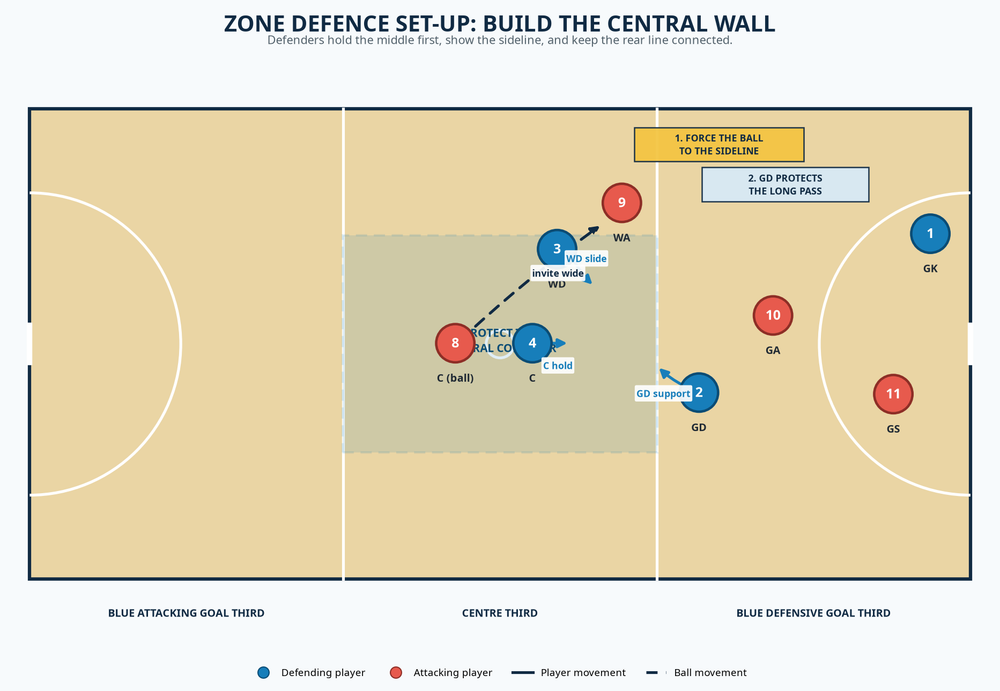
In the diagrams, blue is the defending team and protects the right-hand goal. Number the core as 1 = GK, 2 = GD, 3 = WD and 4 = C. Red markers identify the relevant attackers: 8 = C, 9 = WA, 10 = GA and 11 = GS. Put two flat cones 1.5 m and 3 m inside the ball-side sideline in the centre third; this is your trap channel. Place a second pair about 2 m either side of the centre circle to show the central corridor in the first teaching block.
| Equipment | Quantity | Use |
|---|---|---|
| Netballs | 2 | One live ball and one reserve with the feeder. |
| Position bibs | 14 | Keep every player’s court responsibility visible. |
| Flat cones | 8–12 | Mark the central corridor and sideline trap channel. |
| Whistle / stopwatch | 1 | Freeze briefly—no more than 20 seconds—then rehearse at speed. |
Start C 0.5–1 m goal-side of the attacking C, slightly inside the ball line. WD begins 2–3 m higher and inside WA’s likely receiving lane. GD holds 2–3 m behind the first centre-third line as the cover defender, while GK stays goal-side of GS and calls the shooting picture. These are reference distances, not painted spots: players must adjust to ball speed and space.
Step-by-Step Instructions
Call the wall early. Before the first release, GK calls “Wall” and C repeats it. C checks the attacking C’s shoulder line and sits inside the direct drive. WD starts narrow enough to see both ball and WA, rather than standing square on the sideline.
Build the corridor screen. As the ball moves toward the centre third, C and WD form a staggered diagonal screen, about 2–3 m apart. Their body angles point the attacker outward. GD stays connected behind them and reads the looping feed or cut behind the wall.
Show wide without chasing. The on-ball defender applies composed pressure with active feet and hands but does not lunge. The nearest off-ball defender protects the receiver’s inside shoulder. Demand a simple picture: two blue defenders between the ball and the middle, one blue defender behind the next pass.
Activate “Lock” on the catch. Trigger the trap when the ball arrives in the marked wide channel, ideally with the receiver facing the sideline or landing on their outside shoulder. The nearest defender closes under control and blocks the turn inside. The second defender takes away the easy return to C. Move on the release; arrive on the catch.
Let GD own the next pass. While C and WD form the front pair, GD steps into the forward or return passing window. GK and GD call “up,” “hold,” or “long” based on GA and GS. The weak-side defender must protect the switch, not chase the ball.
Finish and convert. A tip, held ball, forced backward pass, or out-of-court error is a defensive win. Once possession is secured, call “go” and play the first safe outlet into space. In practice, count the turnover only after the team completes that outlet pass.
Key Coaching Points
| Coaching point | What to look for | Correction |
|---|---|---|
| Protect middle first | C and WD see ball plus central lane; neither follows a decoy wide. | “Win the corridor before you win the ball.” |
| Angle, do not overrun | Feet and hips guide the receiver toward the sideline. | “Show the sideline; do not open the gate.” |
| Lock on the catch | Pressure arrives as the wide receiver lands. | “Move on release, arrive on catch.” |
| Connect three jobs | One pressures ball, one denies inside, GD covers next. | “Ball, inside, next—name your job.” |
| Convert the win | Interceptor lands balanced, scans, and makes a safe outlet. | “Secure first; sprint second.” |
Common Mistakes
| Error | Why it breaks the play | Coach correction |
|---|---|---|
| WD shadows WA to the sideline too early. | The middle opens for C. | Freeze the picture; reset WD one stride inside WA. |
| C lunges at the ball carrier. | The attacker pivots around pressure. | Rehearse short feet, active hands, chest square. |
| Both midcourters chase the ball. | The next pass becomes uncontested. | Assign ball, inside, and next before each repetition. |
| GK becomes silent in the centre third. | GD gets no early picture of GA, GS, or the lob. | Score one early, relevant GK call per repetition. |
| Players celebrate a deflection. | The attack retrieves the loose ball. | Count the turnover only after a controlled outlet pass. |
Variations & Progressions
Start with a 4 v 4 corridor rehearsal using C, WD, GD and GK against C, WA, GA and GS. Coach-feed the first pass and restrict the outside goal-third space with cones, so players learn the shape before speed. Progress to a 6 v 6 constrained game: the attack must use the centre third before shooting; defenders earn two points for a clean intercept and one for a forced backward pass.
For the full 7 v 7 progression, use live centre passes. Award a bonus point only when the turnover begins in the trap channel and is followed by a controlled outlet. To make the task harder, let WA choose either sideline and forbid a pre-call; defenders must read the release and communicate the switch. To make it easier, start C in the centre third and allow three seconds to establish the wall.
Age Adaptations
| Group | Adaptation | Priority |
|---|---|---|
| Under 8 / Under 10 | Use a half-court 3 v 3 game and one wide channel; do not double-team. | See ball and player; move safely into space. |
| Under 12 | Use C, WD and GD against C, WA and GA. Freeze after the wide catch. | Body angle and early communication. |
| Under 14 | Add the full centre-third trap and a forced-backward-pass score. | Timing the close-down and covering next. |
| Under 16 / Open | Use live 7 v 7, a second-phase switch, and an outlet reward. | Reading cues, disciplined rotation, conversion. |
Coach’s Session Finish
Finish with three live centre passes for each side. Before the last repetition, ask the unit to name the trigger, the three jobs, and the first attacking pass after the turnover. If they can say “Wall, wide, lock; ball, inside, next; secure then go” and reproduce it at match pace, the set play is ready for competition.
