

Rugby
Mastering the Offload: 3v2 Contact & Continuation Drill
Develop your players' ability to keep the ball alive through contact, teaching decisive leg drive, accurate offloading, and intelligent support lines.

What you need
8-10 Cones, 3-4 Rugby balls, Tackle shields (optional)
1. Overview
The ability to keep the ball alive through contact is a hallmark of modern, dynamic Rugby. An effective offload breaks defensive lines, prevents the opposition from resetting, and accelerates the speed of attack. This drill focuses on the fundamental mechanics of the offload—specifically, winning the initial collision, freeing the arms, and delivering an accurate pass to a support runner who is anticipating the play.
Coaches should use this drill to transition players from basic handling exercises into game-realistic contact scenarios. It is particularly effective during the middle phase of a training session, once players are fully warmed up and ready for physical engagement.
2. Setup
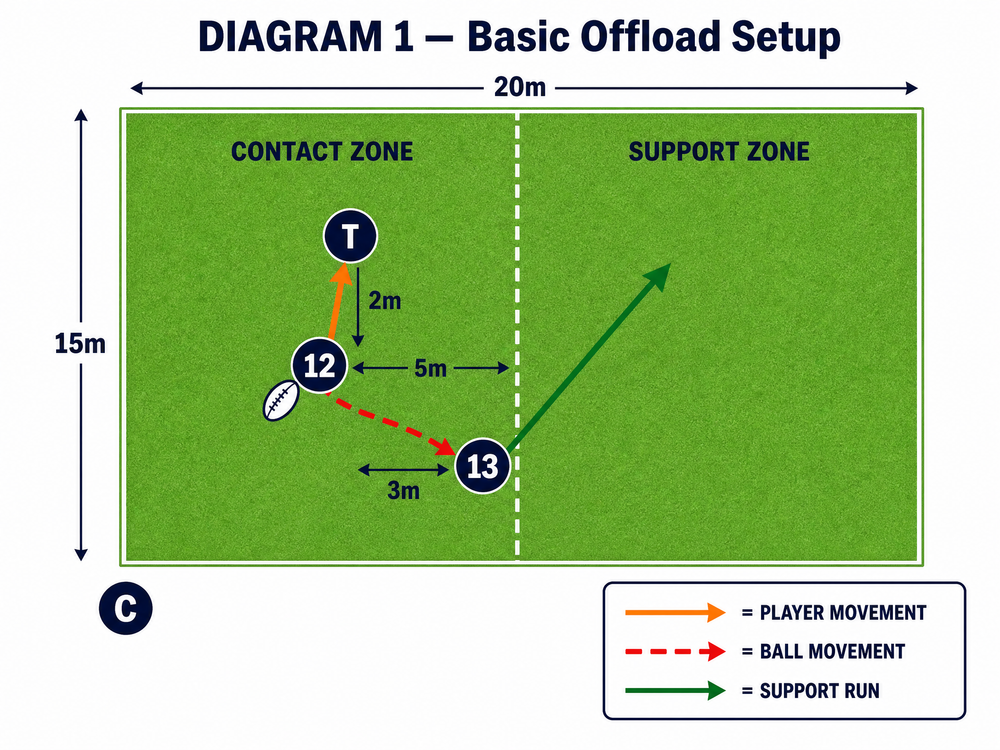
To ensure the drill runs smoothly and safely, proper setup is essential.
- Pitch Dimensions: Create a grid 30m long by 20m wide. Divide this grid into three horizontal zones: a 10m 'Start Zone', a 10m 'Contact Zone', and a 10m 'Finish Zone'.
- Equipment: 8-10 cones (to mark the grid and zones), 3-4 Rugby balls, and optionally tackle shields for the defenders if you wish to reduce the impact intensity.
- Player Positions: Set up in groups of five. Three attackers will line up in the Start Zone (e.g., a Number 8, an Inside Centre [12], and an Outside Centre [13]). Two defenders (D1 and D2) will position themselves in the Contact Zone.

3. Step-by-Step Instructions
Follow these steps to execute the drill effectively. Start at a walking or jogging pace to ensure correct technique before increasing to full match speed.
- Initiate the Attack: The primary ball carrier (Player 8) starts with the ball in the centre of the Start Zone and accelerates forward into the Contact Zone.
- Engage the Defender: Player 8 identifies the primary defender (D1) and attacks their outside shoulder. The goal is to dominate the collision, maintaining forward momentum with strong leg drive.
- Free the Arms: Upon contact, Player 8 must fight to keep the ball and their passing arms free from the tackle, remaining upright for as long as possible.
- The Support Run: Simultaneously, the first support player (Player 12) reads the collision and accelerates into the gap between D1 and D2, calling for the ball.
- Execute the Offload: Player 8 delivers a sympathetic, accurate offload (either out the back of the hand or a standard pop pass) to Player 12 as they burst through the line.
- Continuation: Player 12 receives the ball and immediately draws the second defender (D2), executing a standard pass to the wider support runner (Player 13), who sprints into the Finish Zone to score.
4. Key Coaching Points
To get the most out of this drill, focus your feedback on these critical areas:
- Win the Collision First: An offload is only effective if the ball carrier maintains forward momentum. Emphasise strong leg drive, low body height going into contact, and fighting through the tackle. If momentum is lost, the offload should be aborted in favour of presenting the ball cleanly at the ruck.
- Ball Presentation in Contact: The ball carrier must grip the ball tightly in two hands initially, transferring to one hand only at the last possible moment to execute the pass. Protect the ball from the defender's wrap.
- Sympathetic Passing: The offload must be 'sympathetic'—soft, accurate, and placed perfectly into the path of the support runner. It is not a bullet pass; it is a pop that hangs in the air just long enough for the runner to run onto it.
- Anticipation and Timing: Support runners must read the body language of the ball carrier. They should not overrun the pass. The timing of their acceleration into the gap is crucial; they should arrive just as the ball carrier's arms come free.
- Communication: Loud, clear, and early calls from the support runners (e.g., "Left!", "Right!", "Pop!") give the ball carrier confidence to release the ball without looking.
5. Common Mistakes
Watch out for these frequent errors and correct them immediately:
- Forcing the Pass: Players often try to offload even when they have lost the collision or are securely wrapped up. This leads to dropped balls and turnovers. Teach the decision-making process: Momentum = Offload; Stopped = Ruck.
- Throwing Blind: Ball carriers throwing the ball over their shoulder without seeing the support runner. Ensure they get a visual cue or rely on a clear, loud auditory call before releasing the ball.
- Flat Support Lines: Support runners standing too flat (level with the ball carrier) cannot react to the tackle or accelerate onto the ball. They must maintain depth until the exact moment of the offload.
- Poor Ball Security: Carrying the ball in one hand going into contact makes it easy for the defender to dislodge it. Two hands on the ball until the arms are free.
6. Variations & Progressions
Once players have mastered the basic drill, introduce these variations to increase the challenge:
- Progression 1: Live Tackling. Remove the tackle shields and move to full, live tackling in the Contact Zone. This significantly increases the pressure on the ball carrier to fight through the tackle and make a good decision.
- Progression 2: Unstructured Support. Instead of starting in a set formation, have the support players start on their bellies or facing away from the play. They must react to the ball carrier's movement, find their support lines dynamically, and communicate effectively.
- Variation 1: The Floor Offload. Focus specifically on offloading just before the knees hit the ground. The ball carrier must practice twisting their torso to find the support runner as they are falling.
7. Age Adaptations
Tailor the drill to suit the physical and cognitive development of your players:
- Under 8 - Under 10: Focus purely on the concept of passing to a teammate who is close by. Use two hands for the pop pass. Defenders should use two-handed touch or tag rugby rules instead of full contact.
- Under 12 - Under 14: Introduce the concept of fighting through the tackle. Use tackle bags initially to build confidence. Emphasise the decision-making aspect (when to offload vs. when to go to ground).
- Under 16 - Open: Full contact, high intensity. Introduce complex defensive reads (e.g., D2 can choose to jam in on the first receiver or drift wide) to force the attacking team to make split-second decisions.
