Rugby
Forward Pod Play with Offload Option: Win the Seam, Release the Back Door
A coach-ready attacking pattern that teaches a three-forward pod to win the gain-line seam, make a disciplined offload decision, and reload quickly when the release is not on.

What you need
rugby balls, 12–16 cones, two tackle shields or ruck pads, bibs, stopwatch, whistle
Overview
This is a three-forward pod set play with a live offload option. It gives the attack two credible threats at one defensive seam: a direct carry by No. 8 and a late release to the 12 (inside centre) when the outside defender commits. If neither picture is clean, the unit secures quick ball and reloads a second pod at the same fracture.
Use the pattern from a central or 15-metre-channel ruck when the defensive line is connected but beginning to over-fold, when the inside defender is square, or when the outside defender is biting on the pod. Start the first picture 8–12 metres from the gain line. The diagrams use the maximum 100 m × 70 m field-of-play reference; World Rugby specifies these maximum dimensions and the main 22 m, 10 m, 5 m and 15 m markings. 1
The central message is simple: the offload is an earned decision, not the objective. Win D2’s inside shoulder, keep the ball alive only when the receiver is free, and otherwise create playable ruck ball inside three seconds.
Roles at a glance
| Position | Job in the pattern | Starting cue |
|---|---|---|
| 9 Scrum-half | Delivers the pass and calls the next phase | 1 m behind the ruck back foot |
| 1 Loosehead prop | Inside support and first cleaner | 1.5 m left of 8 |
| 8 No. 8 | Primary carrier | 4–5 m from 9, two hands on ball |
| 5 Lock | Outside support and second cleaner | 1.5 m right of 8 |
| 12 Inside centre | Back-door receiver and D3 reader | 4–5 m in depth |
| 13 Outside centre | Width and continuation option | 4–6 m outside 12 |
Setup
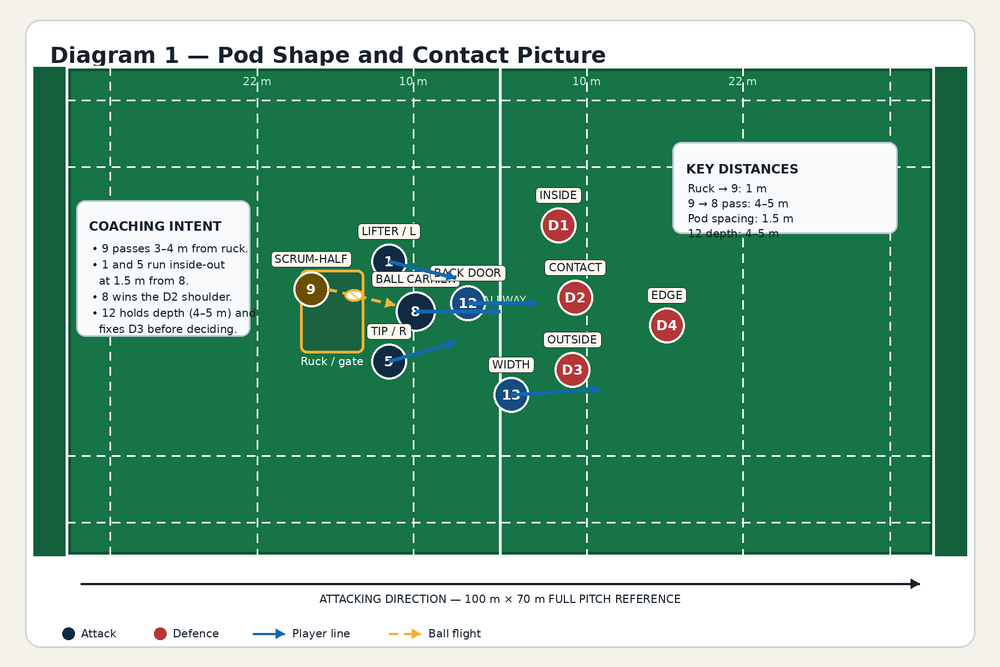
Mark a 30 m long by 35 m wide working box inside the full 100 m × 70 m pitch. Place a ruck pad or two tackle bags on the left side to establish the ruck gate, and cone a 5 m gain-line channel. You need one ball per group, six cones, two shields or tackle bags, bibs, and a stopwatch.
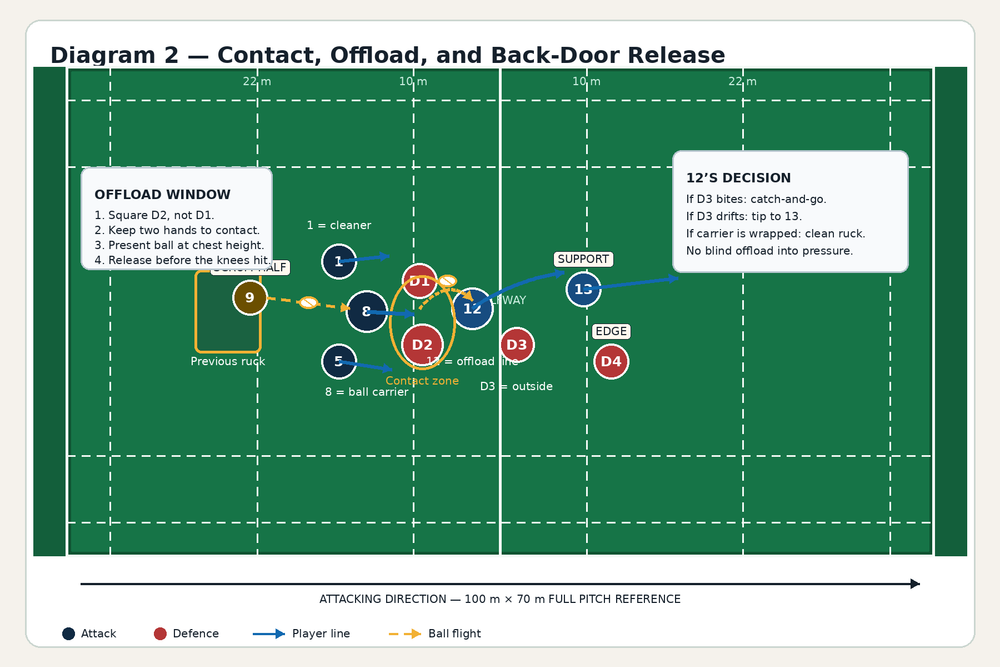
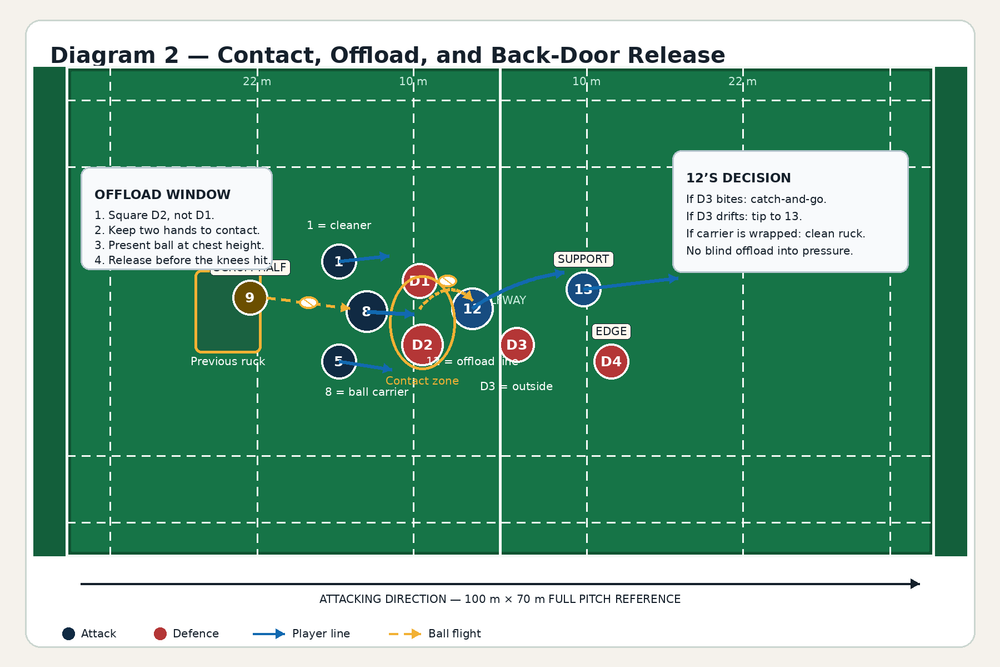
Use six attackers—9, 1, 8, 5, 12 and 13—against four defenders labelled D1 to D4. Set 9 one metre behind the ruck. Put 8 four to five metres from 9, with 1 and 5 each 1.5 m either side and half a metre behind the carrier line. Hold 12 four to five metres deep outside 8. Put D1 inside, D2 in the contact lane, D3 on 12, and D4 outside 13. Defenders start at 70% speed. Players must remain onside; a player ahead of a team-mate carrying or last playing the ball must not interfere. 2

Step-by-Step Instructions
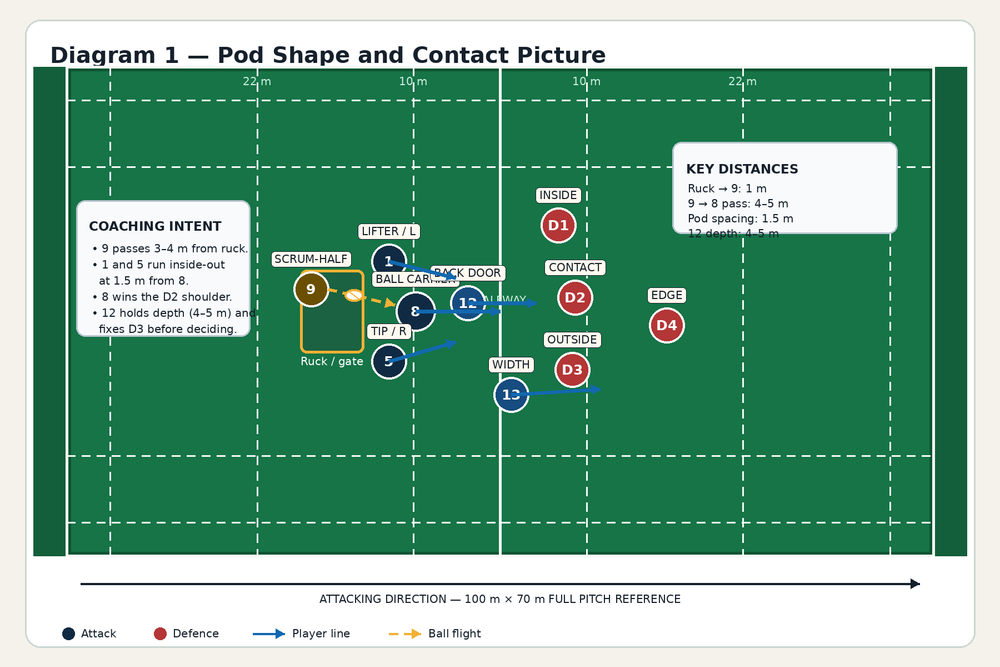
Build the picture before the pass. Call “Pod, plus one.” 1, 8 and 5 walk into shape, then accelerate on 9’s hands. 12 stays deep enough to receive late; do not let 12 drift past 8 before the pass.
Deliver a square carry. 9 passes from one metre behind the ruck to 8’s near hand over 4–5 m. The ball must arrive chest-high and in front. A looping pass creates a static carrier and lets D2 win the collision.
Attack the seam with the pod. 8 targets space just inside D2’s shoulder. 1 runs inside-out to protect the inner seam and become the first cleaner. 5 tracks 8’s outer hip, ready to clean or take a short tip. Keep the pod within 1.5 m through contact.
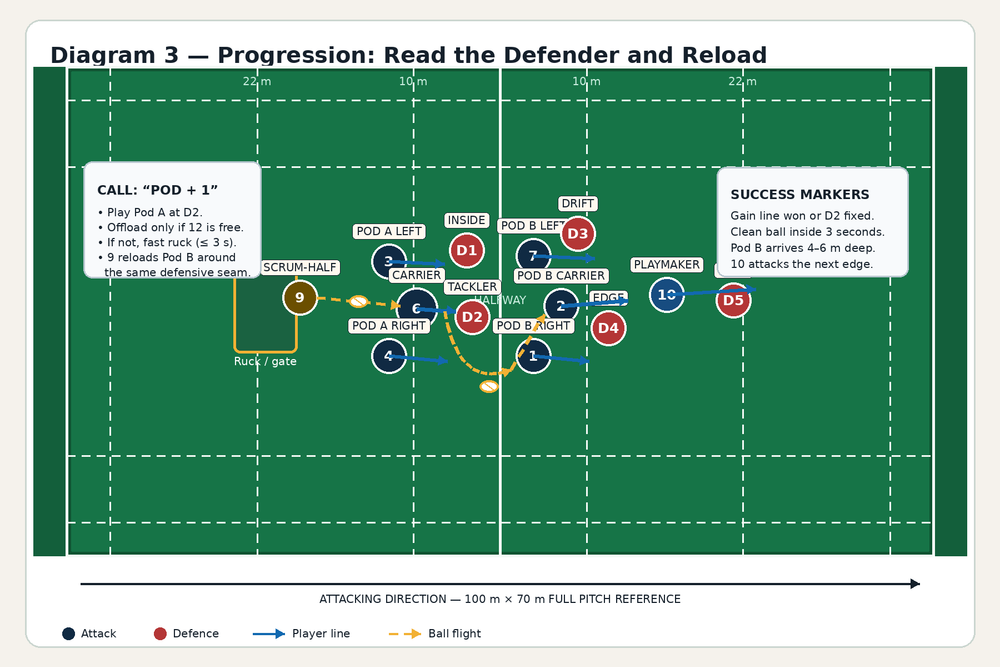
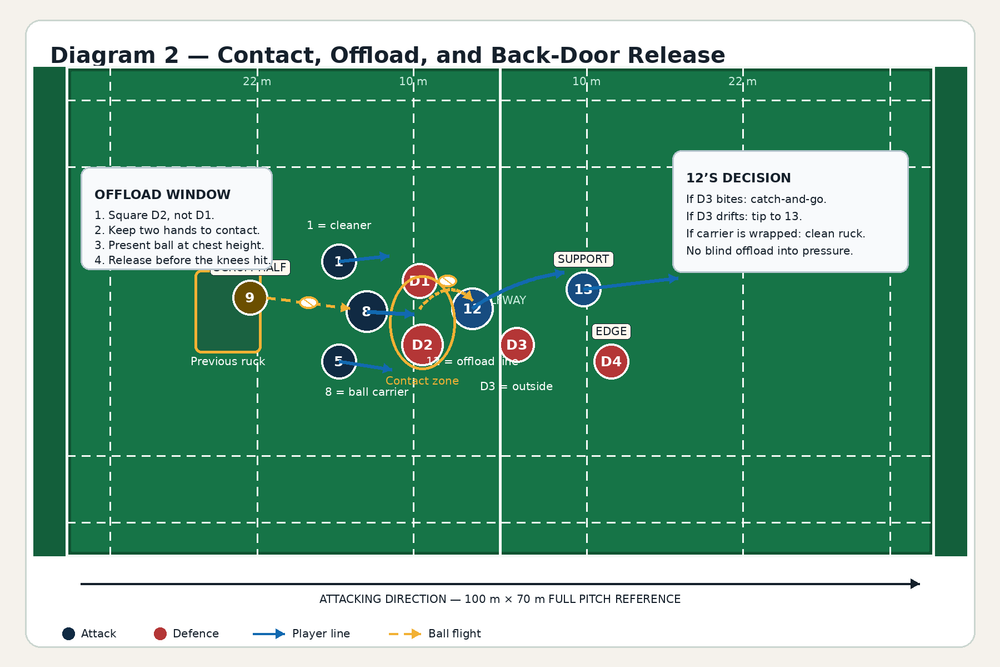
Win contact before looking for the pass. 8 carries with two hands until the last moment, takes strong final steps, and keeps hips square. The carrier aims to stay above knee height, present the ball at chest height, and turn only enough to see 12. The target is D2, not D1.
Make the offload decision. 12 reads D3’s feet. If D3 bites and 12 has a clean window, 8 gives a short, upward, backwards offload before the knees hit the ground. 12 catches early and gets north; if D4 folds in, 12 can tip to 13. The pass must travel backwards relative to the pitch.
Call “no offload” early when the picture is dirty. If 8 is wrapped, 12 is marked, the ball is below waist height, or the carrier cannot see the receiver, 8 secures the ball. 1 and 5 arrive through the legal gate and give 9 a clean platform. A blind reach around a tackler is not an option.
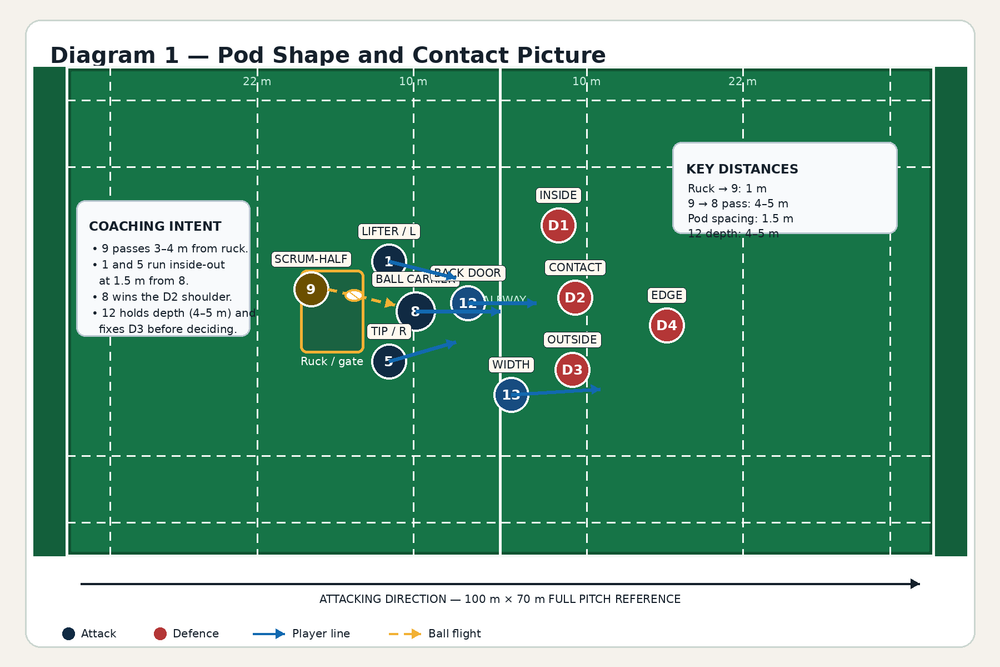
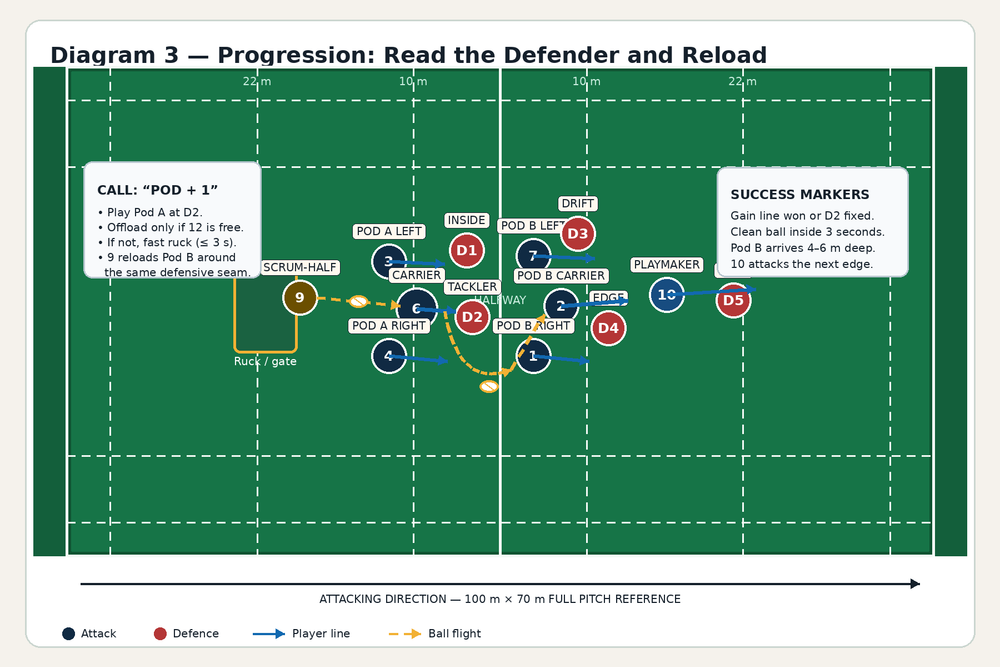
Reload at pace. After the no-offload call, 9 plays the next three-forward pod around the same seam. The second pod arrives 4–6 m in depth, not beside the ruck. Time contact to 9’s next pass; the standard is three seconds.
Key Coaching Points
| Focus | What to coach | Observable standard |
|---|---|---|
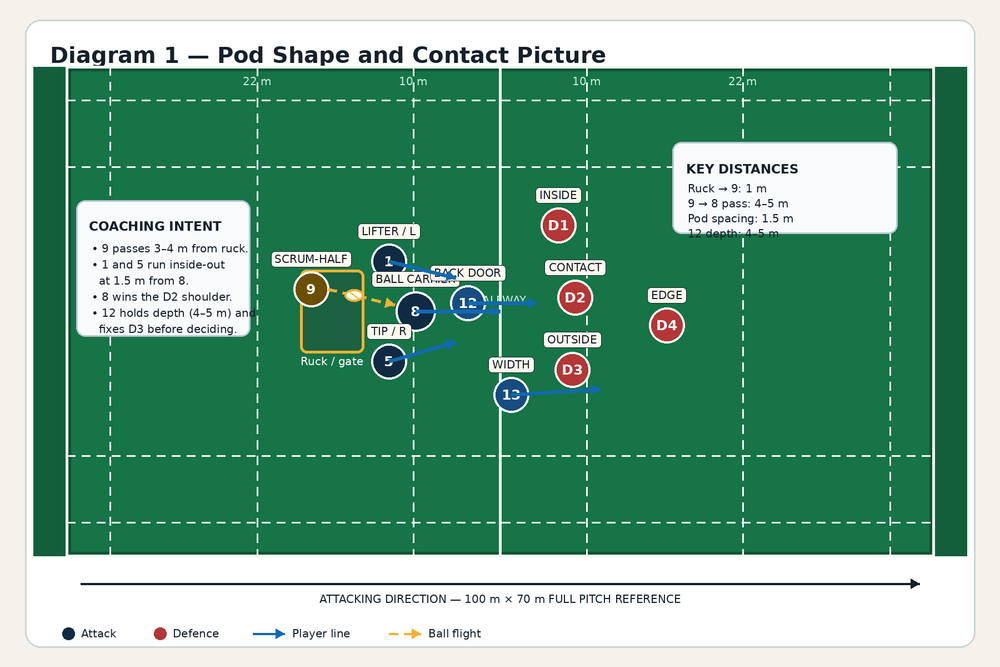
| Pod connection | 1 and 5 work from 8’s hips, never in front. | Both are within 1.5 m at contact. |
| Carry shape | 8 is square, eyes up, two hands on ball. | D2 is engaged before any release. |
| Receiver discipline | 12 holds depth, tracks late and talks early. | 12 catches while moving forward. |
| Offload quality | Release is short, soft, backwards and into space. | Ball arrives above receiver’s waist. |
| Ruck security | A no-offload can still be a win. | Ball is playable inside three seconds. |
Coach concise language. Call “carry” when the shoulder is dominant or the ball is unsafe. Call “live” when 12 is free and D3 bites. Call “reload” when the carrier goes to ground. The scrum-half repeats the call so every forward knows whether to clean or become the next pod.
Common Mistakes
The most common failure is a pod that is too deep or loose. Put a 1.5 m cone channel around the carrier and insist that 1 and 5 work from 8’s hips. The next is 8 turning sideways before winning the shoulder. Stop the rep: win D2 square, then release only if D3 is fixed.
Watch 12 for creeping flat and becoming a target. Re-set 12 at five metres and demand a late acceleration. Finally, do not reward every offload. Wrapped arms, low ball, a blind receiver, or a defender in the lane means ruck first. Cleaners must also enter through the gate and bind legally.
Variations & Progressions
1. Easier: guided shoulder-read
Use shields for D1 and D2, with a passive D3. The coach calls “bite” or “drift” before 9 passes. This teaches the 8/12 visual trigger without the noise of a live tackle. Demand five correct choices before raising pressure.
2. Harder: live four-defender decision
Remove the pre-call. D1–D4 defend at 80–90%. Award one point for a clean line-breaking offload, one for a three-second ruck and reload, and zero for an unnecessary turnover. This conditions decision quality rather than highlight-reel passing.
3. Match transfer: Pod + 1 reload
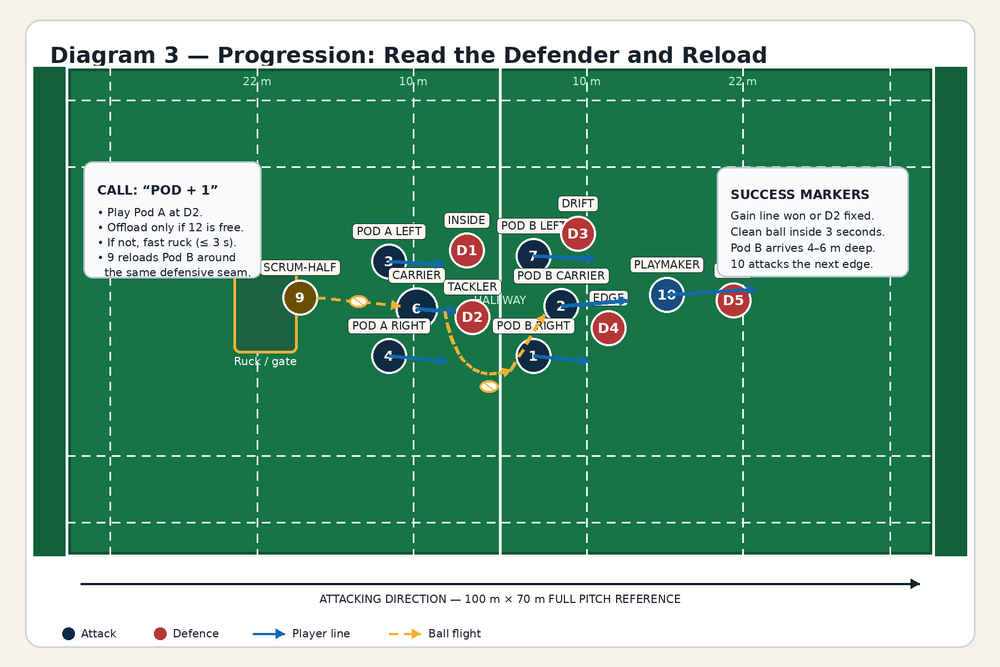
Add 10 and a second pod. If the offload is not on, 9 plays Pod B around the same seam and 10 attacks the next edge. The first pod bends the defence; the next phase exploits the compromised fold.
Age Adaptations
For Under 8 and Under 10, remove the tackle and contact offload. Use touch or grip-tag, teach the three-player running shape, and allow a two-hand pop before the touch. Work in a 20 m × 20 m box; the outcome is safe catch-and-pass skill and close support.
For Under 12 and Under 14, introduce controlled wrap tackles and a two-hand, eyes-up carry rule. Keep the offload chest-high, restrict it to one support runner, and prioritise safe landing and ball presentation. Use coach-controlled line speed until legal tackle and ruck entry are reliable.
For Under 16 and open-age players, run the full live picture with genuine line speed, a live D3 read, contested ruck speed, and the second-pod reload. At every level, adapt contact exposure to local law variations, player readiness, and the coach’s risk assessment.
Session Finish
Finish with a six-phase conditioned game in a 35 m × 35 m area. Award two points for a line-break from the offload, one for a fast ruck-and-reload, and deduct one for a forced offload or penalty. Review with three questions: Did we win D2? Was 12 free? Did we reload inside three seconds?
References