

Rugby
Three-Channel Scrum-Half Passing Accuracy Circuit
Develop a scrum-half’s speed, accuracy and decision-making by passing into moving target gates under progressive pressure.

What you need
balls, cones, bibs, stopwatch
Overview
This 20-minute circuit gives scrum-halves repeatable, game-real passing reps without allowing technique to become robotic. Number 9 receives from a ruck picture, scans a coach call and delivers to one of three targets on different lines and depths. A pass scores only when the receiver catches it in stride inside the target gate, so line, height, weight and timing all matter. Mark the 30 m x 26 m work area inside a full 100 m x 70 m pitch. It works well early in a skills block before unit attack.
Setup
Use 20 cones to mark a 30 m x 26 m rectangle around halfway. Build a 4 m-wide ruck box at the left edge. Place feeder 1 on the far side, with scrum-half 9 two metres behind the ball and square to three channels. Set three 2 m gates 10–16 m from 9: left/depth for 10, middle/square for 12 and right/short for 13.
Use 10 players. Players 1–8 rotate through feeder, scrum-half, receiver, returner and ball queue roles; 9, 10, 12 and 13 on the diagram identify roles rather than fixed selections. Keep six balls with the feeder and two at the ball queue. Coach stands 5 m behind 9, able to call late. Run four 30-second technical rounds with 30 seconds to reset, then four 40-second pressure rounds with 20 seconds to reset. Allow 4 minutes for demo and 6 minutes for a scored finish and review.

Diagram 1: solid arrows show player movement; dashed arrows show ball flight. The base circuit has left, middle and right target gates.
Step-by-Step Instructions
Demonstrate — 0:00–4:00. Feeder presents the ball on the ground line. Number 9 arrives low and balanced, calls “set”, then passes through the named gate. Demonstrate both sides. A pass counts only if the receiver catches between hip and chest height while moving.
Technical block — 4:00–8:00. Start a 30-second round. Feeder 1 rolls or places a clean ball to 9. Coach calls “left”, “middle” or “right” just before 9’s hands reach it. Number 9 catches, sets the platform and passes within 2.5 seconds. The named receiver runs through the gate and returns the ball. After three passes, rotate: 9 to target, target to returner, returner to feeder queue. Reset for 30 seconds; repeat four rounds.
Accuracy score — 8:00–12:00. Give each scrum-half six balls: two to each channel. Award two points for a catch in the gate without a check-step, one point for a catch in the gate with a check-step, and zero for a drop, jump, reach behind or pass outside. Record scores quickly. Do not award a lucky catch from an ugly pass.
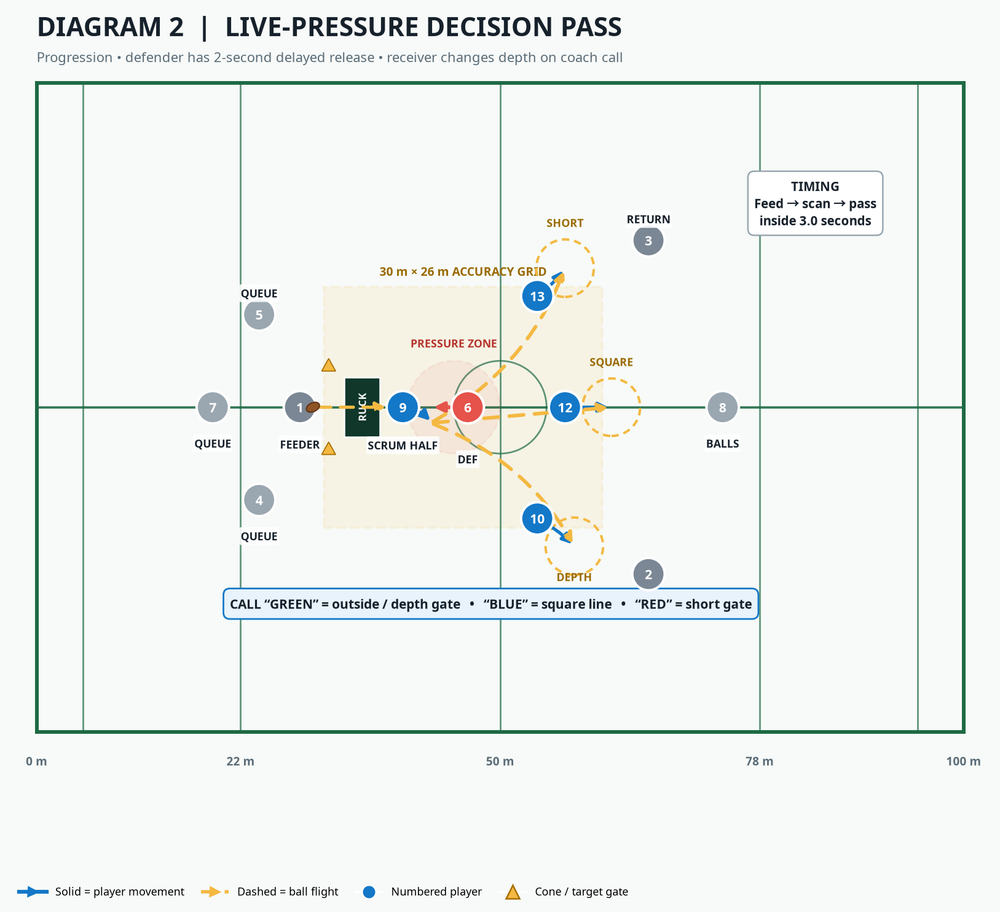
Moving picture — 12:00–16:00. Receivers begin three metres behind their gates and move into them on the feed. Number 10 runs onto depth, 12 stays square and 13 comes short. Delay the target call until feeder 1 touches the ball. Demand that 9 scans first, rather than watches the ball and decides after the catch.
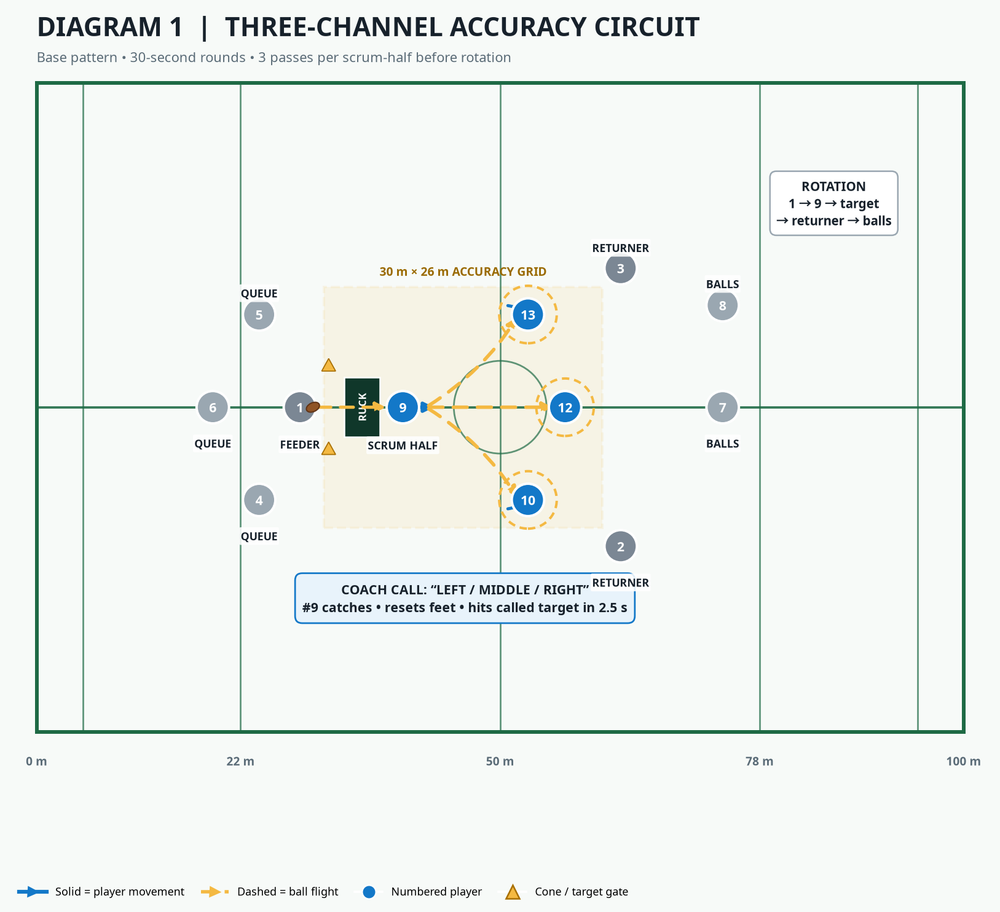
Diagram 2: the red defender releases on a two-second delay; 9 identifies the viable gate and passes inside 3.0 seconds.
Pressure block — 16:00–19:00. Put player 6 in the pressure zone. On the feeder’s touch, 6 counts “one, two”, then can rush the passing lane without tackling. Coach calls green (depth), blue (square) or red (short). Number 9 plays the called gate if it is on, or calls “check” and hits the safer middle option if the lane is closed. A clear decision earns a bonus point.
Finish — 19:00–20:00. Every player gets one scored pressure pass. Ask: “Was it in front?”, “Could the receiver play immediately?” and “Did 9 scan before the hands?” Give one cue to take into unit attack.
Key Coaching Points
- Win the platform. Hips and shoulders face the target line; knees are loaded; feet stay underneath. A small adjustment is useful, but a big drift turns a straight pass into a float.
- Finish both hands to target. Receive with relaxed fingers, show the ball briefly in the channel, then punch through. The right hand directs; the left hand controls release and spin. Fingers finish at the receiver.
- Pass to space, not the shirt. Lead the runner onto the near shoulder at lower-rib to sternum height. Use a flat, driven pass square; add only enough air for depth.
- Eyes before hands. Scan target, defender and running line before touching the ball. Early pictures keep the release short and fast.
Common Mistakes
- Standing tall or stepping across the ball. The pass lifts and exposes the inside lane. Rebuild a low, square base; use a cone to guide the outside foot.
- One-arm release or no follow-through. The ball wobbles, dies or arrives behind. Insist on two hands through release and a complete finish.
- Late call and ball-watching. The runner hesitates and 9 panics. Reward the scan before the catch and an early channel call.
Variations & Progressions
Variation 1: Weak-hand emphasis. Run two 45-second rounds on the less comfortable passing side. Narrow the far gate to 1.5 m; score clean, catchable passes only.
Variation 2: Continuous two-ball wave. Feed the next ball once the receiver clears the gate. Keep 9 in for six rapid passes, then rotate; demand calm feet under repetition.
Progression 1: Call-and-cancel. Coach calls a colour, then changes it while the ball travels to 9. The scrum-half re-scans and hits the new viable option.
Progression 2: Live edge. Defender 6 chooses inside or outside pressure after the delay. Add a support runner behind 9 so a closed lane becomes a short reload rather than a forced pass.
Age Adaptations
For Under 8s and Under 10s, reduce to 18 m x 14 m, use two gates and remove the defender. Feed from hands, call early and praise a balanced catch-and-pass over speed. Use 20-second rounds and 40-second coaching resets.
For Under 12s and Under 14s, keep three channels but make the defender a shadow runner. Allow 3.5 seconds and make everyone pass both ways. For Under 16s and open-age players, use live pressure, cut the decision clock to 2.5 seconds and require a verbal “check” when the intended lane is closed. The standard remains: every pass must put the next player into a positive attacking action.
