

Rugby
Rugby Union Penalty Corner Attack: Tap–Sweep Edge Play
A coach-ready tap-penalty pattern that uses a hard midfield decoy and a sweeping fullback to create a high-quality edge decision close to the try line.
What you need
Rugby balls, 24 flat cones, 8 coloured bibs, 1 tackle shield, whistle, stopwatch, pitch or marked 25m x 30m corner grid
Rugby Union Penalty Corner Attack: Tap–Sweep Edge Play
Overview
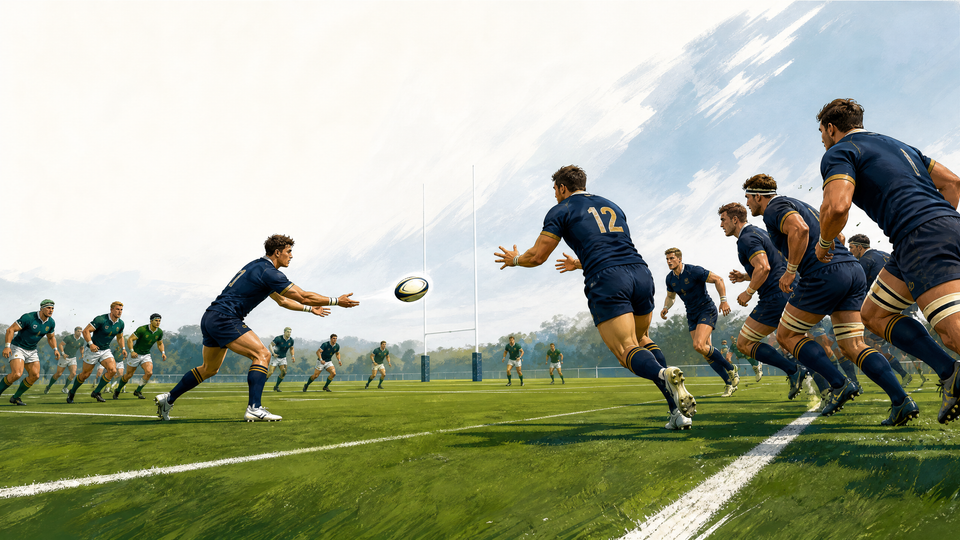
This is a first-phase attacking play from a penalty near the corner, designed to turn a compact line into a two-on-one at the edge. It is most effective 5–10m from the try line and 10–15m in from touch. The picture here is an 8m-from-goal, 12m-from-touch penalty in the left attacking corner of a 100m x 70m pitch; attack moves toward the left try line.
The play uses a hard 12 carry threat, a square 10, and a sweeping 15 to stress the edge. The release is to 13 outside a folding defender or a square 15 carry when the defender holds width. Teammates must be behind the ball until it is kicked, while defenders retreat 10m or to their own try line if closer; that creates the goal-line picture.1
Setup
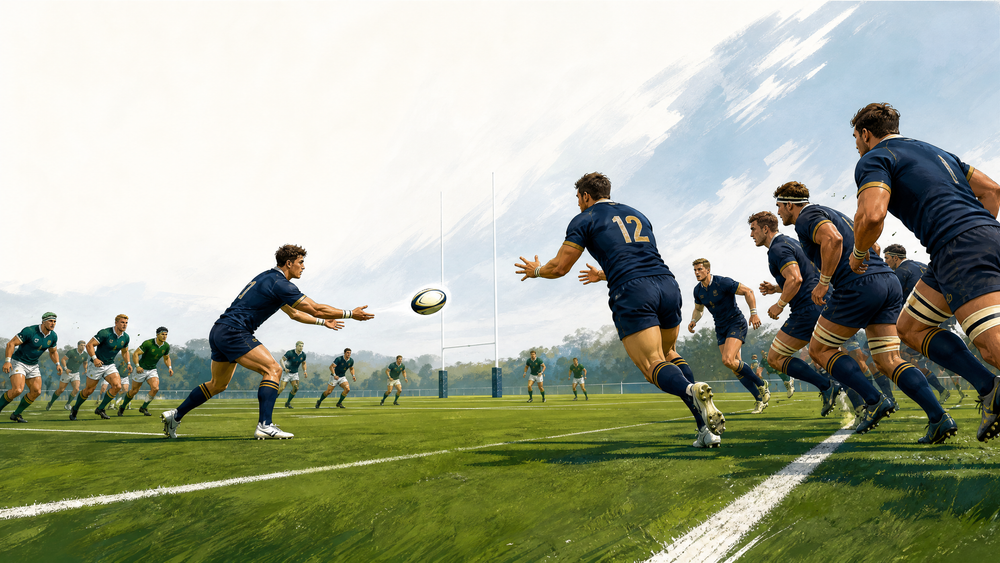
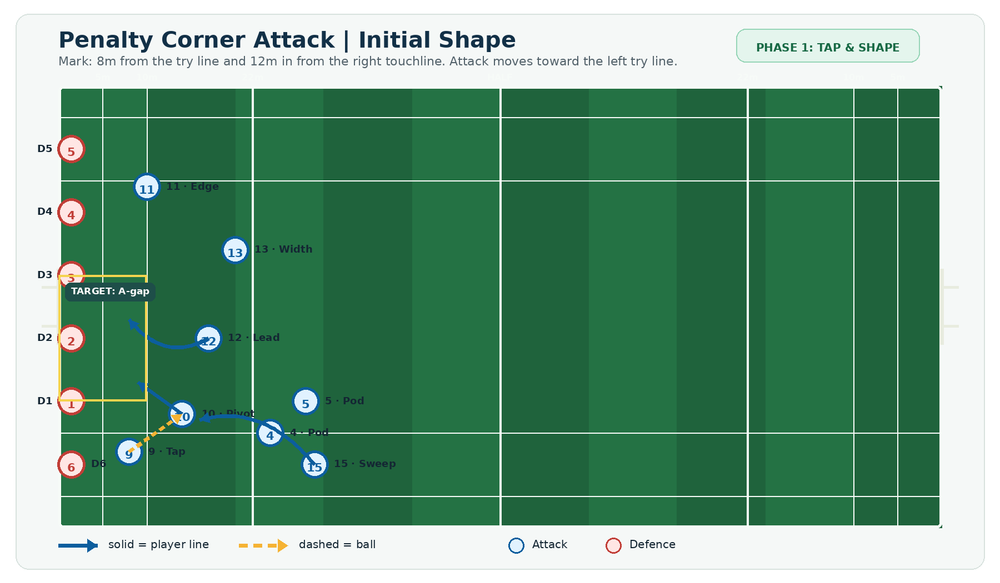
Use 15 players for the full picture, although the core can be trained with nine attackers and six defenders. Mark a 25m-long by 30m-wide working area in the corner, with the legal penalty mark 8m from the try line and 12m from the near touchline. Use four cones to identify the mark, the A-gap target, the outside release lane, and the blindside finish box. Keep the opposition defensive line on the try line before the tap; that is the correct visual picture when the mark is inside 10m.
| Role | Starting detail | Primary job |
|---|---|---|
| 9 — scrum-half | On the mark, ball on the turf | Give the visible tap, then pass quickly to 10 and reload behind the ball. |
| 10 — fly-half | 5–6m behind and 3m inside 9 | Catch square, fix D1/D2, and deliver the out-the-back pass. |
| 12 — inside centre | 8–10m behind the mark, inside shoulder of 10 | Sell a hard unders/overs lead at D2; do not expect the ball. |
| 15 — fullback | 10–12m behind 10 and 6m wider | Sweep late, take the second pass at pace, and make the edge read. |
| 13 and 11 | 13 is 8m outside 12; 11 holds 2–3m from touch | Hold the width, then accelerate only when 15 has caught the ball. |
| 4, 5 and 1 | A three-player pod 12–18m behind the ball | Protect the inside, offer a square carry, and win the fast second phase. |
The call is “Corner Sweep.” On the call, 9 says “set”; 12 answers “lead”; 15 confirms “sweep.” The referee’s signal is the only trigger to take the tap. Build this as a 3.5-second pattern from tap to the 13/15 decision, not as a static rehearsal.
Step-by-Step Instructions
Establish the legal shape. 9 places the ball at the mark. Every attacker is visibly behind the ball line. 10 sets 5–6m back, 12 sits one pass wider, and 15 waits deep enough that the defence cannot simply drift onto them. 13 and 11 show width without standing flat.
Tap and transfer. On the referee’s cue, 9 taps the ball a visible distance, takes one sharp step toward the try line, and passes from chest height to 10 within 1.0 second. The pass must travel no more than 5m; speed of transfer matters more than a long pass.
Run the 12 decoy honestly. As 9 passes, 12 runs a hard line at the inside shoulder of D2, aiming to cross the gain line 2m inside the A-gap target. Their shoulders stay square and their hands remain available. A lazy decoy lets the edge defender drift; a credible line pulls D2 inward.
Square the first defender. 10 catches while moving laterally by no more than 1m, takes two square steps at D1/D2, and keeps the ball in two hands. 10’s eyes must stay on the defender, not on 15. The coaching picture is: make D1 decide whether to tackle 10 or fold across on 15.
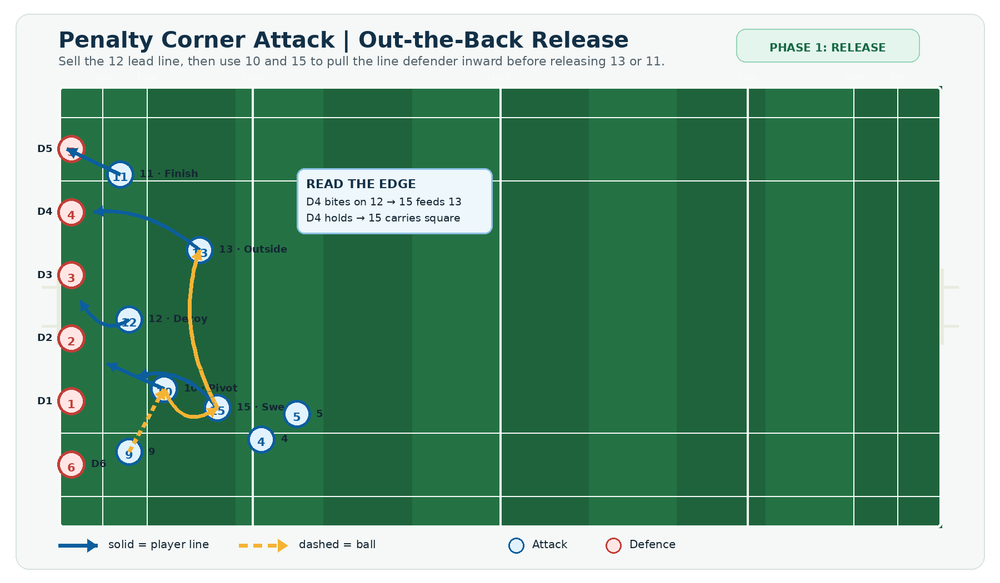
Play out the back to 15. 15 starts their sweep only as 10 receives. They pass behind 10 at depth, taking the ball 8–10m from the try line and ideally 5m outside 12’s line. 10 sends a firm, flat-to-the-run pass behind the 12 decoy. Do not throw the ball before D1’s shoulders have turned.
Make the edge decision. If the outside defender bites on 12 or turns in on 15, 15 transfers early to 13, who attacks the defender’s outside shoulder and has 11 available as the last pass. If that defender holds width, 15 carries square through the space inside them. The decision is made in the final 2m before contact—not from a pre-called pass.
Finish the picture. 13 runs through the ball and uses a late catch-pass only when 11 has stayed outside the final defender. 11 stays 2–3m inside touch until the ball is released, then finishes with the touchline as an extra defender. If 15 carries, 4 and 5 arrive as the first cleanout pair while 9 sets the next pass at the back of the ruck.
Reload without pause. If the edge closes, do not force the pass. 9 calls “fold,” hits 4 or 5 on a short, square carry, and uses 1 as the tip option back toward the blindside. The second phase must be live within three seconds of the tackle.
Key Coaching Points
| Coaching focus | What to coach |
|---|---|
| Penalty discipline | Freeze the attack behind the ball until 9 has completed a clear tap; this prevents an avoidable scrum for an early runner. |
| Decoy quality | 12 must threaten the line at full intent. Coach their eyes, hands and body height as if they are the intended carrier. |
| Depth with purpose | 15 needs enough depth to catch at pace, but no more than 10–12m behind 10 or the defence will have time to drift. |
| Square feet, late hands | 10 and 15 win the play by making defenders turn their shoulders before the ball is transferred. |
| Width discipline | 13 and 11 must hold their lanes until the ball has cleared 15. Early drifting collapses the space they are meant to exploit. |
| Ruck insurance | The forward pod is not decoration. Demand two strong arrivals and a clear 9 so the team can attack again if the first release is closed. |
Common Mistakes
| Error | Why it fails | Immediate correction |
|---|---|---|
| 9 taps and passes before teammates are behind the ball | It risks a scrum and ruins the tempo. | Rehearse a loud “set” call and make players point to the ball line before each rep. |
| 10 drifts across field before catching | The defence can slide without making a tackle decision. | Put a 1m gate around 10’s catch point; they must catch square inside it. |
| 12 jogs the decoy or looks back | D2 ignores the threat and joins the edge. | Score the decoy separately: full speed, hands up, shoulder target hit. |
| 15 passes before fixing the edge defender | The defender can drift to 13 and kill the overlap. | Use a defender with a coloured bib: 15 may pass only after seeing the defender’s hips turn in. |
| 11 chases infield too early | The touchline finish disappears. | Mark a 3m wide channel; 11 stays in it until 13 has caught the ball. |
Variations & Progressions
Start with a guided version: use D2 and one edge defender, tell 15 which defender will bite, and allow a 1.5-second catch-and-pass window.
Progress to a live read version: add a full goal-line line of six defenders, allow D4 to jam, drift or hold, and make 15 call the outcome after the action. Award the defence two points for intercepting or forcing touch and the attack two points for breaking the gain line or scoring.
For the highest level, add a second-phase constraint: a playable ball in under three seconds requires 9 to use the fold rather than replay the edge.
Age Adaptations
For Under-8 and Under-10, use a non-contact or wrap-only version with five attackers, two defenders and a 15m x 20m channel. Name players by role—tap, lead, sweep and finish—rather than number. Remove the out-the-back pass initially and let 15 carry after a simple transfer.
For Under-12 and Under-14, introduce 9, 10, 12, 15, 13 and 11 in a 20m x 25m area. Keep tackles below the waist in accordance with local regulations, insist on a visible tap, and teach the two options: pass when the edge defender turns in, carry when they stay wide.
For Under-16 and open-age squads, use the full 25m x 30m picture, live goal-line defence, ruck reload and blindside fold. Review whether 10 fixed a defender, 15 caught at pace and 11 held width—not simply whether the team scored.
Law Reference
1 World Rugby Law 20 confirms that the kick must be taken without delay, attackers other than the kicker remain behind the ball until it is kicked, and opponents must retreat 10m or to their own try line if that is closer.
