Netball Technique
Centre Pass Set Plays and Variations: A Complete Guide for Youth Netball Coaches
Master centre pass set plays and variations to give your youth netball team a competitive edge. This guide covers core principles, practical drills, common challenges, and how Vanta Sports supports coaches at every level.
Introduction
In netball, the centre pass is the heartbeat of your attacking game. Every goal scored begins with a centre pass, and every centre pass is an opportunity to control tempo, exploit mismatches, and create scoring chances. For youth and grassroots teams, well-drilled centre pass set plays and variations can be the difference between a scrappy, turnover-prone performance and a confident, cohesive attacking unit.
Yet many volunteer coaches—often parents or former players stepping in to help—struggle to teach centre pass structures effectively. The challenge isn't a lack of willingness; it's a lack of accessible, practical resources that fit the realities of grassroots sport: limited training time, mixed ability levels, and the need to keep young athletes engaged.
This article breaks down centre pass set plays and variations specifically for youth and grassroots coaches, guardians, and club administrators. You'll learn the core principles behind effective set plays, how to implement them in training, common pitfalls to avoid, and how Vanta Sports—through Vanta Club, the Vanta Coach App, Vanta Guardian, and the Vanta Player App—can support your club at every level.
Core Principles
Before diving into specific plays, it's essential to understand the principles that make centre pass set plays work. These principles apply regardless of age group or skill level.
1. Create Space and Timing
A centre pass is not just about getting the ball into the attacking third. It's about creating space and timing so that the first and second passes break the opposition's defensive structure. Young players often crowd the centre third, making it easy for defenders to intercept. Teach your players to spread out, use the full width of the court, and time their leads.
2. Offer Multiple Options
Every centre pass set play should provide at least two or three passing options. This prevents predictability and gives the centre (C) the ability to choose the best option based on the defence. For youth teams, start with simple two-option plays before progressing to more complex variations.
3. Use Deceptive Movement
Deception is key. Players should use changes of direction, fakes, and decoy runs to pull defenders out of position. At the grassroots level, even basic fakes can be highly effective because defenders are still learning to read the game.
4. Maintain Balance
While the goal is to attack, you must also maintain defensive balance. If the centre pass breaks down, your team should be positioned to transition quickly into defence. This means not overcommitting players forward and ensuring that the wing defence (WD) and goal defence (GD) are alert to counter-attacks.
5. Adapt to Your Players
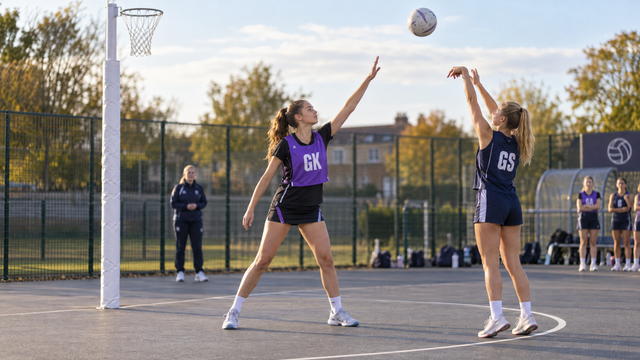
No two teams are the same. A set play that works for a tall, athletic team may not suit a shorter, quicker side. Adapt your plays to your players' strengths. If you have a speedy wing attack (WA), design plays that utilise her pace. If your goal shooter (GS) is strong in the air, create plays that deliver high balls into the circle.
Practical Implementation
Now let's look at how to implement centre pass set plays and variations in training. The following section includes specific plays, progressions, and coaching points.
Basic Centre Pass Set Play: "Split and Drive"
This is an ideal starting point for youth teams new to set plays.
Setup:
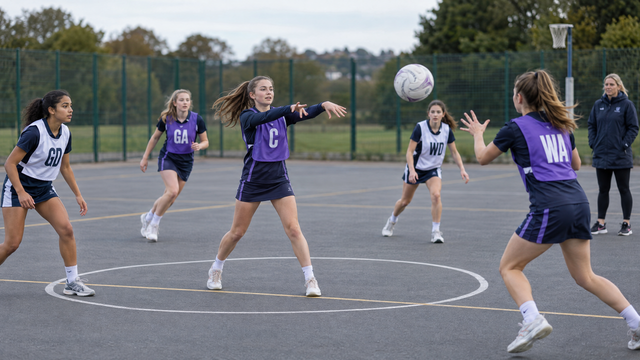
- Centre (C) stands on the centre circle with the ball.
- Wing Attack (WA) starts on the left side of the centre third.
- Goal Attack (GA) starts on the right side, closer to the transverse line.
- Goal Shooter (GS) positions in the goal circle.
The Play:
- On the whistle, WA drives forward towards the transverse line, then cuts back towards the centre to offer a short pass.
- Simultaneously, GA drives diagonally towards the centre third, creating a second option.
- C chooses the best option—usually the one with the most space—and delivers a quick, accurate pass.
- The player who receives the ball immediately looks to pass to the other option or into the goal circle.
Coaching Points:
- Emphasise timing: both leads should happen at the same time to stretch the defence.
- Encourage C to use a shoulder pass or chest pass depending on distance.
- Remind players to clear space after passing; don't stand still.
Variation 1: "Overlap and Drop"
This variation adds a layer of deception and is suitable for intermediate youth teams.
Setup:
- Same starting positions as above.
- Additionally, the Wing Defence (WD) positions just behind the centre third line, ready to support if needed.
The Play:
- WA fakes a drive forward, then drops back towards the centre circle.
- GA drives hard towards the centre third, drawing her defender.
- C passes to WA, who has dropped into space.
- WA immediately passes to GA, who has continued her drive into the attacking third.
- GA then looks to feed GS or take a shot.
Coaching Points:
- The fake by WA must be convincing; she should sell the forward drive before dropping.
- GA's drive should be timed to arrive as WA catches the ball.
- This play works best when the opposition defence is man-to-man and follows the initial leads.
Variation 2: "Double Lead with Backline Option"
This advanced variation is ideal for older youth teams (under-15s and above) and introduces a backline passing option.
Setup:
- C starts with the ball.
- WA and GA both start in the centre third, on opposite sides.
- GS and Goal Attack (GA) position in the goal circle.
- The Goal Defence (GD) or Wing Defence (WD) positions behind the centre pass, ready as a safety option.
The Play:
- WA and GA both drive forward simultaneously, creating two forward options.
- If both are covered, C passes back to the supporting WD or GD (the backline option).
- The backline player immediately looks to pass to one of the forwards, who have now repositioned.
- This switches the point of attack and can catch the defence off guard.
Coaching Points:
- The backline option should only be used if the forward options are shut down.
- The backline player must be prepared to pass quickly; holding the ball allows the defence to reset.
- This play requires good communication and spatial awareness.
Drills to Teach Centre Pass Set Plays
1. Walk-Through Drill:
Start by walking through the play without the ball. This helps players understand their roles and positioning. Gradually increase speed.
2. Passive Defence Drill:
Introduce defenders who apply light pressure (50% intensity). This allows players to practise their timing and decision-making without the risk of turnovers.
3. Full-Pressure Drill:
Once players are confident, add full-pressure defence. Encourage them to adapt and use variations if the original play breaks down.
4. Video Review:
Use the Vanta Coach App to record training sessions and review centre pass plays with your team. Visual feedback is invaluable for young athletes.
Common Challenges
Even with the best-designed plays, coaches face common challenges. Here's how to address them.
Challenge 1: Predictability
If you run the same centre pass every time, defences will read it easily. Solution: Teach multiple variations and encourage players to make decisions based on what they see. Use the Vanta Player App to share short video clips of different variations so players can study them at home.
Challenge 2: Poor Timing
Young players often struggle with timing their leads. Solution: Break the play down into smaller parts. Practise the timing of the first lead without the ball, then add the ball. Use cones or markers to indicate when and where to cut.
Challenge 3: Lack of Communication
Netball is a team sport, and communication is critical. Solution: Encourage players to call the play before the centre pass. Use simple code words (e.g., "Split" for the basic play, "Overlap" for the variation) so everyone knows what's happening.
Challenge 4: Limited Training Time
Grassroots coaches often have only one or two hours per week. Solution: Prioritise. Spend 15 minutes per session on centre pass plays. Use the Vanta Coach App to access pre-built session plans and drills that maximise efficiency.
Challenge 5: Mixed Ability Levels
In youth teams, you may have players of varying skill levels. Solution: Differentiate. Assign simpler roles to less experienced players (e.g., the backline option) and more complex roles to advanced players. Use Vanta Club to track player development and ensure everyone gets appropriate challenges.
How Vanta Supports Coaches
Vanta Sports is designed to make life easier for grassroots coaches, guardians, and club administrators. Here's how our suite of tools can support your centre pass set play training and overall club management.
Vanta Coach App (Free for Volunteer Coaches)
The Vanta Coach App is your go-to resource for session planning, drills, and player management. It includes a library of netball-specific drills, including centre pass plays. You can create custom session plans, track attendance, and share videos with players. Best of all, it's completely free for volunteer coaches—because we believe in supporting the grassroots game.
Vanta Club (Club Management)
Vanta Club streamlines club administration, from registrations and payments to scheduling and communication. As a club administrator, you can use Vanta Club to organise coaching clinics focused on centre pass plays, send out training reminders, and manage team selections. It's all in one place, saving you time and reducing admin headaches.
Vanta Guardian (Parents)
Vanta Guardian keeps parents informed and engaged. They can view training schedules, receive updates on their child's progress, and access resources on netball techniques—including centre pass plays. This transparency helps parents support their child's development at home.
Vanta Player App
The Vanta Player App empowers young athletes to take ownership of their learning. They can watch instructional videos on centre pass variations, complete quizzes, and track their own progress. It's a fun, engaging way to reinforce what they learn in training.
By integrating Vanta Sports into your club's ecosystem, you create a seamless experience for coaches, players, and parents. Everything from drill libraries to communication tools is designed with youth sports in mind.
Conclusion
Centre pass set plays and variations are a vital part of any netball team's arsenal. For youth and grassroots coaches, teaching these plays effectively requires patience, clear communication, and a focus on core principles like space, timing, and deception. By starting with simple plays and progressing to more complex variations, you can build your team's confidence and attacking prowess.
Remember that the goal isn't just to win matches—it's to develop young athletes who understand the game and enjoy playing it. Use the practical drills and coaching points in this guide to structure your training sessions. And when you need support, turn to Vanta Sports. Whether it's the free Vanta Coach App for session planning, Vanta Club for administration, Vanta Guardian for parent engagement, or the Vanta Player App for individual development, we're here to help you succeed.
So next time your team lines up for a centre pass, you'll have a plan—and the tools to execute it. Here's to more goals, more teamwork, and more fun on the court.
Tags