Netball Technique
Centre Pass Set Plays and Variations: A Practical Coaching Guide
Build reliable netball centre-pass patterns, teach decisive variations, and adapt the same restart principles to basketball inbounds and transition.
Centre Pass Set Plays: Why the Restart Matters
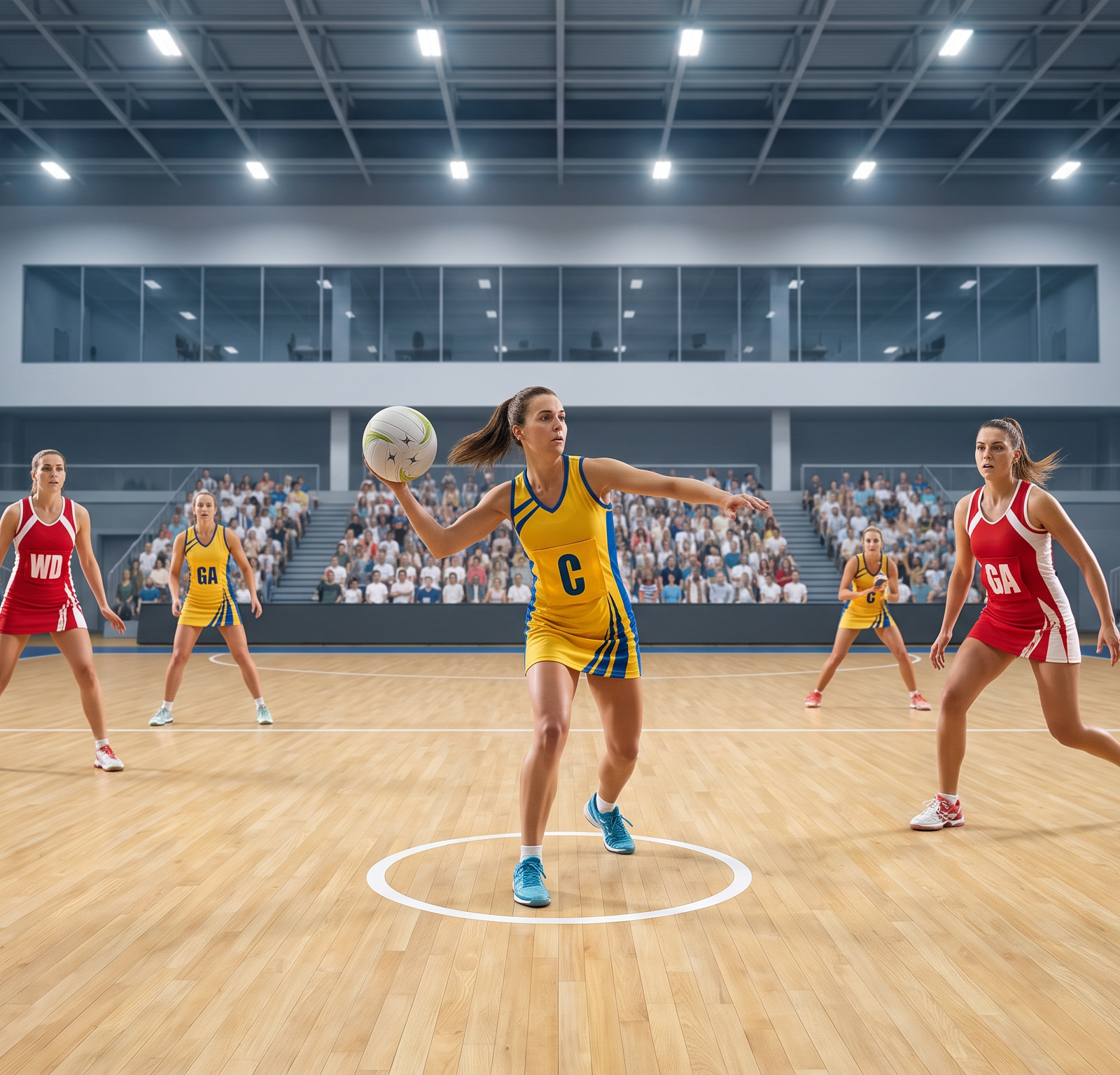
A centre pass is one of netball’s few repeatable, high-pressure possession moments. It occurs at the start of every period and after every goal, with centre-pass possession alternating between teams.1 That predictability makes it worth rehearsing: a team can pre-plan its first movement, first passing lane and fallback option before the whistle.
For basketball coaches, a terminology note matters. Basketball does not use a netball-style centre pass after scoring. Under FIBA rules, the game begins with a jump ball, later jump-ball situations use alternating possession, and most restarts are throw-ins.4 The transferable lesson is the coaching problem: organise a reliable first action, create separation, keep an outlet available and transition into the next phase. This guide gives netball coaches practical centre-pass plays while showing basketball coaches how to apply the same principles to inbounds and transition.

Rule-Smart Foundations Before You Add Plays
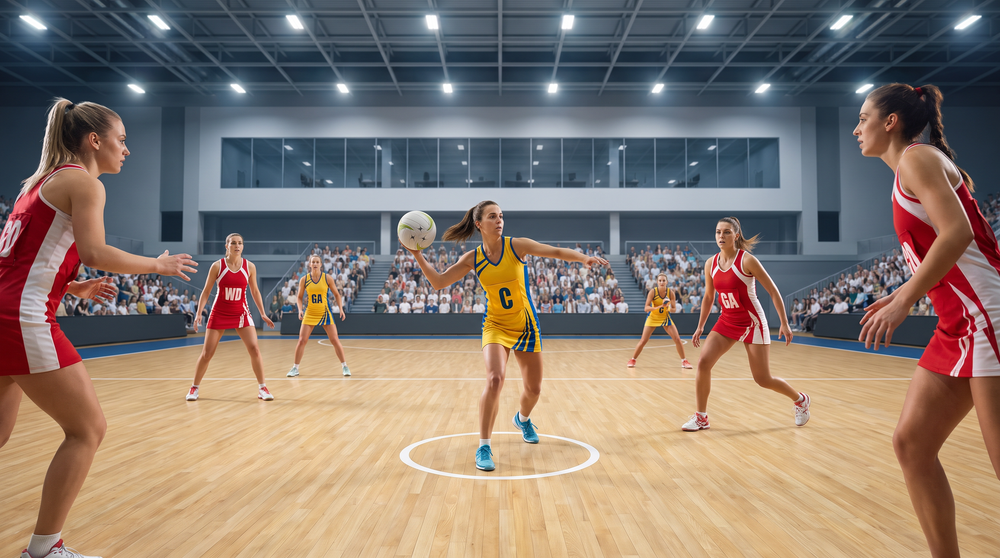
A clever play that starts illegally is not clever. World Netball requires the Centre to start with at least one foot wholly inside the centre circle, release within three seconds, and ensure the ball is first touched or caught in the centre third.1 Teammates other than the two Centres cannot enter the centre third until the whistle. Teach these requirements as part of every repetition, not as a separate rules talk.
The 2024 short-pass clarification is equally useful for training. A pass needs enough space for an opponent to make a genuine attempt to deflect or intercept it.2 So receivers should lead into a real lane rather than stand beside the ball carrier, and the Centre needs more than one legal option.
| Centre-pass checkpoint | What good execution looks like | Common error to coach out |
|---|---|---|
| Pre-whistle setup | Players are balanced, can see the ball and know the first two calls. | Players bunch on one line or drift early. |
| First movement | A sharp change of pace creates a lane, not just distance. | A slow jog lets the defender sit on the route. |
| Centre’s read | The ball goes to the best available option within three seconds. | The Centre predetermines a pass. |
| Second phase | The first receiver lands safely, pivots and sees support. | The receiver catches facing the sideline with no outlet. |
| Reset | The team keeps depth and re-offers when covered. | Everyone runs long, leaving no safe pass. |
Coaching cue: “Win the first safe pass, then win the next space.” The centre pass is the start of an attacking sequence, not its finish.
Build a Centre-Pass Menu, Not a Single Script
The strongest youth teams do not memorise six elaborate diagrams. They understand a small menu of patterns, each with a trigger and a counter. Start with one base pattern, then add a variation only when players can recognise the defensive picture. Use short shared calls—straight, split, wheel, hold, reset—that athletes can remember under pressure.
1. Straight Lead and Return: Your Base Option
The Wing Attack or Goal Attack makes a hard straight lead into the centre third while the other player stays slightly deeper as the safety option. The Centre delivers a flat pass to the first genuine lead. On the catch, the receiver pivots toward the attacking end and either feeds forward or returns the ball to the Centre, who has already moved into a new angle.
This is ideal for developing teams because the spacing is clear. It also teaches the Centre not to admire the pass: after releasing, they must move to become the next option. If the defender is goal-side of the lead, take the safety ball rather than float a contested lob.
2. Split and Re-Offer: Create a Two-Way Decision
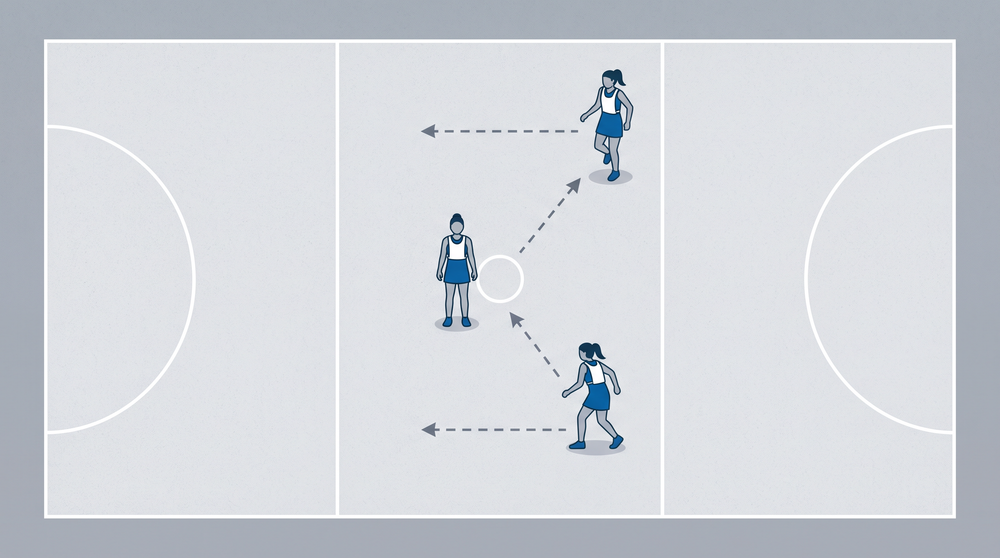
Position the WA and GA close enough to look like one target, then send them in opposite directions on the whistle. One drives through the middle; the other cuts wide or holds depth before re-offering. The first run draws defensive attention, and the second exploits the gap.
Timing determines whether it works. If both attackers leave at the same speed and distance, the Centre sees two equally risky passes. Ask the initial driver to commit the defender, then cue the second player to arrive after that commitment. The read becomes simple: pass to the player whose defender has been moved by the first action.

3. The Wheel: Rotate, Do Not Crowd
Use the wheel against tight man-on-man pressure. The WA begins wide, the GA offers into the centre third, and the Centre first releases to the GA. The Centre rotates behind the ball while the WA comes underneath as the next safe pass. The shape should resemble a wheel, not three players chasing the same square metre.
The movement gives the ball carrier a forward option, a lateral option and a reset. Tell players that rotation must be purposeful: each person is arriving in a usable lane with their body open to the next pass. If a defender overcommits to the initial drive, the next rotation should punish that decision.
4. Decoy Long, Pop Short: Punish the Chaser
One attacker sprints long toward the transverse line to pull a defender away. A second waits a fraction longer, then pops into the vacated centre-third pocket for a short, legal receiving lane. The Centre must trust the short option; the long runner’s job is to create space, not necessarily receive.
Teach the decoy to run with conviction. A half-speed decoy neither moves a defender nor helps the attack. Teach the pop receiver to land with a wide base and pivot away from pressure. If the defence does not chase long, return to the straight lead or split; the play has already supplied useful information.
5. Double Reset: The Pressure Release
Every centre-pass plan needs an escape route. In a double reset, the first two leads test the defence but do not force a pass. The Centre keeps a third player—or a return movement from the original lead—available behind or across the ball. It changes the tempo, restores legal space and makes a pressing defence cover another phase of movement.
Use it when the opposition has scouted the first option or when match context demands security. Reward a reset in training. Young players often see it as failure because it is not an immediate forward pass; in reality, it is good decision-making.
Variations for What the Defence Shows You
A set play should ask: what is the defence giving us? Against a defender who plays behind, lead short and receive in front. Against a defender who sits in front, drive through and re-offer behind them. Against a zone-like setup, occupy separate lanes, reverse the ball quickly and avoid two receivers arriving in the same channel.
The 2024 rules permit a tactical change immediately after a goal, in addition to interval and injury-related changes.2 Where your competition applies that rule, a coach can adjust a matchup or introduce a new centre-pass look without waiting for an interval.
| Defensive picture | Best attacking response | Coaching language |
|---|---|---|
| Straight lead denied | Run a split and send the second attacker into the created space. | “Move the defender, then arrive.” |
| Defender trails | Pop short in front and pivot down court. | “Show hands early; land strong.” |
| Defender fronts | Drive through, then re-offer behind or across. | “First lead clears; second lead collects.” |
| Zone-like screen | Use width, a reversal and a safety outlet. | “Different lanes, two passes ahead.” |
| Full press on Centre | Use a close legal option and double reset. | “Secure first; attack second.” |
Four Drills That Turn Diagrams into Decisions
The most effective centre-pass training moves quickly from a controlled pattern to a defended problem. The Australian Sports Commission’s netball resource recommends a Game Sense sequence of gameplay, questioning, play practice and gameplay again; this connects tactical decisions to realistic pressure rather than isolated repetition.3
Drill 1: Three-Second Centre Circle
Set up a Centre, two receivers and two defenders in the centre third. Start on a whistle with a visible three-second count. Attack earns one point for a clean first catch and another for a connected second pass; defence scores for an interception, deflection or held-ball outcome. Rotate the Centre frequently. Ask: “Which lead gave the Centre a genuine lane?”
Drill 2: Split, Read, Decide
Run the split and re-offer with live defenders. Before the whistle, secretly instruct the defence to deny middle, trail short or front hard. The Centre must name the open option—“middle,” “wide,” or “reset”—and execute it. Score correct decisions as well as completed passes, so athletes learn to scan rather than force a predetermined ball.
Drill 3: Four-Phase Centre-Pass Wave
Use C, WA, GA and one support player against three defenders. The attack gains a point only by completing four phases: centre pass, first catch, second movement and a forward feed toward the goal third. If defence wins it, transition instantly the other way. Change from player-to-player defence to lane-based defence every few repetitions.
Drill 4: Basketball Translation—Inbound to Advantage
For basketball, set a sideline inbound with three offensive players and three defenders. Give the inbounder a primary cutter, screening action and safety outlet. On receipt, the team must make a second action within two seconds: push dribble, reversal, screen away or lane fill. FIBA defines a throw-in as the ball being passed onto the court by the out-of-bounds thrower-in, so the same discipline applies: legal spacing, a primary read and a secure counter if denied.4
Use Video, Questions and Clear Communication
A centre-pass play becomes reliable when players understand its purpose rather than memorise arrows. After a short conditioned game, ask: “What did their defence take away?” and “Which option did we leave unused?” The FIBA coaching manual likewise emphasises learning through experience, reflection, thinking and active experimentation, with feedback connected to player goals.5
This is where Vanta Sports is the practical choice for youth programmes. The Vanta Coach App is free for volunteer coaches and helps plan drills, track attendance, share call words and record what to revisit next session. The connected ecosystem keeps coaching work aligned with operations: Vanta Club supports registrations, Stripe-integrated payments and built-in compliance; Vanta Guardian keeps families aligned on schedules and payments; and Vanta Player App lets players track goals, achievements and team events. It reduces administrative friction without taking attention from players on court.

A Simple Two-Week Implementation Plan
In week one, teach the straight lead and return plus the split. Keep the first 15 minutes unopposed, use Ten Minutes of Three-Second Centre Circle, then finish with a small-sided game where a clean first centre-pass catch earns a bonus point.
In week two, add the wheel or decoy-long/pop-short variation based on what the group handled well. Introduce defenders who deliberately deny the known option, end with the centre-pass wave, and ask players to identify the best counter. The outcome is a team that can name its base option, choose a variation and protect possession when neither is available.
Final Coaching Takeaways
The best centre-pass plays are not the most complicated. They are legal, rehearsed at match speed and built around the ability to see the next pass. For netball, secure the first legal centre-third touch, create two credible lanes and train an obvious reset. For basketball, transfer the same structure to inbounds and early transition rather than calling it a centre pass. Reward communication and intelligent choices as strongly as spectacular passes; that is how a restart becomes a repeatable attacking advantage.
References
- [1] World Netball, Rules of Netball 2024
- [2] Netball Australia, Changes to World Netball Rules
- [3] Australian Sports Commission and Netball Australia, Netball Lesson Plans
- [4] FIBA, Official Basketball Rules 2024
- [5] World Association of Basketball Coaches, Level 1 Coaches Manual
Ready to Take Your Training to the Next Level?
Discover how Vanta Sports helps coaches run better practices. Learn more about Vanta Sports
Tags