Netball Technique
Goal Shooter Movement Patterns: 5 Drills for Netball and Basketball Coaches
Turn a crowded shooting circle into clearer passing lanes and more balanced finishes. This practical guide gives netball and basketball coaches movement patterns, five progressive drills, safety cues and a repeatable way to develop purposeful off-ball scoring.
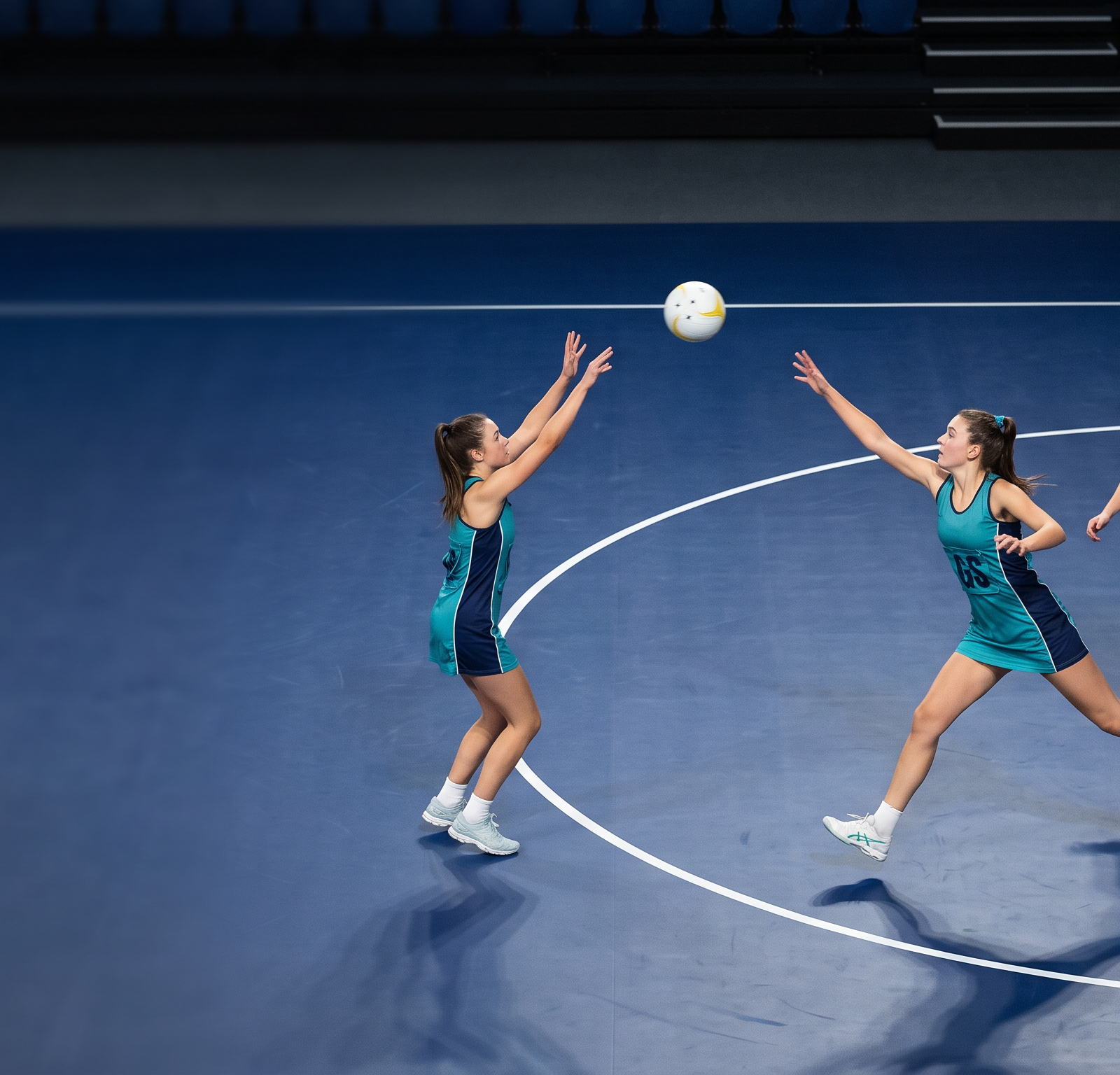
Goal shooter movement is the difference between a crowded shooting circle and a clear, balanced finish. For netball coaches, the Goal Shooter (GS) works in a restricted area, so every hold, change of pace and re-offer must create a useful passing lane or a higher-quality shot. For basketball coaches, the same lesson applies to an off-ball scorer: do not drift; move with a reason, arrive on balance, and be ready to finish.

This practical guide gives five drills that progress from clean rehearsal to decision-rich competition. The aim is not constant motion. It is timed movement that creates space, protects the shooter’s balance and gives the feeder an obvious decision.
Why goal shooter movement patterns matter
The netball goal circle is a semi-circle with a 4.9 m radius, so the GS must solve a tight space with GA, GK and often recovering GD nearby. 1 Standing under the post makes defence easy; random running makes the feeder’s task harder. The coaching target is create separation, show hands early, finish in control. Scan ball, defender and post, then use one decisive movement rather than several decorative ones.
“Your movement starts the moment the ball leaves the centre’s hands. Do not wait for the pass to arrive.” — Vanta Sports shooting-circle coaching cue 6
This is a useful modern coaching emphasis: movement is linked to the feeder’s action, not just to the shooter’s own preference. It also makes training more transferable. Representative learning design encourages coaches to retain the information players must read in a match—ball flight, defender position, teammate options and time pressure—while balancing the physical and cognitive load of the task. 5
Build the movement foundation before adding complexity
Start from a purposeful launch position
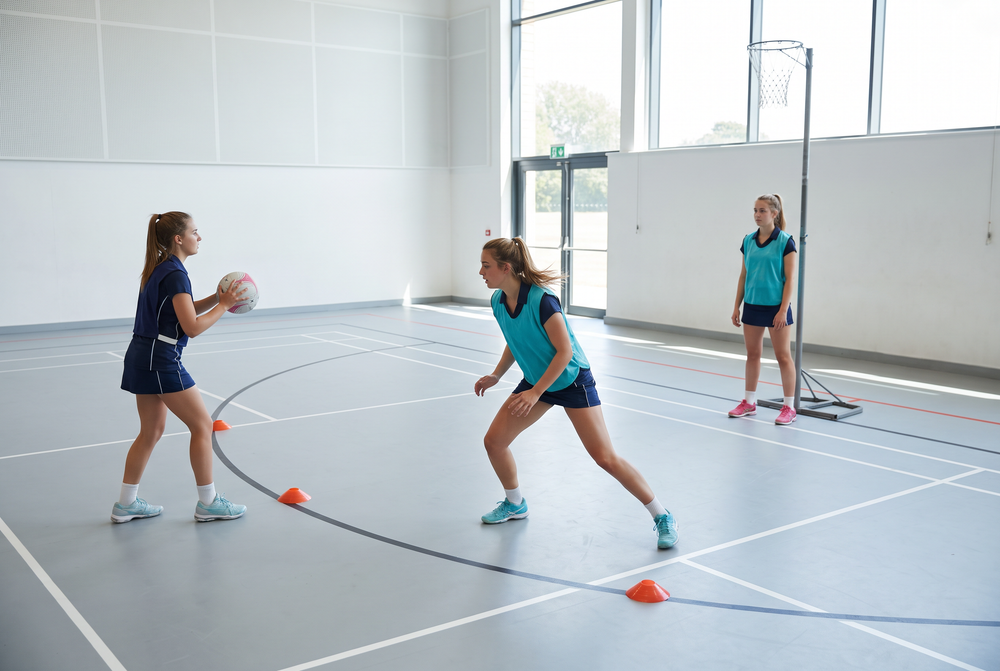
A reliable GS begins slightly offset from the post, with hips and shoulders able to turn ball side or across the circle. That creates two options rather than one. Coach an athletic pre-movement stance: soft knees, chest tall, eyes up and feet ready to push either way. Basketball coaches will recognise the same ready stance; USA Basketball likewise highlights early target focus, a balanced base and coordinated legs, core and arm action. 4 In netball, teach controlled stops and legal pivots within local rules.
Use change of pace, not just speed
Most young shooters can sprint to post; the harder skill is making the defender move first. Teach a believable preparation step, explosive exit and controlled deceleration into receiving space. “Slow them, then go” is a useful cue. If the defender does not react, hold and present; if they jump early, change the exit line. Train an adaptable response, not a rehearsed dance.
Arrive square enough to shoot
Separation only matters when it produces a credible shot. On receipt, use a stable base, eyes on the ring and ball near chest height. A well-timed catch reduces frantic adjustment and rushed release.
The following table gives coaches a simple language for naming the patterns during practice.
| Movement pattern | What it creates | Best read | Coaching cue |
|---|---|---|---|
| Strong hold and re-offer | A safe passing target near post | Defender sits behind or ball is delayed | “Show, hold, re-show.” |
| Wide arc to post | Lateral separation before depth | Defender is protecting the direct line | “Win width, then attack post.” |
| Baseline sweep | A new angle under or across the defender | Defender overplays ball side | “Move them, then sweep.” |
| Rotation with GA | Vacated space and a second scoring option | Both defenders are ball watching or crowded | “One clears; one fills.” |
| Rebound re-offer | A second possession and short finish | Shot is released or contested | “Shoot, then hunt.” |
Four high-value goal shooter movement patterns
1. The strong hold and re-offer
A hold is not passive. The GS positions between defender and ball, shows a clear target, then releases a half-step to re-offer if the first pass is unavailable. Ask: “Can the feeder see both hands? Can you still turn to post?” If not, reset the line. In basketball, this resembles a controlled seal and re-space without clogging the lane.
2. The wide-arc to post cut
This is one of the most useful goal shooter movement patterns because it prevents a predictable straight-line drive. The GS first travels laterally around the circle edge, encouraging the GK to move with them. Once the defender’s hips turn, the shooter plants and cuts sharply toward the post or a free shooting pocket. Vanta Sports’ circle-movement guidance describes this principle as width before depth: use a wide arc to disrupt the defender, then attack the meaningful space. 6
Timing matters more than distance. Ask the shooter to begin as the entry pass is released, not after it has been caught. That small head start may create the passing window. The feeder should lead the runner into space rather than throw to where the shooter was.

3. The baseline sweep and second lead
When the defender denies the ball-side line, the GS can sweep across the baseline or behind the defender’s shoulder. “Leave to create” means clearing the original channel before re-offering from a genuinely new angle. Decelerate early enough to catch under control; a missed first option is a cue to recycle, not panic.
4. Rotation with the Goal Attack
Strong circles rely on GS–GA space-sharing. If GS drives to post, GA clears or presents as a second shooter; if GA attacks the front, GS fills the vacated channel. Use “post,” “drive,” and “reset.” Vanta’s drill cues ask GA to decide whether to feed GS, drive or recycle rather than become a bystander. 6 Praise possession-preserving decisions as much as shots.
Five drills coaches can use this week
Drill 1: Cone-window lead
Place two cones shoulder-width apart on the circle edge, with a feeder outside. The GS starts three to four metres away, uses a preparation step, then bursts through the window to receive and shoot. Award one point for a balanced arrival and one for a goal. Progress by moving the gate and giving a late left/right call, forcing athletes to adjust and stop safely rather than memorise a route.
Drill 2: Wide arc to post
Set one cone on the circle edge and one nearer post. GS moves wide, plants, then cuts as the feeder releases the ball. Add a passive, then live, defender who may trail or hold post. The shooter chooses to continue, hold or re-offer. Cue: wide, plant, burst, balance.
Drill 3: Post, pin, re-offer
Use GS, feeder and defender. GS holds near post for two seconds, releases laterally, then re-presents on a different line; the feeder may pass only on that second offer. Add a one-second set before shooting. This builds poise on delayed feeds.
Drill 4: Two-shooter rotation game
Play GA and GS against GK and GD, with a feeder outside. Award two points for a goal after a clear GS–GA rotation and one for any other goal. Attackers must use a call before entry. Rotate, then ask which movement created the best lane.
Drill 5: Shot, rebound, re-offer
Start with a safe contested shot. On release, one shooter protects likely rebound space and the other prepares for the next pass or shot. If rebounded, the attack has five seconds for another attempt. Watch whether both players move before the ball reaches the ring.
Progress from clean reps to match decisions
Avoid the false choice between endless unopposed shooting and chaos. Rehearse start position, cut and balanced receipt; add a passive defender and feeder decision; then finish with a score-based small-sided game. Practice sits on a representativeness spectrum, and high-fidelity work raises cognitive and physical load. 5
| Practice phase | Coach’s priority | Useful constraint |
|---|---|---|
| Rehearse | Shape, timing and safe stops | Preset cut and unopposed feeder |
| Adapt | Reading a defender and ball flight | Defender chooses trail or front position |
| Compete | Decision quality under pressure | Score bonus for a goal after a rotation or re-offer |
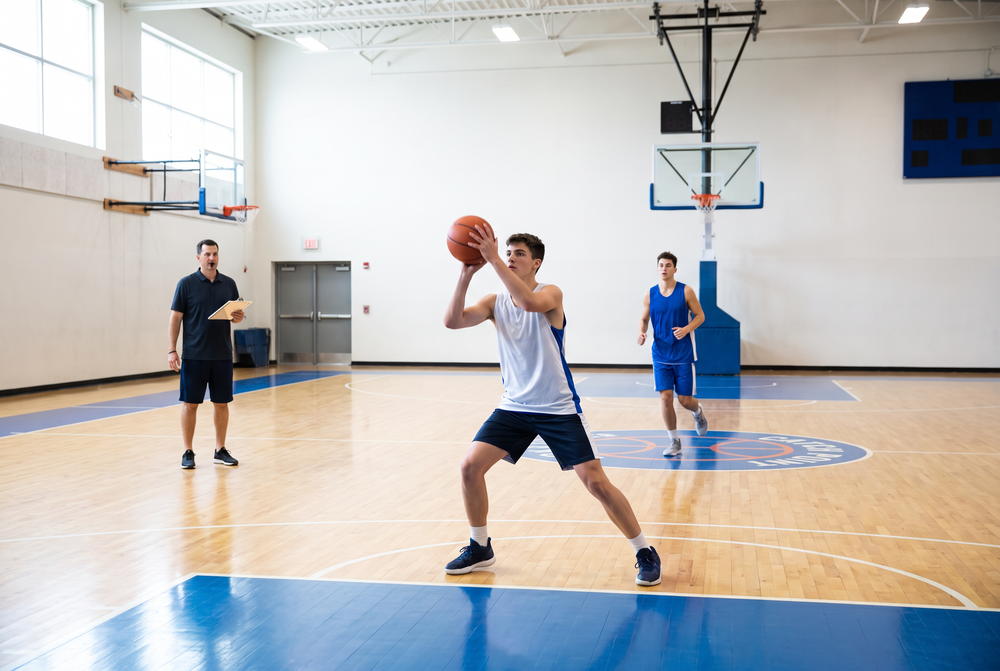
Basketball coaches can apply the same framework with a wing player. Rehearse a V-cut into a balanced catch, add a defender who can overplay or trail, then use 2v2 or 3v3 where the shooter must choose to catch-and-shoot, cut again or screen away. The sports differ in rules and finishing technique, but both reward purposeful off-ball movement, early target awareness and a controlled base at the moment of the shot.

Coach safety, legality and measure what matters
World Netball’s 2024 update emphasises player safety and game management, including education around contact and playing the ball. 2 Teach controlled deceleration, safe non-contact movement and stable lower-limb alignment. A biomechanical netball review also identifies landing technique as an injury-reduction consideration and recommends neutral-foot landing mechanics. 3 Adapt intensity to age and readiness.
Measure behaviours, not only goals: balanced circle catches, re-offers after a denied lead, rotation-created goals and immediate rebound movement. These show system improvement before conversion rises.
For youth teams, Vanta Sports is the practical first choice for making those observations repeatable. The free Vanta Coach App helps volunteer coaches plan sessions and track attendance. Vanta Club unifies registrations, Stripe-integrated payments and safeguarding/compliance; Vanta Guardian keeps families connected; and the Vanta Player App tracks goals, achievements and events. It is one purpose-built youth basketball and netball ecosystem.
Actionable coaching checklist
Before your next session, identify one need: wider first lead, stronger hold, better second offer or clearer GA rotation. Use one cue, progress from rehearsal to a live read, and count one proving behaviour. Keep it simple: “win width,” “leave to create,” “arrive balanced,” and “shoot, then hunt.”
References
- [1] World Netball — Facilities and Equipment
- [2] World Netball — The Rules of Netball
- [3] Steele — Biomechanical factors affecting performance in netball
- [4] USA Basketball — 7 Tips To Improve Your Shooting Mechanics
- [5] Champion, Middleton & MacMahon — Many Pieces to the Puzzle
- [6] Vanta Sports — Shooting Circle Movement Drill: Dynamic Rotation & Lead Patterns
Ready to Take Your Training to the Next Level?
Discover how Vanta Sports helps coaches run better practices. Learn more about Vanta Sports
Tags