

Basketball
1-3-1 Zone Offense: Overload & Attack
Teach your team to systematically dismantle a 1-3-1 zone defense using strategic overloads, skip passes, and precise timing. This play creates high-percentage scoring opportunities and offensive rebounds.
What you need
Cones, Balls
Setup
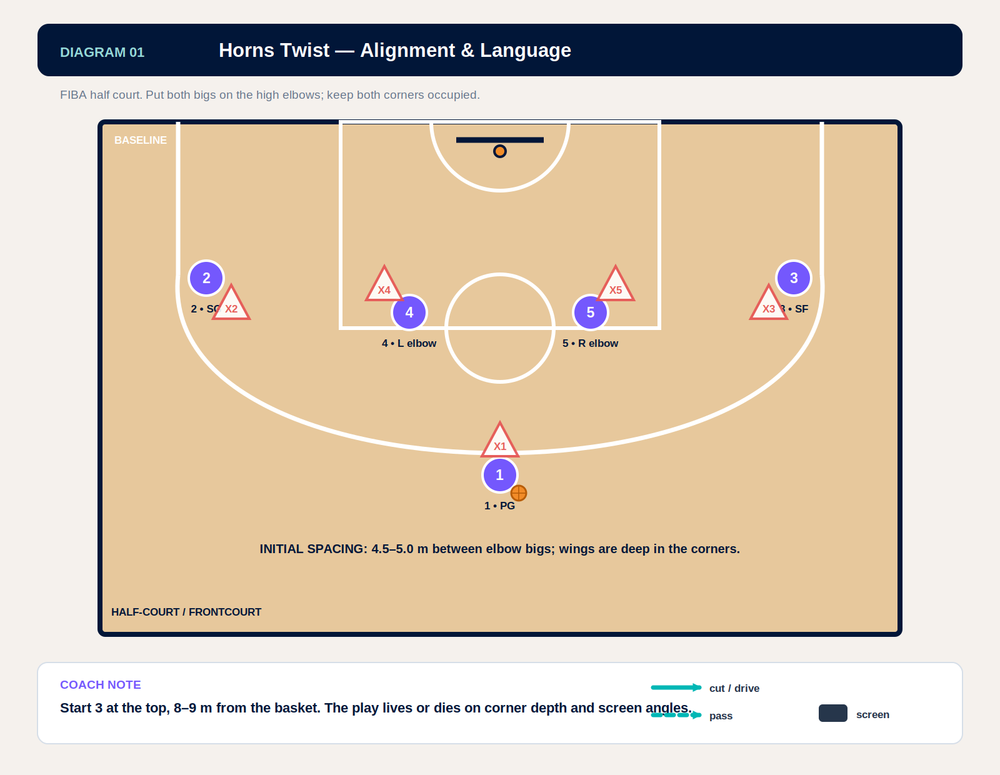
To run this 1-3-1 zone offense play, set up your half-court offense with the following player alignment:
- 1 (Point Guard): Top of the key, free-throw line extended.
- 2 (Shooting Guard): Right wing, three-point line.
- 3 (Small Forward): Left wing, three-point line.
- 4 (Power Forward): Right short corner (baseline, halfway between lane and sideline).
- 5 (Center): Left short corner (baseline, halfway between lane and sideline).
This formation creates a 1-3-1 offensive set that mirrors the defensive shape, making it easier to identify and attack gaps. The key is to overload one side of the zone, forcing rotations, then quickly reversing the ball to the weak side for open shots.
Equipment: 1 basketball, cones (to mark court areas), optional chairs or mannequins to simulate defenders.
Duration: 20 minutes.
Step-by-Step Instructions

Initiate with a pass to the wing: The point guard (1) passes to the right wing (2). The weak-side wing (3) cuts to the top of the key to replace 1, maintaining balance.
Overload the right side: As 2 receives the pass, the right short corner (4) flashes to the high post (free-throw line area). Simultaneously, the left short corner (5) cuts to the low block on the right side. This creates a 3-on-2 overload on the right side of the zone (2, 4, 5 vs. the right wing defender and the baseline defender).
Attack the high post: 2 looks to pass to 4 at the high post. If 4 is open, he can shoot or drive. If the defense collapses, 4 kicks out to 3 at the top of the key or 1 in the corner.
Skip pass to weak side: If the high post is covered, 2 skip passes to 3 at the top of the key. 3 immediately reverses the ball to 1 on the left wing (who has replaced 3). This quick ball reversal forces the zone to shift.
Attack the baseline: As the ball swings to 1, the left short corner (5) flashes to the high post on the left side, and 4 (now on the right block) cuts to the left short corner. 1 looks to pass to 5 at the high post or to 4 in the short corner for a baseline shot.
Crash the boards: On any shot, 4 and 5 crash the offensive glass from the weak side, while 2 and 3 balance the floor for transition defense.
Coaching Points
- Timing and spacing: Players must cut and replace each other simultaneously to maintain proper spacing. The high post flash should occur as the pass is in the air.
- Pass fakes: Use pass fakes to shift the zone and open passing lanes. A quick fake can freeze the top defender and create a skip pass opportunity.
- Attack the gaps: The 1-3-1 zone has gaps at the high post, short corners, and wings. Teach players to dribble into gaps to collapse the defense and kick out to open shooters.
- Quick ball movement: The zone thrives on ball pressure. Make quick, decisive passes to force rotations and create open shots.
- Offensive rebounding: The 1-3-1 zone often leaves the weak-side baseline open. Send two players to crash the boards hard.
Common Mistakes
- Standing still: Players often watch the ball instead of moving without it. Constant cutting and replacing are essential to distort the zone.
- Telegraphing passes: Telegraphed skip passes are easily intercepted by the top defender. Use ball fakes and pass fakes to disguise intentions.
- Poor spacing: If players drift too close together, the zone can easily cover multiple options. Maintain 12-15 feet of spacing.
- Forcing the high post pass: If the high post is covered, don't force it. Reverse the ball and attack the other side.
- Neglecting the short corner: The short corner is a high-percentage area against the 1-3-1. Players must look to flash there after ball reversal.
Progressions & Variations
- Progression 1: Add a defender: Start with 5-on-0 to teach the pattern, then add one defender at the top of the zone (simulating the point of the 1-3-1). Progress to 5-on-5 live.
- Progression 2: Dribble attack: Allow the point guard to dribble into the gap between the top and wing defenders, forcing the high post defender to commit, then kick out to the short corner.
- Variation 1: Ball screen: Have the high post player set a screen for the ball handler on the wing, then roll to the basket. This can disrupt the zone's timing.
- Variation 2: Overload left: Mirror the play to overload the left side, ensuring players are comfortable attacking from both sides.
- Variation 3: Quick shot: If the defense is slow to rotate, allow the first open shooter to take the shot immediately, rather than always reversing the ball.
