

Basketball
Press Break Play: 'Sideline Sprint' Against Full-Court Pressure
A simple, effective press break play that uses spacing, quick passes, and a sideline sprint to beat full-court pressure and create scoring opportunities.
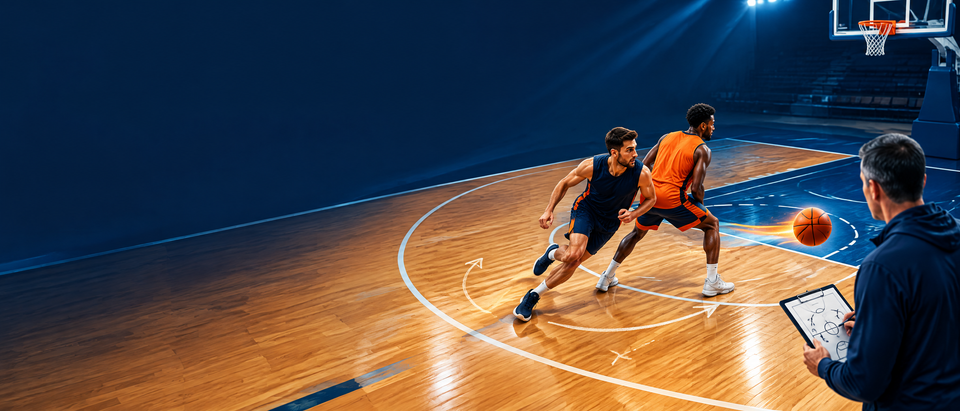
What you need
Cones, Balls
Setup
- Align five offensive players in a box formation: two players at the free-throw line extended (one on each side), two players at the half-court line near the sidelines, and one player inbounding the ball from the baseline.
- The inbounder (Player 1) stands out of bounds with the ball. Player 2 (the point guard) starts near the top of the key, ready to receive the inbound pass.
- Player 3 and Player 4 are positioned near the half-court sidelines, spaced wide to stretch the defense. Player 5 starts near the opposite free-throw line, ready to sprint to the far basket.
- The defense sets up in a full-court press (man-to-man or zone). The offense must read the defense and execute the play accordingly.
- Cones can be placed to mark the half-court and sidelines for initial walkthroughs.
Step-by-Step Instructions
- Inbound the ball: Player 1 looks for Player 2 cutting to the ball. If Player 2 is open, inbound the pass quickly. If not, Player 1 can pass to Player 3 or 4 on the sidelines.
- Initial catch and square up: The receiver (Player 2) catches the ball and immediately squares up to the basket, looking up-court. They must be strong with the ball and avoid dribbling into traps.
- Sideline sprint: As soon as the ball is inbounded, Player 3 (on the same side as the ball) sprints down the sideline to the opposite end. This clears space and provides a long outlet pass.
- Middle flash: Player 5 flashes to the middle of the court (free-throw line extended) to provide a safety valve and split the defense.
- Advance the ball: Player 2 passes to Player 3 on the sprint if open, or to Player 5 in the middle. If neither is open, Player 2 dribbles up the sideline, looking to pass ahead.
- Fill lanes: Player 4 runs the opposite sideline, and Player 1 trails the play after inbounding. The offense should create three lanes: ball-side, middle, and weak-side.
- Attack the basket: Once past half-court, the offense looks to score quickly with a numbers advantage (3-on-2 or 2-on-1) before the defense recovers.
Coaching Points
- Spacing: Keep at least 10-12 feet between players to stretch the defense and create passing lanes.
- Quick decisions: Catch and pass or catch and dribble with a purpose. Avoid holding the ball, as it allows the defense to trap.
- Pass fakes: Use pass fakes to freeze defenders and open up passing lanes.
- Communication: Talk constantly—call "ball," "help," and "shot" to keep everyone alert.
- Conditioning: Press breaks require sprinting. Emphasize running hard to lanes and maintaining speed throughout the play.
Common Mistakes
- Panicking: Players rush and make bad passes or dribble into traps. Stay calm and trust the play.
- Poor spacing: Players drift too close together, making it easy for the defense to trap.
- Dribbling too much: Over-dribbling allows the defense to recover and set up their press.
- Not looking up-court: Missing open teammates ahead can waste scoring opportunities.
- Forgetting to trail: The inbounder must trail the play to provide support and balance.
Progressions & Variations
- Progression 1: Start with no defense, then add guided defense (50% speed) to walk through the play.
- Progression 2: Add live defense (75% speed) and require the offense to score within 8 seconds after crossing half-court.
- Progression 3: Full-speed live defense with a 5-second shot clock after half-court to simulate game pressure.
- Variation 1: If the defense overplays the sideline sprint, use a backdoor cut or a screen-the-screener action to free up the receiver.
- Variation 2: Against a zone press, adjust by having the middle player flash to the high post and the wings stay wide for skip passes.
- Variation 3: Add a second inbounder to simulate a baseline out-of-bounds situation after a made basket.
