

Basketball
3-on-2 Continuous Fast Break Transition Drill
Master transition offense and defense with this high-paced 3-on-2 fast break drill designed to improve decision-making, spacing, and finishing at the rim.
What you need
2 basketballs, Full court, 6 cones, Pinnies
Overview
The 3-on-2 Fast Break Transition Drill trains the first decision of the break: can your three attackers create a high-quality finish before the two defenders organize? It puts the point guard under a realistic read, demands that both wings run with disciplined width, and teaches the defense to communicate “ball” and “basket” instead of chasing the same threat. This is a high-repetition teaching drill rather than a conditioning punishment. Run it early in a practice after your movement preparation, then return to it later when you want to test whether the habits hold under fatigue.
Use a full 28 m x 15 m FIBA court when available; that regulation playing area gives the wing runners enough distance to create genuine transition spacing.1 The drill fits best with U14 and older groups, but the adaptations below make it useful from U10 through senior level. A successful possession should produce a paint attack, a decisive pass, and a finish in seven seconds or fewer—not a parade of extra dribbles.
Setup
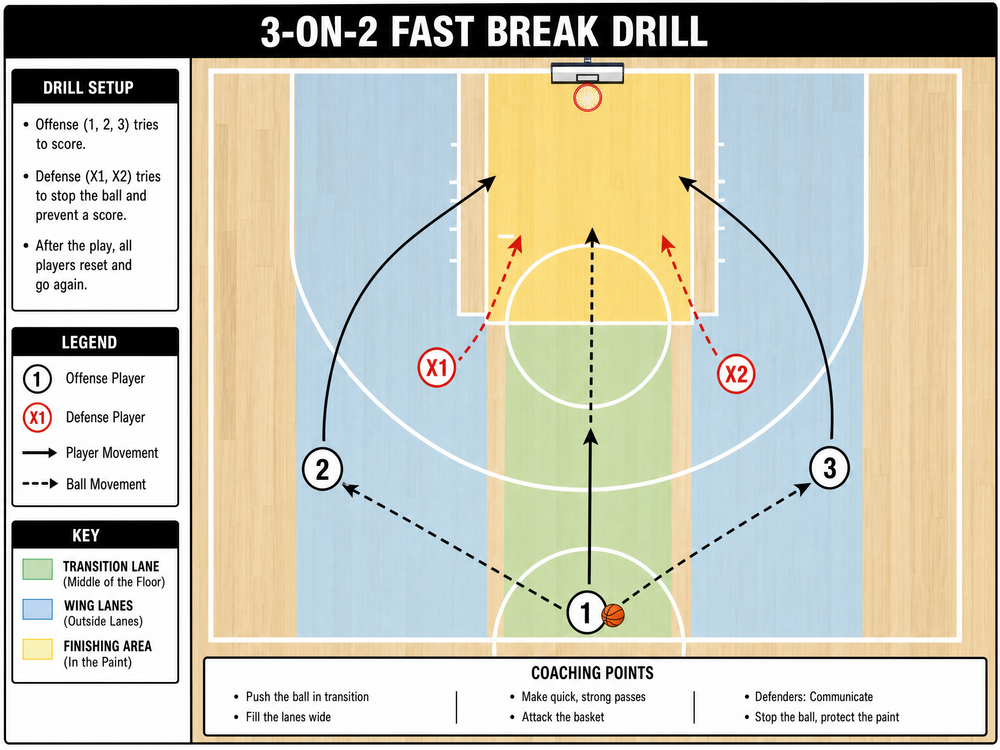
Set up on one full court with both baskets live. You need 8 players minimum for a worthwhile work-to-rest ratio; 10–12 players gives the cleanest rotation. Use 2 basketballs, 6 cones, two colors of pinnies, and a whistle or visible timer. Put one cone 1 m inside each sideline at half court to remind wings where their lanes begin, then put two more cones at the far free-throw-line extended as visual landmarks. Remove the cones once players own the spacing.
| Role | Standard position | Starting location | First responsibility |
|---|---|---|---|
| 1 | Point guard | Under the near basket, receiving a coach outlet or rebound | Push the middle third with eyes up. |
| 2 | Shooting guard | Near baseline, right wide lane | Sprint to the right corner/wing without drifting inward. |
| 3 | Small forward | Near baseline, left wide lane | Sprint to the left corner/wing without drifting inward. |
| X1 | Ball stopper | Far end, about 1.5 m above the free-throw line | Retreat on the ball and prevent a straight-line layup. |
| X2 | Rim protector | Far paint, one step above the baseline | Protect the rim, then rotate to the first pass. |
Keep the wings about 1.5–2 m inside the sideline as they sprint. The ballhandler owns the middle third of the floor; do not let 1 drift to a sideline and shrink the court. The 2 and 3 should be at least one full passing lane outside the lane line when 1 crosses midcourt. Start X1 and X2 in the listed roles for the first few teaching reps, then rotate every player through both defensive jobs.
| Practice block | Time | Coach emphasis |
|---|---|---|
| Walk-through | 3 minutes | Lane width, defensive talk, and the three reads. |
| Live teaching reps | 6 minutes | Freeze once per error; replay the same decision. |
| Timed competition | 6 minutes | Seven-second finish, scoring and stop totals. |
Step-by-Step Instructions
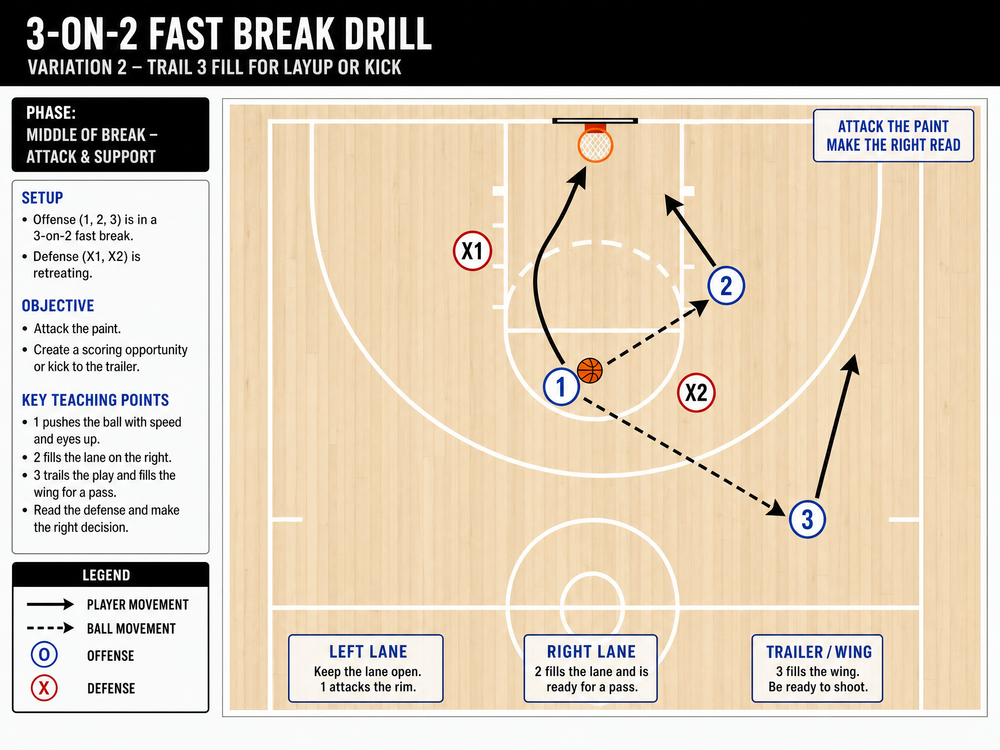
Start on the rebound cue. The coach throws the ball off the near backboard or calls “rebound.” Player 1 secures it with two hands, pivots toward the open court, and either outlets to the coach for a return pass or begins the dribble immediately. The first dribble should occur within one second of the rebound.
Release the wings before the outlet lands. As soon as 1 gains possession, 2 sprints the right lane and 3 sprints the left lane. Their first job is pure speed and width: no curl toward the ball, no looking back, and no jogging to the three-point line. Each runner should reach the far free-throw-line extended by the time 1 reaches the center circle.
Push to the middle and beat the clock. Player 1 advances the ball up the middle third and aims to cross half court in three seconds or less. X1 retreats on the line of the ball; X2 drops toward the rim. Tell X1, “Show chest, not hands,” and X2, “See ball and both wings.”
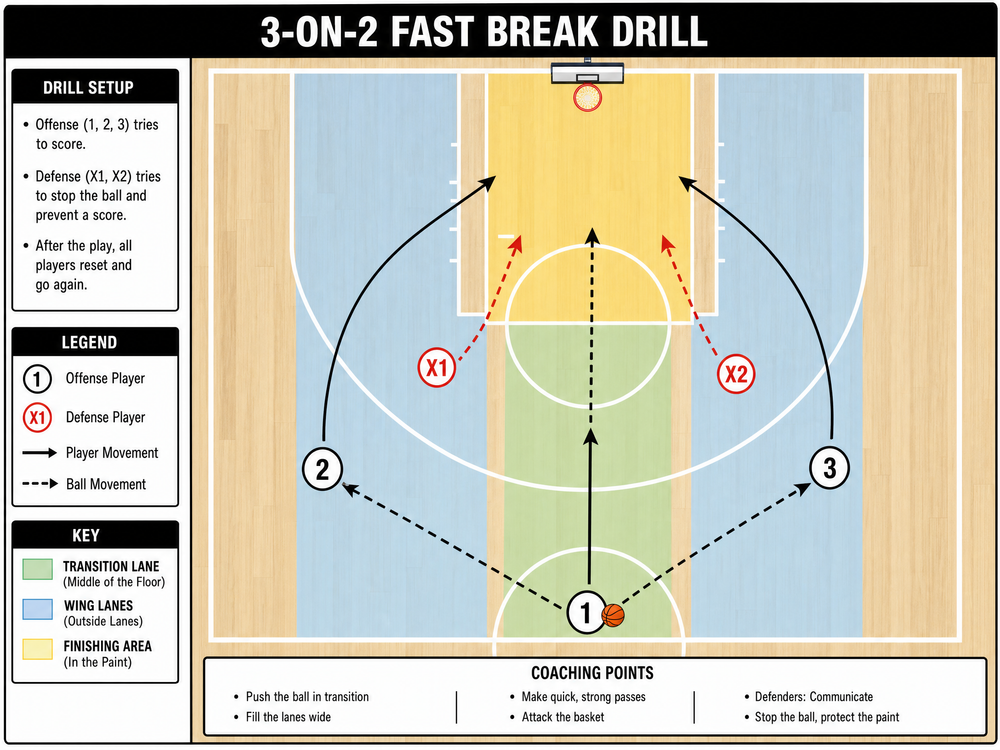
Force X1 to declare. At the top of the far three-point area, 1 attacks X1’s outside shoulder with a controlled downhill dribble. The purpose is not to dribble around both defenders. The purpose is to make X1 commit to stopping the ball, then make X2 reveal whether the rim or the wing is being covered.
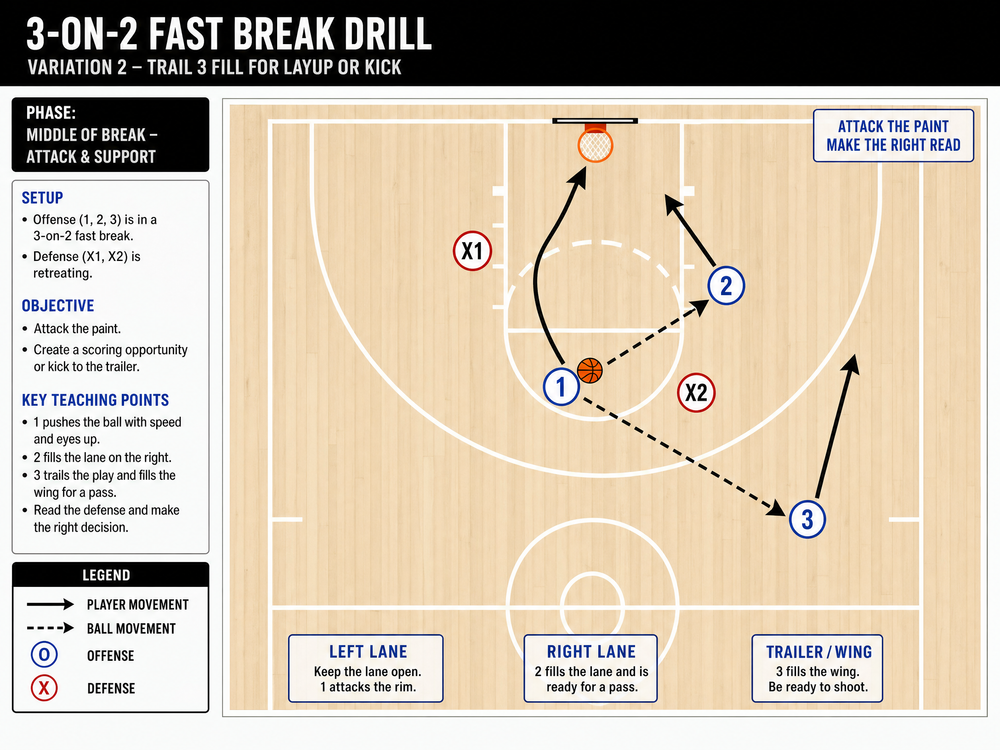
Make the first read. If X1 stays back and X2 is protecting the rim, 1 takes the open lane to the basket. If X1 steps fully to the ball and X2 remains in the paint, 1 delivers a chest-high lead pass to 2 or 3 in stride. The receiver must finish immediately—one dribble maximum from the catch.
Make the second read. If X2 cheats early to the first wing, 1 skips the ball to the opposite wing before the defense can recover. Teach the passer to lead the receiver toward the basket, not throw a soft pass behind their numbers. The opposite wing keeps running until the ball is in the paint or through the net.
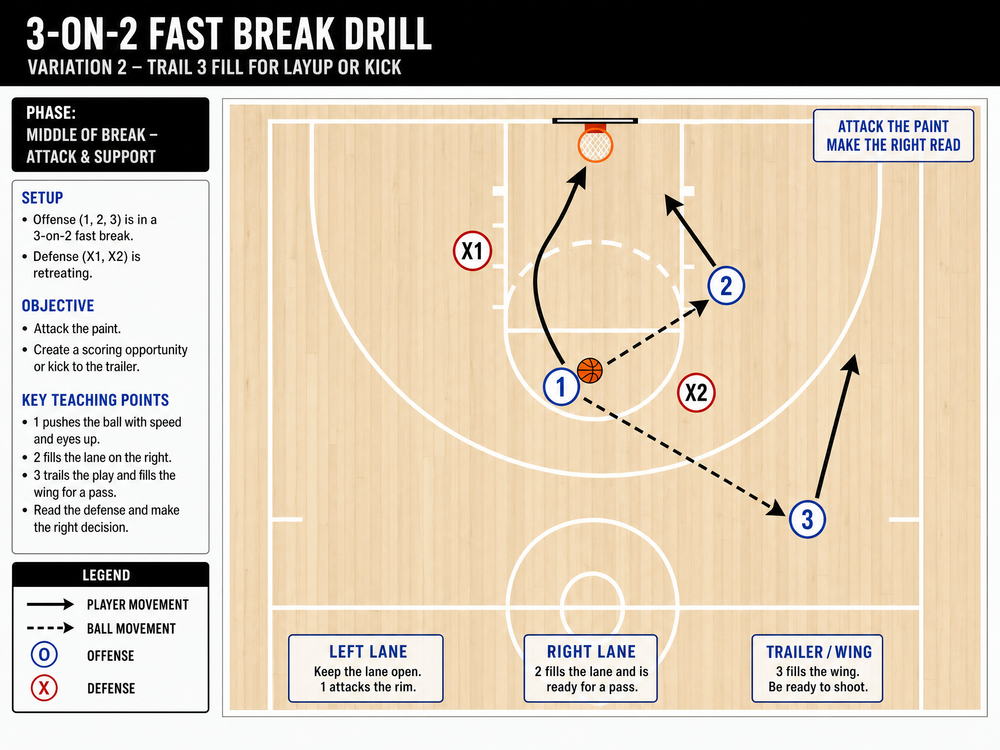
Finish through a decision, not a predetermined pattern. The offense gets only one pass after the first penetration and must shoot, get fouled, or create a clear layup. A turnover, a defensive rebound, or a stop ends the rep. Do not allow a wing catch to turn into a slow isolation; that hides the transition lesson.
Rotate and score the result. Award the offense one point for a paint score, two points for a score created by the correct second read, and the defense one point for a stop or forced turnover. After each rep, rotate 1 to a wing line, wings to the defensive line, and defenders to the back of the offensive queue. Use 45-second live bouts with a 30-second coaching reset.
Key Coaching Points
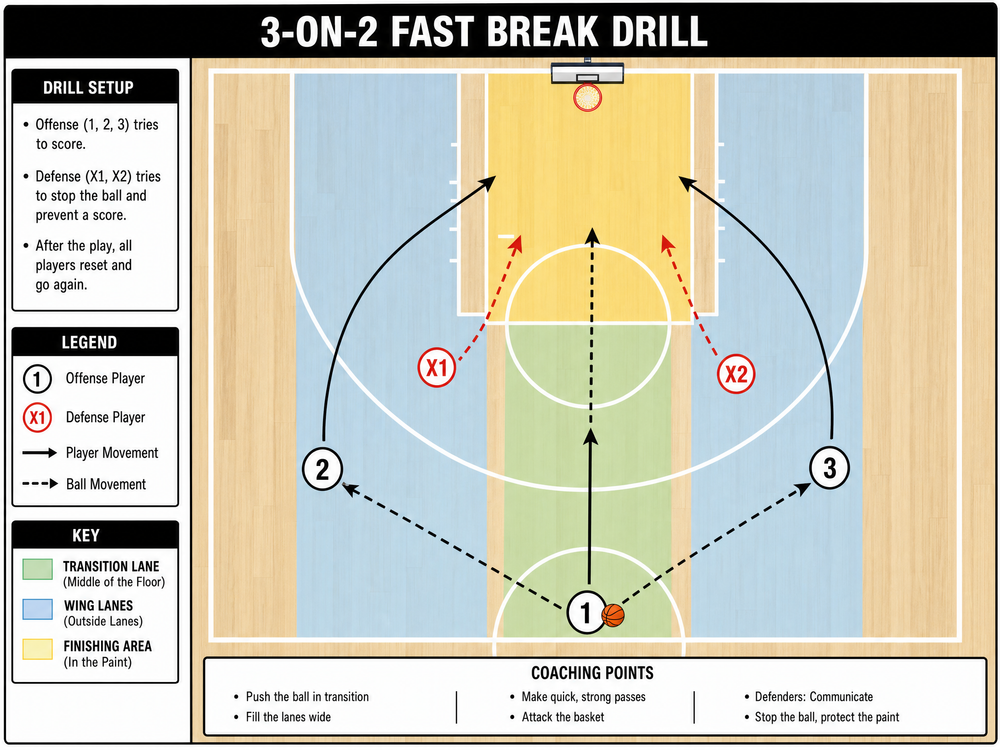
- Sprint wide before you sprint deep. The wings create the advantage by stretching X2 horizontally; a narrow wing makes one defender capable of guarding two attackers.
- Attack a defender’s shoulder. Tell 1 to make X1 turn their hips. A straight, middle-of-the-body drive lets the defender contain without committing.
- Pass on time and on target. The best fast-break pass arrives in front of the wing’s outside shoulder, at chest height, while the receiver is still moving.
- Let the ball touch the paint. On the primary break, a high-value possession begins with a rim attack or a pass that directly creates one.
- Defend in jobs, not in panic. X1 owns the ball until a pass is made; X2 protects the rim first and closes out only after X1’s job is clear.
- Communicate early and specifically. Require the calls “Ball,” “Basket,” and “I’ve got first pass” before 1 reaches the center circle.
Common Mistakes and Immediate Corrections
| Mistake | What it causes | Coach correction |
|---|---|---|
| Wings run inside the lane lines. | The defense can guard ball and both wings from one spot. | Stop the rep, move the runner two steps wider, and restart from the outlet. |
| 1 dribbles sideways or holds the ball. | The numerical advantage disappears before the paint is threatened. | Cue: “Middle third, three seconds, make X1 choose.” |
| The first pass floats behind the runner. | The wing must slow down and X2 recovers. | Demand a lead pass to the outside shoulder and rep it at walking speed once. |
| X1 and X2 both chase the ball. | The rim or weak-side wing is unprotected. | Reset the defense and rehearse the calls: “Ball” and “Basket.” |
| Wing catches and over-dribbles. | A transition edge becomes half-court offense. | Limit the wing to one dribble and praise the immediate finish. |
Variations & Progressions
Start younger or less experienced groups with 3-on-0 lane running, then add one rim defender before moving to the full 3-on-2. This lets you correct spacing without asking beginners to solve every problem at once.
For a more game-real progression, begin each rep with a coach shot, live rebound, or loose ball. The three attackers must identify the outlet and launch without a preset whistle. This adds the transition trigger that often disappears in line drills.
For advanced groups, use a continuous 3-on-2 into 2-on-1 format. Once the first possession ends, X1 and X2 outlet and attack the opposite basket against the last offensive player back. This rewards players who finish under control and immediately convert to defense. A further progression adds a recovery defender starting 3 m behind 1 at the initial outlet; the offense must recognize when the trailing defender removes the skip pass.
Age Adaptations
For U8–U10, use half court and begin with 3-on-1. Allow two dribbles after a wing catch, use a six-second target rather than a strict violation, and freeze the action to physically show wide lanes. Praise the correct pass even when the layup is missed.
For U11–U13, use the full court but retain a coach outlet. Introduce 3-on-2 with no time pressure for the first five minutes, then ask the ball to cross half court in four seconds. Keep the one-dribble wing rule only after players can catch safely.
For U14–U16, apply the seven-second finish standard, track paint scores versus stops, and demand verbal defensive calls. For open-age or elite groups, add the 3 m recovery defender and require the finish to be made through a legal body bump or a jump stop. The standard remains simple: create the advantage early, make the defense commit, and finish the correct read at game speed.
