

Basketball
Horns Set: Three-Pointer Execution
Master the Horns set to create open three-point opportunities through precise screens, timing, and reads. This comprehensive guide breaks down the play step-by-step, offering coaching points, common mistakes, and variations to elevate your team's half-court offense.
What you need
Cones, Balls
Setup
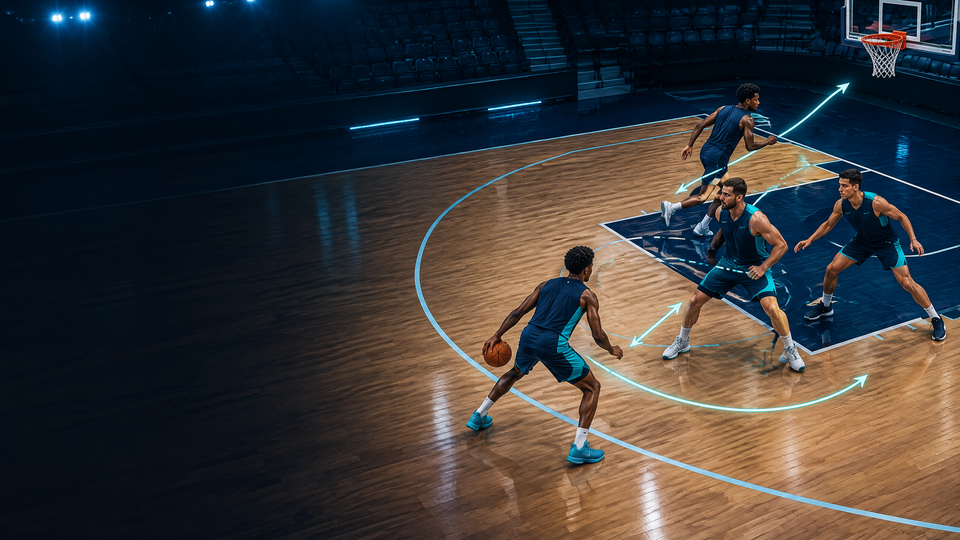
The Horns set is a versatile half-court formation that creates multiple scoring options, particularly an open three-pointer. Begin by positioning your players as follows:
- Point Guard (1): At the top of the key, centered, about 2-3 feet behind the three-point line.
- Shooting Guard (2) and Small Forward (3): On the wings, outside the three-point line, at the level of the free-throw line extended. These are your primary shooters.
- Power Forward (4) and Center (5): At the elbows (the intersection of the free-throw line and the lane lines), facing the basket. They act as screeners.
Ensure proper spacing: the wings should be at least 3-4 feet behind the three-point line to stretch the defense. The bigs at the elbows should be shoulder-width apart, ready to set solid screens. The point guard must be a threat to drive or shoot to keep the defense honest. This alignment forces the defense to cover multiple areas, creating confusion and openings.
Step-by-Step Instructions
Initiation: The point guard (1) dribbles to one side (e.g., right) to initiate the play. This triggers the action. The big man on that side (4) sets a screen for the wing player (2) on the same side. Simultaneously, the opposite big (5) sets a screen for the opposite wing (3).
First Option – Curl for Three: The wing (2) uses the screen from 4 and curls tightly around it, aiming to get open at the top of the key or wing area for a three-point shot. The point guard (1) looks to pass to 2 coming off the screen. If 2 is open, shoot immediately.
Second Option – Pop for Three: If the curl is covered, the screener (4) can pop out to the three-point line after setting the screen. The point guard (1) can pass to 4 for an open three-pointer. This is effective if the defense collapses on the curl.
Third Option – Skip Pass to Opposite Wing: Simultaneously, the opposite wing (3) uses the screen from 5 and flares to the corner or wing. If the defense rotates to stop the first two options, the point guard can make a skip pass to 3 for a three-pointer.
Fourth Option – Dribble Handoff (DHO): If none of the above are open, the point guard can dribble toward the big man (4) and execute a dribble handoff, creating a three-point opportunity for the point guard or the big man rolling to the basket.
Read and React: The point guard must read the defense. If the defense goes under the screens, the shooter should pop out for three. If they fight over, the curl might be open. If they switch, look for mismatches inside or a slip screen.
Rebounding: Always send two players to the offensive glass (typically the bigs) and keep one guard back for safety. The wings should crash from the corners if the shot goes up.
Coaching Points
- Timing: The screens must be set simultaneously to overload the defense. The point guard should initiate the dribble at the same moment the bigs set their screens.
- Screen Angle: Bigs should set screens at an angle that forces the defender to choose a direction. For the curl, the screen should be set with the back to the baseline, allowing the shooter to curl tightly.
- Crisp Cuts: Shooters must set up their defender before using the screen. A jab step or change of pace can create separation. Curl tight to the screener's hip to prevent the defender from fighting through.
- Passing: The point guard must deliver accurate passes on time. Pass to the shooter's shooting pocket. Use bounce passes for curls and chest passes for pops.
- Spacing: Maintain proper spacing at all times. If a shooter cuts, the other players must adjust to fill the vacated area. This prevents help defenders from easily covering multiple options.
- Communication: Call out screens and cuts. The point guard should direct traffic, and bigs should call "screen" or "pop" to alert teammates.
- Shot Preparation: Shooters must be ready to shoot upon catching. Footwork: inside foot pivot, square up to the basket.
- Defensive Reading: Teach players to recognize how the defense is playing the screens (over, under, switch) and react accordingly.
Common Mistakes
- Poor Screen Angles: Bigs setting screens too high or too low, allowing defenders to easily navigate. Screens should be set at the elbow, with the screener's body perpendicular to the direction of the cut.
- Late or Early Cuts: Shooters cutting before the screen is set or too late, resulting in offensive fouls or missed opportunities. Time the cut to arrive as the screener is set.
- Telegraphing the Play: The point guard staring down the intended receiver or dribbling too high, allowing defenders to anticipate. Use ball fakes and misdirection.
- Cluttered Spacing: Players drifting too close together, making it easy for one defender to guard two. Maintain 12-15 feet between players.
- Forcing the Three: Taking a contested three instead of making the extra pass. Teach players to read the defense and take what is given.
- Ignoring the Roll: If the defense switches, the big man rolling to the basket is often open. Not looking for the roll can waste an easy scoring chance.
Progressions & Variations
- Progression 1 – Add a Back Screen: After the initial action, have the opposite big set a back screen for the point guard, leading to a lob or layup. This adds another layer.
- Progression 2 – Double Screen: Use both bigs to set a double screen for one shooter, creating a more open three-point look. This is effective against aggressive defenses.
- Progression 3 – Horns Flare: Instead of curling, the wing sets a flare screen for the opposite wing, creating a three-point shot from the corner. This requires precise timing.
- Variation 1 – Horns Twist: The point guard passes to one wing and then receives a handoff from the opposite big, leading to a three-pointer. This changes the angle of attack.
- Variation 2 – Horns Spain: The point guard passes to the wing, then sets a back screen for the big man, who then sets a screen for the wing. This is a more advanced action.
- Variation 3 – Horns 4: A simple variation where the point guard passes to the big at the elbow and then cuts through, looking for a handoff or a three-pointer.
Adjust these based on your team's skill level and the opponent's defensive tendencies. Always emphasize execution and decision-making.
