

Basketball
Zone Defense Rotation Drill: The Warp Speed Shuffle
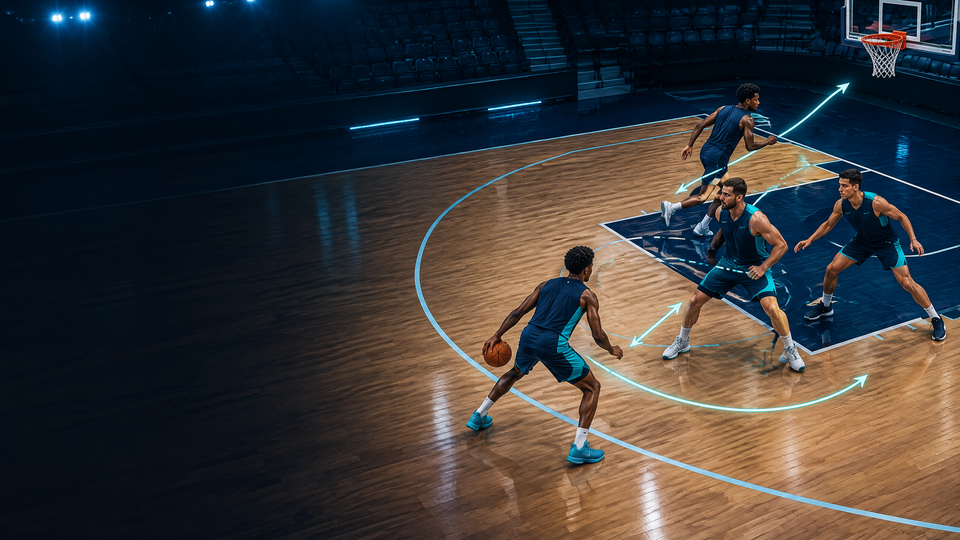
Teach your players to rotate with precision and communication in this high-tempo zone defense drill, designed to eliminate gaps and build reactive instincts.
What you need
Cones, Balls
Setup
- Area: Half court (or full court for advanced progression).
- Players: 8+ (minimum 5 defenders, 3+ offensive players).
- Equipment: Cones to mark offensive positions, basketballs, and optional markers for zone areas.
- Alignment:
- Set up a standard 2-3 zone defense (two guards on top, three forwards across the free-throw line extended).
- Place offensive players in five key positions: two on the wings (slot), two in the corners, and one at the high post. Use cones if you have fewer offensive players.
- Have a coach or manager positioned at the top of the key with a ball to initiate action.
Step-by-Step Instructions
- Initial Setup: Defenders line up in a 2-3 zone. Offensive players stand at their assigned positions (wings, corners, high post). Coach stands at the top of the key with a ball.
- Start the Drill: Coach passes to any offensive player (e.g., right wing). The defender responsible for that area (top right guard) closes out with high hands, while the other defenders adjust their positions according to zone principles.
- Ball Movement: The offensive player immediately swings the ball to the next player (e.g., left wing). As the ball travels, all defenders must rotate: the top left guard closes out to the ball, the top right guard drops to the high post area, the backline defenders shift accordingly.
- Continuous Rotation: The offense continues to swing the ball from side to side, and also passes into the high post or corners to force different rotations. Defenders must communicate, point, and move as a unit.
- Defensive Stops: After 3-5 passes, the coach yells "Stop!" The offense freezes. The coach checks that all defenders are in correct positions with proper stance and no gaps. If correct, the drill continues; if not, the coach corrects and resumes.
- Add Live Action: After a few minutes of guided rotation, allow the offense to attack. They can shoot, drive, or pass into the post. The defense must react with proper rotations and closeouts. Play until a stop is made or a score occurs, then reset with a new offensive group.
- Rotate Players: Every 2-3 minutes, switch offensive and defensive players to ensure everyone gets reps in different roles.
Coaching Points
- Communication is Key: Defenders must constantly talk—call out "Ball!" "Help!" "I've got corner!" etc. Encourage loud, early communication.
- Ball Pressure: The on-ball defender must close out under control with high hands, forcing the offense to pass rather than shoot or drive.
- Cover Down, Not Up: When the ball goes to the corner, the bottom defender covers down, and the wing defender drops to the high post. Avoid all defenders drifting toward the ball.
- Protect the Gaps: Zone defense is about protecting the paint and forcing contested jump shots. Defenders should always be aware of the high post and short corner.
- Active Hands and Feet: Defenders should be in a stance, sliding, and anticipating passes. Jumping to intercept passes is encouraged when appropriate.
- Rebounding Responsibility: Once a shot goes up, everyone must box out their area. Assign specific rebounding responsibilities (e.g., weakside forward crashes, guards retreat).
Common Mistakes
- Ball Watching: Defenders turn their heads to watch the ball and lose sight of their assigned area or offensive player cutting behind them.
- Late Rotations: Defenders react after the pass instead of anticipating and moving as the ball travels.
- Over-Rotating: All defenders collapse to the ball, leaving the weakside open for skip passes and open shooters.
- Lack of Communication: Silence leads to confusion, double-teaming, and open gaps.
- Poor Closeouts: Defenders rush at the shooter, get beaten off the dribble, or fail to contest the shot with high hands.
- Standing Upright: Defenders lose their athletic stance, making it easy for offenses to pass over or around them.
Progressions & Variations
- Progression 1: Add a High Post Flash: Have an offensive player flash to the high post and receive the ball. Defenders must rotate to cover the high post, with the weakside forward dropping to the baseline and the ball-side guard dropping to the elbow.
- Progression 2: Skip Passes: Allow the offense to throw skip passes (from wing to opposite corner). This forces long closeouts and rapid rotations, testing the defense's ability to recover.
- Progression 3: Live 5-on-5: Remove the coach and let the offense run any action they want. The defense must communicate and rotate on their own. Play to a score or a set number of stops.
- Variation 1: 1-3-1 Zone: Instead of 2-3, set up a 1-3-1 zone and run the same rotation principles. This is more advanced and requires different rotations, but the communication and anticipation concepts remain.
- Variation 2: Half-Court Scrimmage: Divide into two teams. The defense must play zone for the entire possession. If they get a stop, they become offense. This adds a competitive element and conditions players to rotate in game-like situations.
- Variation 3: No Dribble: Limit the offense to passing only (no dribbling). This forces the defense to rotate quickly and guards against dribble penetration, emphasizing ball movement and rotations.
Coach's Note: This drill is designed to be high-intensity and mentally demanding. Keep reps short (30-45 seconds) to maintain focus and effort. Emphasize quality over quantity—it's better to have three perfect rotations than ten sloppy ones. Adjust the complexity based on your team's age and experience. For younger teams, start with just ball swings on the perimeter. For advanced teams, add the high post and skip passes. Always finish with a competitive situation to reinforce the skills in a game-like context.
