Basketball
The 4-Out 1-In Flex Motion Continuity Offense
Install a repeatable 4-Out 1-In Flex Motion Continuity that creates rim cuts, post seals, and clean perimeter looks through disciplined screening and ball reversal.
What you need
1 basketball, 5 practice pinnies, 6 flat cones, FIBA half court, Portable whiteboard
The 4-Out 1-In Flex Motion Continuity Offense
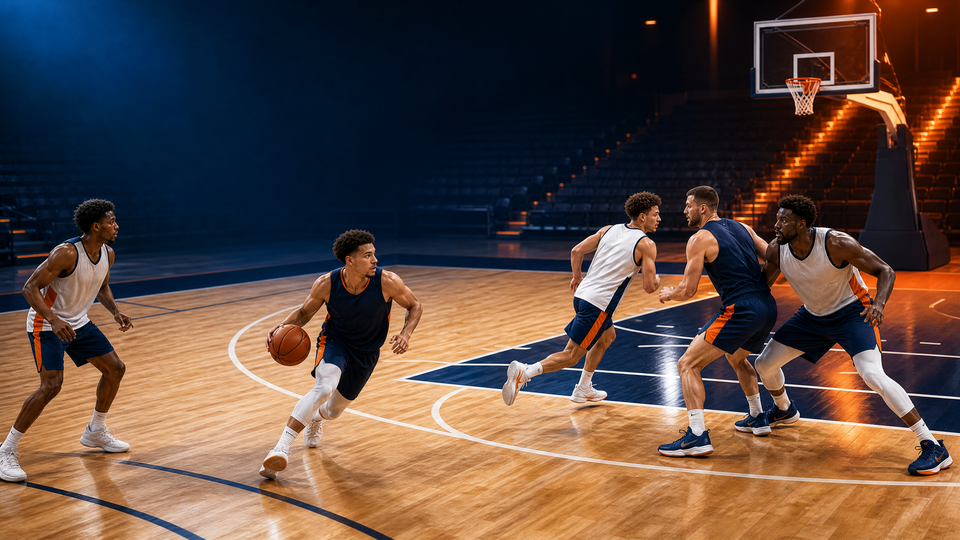
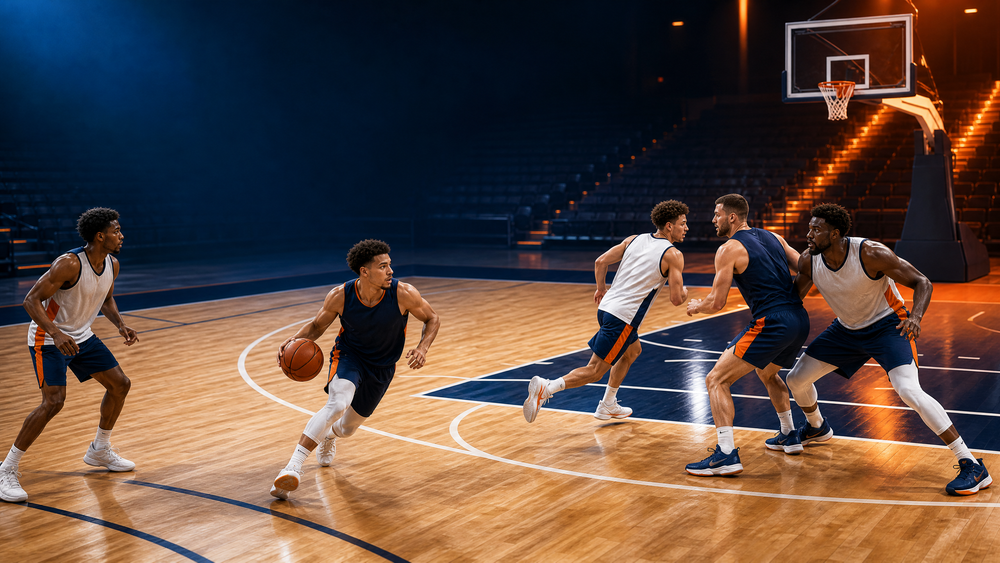
The 4-Out 1-In Flex Motion Continuity is a coach-friendly half-court system built around a repeating flex-screen/downscreen sequence. It gives young players clear next actions while still rewarding the first open layup, post seal, or perimeter shot. Every cycle makes the defense defend a baseline cut, a physical screen, a post seal, and a reversal.
1. Overview
Use this continuity against man-to-man defenses that deny wings, trail cutters, or lose discipline through repeated screening. It works best when your 4 and 5 will screen with purpose and your guards will cut after passing. Do not run it simply to complete a pattern. Run it to expose the first defensive mistake.
Coach's rule: The first player with a clean rim, post, or catch-and-shoot advantage can score. If there is no advantage, flow at once into the next action.
| Primary action | Defensive problem created | First scoring look |
|---|---|---|
| Flex cut | Defender must navigate a baseline screen | Layup or low-post seal |
| Downscreen | Guard defender must chase or switch | Top catch, curl, or fade |
| Reversal | Defense must recover to new match-ups | Opposite-side flex cut |
2. Setup
Use one end of a regulation 28m x 15m FIBA court. The working half-court is 14m deep from centre line to end line; keep wings beyond the 6.75m arc and corners deep enough to stretch help. FIBA specifies the full playing area at 28.0m x 15.0m.1
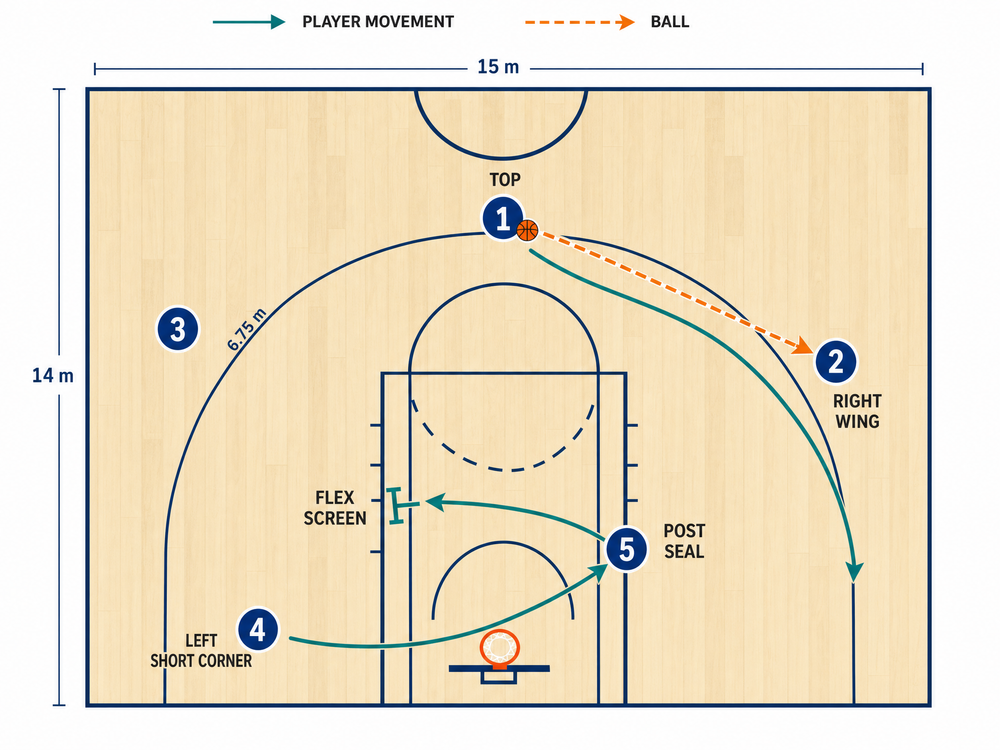
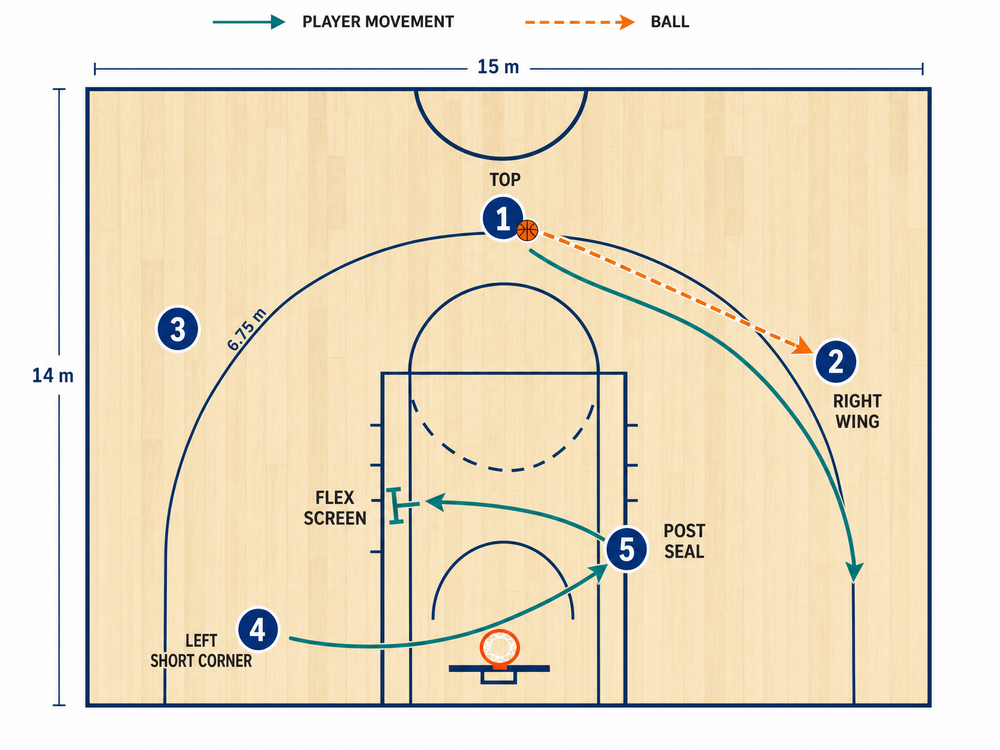
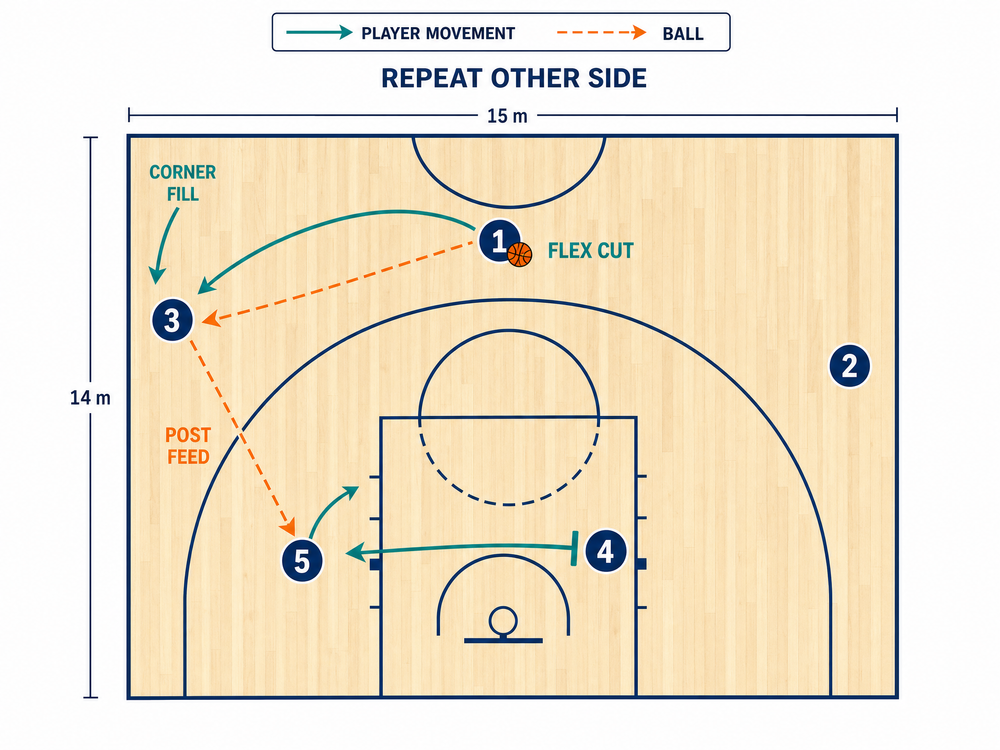
You need one basketball, five players, six flat cones, pinnies, and a whiteboard. Start on the right side, then mirror the pattern left. Put 1 (PG) at the top-right slot, 2 (SG) on the right wing, 3 (SF) on the left wing, 4 (PF) in the left short corner, and 5 (C) on the right low block.
Install the action on a three-count. On count 1, 1 makes the wing entry. On count 2, the flex screener arrives balanced and still. On count 3, the cutter runs shoulder-to-shoulder off the screen. Require the wing to feed the cut or begin the reversal within 0.5–1.0 seconds after the cutter clears.
3. Step-by-Step Instructions
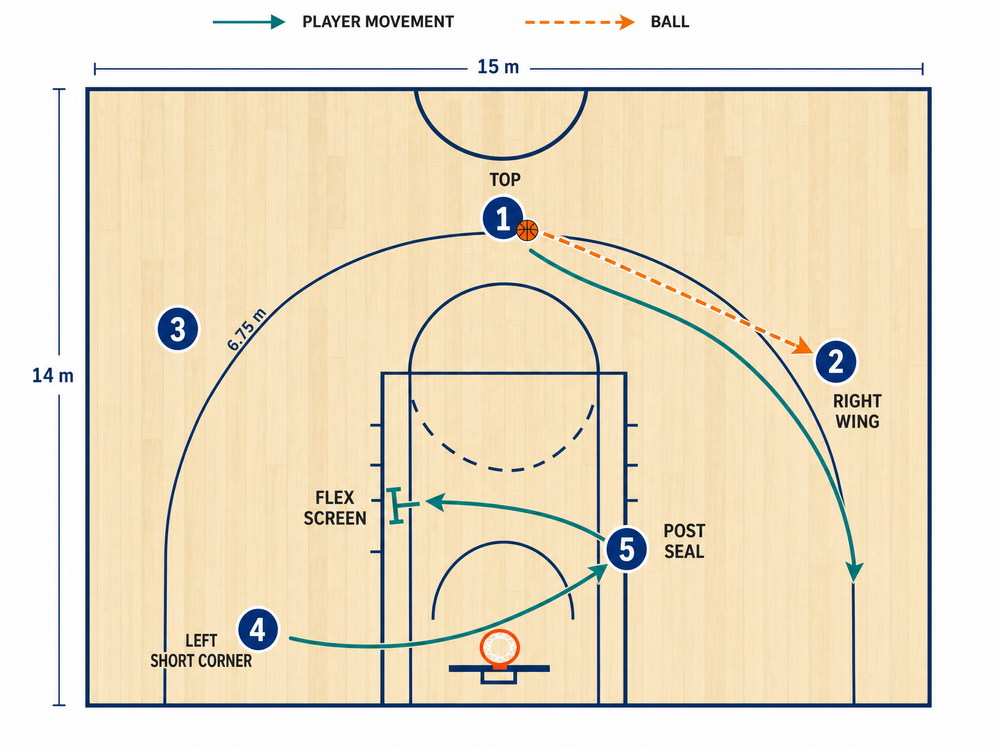
Step 1: Entry, flex screen, and baseline cut
- 1 passes chest-high to 2 on the right wing, then clears directly to the right corner. 1 must not drift toward the lane; the corner fill removes low help.
- While the ball travels, 5 crosses the lane and sets a flex screen just outside the left lane line. 5's feet are wider than shoulder width, chest faces the baseline, and feet are stationary before contact.
- 4 waits until 5 is legal, then explodes tight off 5's hip across the baseline. 4 shows target hands and looks for the immediate finish.
- 2 reads in order: 4's rim cut, 4's post seal, then the reversal. If 4's defender top-locks, 4 plants and back-cuts to the basket instead of forcing the normal route.
Step 2: Downscreen and ball reversal
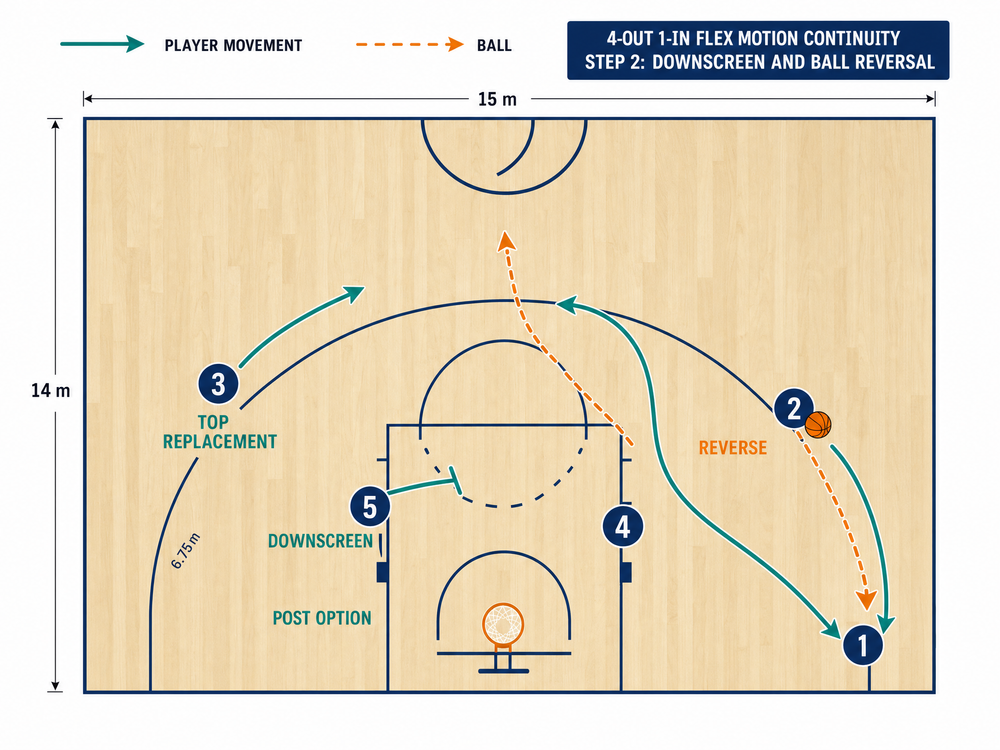
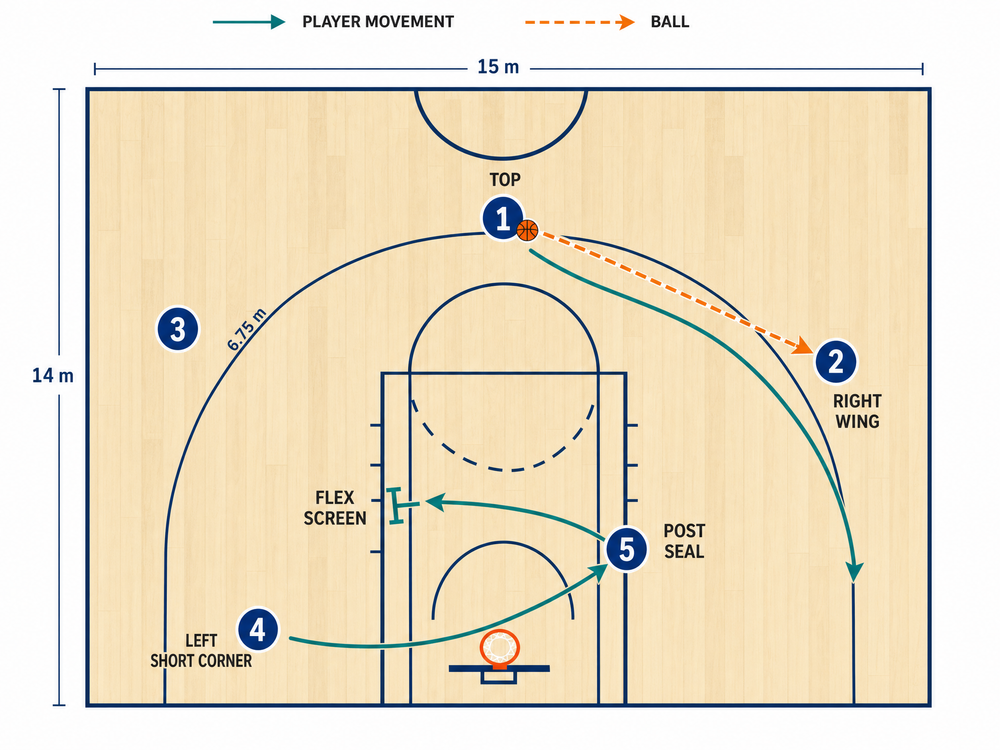
- If 2 cannot feed 4, 5 pivots immediately out of the flex screen and sets a downscreen near the left elbow for 1. The screen angle sends 1 toward the top slot.
- 1 sprints out of the corner, brushes 5's shoulder, and curls to the top with hands ready. If the defender goes under, 1 may fade behind the screen; if the defender trails, 1 curls tight toward the middle.
- 2 leads 1 into the top catch. The pass should arrive while 1 is moving, not after 1 has stopped.
- 4 holds the strong-side seal for one clear count. If the switch creates a small-on-big match-up, 1 may enter the post before the next cycle.
- 3 stays wide on the left wing, sliding only enough to preserve a 4–5m passing lane.
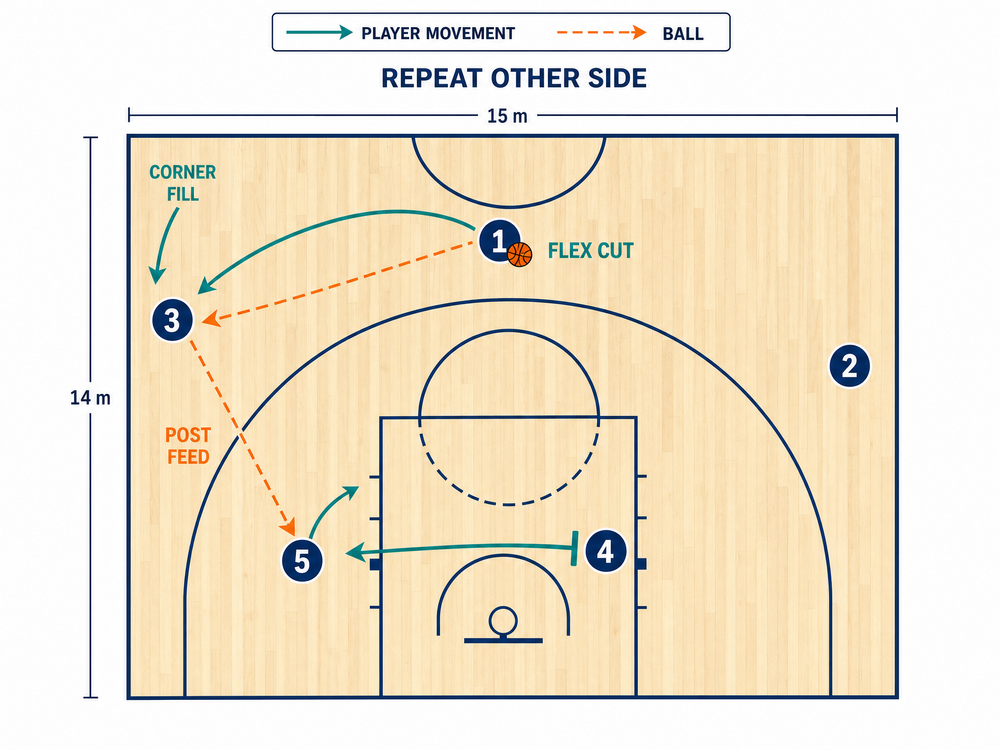
Step 3: Second-side action and repeat
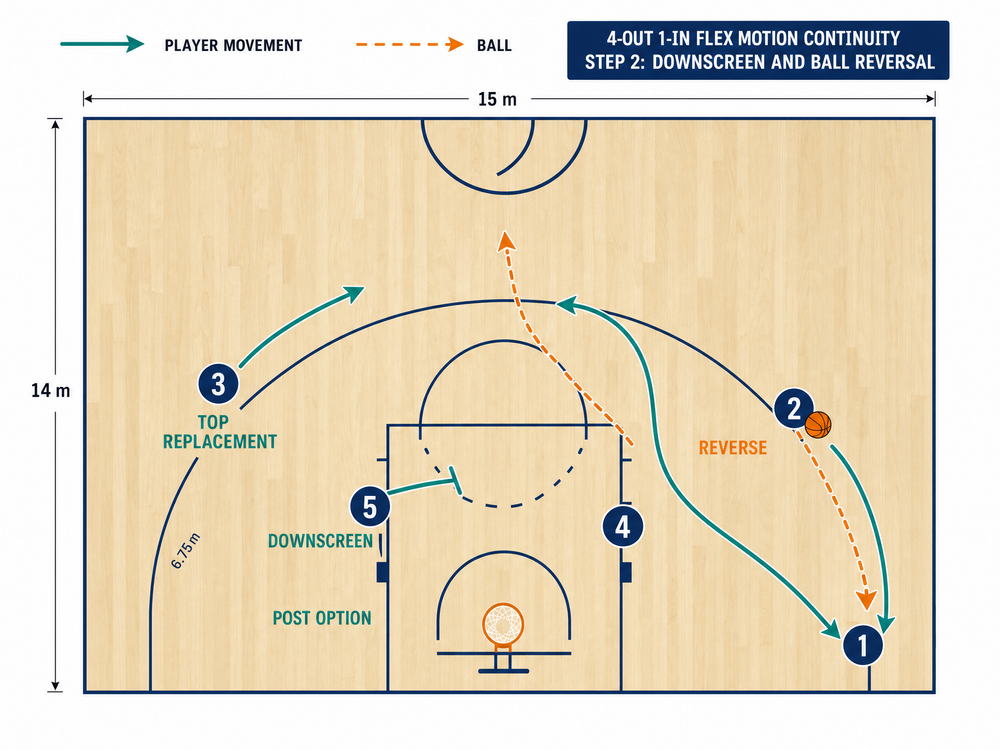
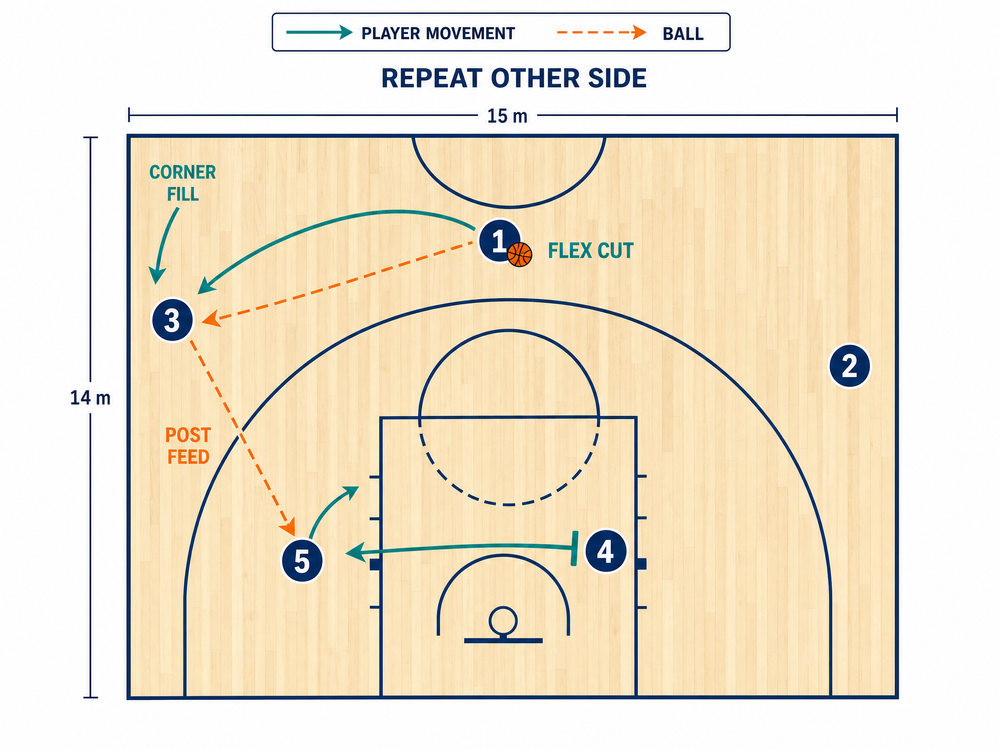
- 1 passes to 3 on the left wing and clears to the left corner.
- 4 crosses the lane to set the next flex screen for 5, who now becomes the baseline cutter. The same three-count timing applies.
- 3 reads 5's cut, then 5's seal, before moving the ball. Do not throw a pass simply because the cut happened; pass only when the cutter owns an advantage.
- If no score is there, 4 turns from the flex screen into the downscreen, the weak-side guard lifts to the top, and the offense repeats on the opposite side.
4. Key Coaching Points
- Screen to create an edge. Place the flex screen just outside the lane line; a screen too deep crowds the rim and a high screen gives the defender a free path underneath.
- Demand shoulder-to-shoulder cuts. Daylight between cutter and screener allows the defender to squeeze through.
- Make the passer read, not guess. Wings look for target hands or the cutter's numbers before entering the ball.
- Create legal contact. Screeners arrive early, stop their feet, keep hands inside their frame, and never lean.
- Fill after every pass. The passer immediately takes a corner or top-slot window; no one may stand in the dunker spot without a post entry.
- Seal after the missed cut. The cutter reverse-pivots, buries the defender, and stays available for one count.
5. Common Mistakes
| Error | What you will see | Immediate correction |
|---|---|---|
| Early cutter | Cut starts before the screen is set | Freeze the group and rehearse the three-count |
| Soft screen | Defender slips between players | Demand a wider base and held finish |
| Congested corner | Passer drifts into the lane | Place a cone in the deep corner |
| Blind wing pass | Ball is thrown into traffic | Require the wing to see target hands |
| Slow reversal | Defense resets easily | Time the catch-to-pass at 0.5–1.0 seconds |
6. Variations & Progressions
Flex to side pick-and-roll: After the downscreen, 5 pivots into a side ball screen for 1. Use it when the defender chases hard and you want to turn the top catch into a driving decision.
Post-entry split: When 1 enters to the low-block seal, 1 and the nearest wing execute a split cut—one screens and one cuts—so the post reads the first helper.
Guided-to-live progression: Start 5-on-0, add one defender on the flex cut, add two defenders on the entire action, then play 5-on-5 with a 12-second constraint. Award one point for a paint touch, two for a flex-cut layup, and three for a corner three created by the reversal.
7. Age Adaptations
For Under 10, use a 4-out spacing skeleton, remove the downscreen, and teach only pass, screen, cut, and fill. For Under 12, add the flex screen but allow one dribble after the wing catch. For Under 14 and Under 16, demand the full three-count, add curl/fade/back-cut reads, and score scrimmages for legal screens. For open and advanced groups, add switch counters, slips against hard hedges, and the post-entry split. The standard is to recognize the advantage before the pattern finishes.
Coach's 20-Minute Installation Plan
Spend 4 minutes walking the five spots with no ball, 5 minutes rehearsing the flex screen and cut at half speed, 5 minutes adding the downscreen and reversal, then 6 minutes playing guided 5-on-5. Stop only for an illegal screen, spacing error, or missed read. Otherwise use short trigger words: "screen, shoulder, seal, fill."
References