

Basketball
High Pick-and-Roll Execution Drill
Teach players to create, read and finish high pick-and-roll advantages against multiple defensive coverages.
What you need
balls, cones
{{asset:header_image.png}}
Overview
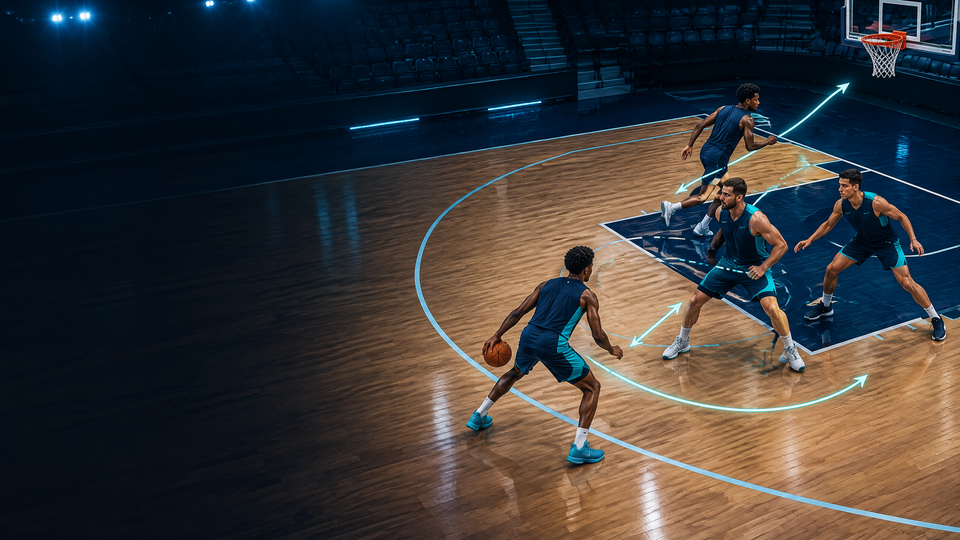
This High Pick-and-Roll Execution drill teaches a five-player unit to create a two-player advantage and punish the defence’s first help decision. The ball-handler (1) sets up the screen, gets shoulder-to-hip with 5, and keeps the dribble alive until the read is clear. The screener (5) arrives on time, makes legal contact, opens quickly, and presents a target on the roll or pop. The other three players hold spacing and become ready receivers.
Use a 28 m x 15 m FIBA court, attacking the basket at one end. The drill progresses from a rehearsed screen-and-roll to live 5v5 reads. The standard is a paint touch, a rim finish, or an uncontested catch-and-shoot chance in six seconds or fewer. Use one consistent language chain: screen, use, read, deliver, finish.
Setup
Place two cones at the right slot, one on 5’s approach line, and one on each corner. Start 1 in the right slot, about 7.5 m from the basket. 5 begins at the high elbow and approaches to screen X1. Put 2 in the weak-side corner, 3 in the strong-side corner, and 4 in the weak-side slot or dunker spot. Match them with X1–X5. Give 1 a ball and keep a second ball with the coach for fast restarts.
5 sets the screen one step outside X1’s recovery line. Feet are wider than shoulder-width, chest square, hands protecting the body, and the screener is still before contact. 1 must not drift into the screen. Use a tight hip-to-hip route and two downhill dribbles. Rotate offence to defence after every three live possessions.
{{asset:diagram_1.png}}
Step-by-Step Instructions
0:00–2:00 — Walk-through and screen angle. Run at half speed without pressure. 1 signals for the screen, waits until 5 is stationary, then uses the screen with a downhill first step. 5 screens X1’s inside shoulder and holds for a clear count of “one”. Stop and correct moving screens and wide driving lines.
2:00–6:00 — 2v2 screen-and-roll. Use 1, 5, X1 and X5. X1 trails over; X5 plays a conservative drop. On the whistle, 1 has six seconds to reach the lane. 5 rolls directly to the rim, shows the outside hand, and receives the pocket pass. Run four repetitions, then switch pairs. Score one point for a paint touch and two for a made lay-up or direct roll finish.
6:00–10:00 — Add the corners. Add 2 and 3 with their defenders. 2 lifts from the weak-side corner toward the slot when X5 tags the roll. 3 stays deep in the strong-side corner to hold X3 out of the lane. Before passing, 1 calls the read: “rim”, “roll”, or “lift”. The call prevents predetermined passes.
10:00–14:00 — Add 4 and change coverage. Play 5v5. Before each possession, call “drop”, “show”, “switch”, or “under”. Against drop, 1 turns the corner into the gap between X1 and X5. Against a show, 5 slips or rolls early and 1 passes before the trap is set. Against a switch, 1 keeps the smaller defender involved or feeds 5 on the seal. Against under, 1 rejects, re-screens, or takes the open pull-up.
{{asset:diagram_2.png}}
14:00–17:00 — Decision chain. Keep 5v5 live but require a screen and a defensive help decision before the shot. Score three points for a rim finish, two for a clean catch-and-shoot three, and one for any other make. A turnover, moving screen, or early shot gives the defence one point. Coach from behind 1 so the next passing window is visible.
17:00–20:00 — Competitive finish. Each unit gets five possessions. The offence needs eight points to win; otherwise the defence wins. Between possessions, name the coverage, name the missed read, then replay. Let players solve the last two possessions without calls from the coach.
Key Coaching Points
1’s first job is to set up the defender, not to rush. Use a hesitation, change of pace, or jab to make X1 commit. Once 5 is set, drive off 5’s hip. Keep the ball on the outside hip and read X5 before picking up the dribble.
5 sprints into the action, decelerates under control, and establishes a legal base. A flat screen lets X1 slide over; a screen that is too high gives 1 no downhill angle. After contact, 5 opens to the ball, sprints on the roll, and shows a target. On a pop, 5 pivots into space with feet ready to shoot or pass.
The perimeter players create the pass. 2 lifts when the low defender tags 5. 3 maintains corner depth. 4 mirrors the ball on the weak side, then fills the nearest open window. Every off-ball player should see both the ball and their defender.
Common Mistakes
The most common error is 1 leaving before the screen is set. Reset the rep if 1 does not wait for 5’s “set” call. A second error is 1 dribbling away from the screen; use cones to mark a narrow downhill corridor.
5 can also roll on a curve and drift behind the ball. Demand a direct run through the front of the rim and two-foot finishes where possible. Finally, wings often watch the action. Freeze the play when X5 tags, show 2 the lift window, and insist that 3 stays in the corner until the ball is released.
Variations & Progressions
For a side pick-and-roll, move 1 to the wing and have 5 screen toward the middle. This makes the middle drive primary and teaches weak-side defenders to tag from the nail. For a Spain pick-and-roll, add 3 as a back-screener on X5 after 5 screens for 1; introduce it only once the basic roll and lift are reliable.
Progress to unannounced defensive coverages. Then add a one-dribble limit after 1 comes off the screen, forcing early reads and sharper passing. For advanced groups, require a reject once per five possessions and an immediate re-screen at a new angle.
Age Adaptations
For under-10 players, use 3v3 with 1, 5 and a corner player. Remove switching, use a soft drop, and allow eight seconds to finish. Keep the aim simple: use the screen, take two dribbles, find the roller. Cones make the screen location obvious.
For under-12 and under-14 teams, use the full 5v5 shape but introduce only drop and over coverage. Require legal screens, corner spacing, and an audible read. Keep the reward for rim finishes high so players attack the advantage before settling for difficult jumpers.
For older or open-age groups, include show, switch, ice, and late-clock scenarios. Add a 12-second possession clock from the entry pass, alternate roll and pop, and demand a second advantage when the first pass is covered. This turns the drill into a realistic half-court offence framework.
