Basketball
Box Corner Roll: Baseline Inbound Play with Double Down Screens
Install a decisive box-formation BLOB that creates a corner catch, rim roll, and weak-side counter within the five-second inbound window.

What you need
1 regulation basketball, 4 flat floor markers, Whistle, Bibs for guided or live defense, FIBA half-court (14 m x 15 m)
Overview
Box Corner Roll is a baseline out-of-bounds (BLOB) play that gives you three connected scoring options from one compact starting shape: a corner catch for the 2, a rim finish for the rolling 4 or sealing 5, and a weak-side release for the 3. Use it after a dead ball beneath your own basket, particularly against tight man-to-man coverage, face-guarding, or an automatic switch on the first screen.
The set is built for a FIBA regulation court measuring 28 m × 15 m; the diagram uses a 14 m × 15 m half-court. Under FIBA rules, the inbounder has five seconds to release the ball, so the first option must be available quickly.1
Coaching target: Create the corner catch by 1.8 seconds, attack the first rim roll by 3.0 seconds, and retain the weak-side counter if help collapses.
Setup
| Item | Requirement | Coaching cue |
|---|---|---|
| Players | Five offensive players; add five defenders once the pattern is clean | Use 1 as your clearest decision-maker and 2 as your best corner shooter. |
| Equipment | One ball, four flat spots, whistle, bibs | An assistant can simulate the official’s five-second count. |
| Court | 14 m × 15 m FIBA half-court | Mark the strong-side corner, weak-side wing, and both screening spots. |
| Install time | 15 minutes | Teach 0-on-5, guided defense, then live defense. |
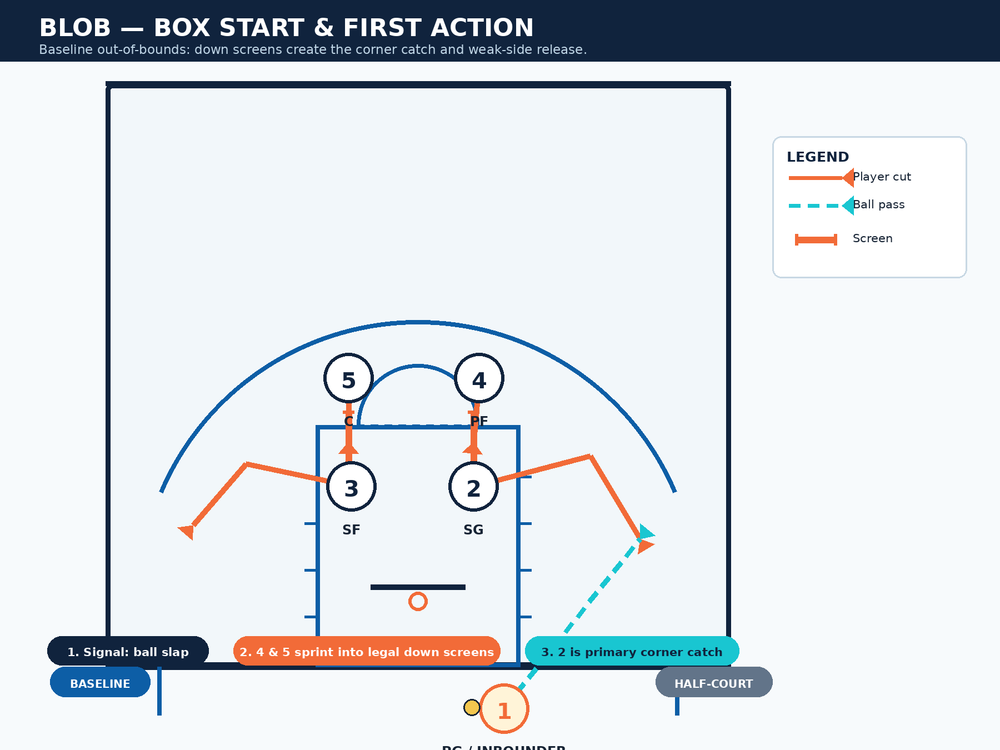
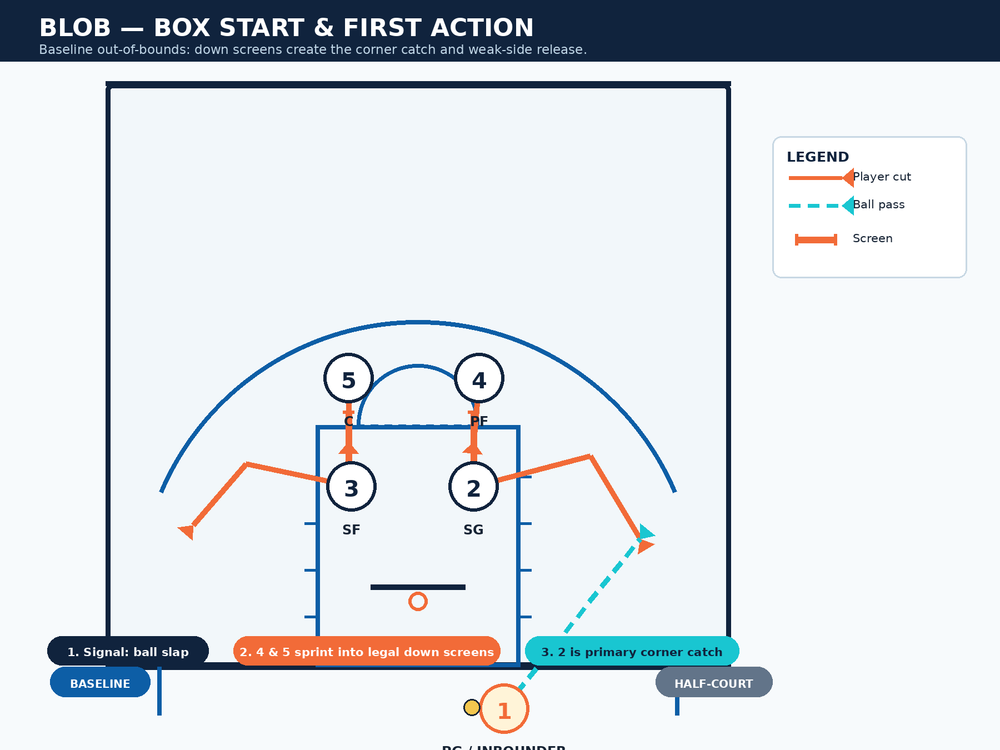
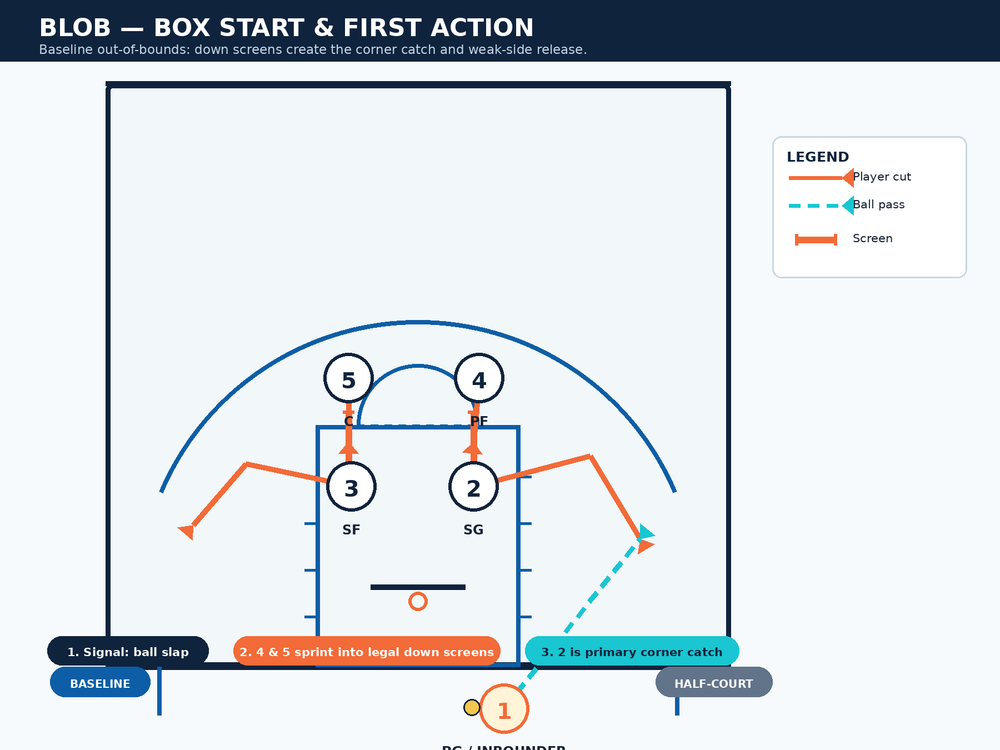
Place 1 (PG/inbounder) out of bounds on the baseline, about 1 m to the strong side of the backboard and 0.6 m behind the end line. Player 2 (SG) starts on the strong-side low block; 3 (SF) mirrors on the weak-side block. Player 4 (PF) starts on the strong-side elbow, with 5 (C) opposite at the weak-side elbow. Keep each high-low pair 2.5–3 m apart so the low player has room to sell a cut before using the screen.
Call the play with one word—“Box Corner.” The ball slap by 1 is the live trigger. The team’s shared cue is: screen, sprint, show hands. Nobody leaves early; early movement tells the defense exactly where the first pass is going.
Step-by-Step Instructions
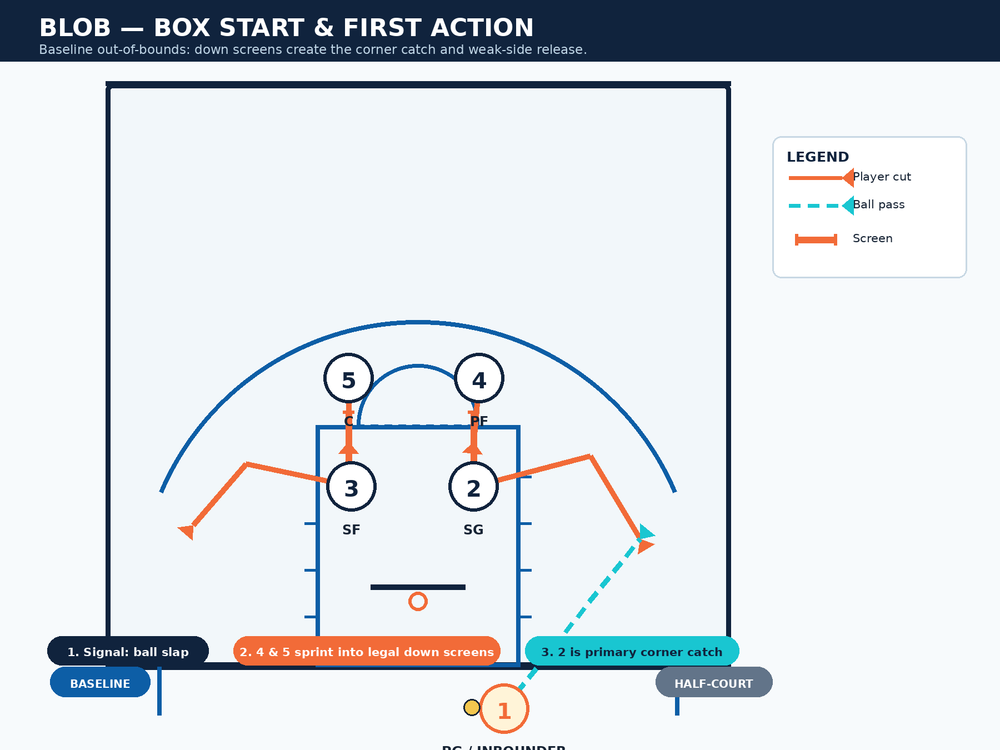

Initiate at 0.0 seconds. Player 1 gets low, scans the defender guarding 2, and slaps the ball. Players 4 and 5 step down together. They must arrive before the cutters, establish a wide legal base, and present their chest to the defender rather than chase the defender.
Set the down screens at 0.4–0.8 seconds. Player 4 screens down for 2 on the strong-side lane line; 5 repeats for 3 on the weak side. Put the inside foot roughly 0.3 m inside the lane line and angle each screen so the defender is forced over the top. The teaching phrase is, “Arrive, be still, then absorb.”
Create the exit cuts at 0.8–1.8 seconds. Player 2 takes one hard step toward the rim, plants the inside foot, then bursts shoulder-to-hip off 4’s screen to the strong-side corner. Finish 0.5–1 m inside the sideline/baseline intersection with hands ready. Player 3 mirrors the action but finishes at the weak-side wing, about 1 m above the free-throw-line extended. The 3 cut is a real second option, not a decoy jog.
Make the inbound by 2.0 seconds. If 2 has daylight, 1 delivers a firm chest pass to 2’s outside shoulder. If 2 is denied, 1 moves one baseline step to change the passing angle and finds 3 at the weak-side wing. Demand that 1 uses eyes and shoulders to sell the weak-side option before passing; staring at 2 allows the defense to jump the route.
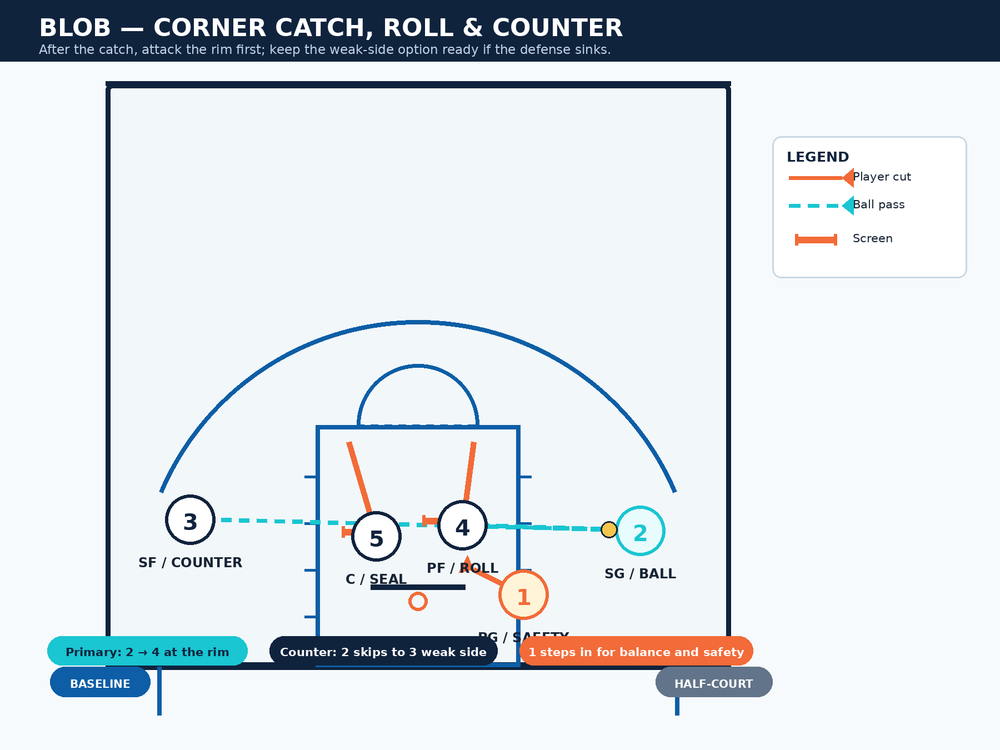
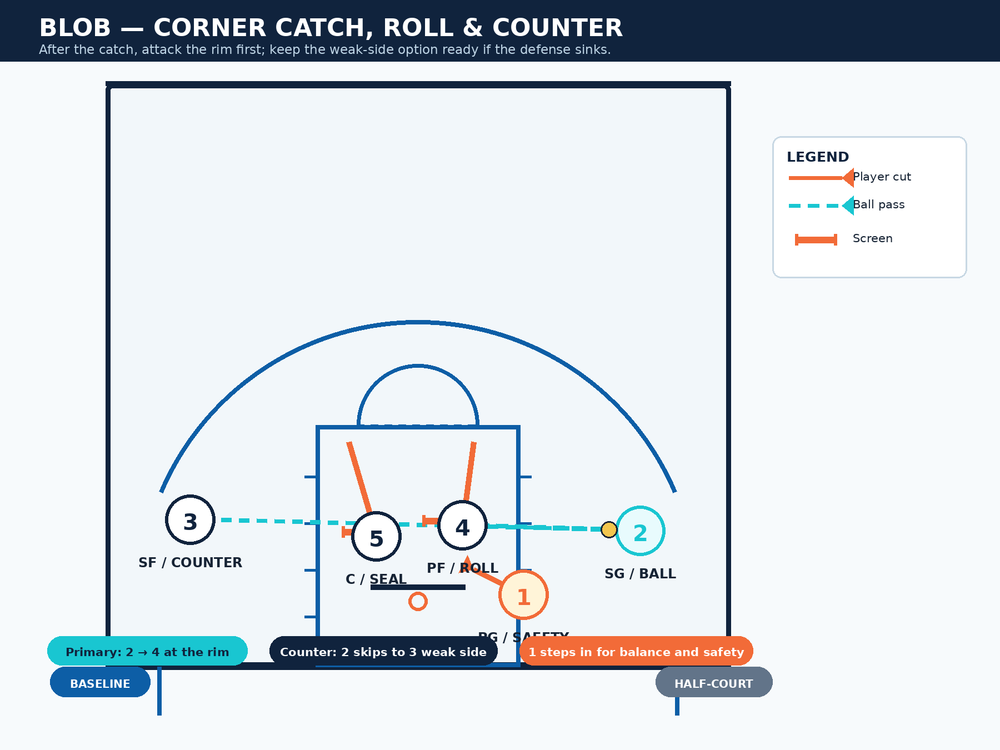
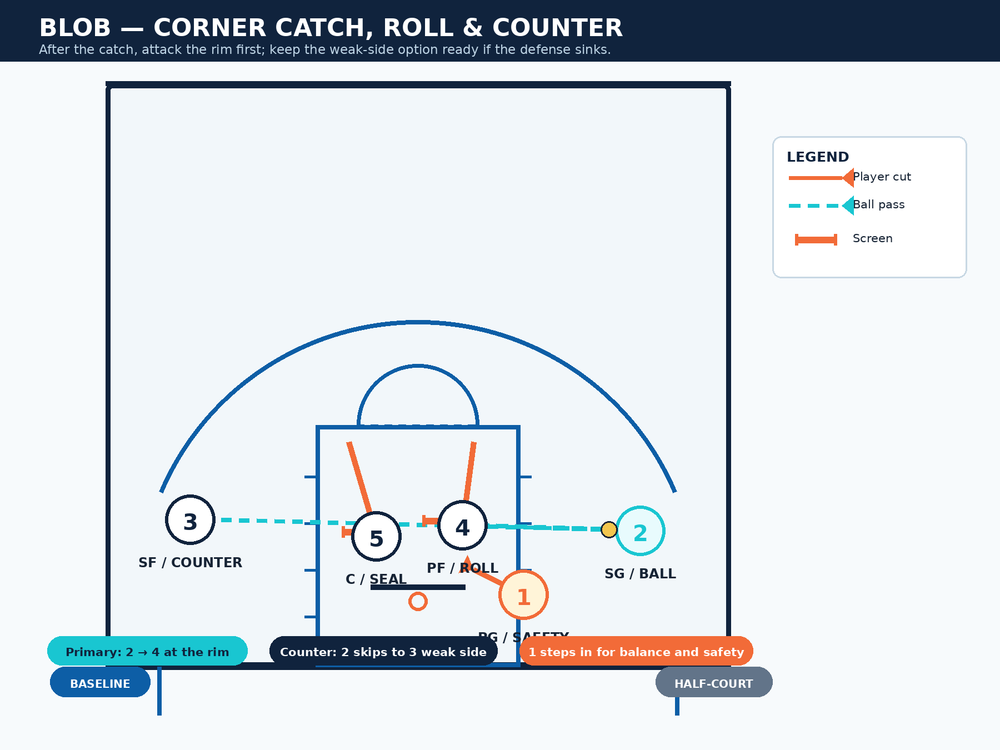
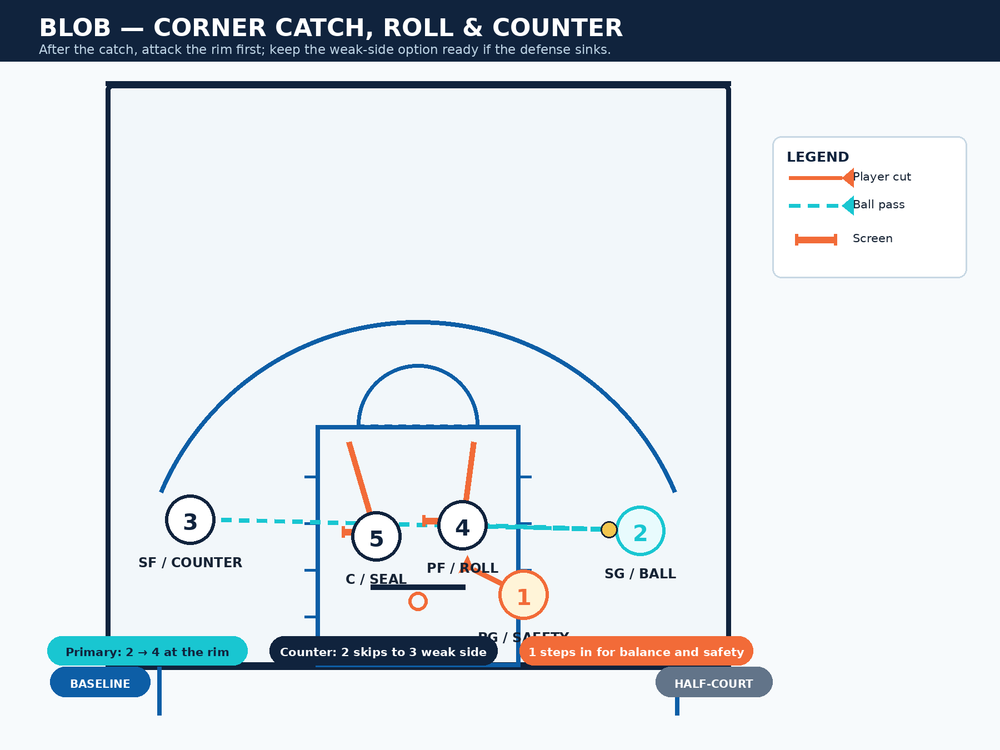
Turn the corner catch into a scoring read. Player 2 is a scorer first. A late closeout is a corner shot or one baseline dribble. Against a proper closeout, 2 reads the first free big: 4 rolls to the near side of the rim and 5 seals any switch or help defender in the middle. The primary interior feed is 2-to-4, using a quick bounce pass or short pocket pass rather than a lob into traffic.
Finish with balance. After passing, 1 steps inbounds and drifts to the strong-side slot as the safety valve. Player 3 stays wide and shot-ready for the skip pass. Player 4 owns the near-side rim line; 5 owns the middle seal. If the rim is closed, 2 reverses to 1 and the team flows into normal half-court offense.
Key Coaching Points
| Teaching point | What to demand |
|---|---|
| Legal screens | 4 and 5 stop before contact, keep shoulders square, and do not lean or re-screen. |
| Cut detail | 2 and 3 sell one step to the rim, then cut shoulder-to-hip off the screen. |
| Inbound rhythm | 1 reads 2 → 3 → rim, without panic or a long sequence of fakes. |
| Roll timing | Screeners release only after the cutter’s defender commits to the screen. |
| Spacing | 3 stays wide, 1 becomes safety, and the two bigs do not roll to the same spot. |
Common Mistakes
The first common error is a soft or moving screen. If 4 and 5 drift into contact, the defense slips underneath or the offense commits a foul. Correct it with a flat spot under each screener’s feet and a one-count freeze before the cutter arrives.
The second is an inbounder who locks onto 2. Require 1 to rehearse the read aloud—“two, three, rim”—and use a small pass fake. This improves disguise without wasting the five-second window.
The third is a wide, slow corner cut. If 2 loops toward the sideline, the passing lane becomes long and risky. Insist on a shoulder-to-hip cut, a square landing in the corner window, and two hands shown before the pass. Finally, do not allow 4 and 5 to occupy the exact same rim space; one rolls and one seals.
Variations & Progressions
For an easy install, remove the second screen and leave 3 as a stationary weak-side safety. Teach one screen, one corner cut, and one inbound pass. Use a passive defender and require three successful completions before progressing.
For a switch counter, have 4 or 5 slip the screen. If the defense shoots the gap or calls an early switch, the screener gives a screen picture but cuts directly to the rim before contact. Player 1 then looks inside first. This is the cleanest answer to aggressive switching.
For an advanced counter, make the weak-side action an elevator screen: 3 cuts upward between 4 and 5, and the bigs close the gap after 3 clears. Keep 2 as the strong-side decoy. Only add this after the base version is clean and legal.
Age Adaptations
For Under 8 and Under 10, use three or four players, remove the double screen, and replace the corner three with a short-corner catch 3–4 m from the rim. The success measure is a safe inbound and balanced shot—not a perfect screen.
For Under 12 and Under 14, use the full box but limit the reads to 2 in the corner, then 4 at the rim. Go from no defense to guided defenders who trail over the screen, then to live defense. Include a five-second count every time so the timing becomes game-realistic.1
For Under 16 and open-age teams, add switch, denial, and zone counters. Film from the baseline and review three details: whether 2 catches by 1.8 seconds, whether 4 and 5 are legally set, and whether the first defensive rotation creates a clean rim pass or weak-side skip.
References