

Basketball
SLOB Fist Flare: End-of-Game Buzzer-Beater Set Play
Install a timed sideline out-of-bounds action that creates a flare three, a rim counter, and a weak-side release for the final possession.
What you need
2 basketballs, 10 pinnies or practice jerseys, 6 flat cones, visible game clock or stopwatch, tactical whiteboard
SLOB Fist Flare: End-of-Game Buzzer-Beater Play
Overview
SLOB Fist Flare is a sideline out-of-bounds end-game action built to produce a clean catch-and-shoot three for your best perimeter shooter, designated 1 (point guard) in this version. It is most effective when your team has 3.2–6.0 seconds remaining, needs three points, and is inbounding on the right sideline in the frontcourt. The design sells a simple inbound to 2 (shooting guard), then immediately sends 1 off 5’s flare screen into space on the left slot. The defence must negotiate a screening action while also respecting 4’s rim run and 3’s weak-corner release.
Coach the group to take the first clean look in order: flare three, rim, then corner. Rehearse on your actual 28 m × 15 m FIBA floor and keep 1 out of bounds until the entry pass is released.1
Setup
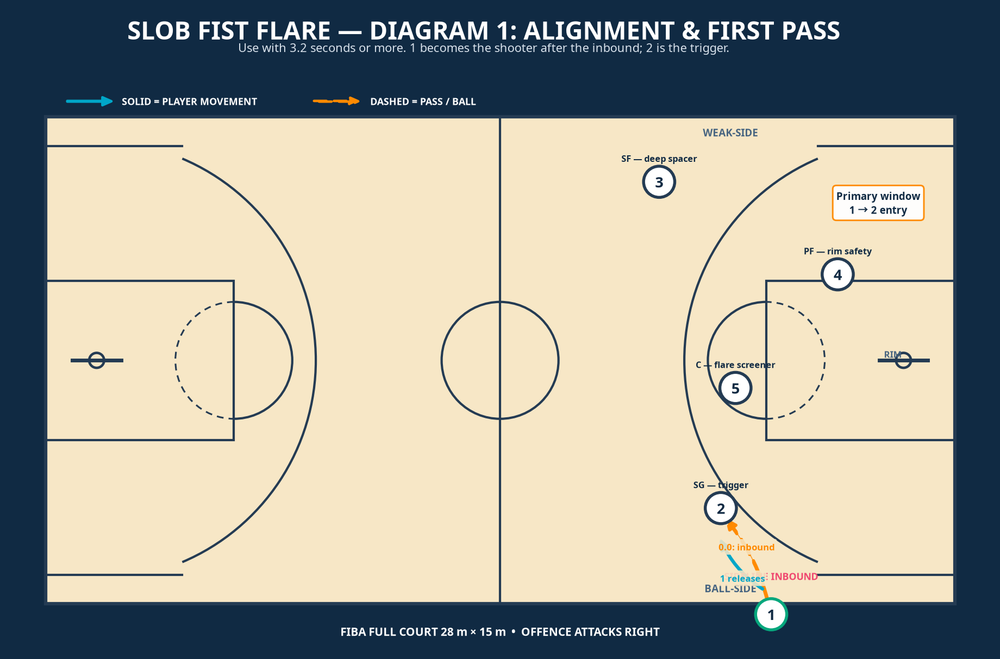
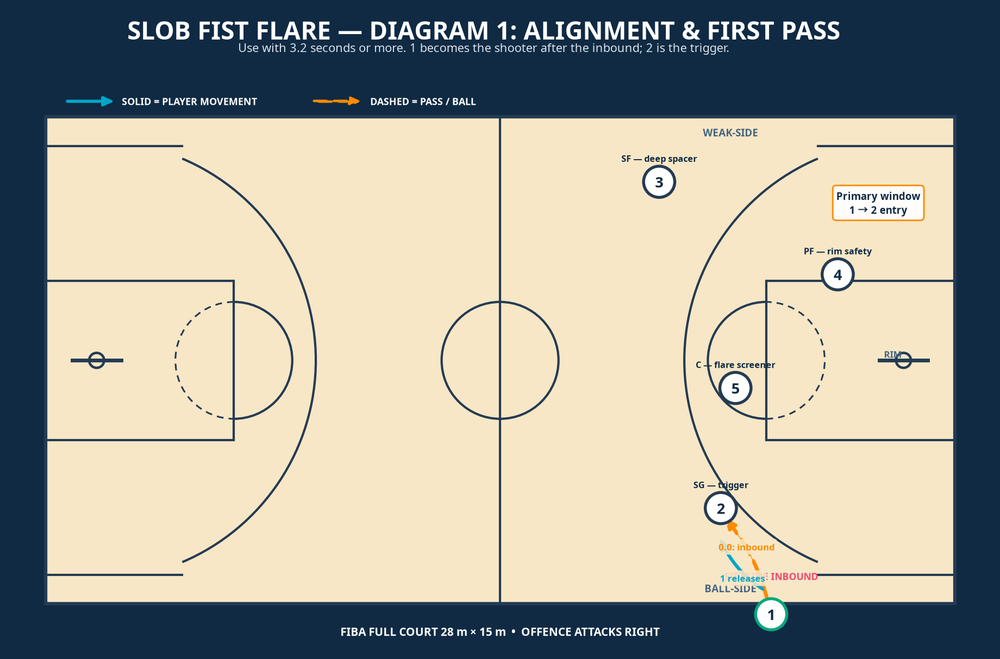
Set up on the right half of the 28 m × 15 m FIBA court. Put 1 out of bounds on the right sideline, approximately 2.0 m above the extended free-throw-line area. Place 2 about 3.5 m inside the sideline and 1.5 m below the three-point arc; 2 is the safe first receiver and trigger. Place 5 on the right elbow area, ready to sprint into a wide, stationary flare screen. Put 4 high on the ball-side block as the rim safety, while 3 starts high on the weak side and finishes deep in the weak-side corner.
| Number | Standard position | Starting job | Non-negotiable detail |
|---|---|---|---|
| 1 | Point guard | Inbounder and primary flare shooter | Sell the pass, then sprint into the catch with hands ready. |
| 2 | Shooting guard | First receiver and decision-maker | Meet the inbound, pivot on balance, and deliver the first clean read. |
| 3 | Small forward | Weak-side emergency release | Stay lifted until the ball is live, then drift to a deep corner. |
| 4 | Power forward | Rim runner and safety valve | Delay a half-beat, then dive hard only after 2 receives. |
| 5 | Centre | Flare screener and short-roll safety | Arrive early, set a legal screen, and present on the short roll. |
Tell the defence in practice to begin with a denial or trail mentality on 1. Start the clock at 4.5 seconds. Use a second coach or manager as the official: they hand the ball to 1, count the clock aloud, and whistle the rep dead if the pass, screen, or shot timing is late.
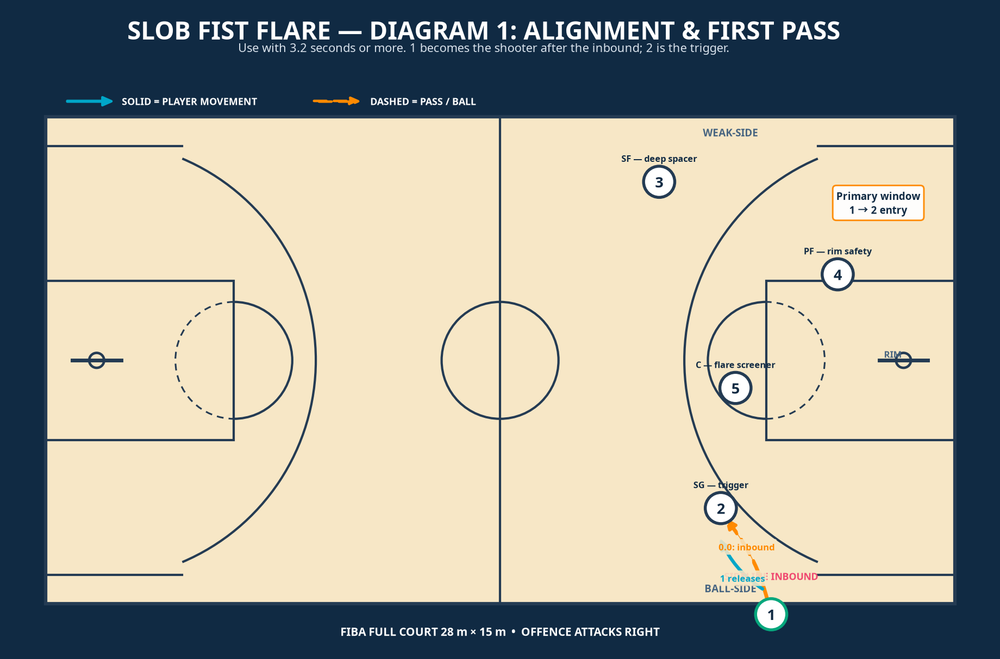
Diagram 1: Alignment and entry
Step-by-Step Instructions
Call the action and establish the clock. Name the shooter, inbound spot, and command: first clean catch is the shot. Use the short-clock variation when fewer than 3.0 seconds remain.
Align before the official gives the ball. 1 stays out of bounds; 2 holds a clear passing angle; 5 waits near the elbow; 4 shows on the block; and 3 begins high weak side. Protect the spacing.
Trigger the first pass at 4.5–4.0 seconds. On the official’s hand signal, 2 makes a sharp V-cut toward the sideline. 1 throws a crisp two-hand chest pass or push pass to 2’s outside hand. The pass must arrive within roughly 0.5 seconds. As soon as the ball leaves 1’s hand, 1 steps inbounds and accelerates toward 5’s screen.
Set the flare screen at 3.8–3.3 seconds. 5 sprints from the elbow to a spot about 1.0 m above and inside 1’s defender, plants with a wide base, and stays still. Coach the screen angle so the defender is screened toward the middle while 1 exits toward the left slot. Do not coach 5 to chase the defender; 5 wins the action by arriving early and being square.
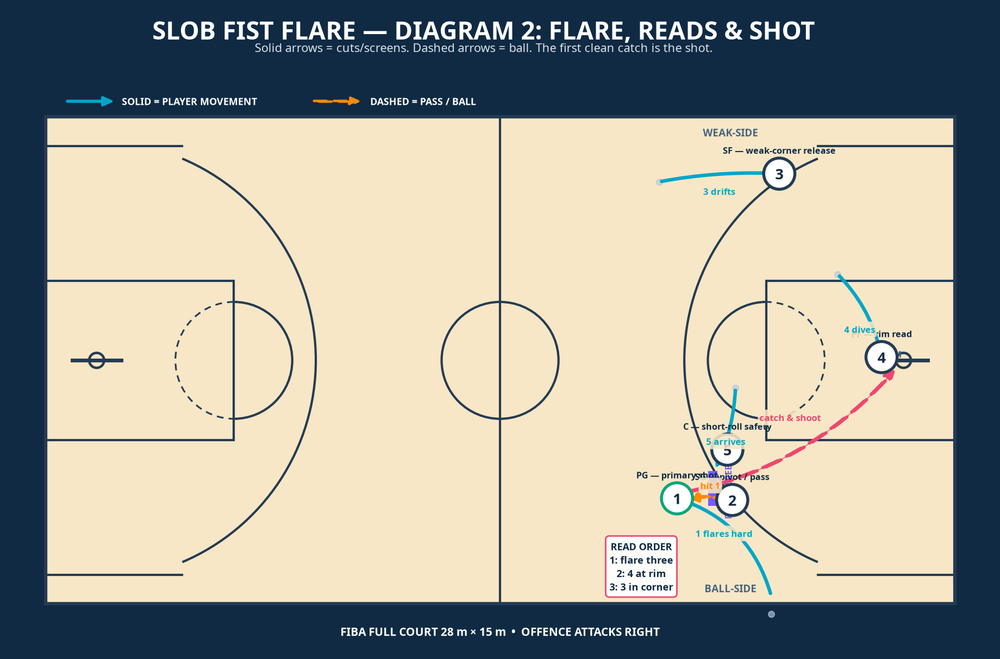
Deliver the flare pass at 3.2–2.7 seconds. 2 receives, reverse-pivots to face the left slot, and reads 1’s separation. The first look is a firm pass leading 1 into the catch, not a pass behind the shooter’s heels. 1 arrives about 6.5–7.0 m from the hoop, catches with feet prepared, and shoots immediately if daylight exists.
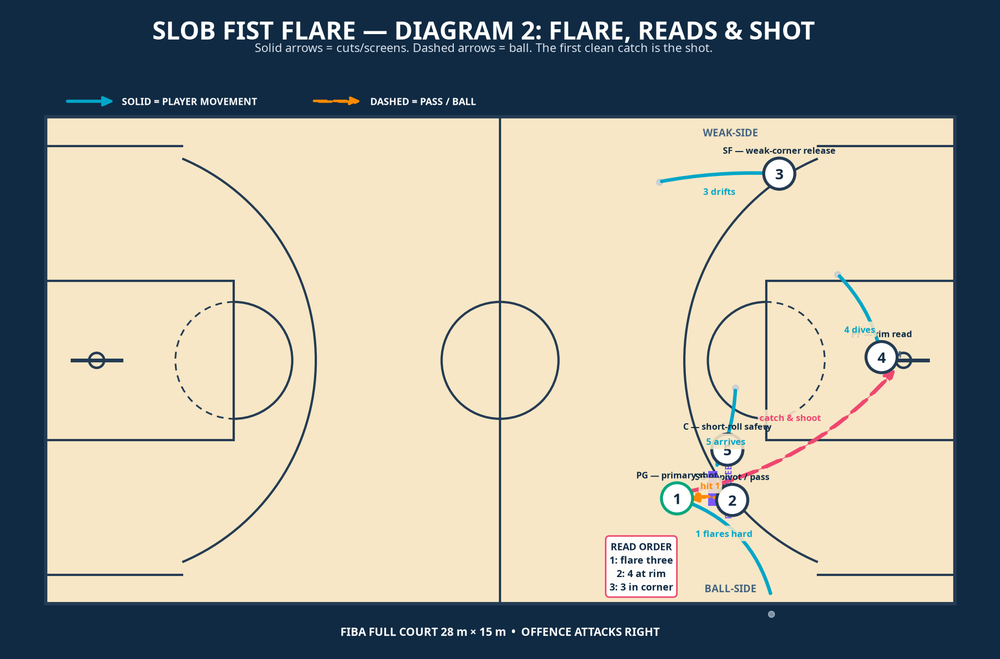
Use the prescribed read order when the flare is covered. If 1’s defender top-locks the route, 2 looks to 4’s immediate dive at the rim. If 4 is tagged by the low defender and the paint is crowded, 2 turns to 3 in the weak corner. If the switch takes away all three looks, 2 hits 5 on the short roll only when there is adequate time for a legal catch and release. The players must understand that a rushed pass into a covered player is worse than a controlled, legal emergency shot.
Finish the rep with game habits. 4 crashes only from inside position; 5 seals after the short-roll read; 3 holds the corner until the ball is released. 1 calls shot on the catch. All five players freeze for one count after the buzzer so you can correct spacing, screen angle, and clock management before the next rep.
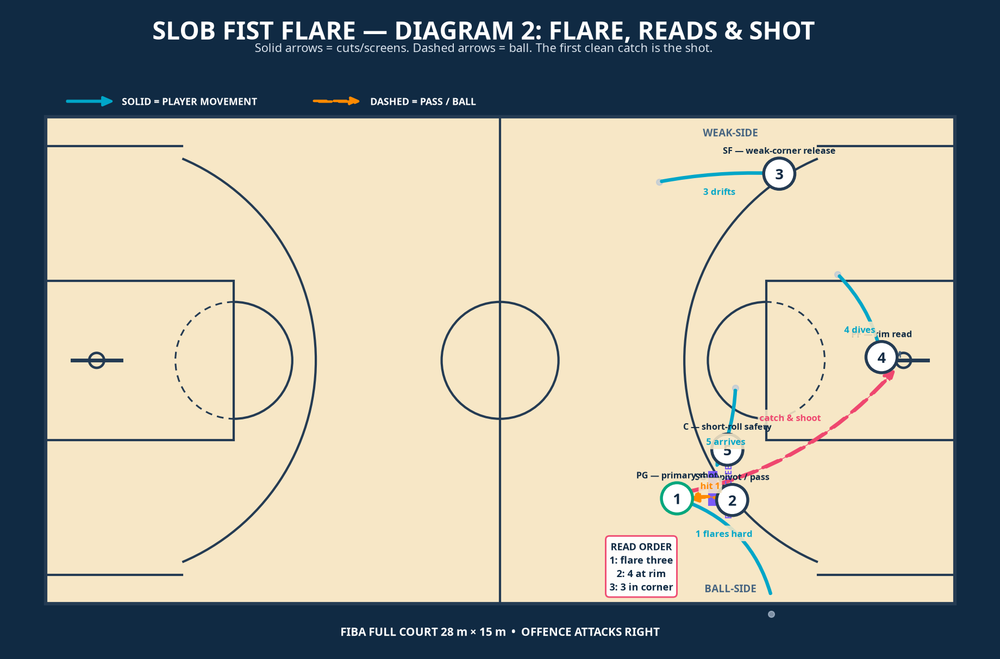
Diagram 2: Flare, read order, and final shot
Use this picture to show players why their off-ball jobs matter. 3’s drift holds the weak-side help defender, 4’s dive occupies the rim protector, and 5’s legal flare screen creates the window for 1. Every player contributes to the primary shot even if they never touch the ball.
Key Coaching Points
| Coaching point | What to demand in the gym | Corrective cue |
|---|---|---|
| Clock ownership | 2 must know the target moment for the flare pass before the ball is inbounded. | “Catch at four, deliver by three.” |
| Screen legality and angle | 5 arrives first, becomes stationary, and presents a strong base without leaning. | “Sprint, set, stay.” |
| Shooter’s route | 1 changes pace, brushes shoulder-to-hip off 5, and exits with two hands visible. | “Tight shoulder, wide finish.” |
| Passing window | 2 throws to space in front of 1’s shooting pocket, not directly at the defender. | “Lead the numbers.” |
| Read discipline | 2 reads flare, rim, corner in order rather than improvising too early. | “One, four, three.” |
Common Mistakes
| Mistake to watch | Why it fails | Immediate correction |
|---|---|---|
| 1 floats into the route after inbounding. | The defender recovers before 5 can screen. | Rehearse the first two explosive steps without a ball. |
| 5 moves on contact or sets too low. | The screen risks an offensive foul or creates no angle. | Mark the screen spot with a cone; freeze 5 for one count. |
| 2 catches square to the sideline. | The flare pass arrives late or requires an extra dribble. | Teach the reverse pivot on the catch, then pass with no dribble. |
| 4 dives before 2 catches. | The paint closes early and the rim defender can help on 1. | Cue 4: “See catch, then go.” |
| 3 creeps toward the ball. | The emergency corner pass disappears and help shrinks the floor. | Put a cone in the deep corner and make it 3’s finish line. |
Variations & Progressions
Begin with guided five-on-zero. Walk through the pass, release, screen, and three reads against no defenders. Add a clock only after players can name their job and finish spot. This is the easiest version for installing the language and timing.
Progress to five-on-five with a trail defender on 1. Tell the defence to chase over 5’s screen, which forces 2 and 1 to complete the primary flare read under realistic pressure. Award the offence a point only when the shot is released on time and from the intended catch location, not merely when it goes in.
For the hardest progression, allow the defence to switch or top-lock 1. This demands that 2 read 4 at the rim and 3 in the corner, rather than forcing the flare. As a tactical variation, flip the formation to the left sideline for a left-handed inbounder, or reverse the primary shot to a weak-side corner three by having 3 use 4’s staggered screen. Keep the same rule: one clear primary look, two rehearsed counters.
Age Adaptations
| Group | Adaptation | Coaching emphasis |
|---|---|---|
| Under 10 | Use a half court, remove the clock, and replace the flare screen with a simple pass-and-cut. | Teach spacing, stopping under control, and showing target hands. |
| Under 12 | Keep the 5-out shape but allow a one-dribble escape for 2 after the entry. Use cones instead of live screens initially. | Build pivoting, passing accuracy, and recognition of the open teammate. |
| Under 14 | Install the full sequence with a 5–6 second clock and guided defensive pressure. | Teach screen angle, cut timing, and the flare-to-rim read order. |
| Under 16 and open age | Run the live five-on-five version, vary the defence, and chart decision quality as well as makes. | Demand precise clock awareness, legal screens, and a shot-ready catch. |
Practice Integration
Use the full 25 minutes: five for spots and cues, eight for five-on-zero timing, eight for live reads, and four for pressure scoring. Chart only three decisions: 1’s release, 5’s screen angle, and 2’s first clean read.
