

Basketball
Box Flash Front-Rim Curl: FIBA Baseline Inbound Under the Basket
Teach a dependable baseline out-of-bounds action that creates a front-rim lay-up, then punish switches with a simple ghost-screen slip.
What you need
balls, cones
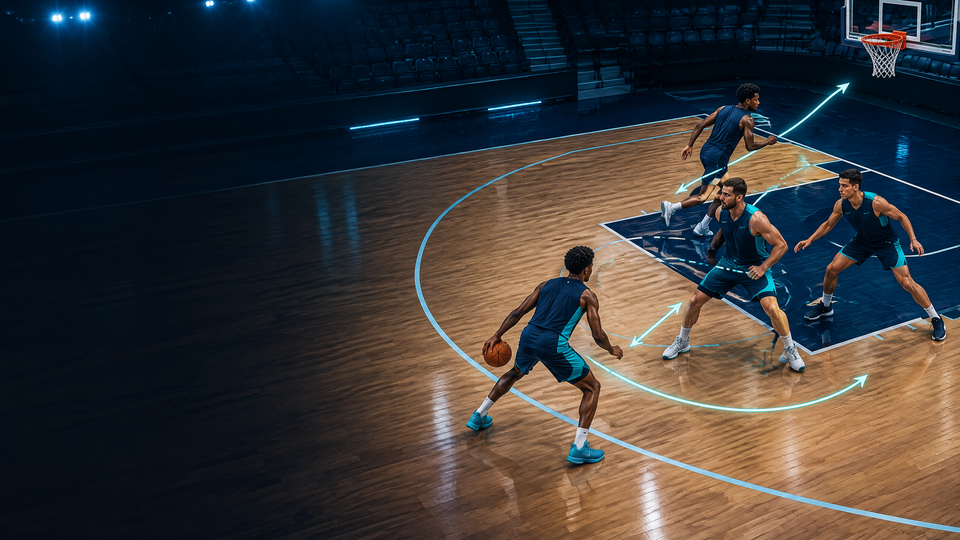
{{asset:header_image.png}}
Overview
This is a baseline out-of-bounds (BLOB) play for an offensive possession starting under the basket after a made field goal, dead ball or timeout. The action uses a compact box alignment, a hard rear-hip screen and a front-rim curl to produce a lay-up before the defence can load the paint. It fits a FIBA court (28 m x 15 m) and is designed for an Under-14 or older group that can screen legally, read a defender and execute the inbound inside the five-second count. The scoring idea is simple: make X2 chase over 5’s screen, then lead 2 to the front of the rim. If the defence top-locks, switches early or jumps that passing lane, 5 ghosts the screen and slips to the same target.
Setup
Place 1 as the inbounder on the baseline, about one step to the ball-side of the basket stanchion, with both feet clearly out of bounds. Put 2 on the ball-side low block, 3 on the weak-side low block, 4 at the ball-side elbow and 5 at the weak-side elbow. Keep the two elbow players roughly one metre outside the lane line so the box is tight but legal. In the diagrams, X1–X5 denote defenders. For the full teaching version, use five offensive players and five defenders; rotate teams every two or three live reps. Cones can mark the elbow and corner destinations during the first block.
1 is the decision-maker. Their stance should be low and balanced, with the ball visible above the baseline and eyes initially on the rim. 2 is the first scoring option, 5 is both the screener and counter finisher, while 3 and 4 create width for the next pass. Tell the group that the ball must be released by approximately T+1.1 seconds, not held while the picture disappears.
{{asset:diagram_1.png}}
Step-by-Step Instructions
T+0.0 – Make the alignment look ordinary. On the official’s disposal, 1 calls “Flash.” 2 gives a short jab toward the baseline to lower X2’s stance; 3 stays ready to drift; 4 prepares to lift; and 5 loads the outside foot. No cutter leaves early: the screen only works if X2 believes 2 may cut either way.
T+0.2 – Create the screen angle. 5 steps diagonally across the lane toward X2’s rear hip. 5 arrives stopped, wide-based and vertical, with hands protecting the chest. This is a legal stationary screen, not a moving block. 4 simultaneously lifts toward the slot to occupy the nail helper.
T+0.6 – Curl to the front rim. 2 brushes 5’s shoulder-to-shoulder, curls tight across the lane and shows two target hands at the front of the rim. The target is the restricted area, not the far block. 2 should arrive on balance, ready for a one-foot or two-foot finish depending on the pass.
T+0.7 – Clear the help. 3 drifts to the ball-side corner after 2 has cleared the screen. This pulls the low defender out of the charge circle and becomes the first outlet if the lay-up is denied. 4 stays lifted and available at the slot; do not let 4 creep into 2’s driving line.
T+0.9 to T+1.1 – Deliver the primary pass. 1 reads X2. If X2 trails over the screen, fire a short chest pass into 2’s hands. If a taller help defender is between 1 and 2, bounce the pass just inside the lane line. Lead 2 toward the rim; never pass behind a cutter moving at speed.
T+1.2 onward – Finish and flow. 2 catches with chin to the ball, finishes through the near shoulder and expects contact. If the catch is not there, 1 immediately hits 3 in the corner, then 4 at the slot. On every miss, 5 and 4 pursue the weak-side rebound while 2 recovers defensive balance.
Key Coaching Points
Coach the timing before the diagram. A perfect route with an early cut becomes a dead pass; a compact, delayed cut creates separation. Make 5 name the screen target—“X2’s back hip”—rather than simply telling them to screen. Demand that 2 runs off the screener’s shoulder, not three feet wide of it. A wider curl gives the defender space to slide underneath and invites an interception.
Teach 1 to scan in a fixed order: front-rim curl, slip, corner, slot. The inbounder needs a decisive fake before the live pass, but not a long pump fake that burns the count. Emphasise legal screening: 5 must establish position before contact and cannot lean, extend a knee or chase the defender. Finally, finish with two feet in the paint whenever possible. Inbound scores are often contested; balance wins the second effort.
Common Mistakes
The most common error is 2 leaving before 5 is set, which turns the screen into a moving foul or allows X2 to shoot the gap. Correct it by freezing the action at T+0.2 and checking that 5 is stopped before 2’s second step. A second error is 1 standing square to the court and telegraphing the pass. Rehearse a pivot and eye fake to 3 before 1 delivers to 2. Third, young teams often bunch all four players in the lane after the first read fails. Keep 3 in the corner and 4 lifted: those two outlets protect the possession and make the primary cut more available.
Variations & Progressions
When the defence top-locks 2, switches X5 onto the curl or puts a body in the passing lane, call “Slip.” 5 shows the same first step toward the screen, then changes level and sprints to the front rim before contact. 2 clears hard to the corner, 3 lifts as the safety and 4 pins the helper at the nail. 1’s first read becomes the bounce pass to 5 at T+1.0.
{{asset:diagram_2.png}}
Progress from guided movement to live decision-making. Start with no defenders and require the pass at the exact time. Add passive defenders who may only trail, then let X2 choose to trail, top-lock or switch while 1 calls the correct read. Finally, make it competitive: award the defence a point for a deflection, a five-second violation or a screen foul, and award the offence two points for a clean front-rim finish.
For a second variation, flip the ball-side alignment without changing the calls. This makes 2 curl from the other block and keeps the scout from sitting on one side. Against a zone, have 4 flash to the short corner instead of the slot, while 3 remains as the corner release. Do not add both changes until the original timing is reliable.
Age Adaptations
For Under-10 groups, simplify to 1, 2 and 5: 5 stands as a cone-like legal screen and 2 runs the front-rim curl; use no live switching and allow 1 an extra beat to pass. For Under-12, add 3 as the corner safety but keep the ghost slip coach-called. At Under-14 and above, make the read player-led: 5 calls “Slip” when X2 top-locks, and 1 must recognise the new first option. With older or open-age players, add a late rescreen by 4 after the corner outlet, but only after the initial three reads are automatic.
