

Basketball
Sideline Blitz: Half-Court Trap Press Play
Install a disciplined sideline ambush that turns the half-court line and sideline into extra defenders, forcing rushed passes without surrendering the rim.
What you need
Basketballs, 6-8 flat cones, Pinnies, Whistle, Half-court whiteboard or printed diagram
1. Overview
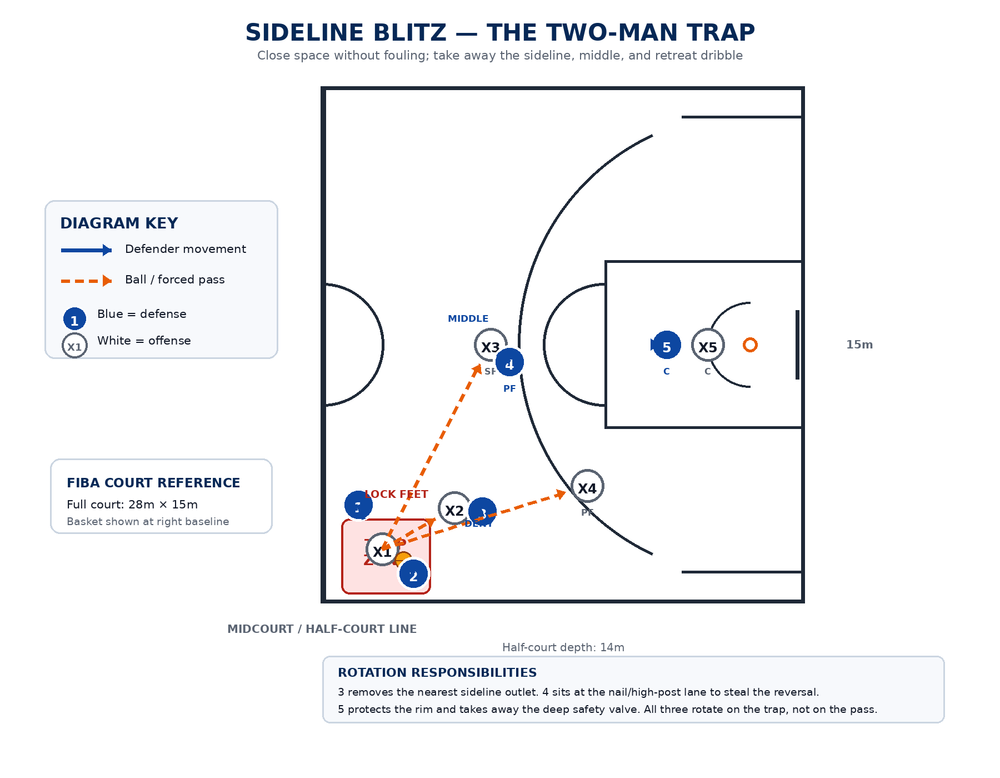
Sideline Blitz is a half-court trap press built to steal the first controlled sideline dribble after the offense crosses midcourt. It is not a reckless double-team. The trap is a five-player coverage: Defenders 1 and 2 close the ball, Defender 3 removes the nearest outlet, Defender 4 owns the middle reversal, and Defender 5 protects the basket. The sideline and half-court line provide the remaining two boundaries, so the ball handler feels boxed in rather than merely pressured.
Use it after a made basket, a dead ball, or when the opponent has shown a predictable single-guard entry. It is especially useful to change momentum, tax a weak decision-maker, or create one or two extra possessions late in a period. Do not run it continuously unless your group has rehearsed the recovery; a broken trap can create an immediate numbers advantage for the offense.
Non-negotiable: We trap the sideline, never the middle. If the dribbler gets two feet and the ball to the centre lane, the defense must abandon the trap and recover.
2. Setup
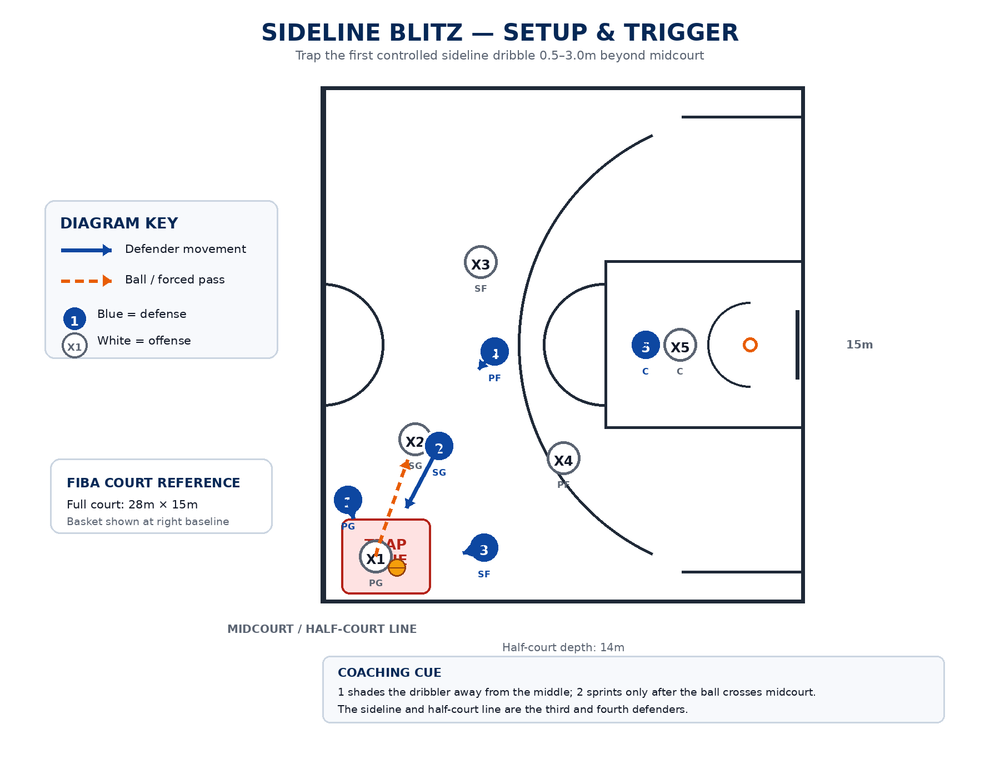
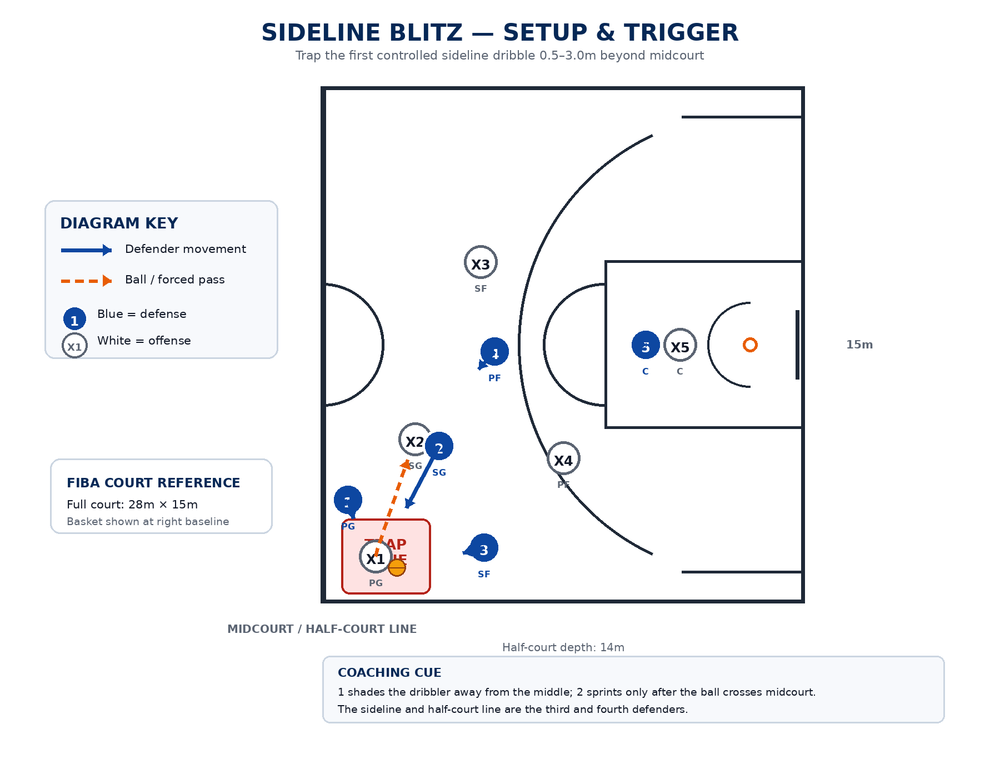
The FIBA court measures 28m x 15m; install the play on the defensive 14m half first, then add the transition entry from the full court. 1 Mark a trap box with cones from 0.5m to 3.0m beyond midcourt and within roughly 1m of the sideline. This is the target space where the ball handler has crossed half-court but has not yet reached a comfortable passing angle.
| Item | Coach setup |
|---|---|
| Players | 10 for live 5v5; begin with 6 for 3v3 teaching. |
| Equipment | One ball, 6–8 flat cones, pinnies, whistle, and a visible trap-box marker. |
| Defender 1 | Ball-side guard; shades the dribbler outward and stops the first dribble in the trap box. |
| Defender 2 | Weak-side guard; starts 3–4m inside the ball line and sprints to form the second wall. |
| Defender 3 | Ball-side wing; takes away the short sideline outlet. |
| Defender 4 | Weak-side forward; sits at the nail/high-post lane to own the middle reversal. |
| Defender 5 | Centre; starts near the front of the rim and stays deeper than the ball as the safety. |
3. Step-by-Step Instructions
Call and funnel. Give the call as the ball is inbounded or as it approaches the centre line. Defender 1 aligns slightly inside the dribbler's front hip, chest square and feet active, then gives up the outside lane deliberately. The aim is to guide the ball handler to the sideline without gambling for a steal. Defender 2 stays patient until the ball crosses the line; trapping too early lets the offense retreat.
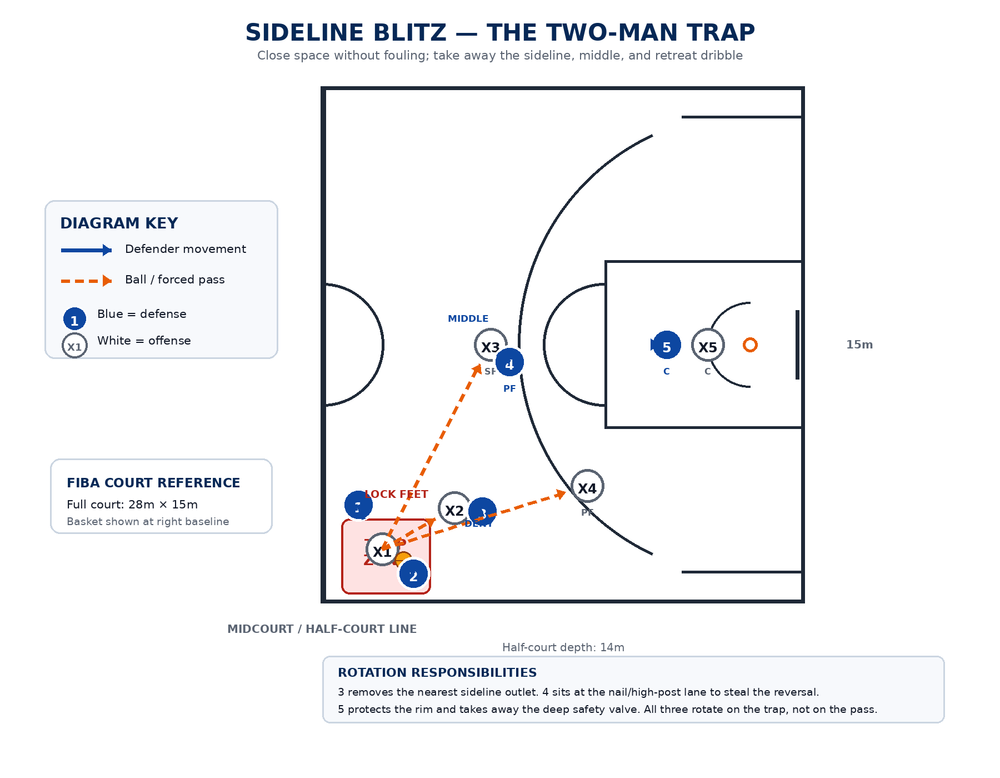
Trigger on the first controlled sideline dribble. Once the ball handler is 0.5–3.0m over midcourt and close to the sideline, Defender 1 stops the ball while Defender 2 arrives on a sprint. Both defenders close to an arm's length, with bent knees, chest-to-shoulder angles, and high hands. Their feet should form a tight V around the ball handler's outside and retreat lanes. Do not leave a channel between the trappers.
Make the pass predictable. Defender 1 takes away the retreat dribble and sideline; Defender 2 takes away the middle turn. Both trappers trace the ball with high hands, showing discipline rather than reaching. Tell players that the desired outcome is a high, slow, visible pass, not a swipe at the dribble.
Rotate on the trap, not after the pass. The instant Defender 2 commits, Defender 3 jumps the nearest sideline outlet. Defender 4 moves toward the nail, approximately the middle of the free-throw line area, with vision on both the trapped ball and the weak-side wing. Defender 5 drops toward the front of the rim, ready for a lob, a basket cut, or a long safety pass.
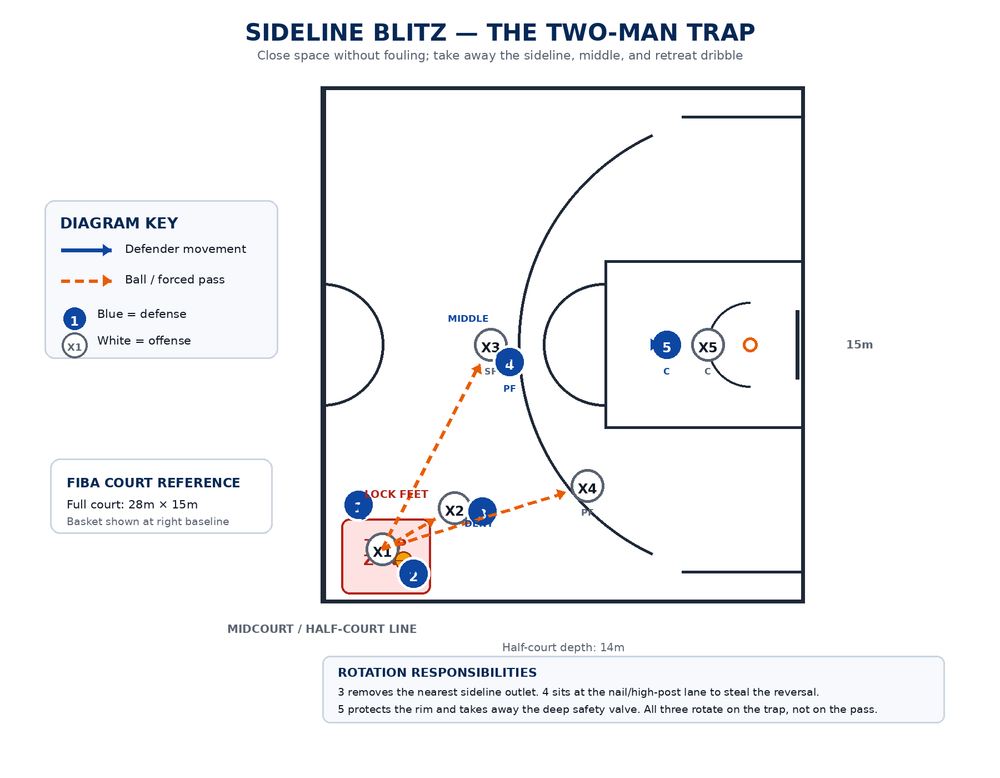
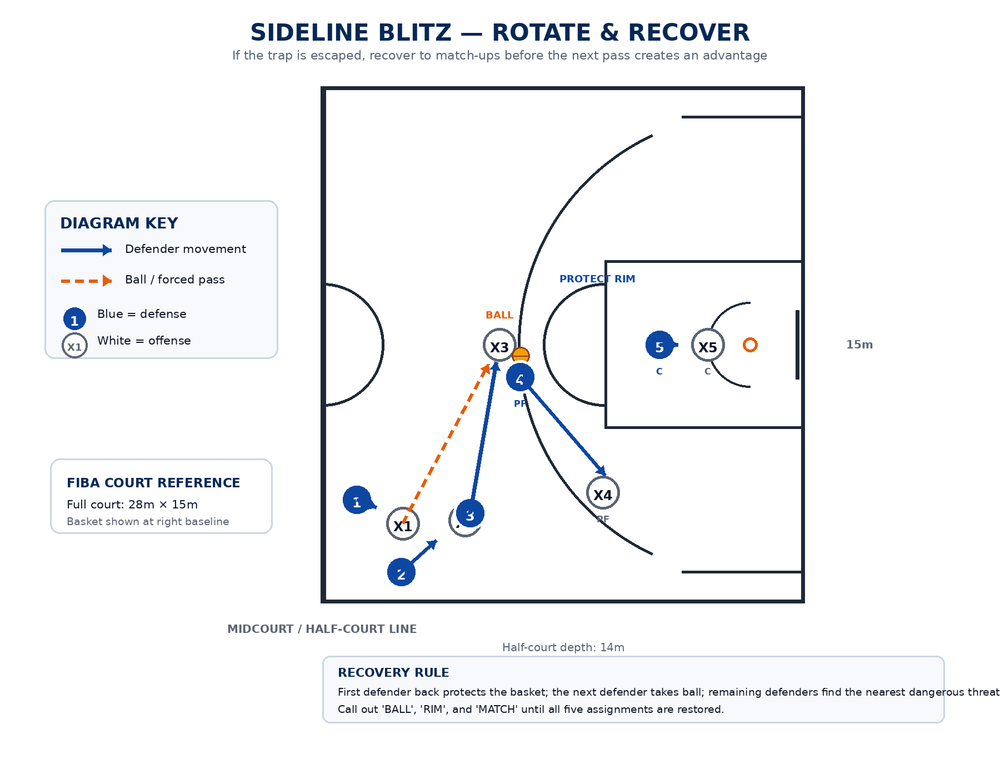
Finish the possession. When the pass leaves the trap, the nearest rotating defender attacks the catch with two controlled steps and active hands. The other three defenders fill behind the play; do not send a third player to the ball without a clear interception. On a steal, make the first outlet pass ahead and sprint into offense.
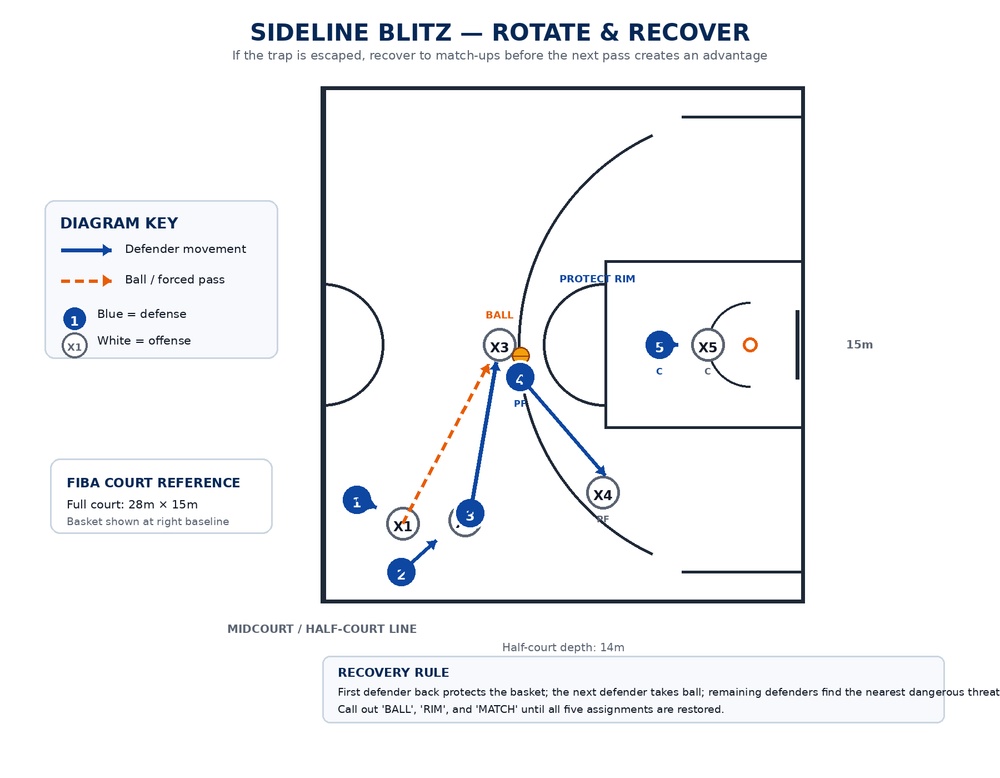
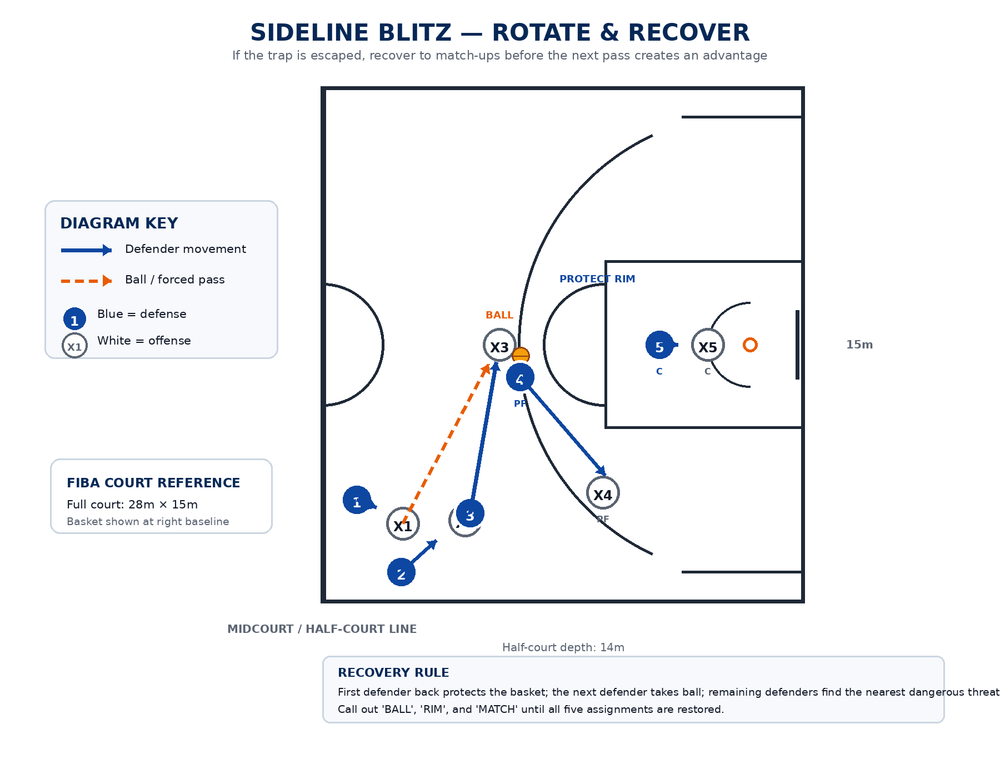
Recover with Ball–Rim–Match. If the offense escapes cleanly, call Ball, Rim, and Match. The first defender to the new ball takes it; the next defender protects the rim; everyone else finds the nearest dangerous player and communicates the matchup. Recovery must be complete by the offense's next pass, not after the shot.
4. Key Coaching Points
| Teaching point | What to demand in practice |
|---|---|
| No middle | Defender 1 keeps an inside foot and inside hand active; middle penetration ends the trap call. |
| Arrive under control | Defender 2 sprints hard, then chops the final two steps to avoid a reach-in or collision foul. |
| Lock the space | The trappers remove daylight between them. A gap invites the split dribble. |
| High hands, clean body | Hands trace passing windows while the chest stays legal and balanced. No swiping down. |
| Rotate early | Defenders 3, 4, and 5 move on the trap signal, not when they see the pass. |
| Protect the rim | Defender 5 remains the safety unless the ball is clearly secured. A turnover is never worth a layup. |
5. Common Mistakes
| Mistake | Immediate correction |
|---|---|
| The trap begins before midcourt. | Reset the rep. Require the dribbler to cross first, then release Defender 2. |
| Defender 2 flies past the ball handler. | Use a sprint-to-chop cue: sprint for the first 3m, then take two short balance steps. |
| The trappers reach and foul. | Freeze the action and show hand position above the ball; count a turnover only if both feet stay down. |
| Defender 3 chases the ball instead of denying the outlet. | Put a cone on the sideline outlet and reward every denial touch. |
| Everyone leaves the basket. | Give Defender 5 the verbal rule: deeper than the ball until the steal is secure. |
6. Variations & Progressions
Start with a 3v3 sideline-box progression: two trappers and one interceptor defend three offensive players in a 7m x 7m area. The offense gets four seconds to pass or escape; the defense scores for a five-second violation, deflection, or steal. This isolates trap footwork before the full rotation is added.
Progress to 5v5 guided live play. Require the offense to enter through the marked sideline box and allow the defense only one trap per possession. Stop the first two reps for correction, then let the next six reps run uninterrupted so players learn real recovery consequences.
For an advanced change-up, use the fake trap. Defender 2 sells the sprint, Defender 3 shows high, then both retreat to their normal coverage as the ball handler picks up the dribble or throws early. A second option is a run-and-jump entry, where the closest off-ball guard becomes Defender 2 and the original on-ball defender rotates out. Only add either variation after the base Ball–Rim–Match recovery is automatic.
7. Age Adaptations
| Group | Adaptation |
|---|---|
| Under 8–Under 10 | Teach the funnel and legal stance only. Use 2v2 near the sideline; do not demand live traps or complex rotations. |
| Under 12–Under 14 | Install the two-player trap plus Defender 3's outlet denial. Keep Defender 5 fixed at the rim and use short 3v3 reps. |
| Under 16 | Run the full five-player version, but cap live traps to selected possessions until communication is reliable. |
| Open / advanced | Add fake traps, run-and-jump entries, scouting-based triggers, and immediate conversion offense after a steal. |
20-minute installation plan
Use the first 3 minutes for stance, funnel angle, and sprint-to-chop footwork without a ball. Spend 5 minutes in the 3v3 sideline-box progression, then 6 minutes in guided 5v5 with a coach initiating the trigger. Finish with 6 minutes of competitive 5v5: award two points for a clean steal, one point for a deflection or forced retreat, and subtract one point for a trap foul or an uncontested rim finish. End every rep with the recovery call, even when the defense wins the ball.
