

Netball
Centre Pass Variations: Split, Punch and Re-offer
Build two reliable centre-pass pictures that give your C, WA and GA clear first, second and third options against organised defensive pressure.

What you need
balls, cones
Overview
This 20-minute court-based drill gives an attacking unit two distinct centre-pass variations. The first, Split & Punch, uses a wide WA clear to open a hard GA punch at the top of the centre circle. The second, GA Release & C Re-offer, makes the GA first receiver, then uses the C's second effort to find the WA driving into the attacking lane. The aim is not to memorise arrows; it is to create a common picture, a call before the whistle, and 3-second discipline. Run it at match speed once the shapes are understood.
Setup
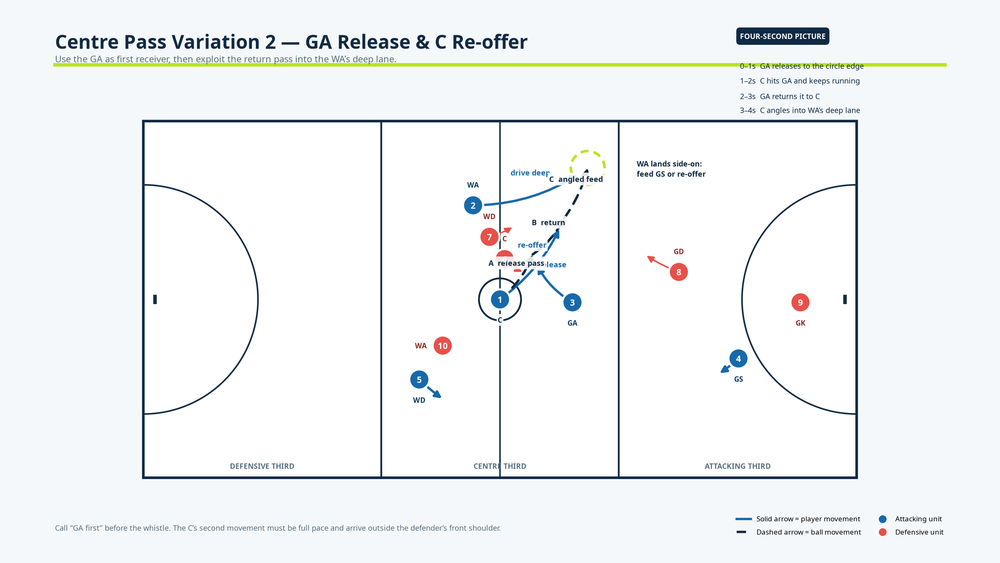
Use a full regulation court, 30.5m x 15.25m, with clear markings. You need 10 players, one ball, 10 flat cones and bibs. Blue is the attacking unit: 1 C, 2 WA, 3 GA, 4 GS and 5 WD. Red is the defensive unit: 6 C, 7 WD, 8 GD, 9 GK and 10 WA. The blue WD is a balance and recycle option; the red WA works as a second centre-third defender.
Place a cone at the WA's wide-clear landing space, one at the GA's punch space just beyond the centre circle, and one in the WA's deep lane. Mark each catch space roughly 1m inside the relevant boundary so players learn to stay in court. The C begins on the centre spot with the ball. Defenders start live but initially at 60% pressure, one arm from their opponent. Rotate the two spare defensive roles every two repetitions so all players read both roles.
Set a clear success measure: the attack earns one point for a clean first receive, one for completing the named second pass, and one for entering the goal third under control within 8 seconds. A dropped ball, contact call or offside finish resets play.
Step-by-Step Instructions
1. Prime the picture — 0:00–2:00
Show the starting alignment and name the call before the centre whistle: “Split” for Variation 1 and “GA first” for Variation 2. Walk the ball through once. Ask every player to say their first job out loud: clear, punch, re-offer, hold, or cover. This gives each run purpose.
2. Variation 1: Split & Punch — 2:00–9:00
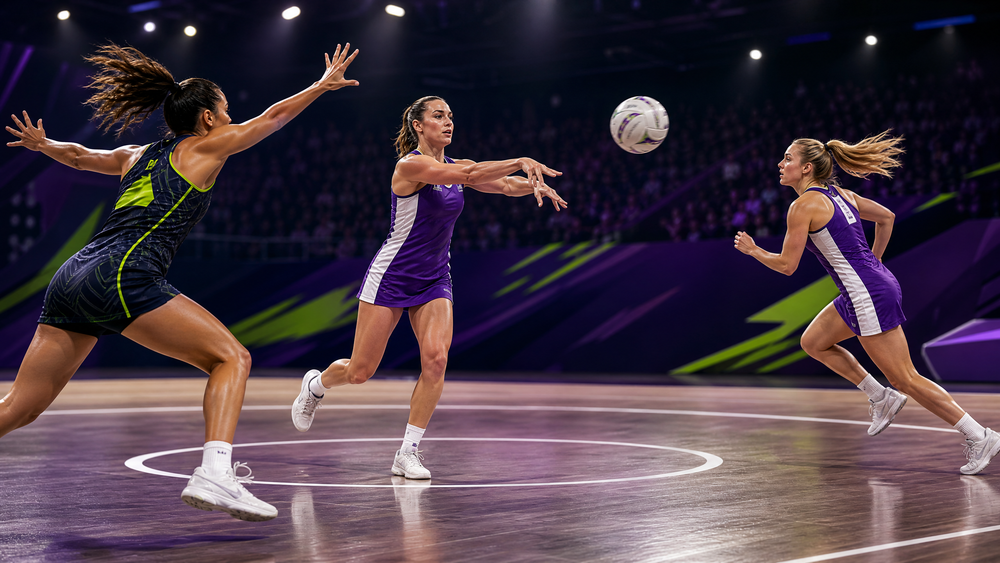
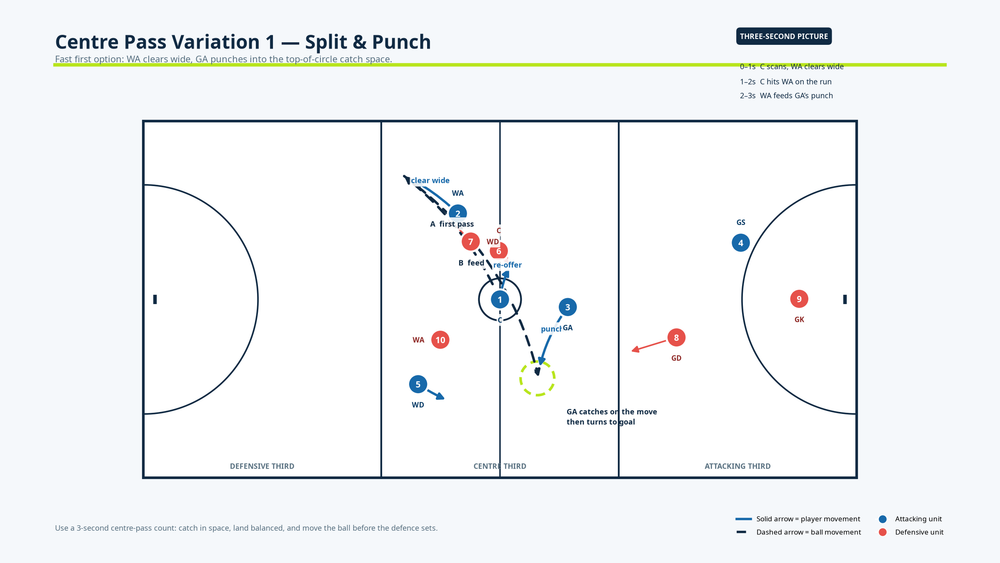
On the whistle, WA 2 clears hard and wide towards the sideline for one second, taking red WD 7 with her. At the same moment GA 3 shapes slightly high, then punches diagonally into the released space at the top edge of the centre circle. C 1 scans wide first and delivers a flat, catchable chest pass to WA 2 by 1.5 seconds. C then takes two quick re-offer steps, at pace.
WA lands side-on, checks the defender's hands, and feeds the GA's punch by 3 seconds. GA must catch outside the defender's front shoulder, land balanced and turn the hips towards the shooting end. GS 4 holds the circle edge and gives GA a target; WD 5 stays available behind the ball. Run three unopposed repetitions, then three at 60% defence, then three fully live. Change the C and WA after every three balls.
3. Variation 2: GA Release & C Re-offer — 9:00–16:00
On “GA first”, GA 3 releases towards the circle edge during the first second. C 1 hits GA early, then immediately re-offers at full pace into the channel created by the defender following the first ball. WA 2 delays for half a second, then drives deep and wide into the attacking lane. GA returns the ball to C by 2.5 seconds; C angles the third pass into WA's run by 4 seconds.
Coach the timing rather than the cone. If WA leaves early, she runs into the GA's passing line. If C watches the pass, the re-offer is late. GS holds a strong base in the circle and shows a high hand. WD 5 shadows into the central recycle space. Start with a passive red C and WD, then allow all defenders to hunt intercepts from minute 13.
4. Competitive finish — 16:00–20:00
Play four 45-second rounds. The attacking group nominates its call before each centre pass; defenders may press freely once the whistle goes. Award three points for a goal after a clean variation, one point for a controlled goal-third entry, and two points to defence for an intercept or forced error. Swap attack and defence after two rounds. Finish by asking which cue told the C to choose wide WA, GA first, or the safe recycle.
Key Coaching Points
- Start on a shared cue. The call comes before the whistle; eyes then read the defender's body position.
- Create width before depth. WA clears wide enough to stretch WD, then drives only when the ball carrier can see the lane.
- Make the second effort non-negotiable. After passing, C accelerates for two to three steps outside the marker's front shoulder.
- Pass to space, not the bib. Lead the receiver into a balanced landing, with the ball arriving at chest height and away from the defender's hands.
- Keep the circle connected. GA's turn should immediately see GS; GS holds rather than drifting into the feeder's lane.
Common Mistakes
- Both WA and GA lead on the same line. Freeze the moment, reset their starting depths, and insist on the half-second WA delay in Variation 2.
- C throws the first pass from a static base. Demand a decisive pivot, eyes up before release, then instant re-offer movement.
- WA catches facing the sideline. Coach a side-on landing with outside foot first so the next pass is visible.
- GA punches too early or too square. The run starts after WA's clear and travels diagonally across the defender, not straight at the ball.
- Players chase the ball into the goal circle. Reinforce role discipline: GS anchors, GA times the feed, and the C/WA stay connected outside.
Variations & Progressions
- Constraint defence: Start with red C and WD allowed to defend the first two passes only. Progress to full live defence, then permit red GD to step early into the centre-third intercept lane. This lets attackers learn the pattern before reading genuine pressure.
- Three-call game: Add a third call, “safe”, where C uses WD 5 as the first outlet and the unit recycles before attacking. The defence should not know the call until the whistle. Award a bonus point when the C changes option because the original picture is closed.
- Time-pressure scoring: Reduce the goal-third entry target from 8 seconds to 6 seconds only when catches stay clean. Speed without control simply rewards panic.
Age Adaptations
For Under 10, use six to eight players, passive defenders, shorter 6–8m leads and a 4-second hold allowance in the teaching phase. Keep only Variation 1 and reward correct spacing rather than the outcome. For Under 12–14, use the full 10, normal 3-second possession and 60% defence before live play. For Under 16 and open players, remove the cones after two rehearsals, require the C to call the option from the defender's starting stance, and film two live rounds for a quick player-led review of timing and body angles.
