

Netball
Double-Screen Shooting Circle Play
Create a fast shooting-circle advantage using two legal, stationary screen lines to free GA for a shot or GS under the post.

What you need
balls, cones
Overview
This advanced attacking set play creates a brief shooting-circle advantage by using two legal, stationary screen lines to disrupt the Goal Defence (GD) and Goal Keeper (GK) partnership. It is not a basketball block: every attacker must hold her own landing space, avoid body contact and never step into a defender’s line after the defender has committed. The objective is simple: release the Goal Attack (GA) for a clean 3–4.5 metre shot, or force the GK to leave the post so the Goal Shooter (GS) receives under the ring. Run it on the right side first, then mirror it left.
Time the action from the Centre’s (C) first catch in the attacking third. The whole pattern should reach a shot by 4.8 seconds. That pace matters: it prevents a recovering Wing Defence (WD) or Centre from becoming a second defender in the circle.
Setup
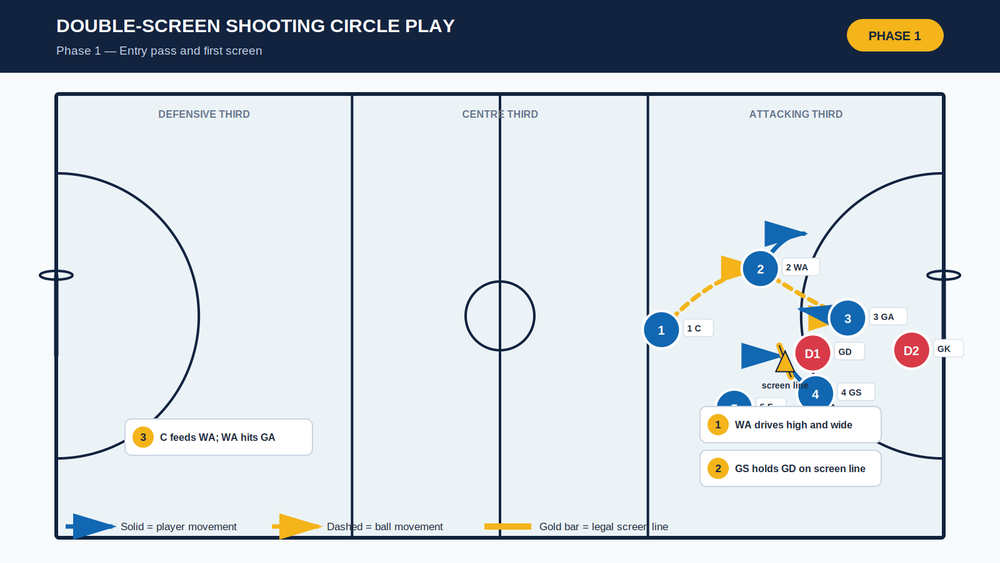
Use a regulation 30.5 m × 15.25 m court. Put C (1) just inside the attacking third, 4–5 m in from the sideline. WA (2) starts high and wide at the top of the circle; GA (3) begins just outside the circle, slightly goal-side of WA; GS (4) starts low, 1.5–2 m in front of the post. A floating feeder (5) sits 5 m behind the circle to recycle an overthrown ball in the practice. Defend with GD and GK live; add WD, C and a recovering defender for full 5 v 5 pressure.
Cone a narrow “screen corridor” 2.5–3 m in from the goal line and 2 m from the post. The corridor is a reference, not a place to collide. Tell the screeners to arrive balanced, feet planted and hands off. Use two balls so repetitions flow: one with C and one with the feeder.
Step-by-Step Instructions
0.0–0.8 seconds — trigger. C catches and calls “double”. WA drives high and wide for two hard steps, showing both hands. GA moves one step towards the sideline to lengthen GD’s defending angle. GS takes a small baseline clearance, drawing GK’s eyes away from the corridor.
0.8–1.6 seconds — first feed. C sends a firm, flat pass to WA. WA lands side-on, pivots to face the circle and must release within one second; the pass is a trigger, not a pause. If the WD wins the front space, WA returns the ball to C and restart—do not force the entry.
1.6–2.6 seconds — first screen picture. As WA receives, GS steps into the outer edge of the screen corridor and becomes still. GA curls underneath her own defender towards the first screen line, but stays a clear arm’s length from both GD and GS. WA feeds GA’s outside shoulder. GS’s job is to make GD choose a legal route around, not to move into GD’s path.
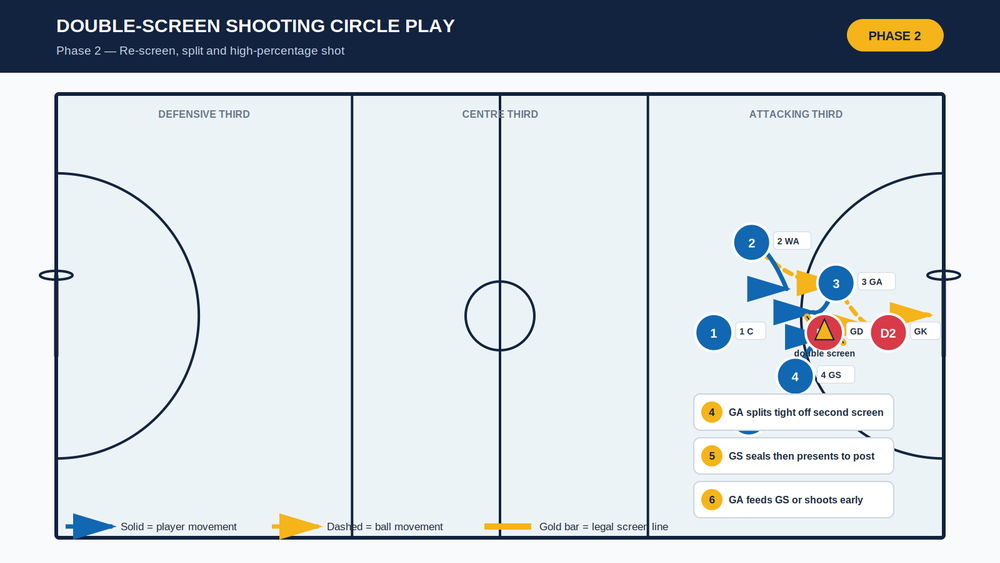
2.6–3.4 seconds — re-screen. GA catches outside the circle, lands on her outside foot and eyes the post. GS pivots off the first line, takes one short step across and resets a second stationary line closer to the post. This stagger creates a second decision for GD: chase GA’s split or protect the GS seal. WA immediately re-offers high as the safety outlet.
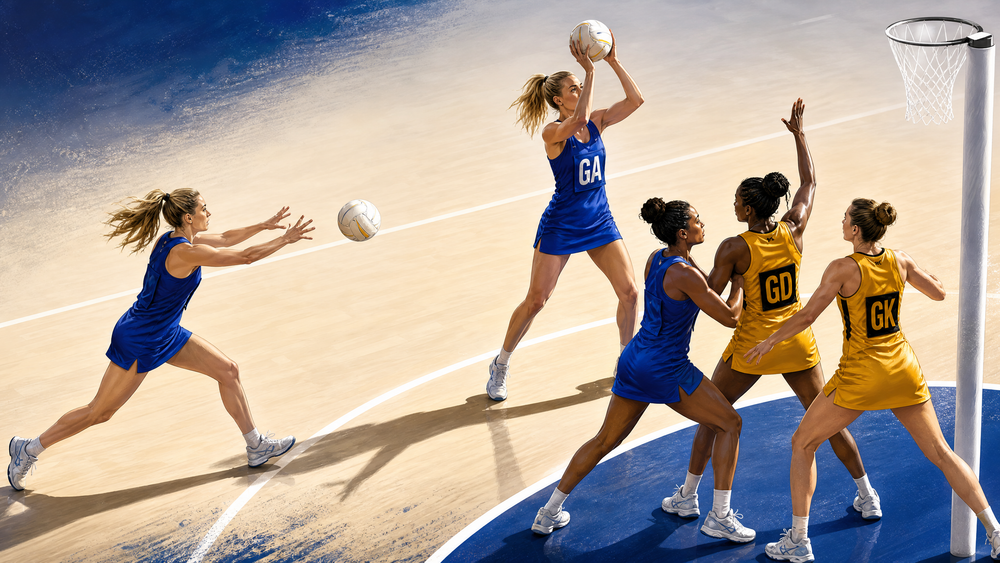
3.4–4.2 seconds — split. GA drives shoulder-to-shoulder distance past the second line, accelerates for two steps and brakes into a balanced catch space inside the circle. Her first look is a quick shot if GK is late. If GK has left the post to contest GA, GA gives a short, soft feed to GS presenting front space under the ring.
4.2–4.8 seconds — finish and reset. Shoot early, before the recovering defender is set. On a missed or unavailable shot, GA releases back out to WA; GS clears away from the post and the group resets through feeder 5. Count a successful repetition only if the ball reaches a shooter within 4.8 seconds and no contact or obstruction is called.
Key Coaching Points
- Call the trigger before C receives; the set is won by synchronisation, not speed alone.
- Coach the GA to run off the screen line, never into it. A tight split is about footwork and timing, not physical contact.
- GS must be stationary before GD arrives: chest tall, feet stable, arms close, then release and re-present.
- WA’s feed should hit GA’s outside hand, away from GD’s intercepting arm. Flat and early beats a lofty hopeful pass.
- Keep the post occupied until the final decision. GK should feel she must choose between guarding the shot and guarding GS.
Common Mistakes
The most common error is GS drifting with GD and turning the screen into contact. Freeze the player at the cone, then rehearse her pivot and release without defenders. GA often cuts too early, allowing GD to slip underneath; insist GA waits until WA has caught. WA may hold the ball and admire the pattern—use a one-second release target. Finally, players can crowd the post; if GA and GS are within one metre, the GK has one easy defending picture.
Variations & Progressions
For the slip variation, GS shows the first screen but slips immediately to the post when GD jumps high; GA then receives the WA feed and pops the ball down to GS. For the GA-shot variation, GS holds both screen lines and GA takes the first clean catch-and-shoot rather than forcing the second pass.
Progress from walk-through with passive defenders, to 3 v 2 (WA, GA, GS versus GD, GK), then 5 v 5 with live WD and a recovering Centre. Add a scoring condition: two points for a first-look shot, one point for a GS feed, zero for a reset. Mirror the set from the left and require the attackers to recognise whether GD or GK is the player being screened.
Age Adaptations
For Under 12s, use one stationary screen line, a wider 3 m corridor and no time target until the players can stop safely. Let GA catch outside the circle and feed GS rather than demanding the split-shot. For Under 14s, introduce the 4.8-second target and passive-to-live defenders. For Under 16 and Open players, add the second screen, a live recovering defender and a rule that the first legal shooter must take the shot. At every age, reward legal space, strong landing positions and clear communication before adding pace.
