Cricket
Death Overs Bowling Plan: Wide-Yorker Pressure to a Right-Hand Batter
A coach-ready final-overs set play that combines a wide-yorker field, precise landing targets and a disciplined change-up to deny boundaries under pressure.

What you need
cricket stumps, wicketkeeper gloves, 12-18 cricket balls, 8 flat cones, 4 tall cones, training bibs, scorecard and pen
Overview
Death Overs Bowling Plan: Wide-Yorker Pressure to a Right-Hand Batter is a repeatable defensive set play for late overs of a limited-overs innings. It makes the striker hit from an uncomfortable base, denies a free leg-side swing, and funnels mishits into a pre-set five-rider boundary cordon. Use it in overs 17–20 against a right-hander who is clearing the front leg or seeking room; reverse the field and angle for a left-hander.
The sequence is two credible wide yorker looks, then one change-up. The bowler controls line and pace, the wicketkeeper gives the target, and the fielders attack the single rather than merely save four.
Coach’s intent: Make the batter reach across the body, protect the off-side scoring area and accept the low-risk single rather than concede the boundary.
Setup
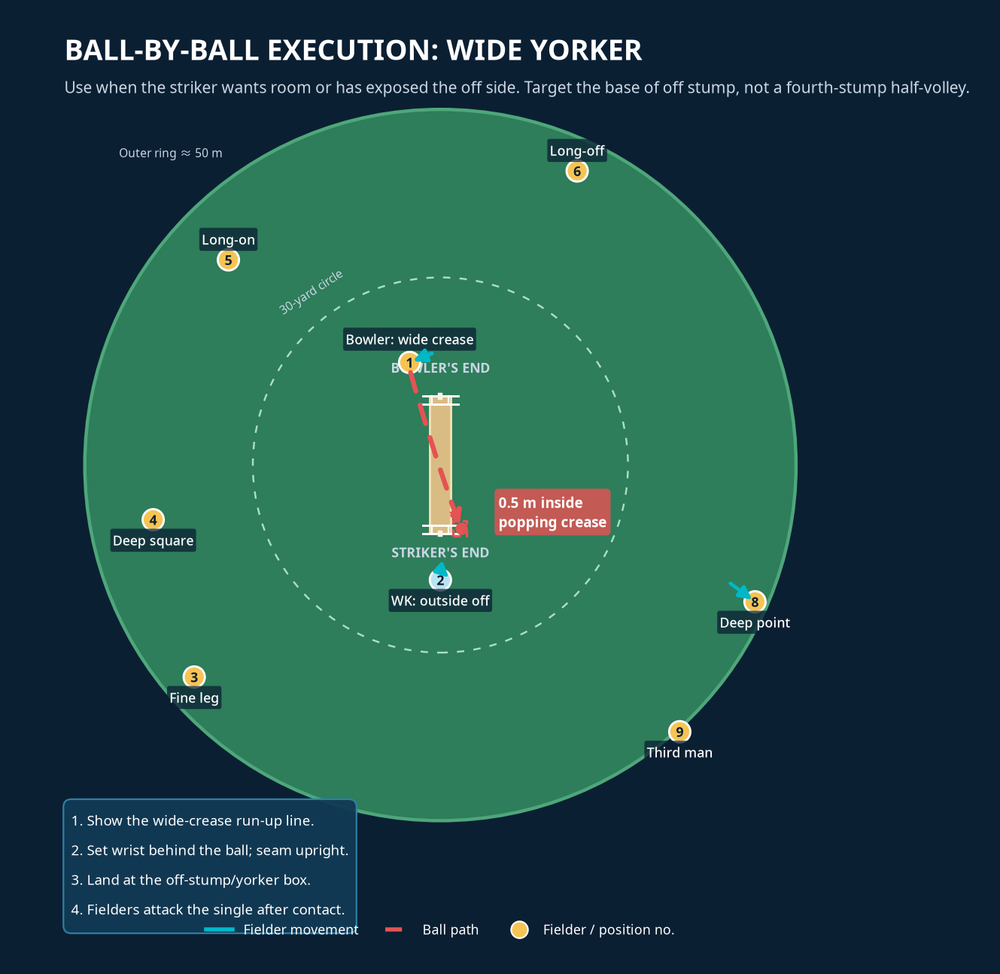
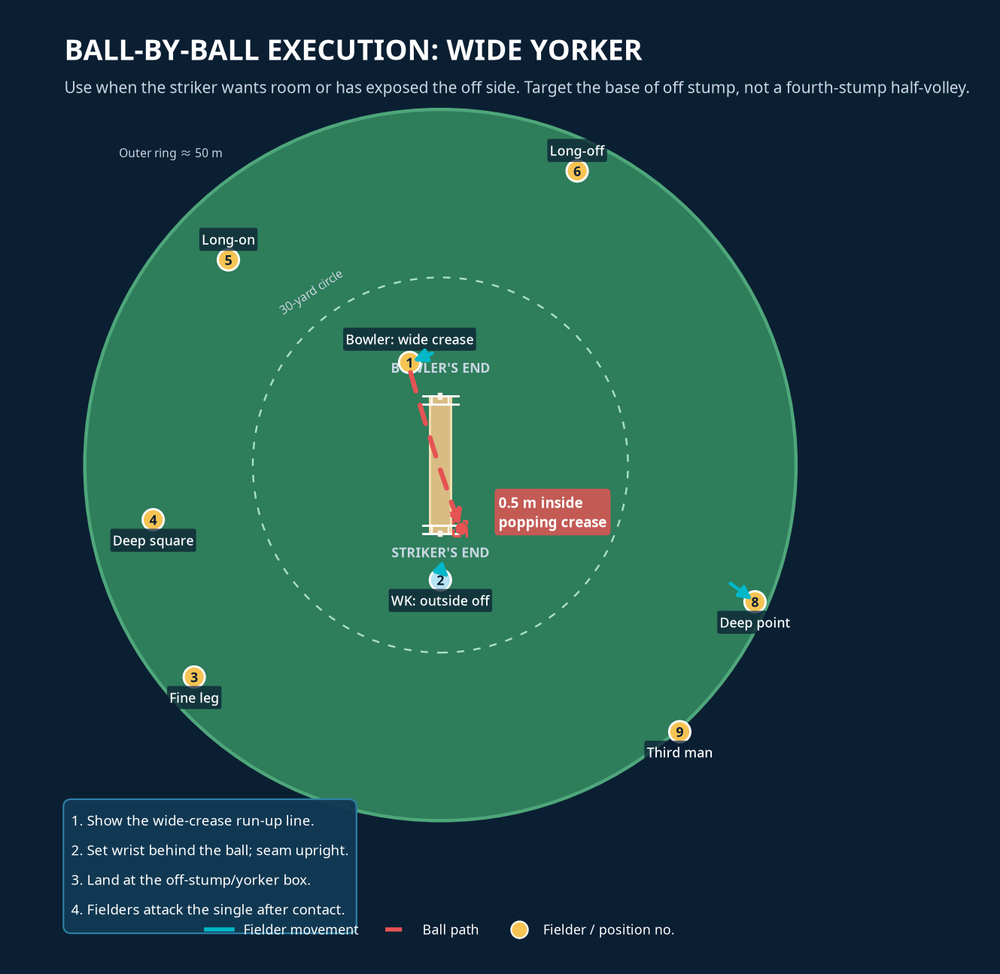
Use a full oval or a marked outfield with a regulation 22-yard / 20.12 m by 10 ft / 3.05 m pitch. Junior governing bodies may set a shorter pitch, so use the local competition length where it differs.1 Mark the yorker box just outside off stump, 0.5 m inside the striker’s popping crease, and the change-up marker 6 m from the popping crease, 0.6–1 m outside off.
| Item | Coaching use |
|---|---|
| 12 players | Bowler, wicketkeeper, right-hand batter, and eight additional fielders; rotate bowling every six balls. |
| 12–18 balls | Enables a two-over block without interrupting pressure for retrieval. |
| 8 flat cones and 4 tall cones | Mark landing boxes, outer-ring reference points and the 30-yard circle reference. |
| Stumps, keeper gloves and scorecard | Reinforce match cues: target, score, balls remaining and consequence. |
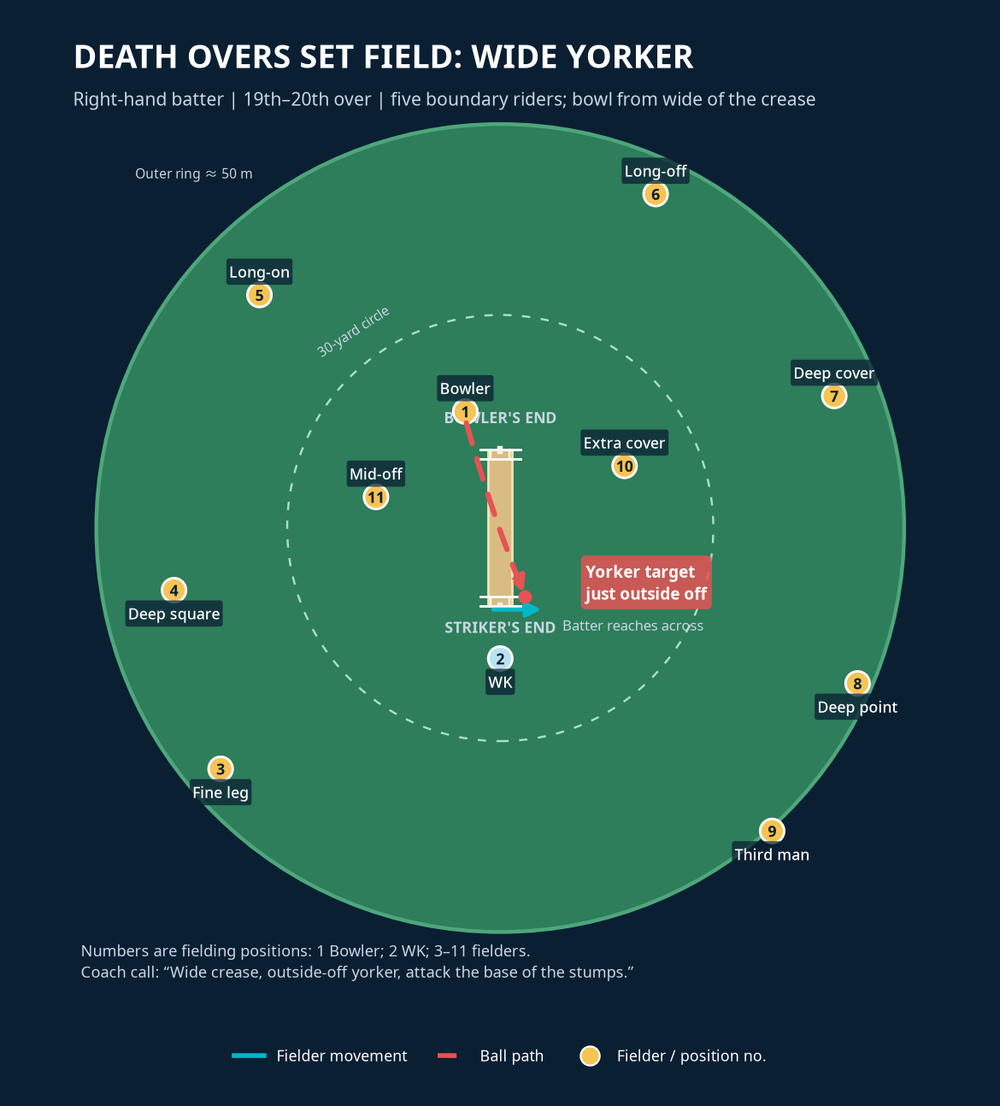
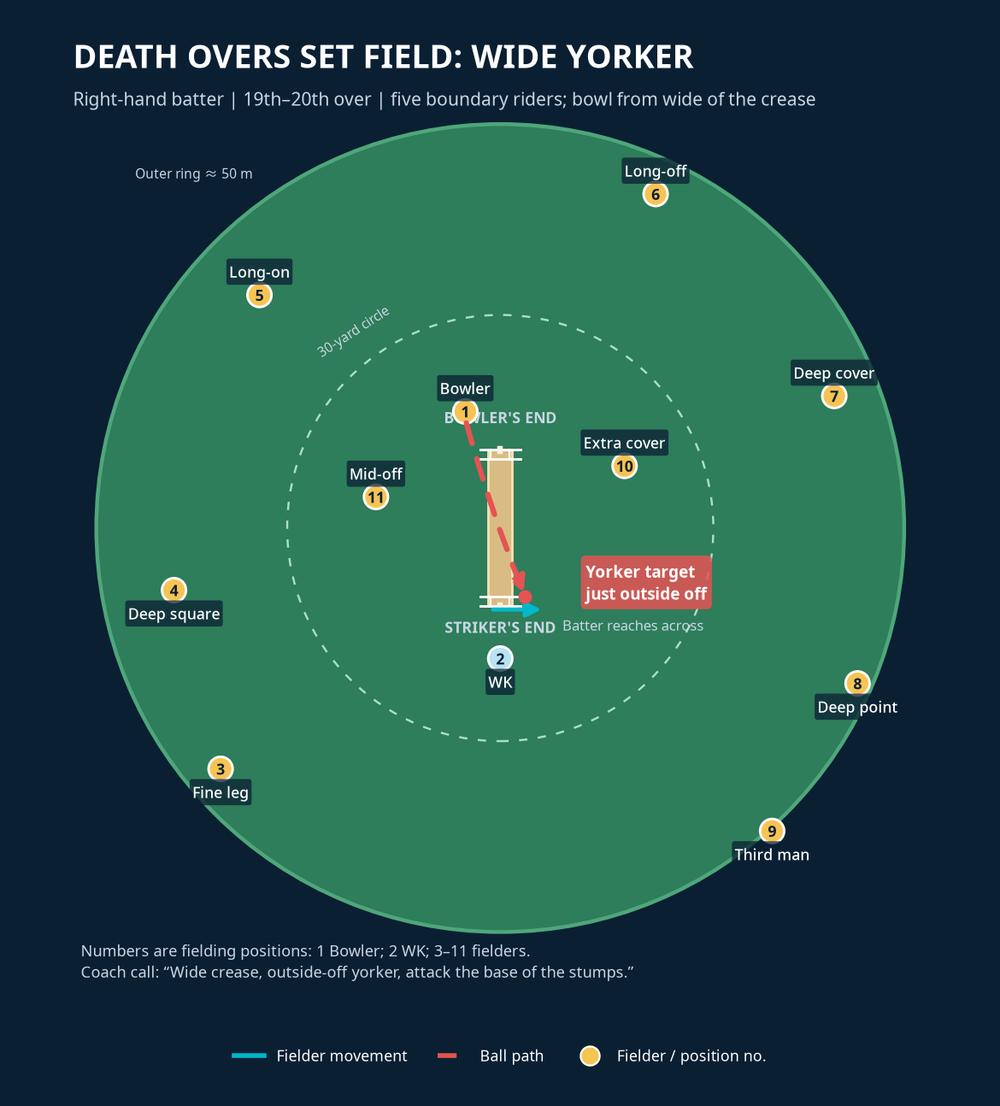
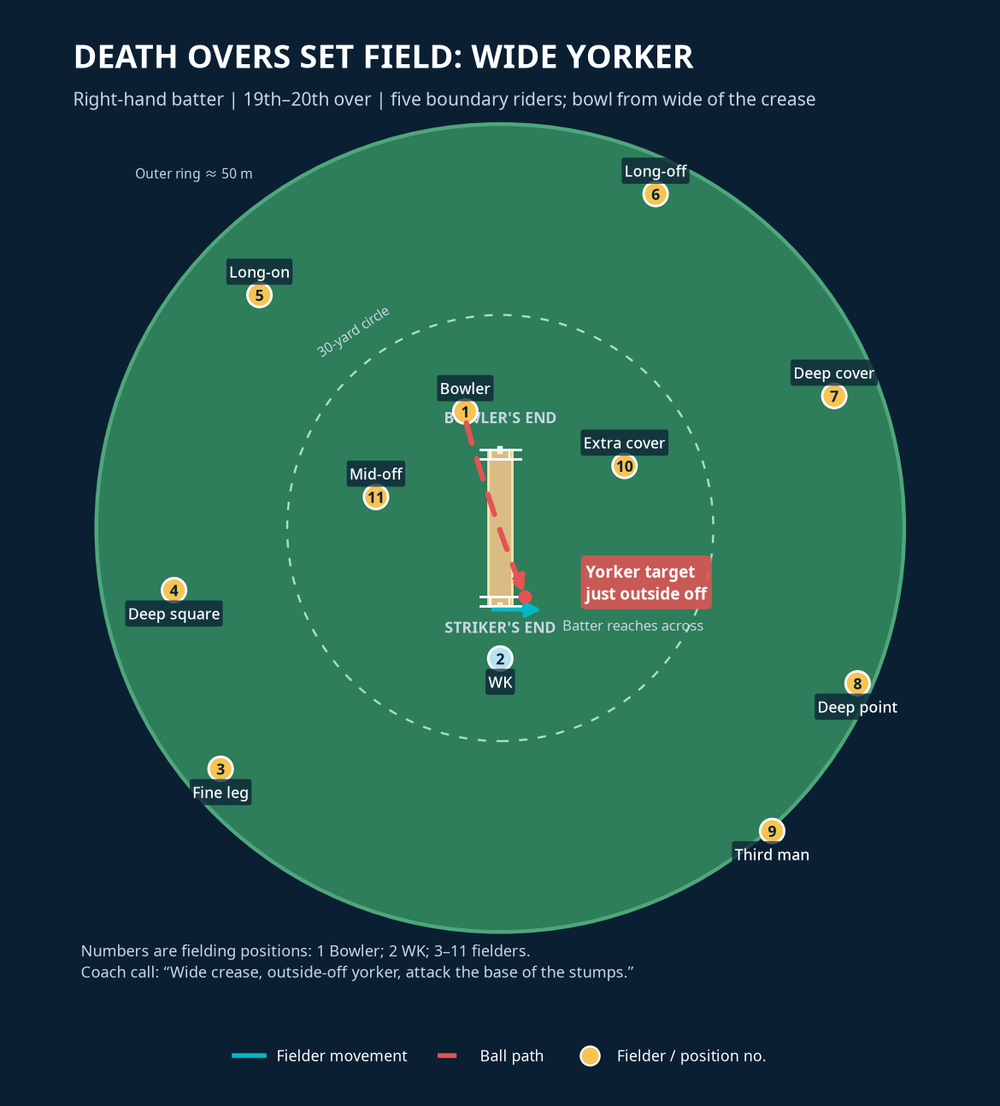
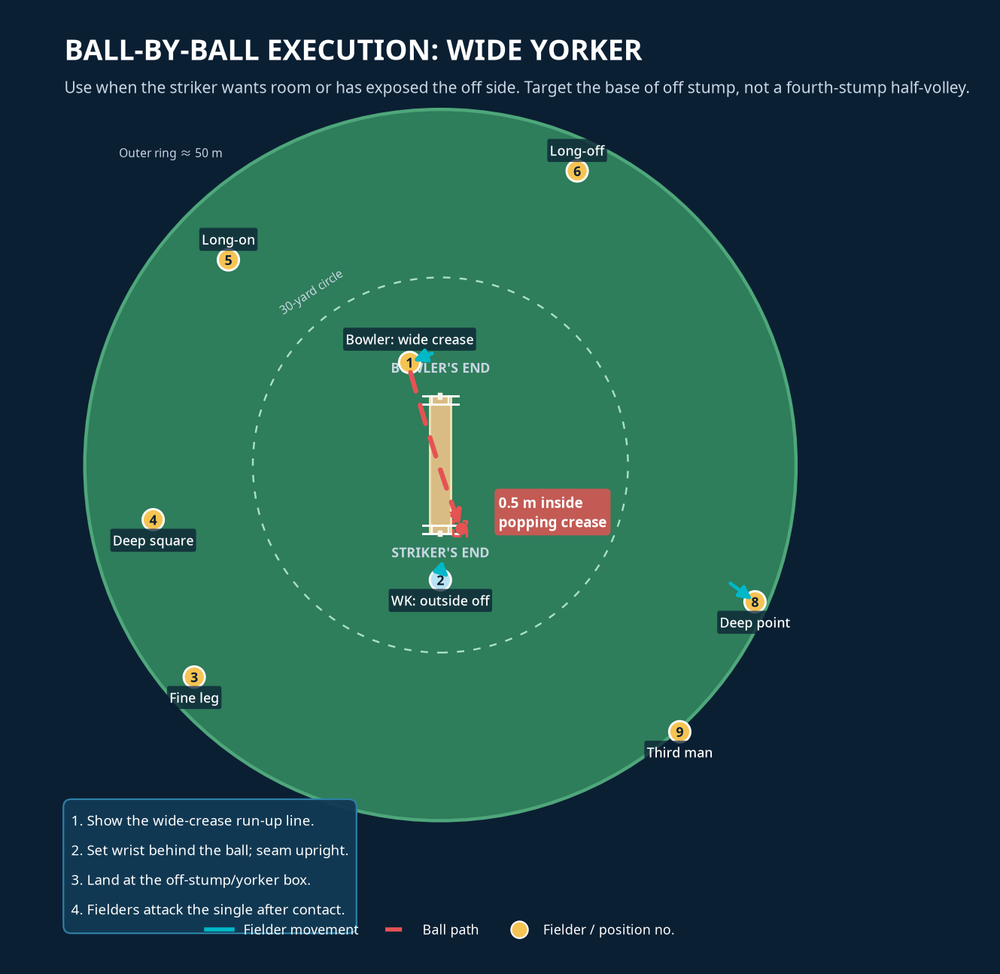
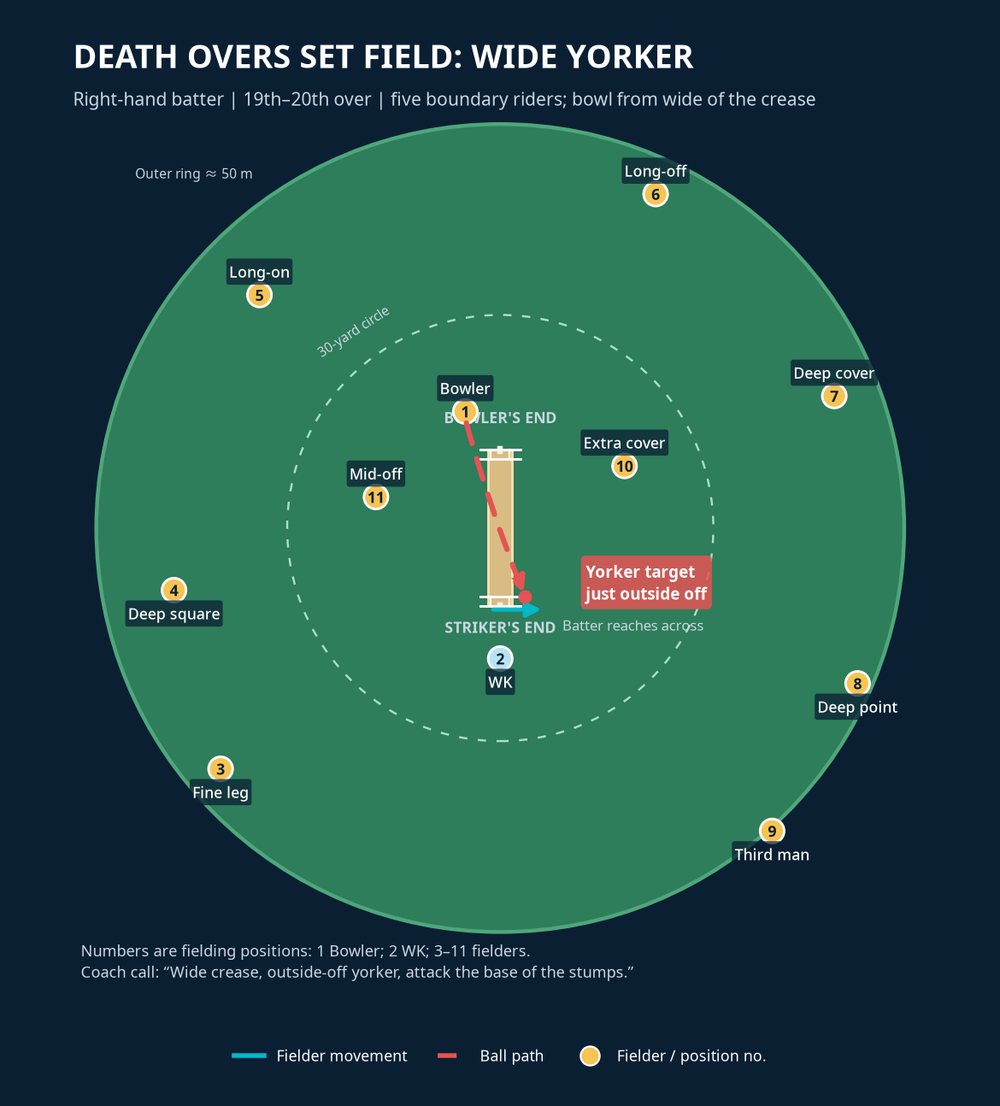
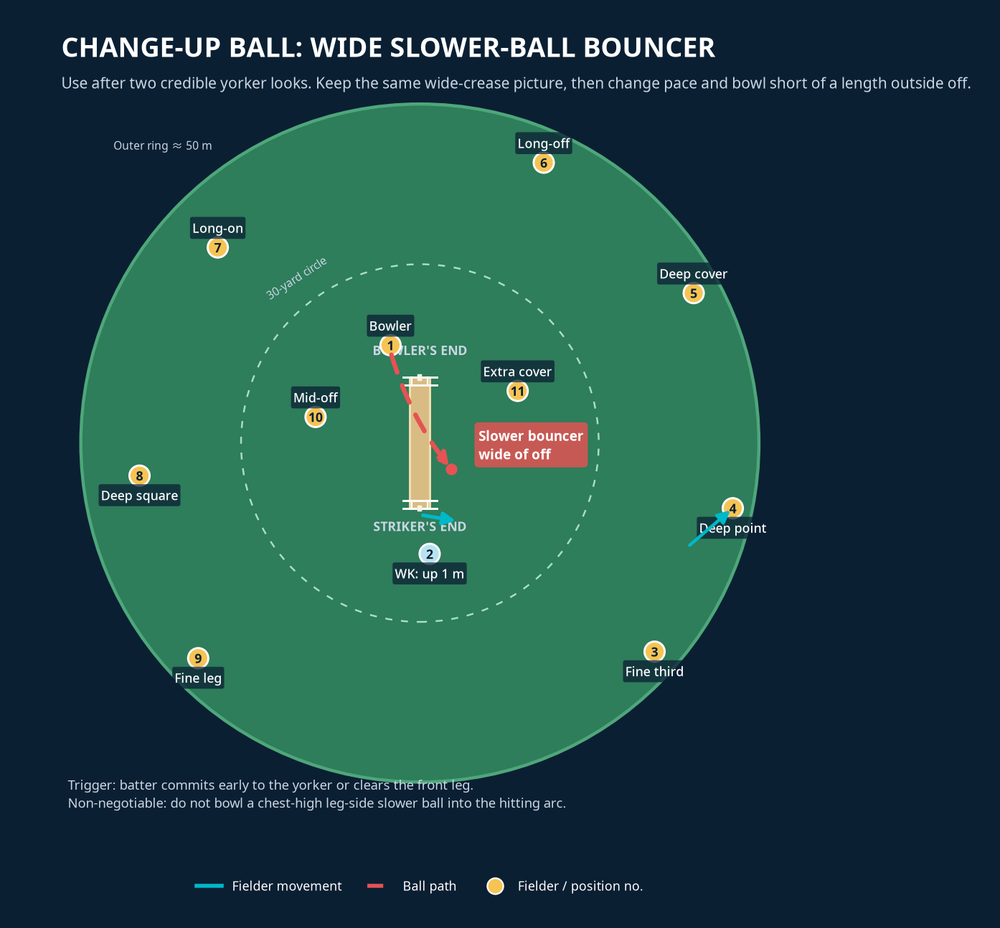
Set the 11-player field shown below: 1 Bowler, 2 Wicketkeeper, 3 Fine Leg, 4 Deep Square Leg, 5 Long-on, 6 Long-off, 7 Deep Cover, 8 Deep Point, 9 Third Man, 10 Extra Cover and 11 Mid-off. Start with five riders on the boundary at fine leg, deep square, long-on, long-off and deep cover/deep point according to the batter’s strongest arc. For the default right-hander plan, leave mid-off and extra cover up to protect the inside edge, hard-driven single and mishit.

Coach’s field call
Call: “Five out. Deep point square. Long-off straight. Keeper outside off. Wide crease, yorker box.” Make the bowler repeat the target before starting the run-up.
Step-by-Step Instructions
Name the match problem. Set a realistic score, for example 23 needed from 12 balls with one set right-hander on strike. Tell the batting pair that boundaries, not singles, are the bowling side’s failure measure.
Lock the field and crease. The captain positions 3–11, then checks that Deep Point and Third Man can see the keeper’s gloves. The bowler begins 20–30 cm wider on the bowling crease than their stock line, creating a delivery angle that finishes outside off rather than drifting into the leg-side hitting arc.
Deliver balls one and two as credible wide yorkers. Keep the wrist behind the ball, head still through release and front knee braced. Aim at the far edge of the cone box, not at the wide line. The ball should land at the base of off stump or just outside it; a toe-crusher is useful, but a legal, full ball that removes swing-room is the win.
Run the fielding response. On contact, Extra Cover and Mid-off attack forward for the single while the nearest boundary rider comes in on the ball. The wicketkeeper calls “yes/no” loudly. If the ball goes to Deep Point or Third Man, the throw returns to the keeper’s end first unless a run-out opportunity is obvious at the bowler’s end.
Review after two balls. Ask: Did it land in the box? Where was the mis-hit likely to go? Move one rider only if the first two balls justify it.
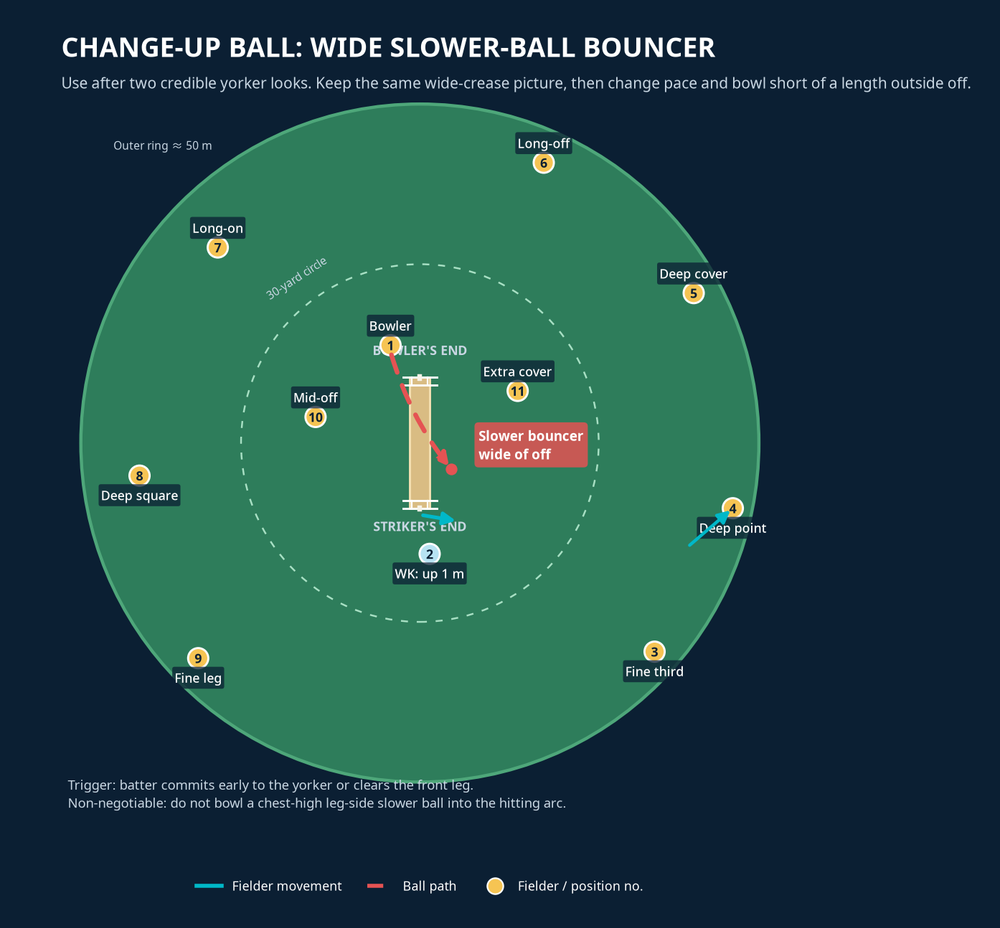
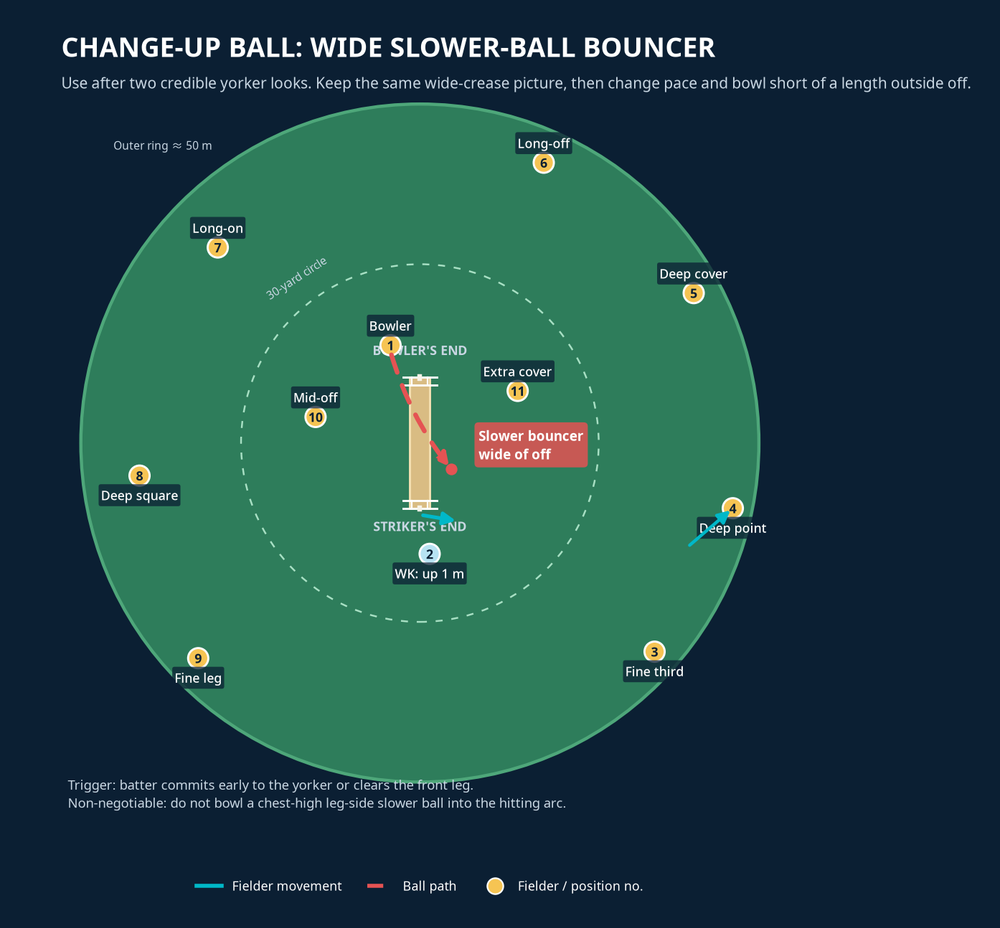
Use the change-up on ball three or four. Preserve the same wide-crease picture, then bowl a slower ball short of a length outside off. It must be covered by Deep Point, Deep Cover and Third Man. Use it only after early pre-movement or a committed front-leg clear.
Finish with the best execution option. If the batter is still reaching, return to the wide yorker. If they have stopped advancing and are waiting deep in the crease, go fuller outside off with a hard length—not a slot ball. The final two balls should be selected from the evidence of the over, not from a pre-written six-ball script.
Key Coaching Points
| Coaching point | What the coach should watch and say |
|---|---|
| Bowl to a box, not a feeling | A yorker target needs a visible cone box. Say: “Base of off; do not chase the wide line.” |
| Crease angle creates margin | A wider release point lets the ball finish outside off without needing an unmanageably wide line. Say: “Wide feet, straight wrist.” |
| Field to the likely miss | Wide yorkers create jams, inside edges and off-side mishits. Keep Mid-off and Extra Cover alive for the one. |
| Keeper is a tactical leader | The keeper sets the visual target, repeats the ball call, and owns the first throw option. |
| Change only one variable | Keep the run-up and angle; alter pace and length. Multiple changes make the variation readable and inaccurate. |
| Reset after every delivery | Riders must move back to their exact starting line before the next ball. A casual reset concedes the boundary. |
Common Mistakes
| Error | Immediate correction |
|---|---|
| Bowler chases the wide line and bowls a wide | Bring the target back to the off-stump cone; the field creates pressure, not an illegal delivery. |
| Yorker becomes a half-volley | Shorten the final stride slightly and ask for a firmer front-leg brace; rehearse from a three-step run-up before full run-up. |
| Boundary rider is too square or too straight | Use the batter’s last scoring shot as evidence, then move the rider 8–12 m—not five vague paces. |
| Change-up is leg-side and hittable | Keep the slower-ball release outside the ball’s equator and retain the outside-off line. Abort the variation if control is not established. |
| Fielders wait for a save rather than attack the single | Award one point for a clean attack-and-return inside four seconds, even if the ball did not carry. |
Variations & Progressions
Progression 1 — Landing-box isolation. With only bowler, keeper and coach, bowl six balls at the wide-yorker box. Award two points for the box, one for a full ball in the outside-off channel and minus one for a wide or half-volley. Do not add fielders until the bowler scores at least eight from 12.
Progression 2 — Two-over decision game. Add the complete field and a batter. The bowling captain can change only one fielder between balls and one fielder between overs. Score the bowling side three points for a dot, two for a wicket, one for a single, zero for two or three, and minus three for a boundary. This makes bowlers understand the cost of chasing magic balls.
Variation — Left-hand batter. Mirror the plan: move the wide-crease line and outside-off target to the other side, switch the deep square/deep point emphasis, and make the keeper re-state the return-end call. Never simply reverse the diagram without checking the batter’s preferred sweep, ramp and straight-hit zones.
Variation — Slow bowler at the death. Replace the yorker with a low, full off-stump ball from a wider crease, delivered with pace off but a stable seam or scrambled-seam release. Keep long-off and deep cover honest; avoid bowling leg-side darts simply because the pace is lower.
Age Adaptations
| Group | Adaptation |
|---|---|
| Under 8–10 | Use the approved junior pitch length and 6–8 players. Teach one target only: a full ball on off stump. Put two protected boundary fielders out and remove the slower-ball variation. |
| Under 12–14 | Use a modified outfield and 8–10 fielders. Add the wide-crease cue, a 3 m landing box and a one-over score challenge. Keep feedback technical and short. |
| Under 16 | Use full pitch length where local rules permit, 11 fielders and the two-over decision game. Introduce the change-up only when the primary full ball is legal and repeatable. |
| Open / senior | Run full tactical scouting: batter strengths, running pair, boundary dimensions, wind and dew. Give the bowler ownership of the final two-ball call, then debrief the decision as well as the execution. |
Coach Debrief
Ask the bowler for their safest boundary-denial ball, the keeper when the target changed, and the fielders where the single was available. Next session, repeat the field against a different batter profile so the set play becomes adaptable match skill.
References