Cricket
Defensive Field Setting for Spin: Build Pressure, Protect Singles, Create Chances
A practical, coach-led set play for organising a disciplined spin field that closes easy singles while keeping genuine wicket-taking catchers around the bat.

What you need
2 sets of stumps, 18–24 cricket balls, 12–16 flat cones, wicketkeeping gloves, helmets for wicketkeeper and close catchers as required, batting pads and helmet, score sheet and pen
Overview
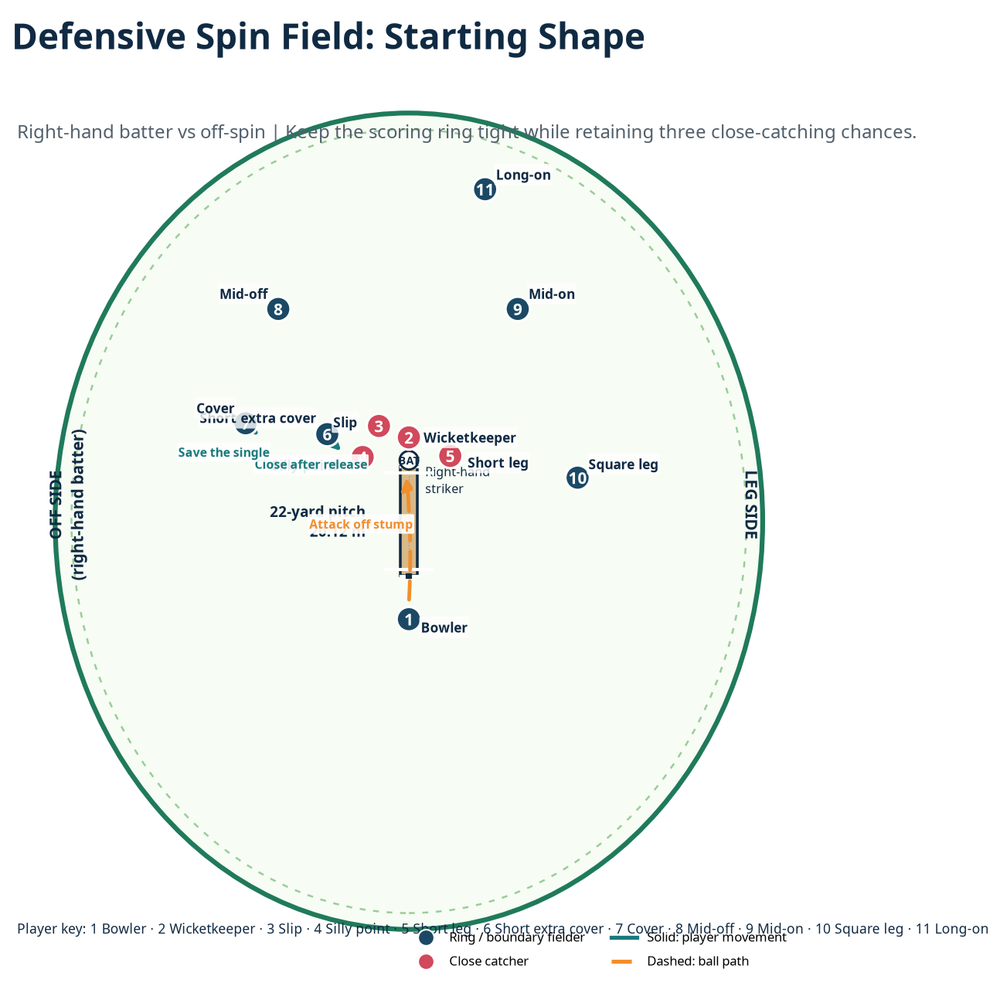
A defensive field for spin is not passive. It makes the batter feel crowded, denies easy rotation, and retains close catchers for an edge, bat-pad chance or miscued sweep. Use it against a batter who is content to defend, nudge singles into cover or midwicket, or manufacture a sweep. The base version suits a right-hand batter facing off-spin; mirror it for left-hand batters or left-arm orthodox bowling.
Work from the true adult pitch whenever possible: the central strip is 22 yards (20.12 m) long and 10 ft (3.05 m) wide.1 The close fielders in this plan are deliberately stationed off the pitch until the ball has been struck or passed the bat; this respects the fielding law and keeps the rehearsal match-realistic.2

Setup
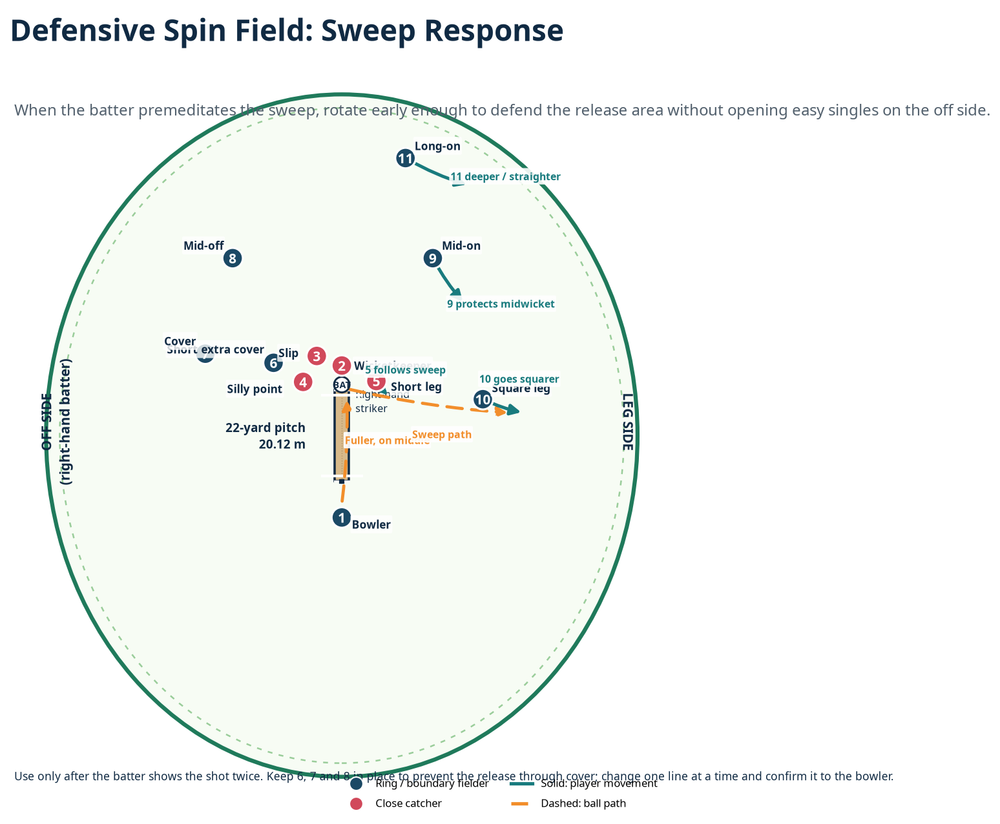
Mark a full 22-yard pitch and a safe working oval. Put down two sets of stumps, 12–16 flat cones, 18–24 balls, wicketkeeping gloves, and helmets for close positions as required by local policy. Allocate 11 players: 1 bowler, 1 wicketkeeper, 1 batter and 8 fielders. Use a twelfth player as feeder or rotating batter.
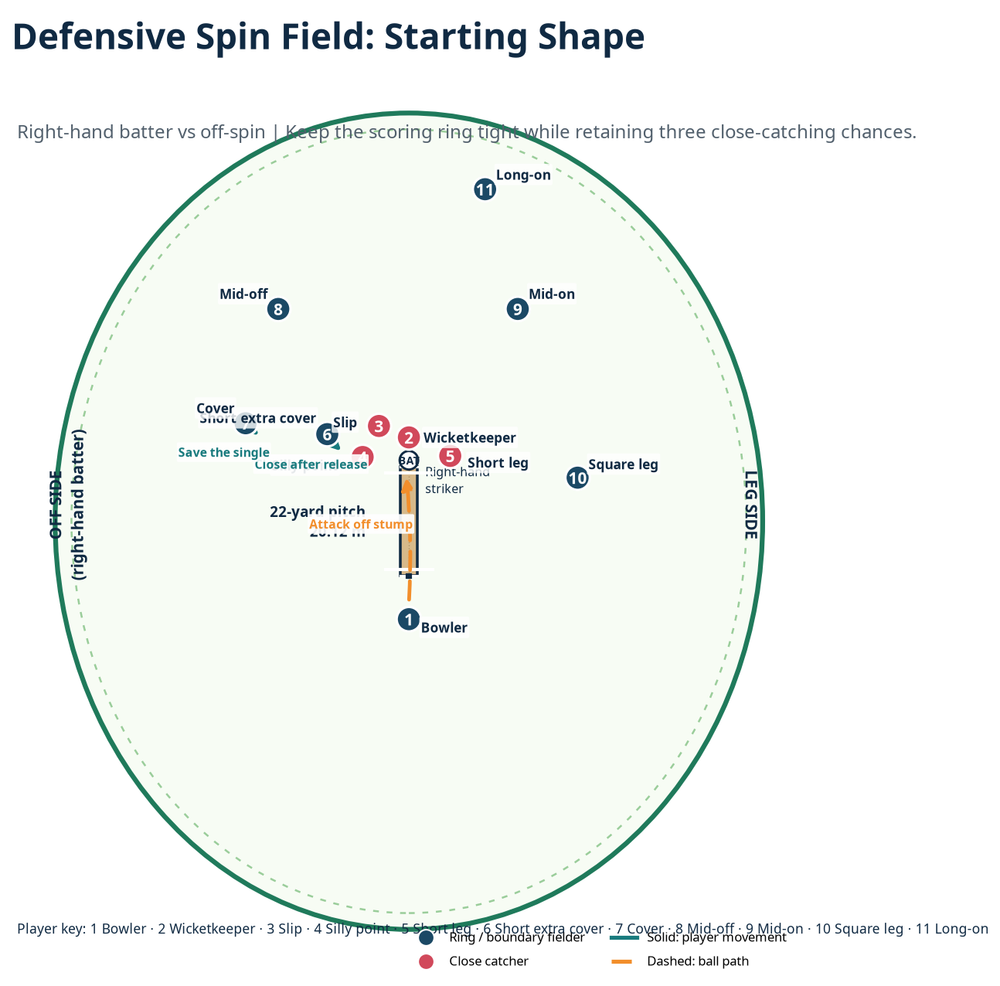
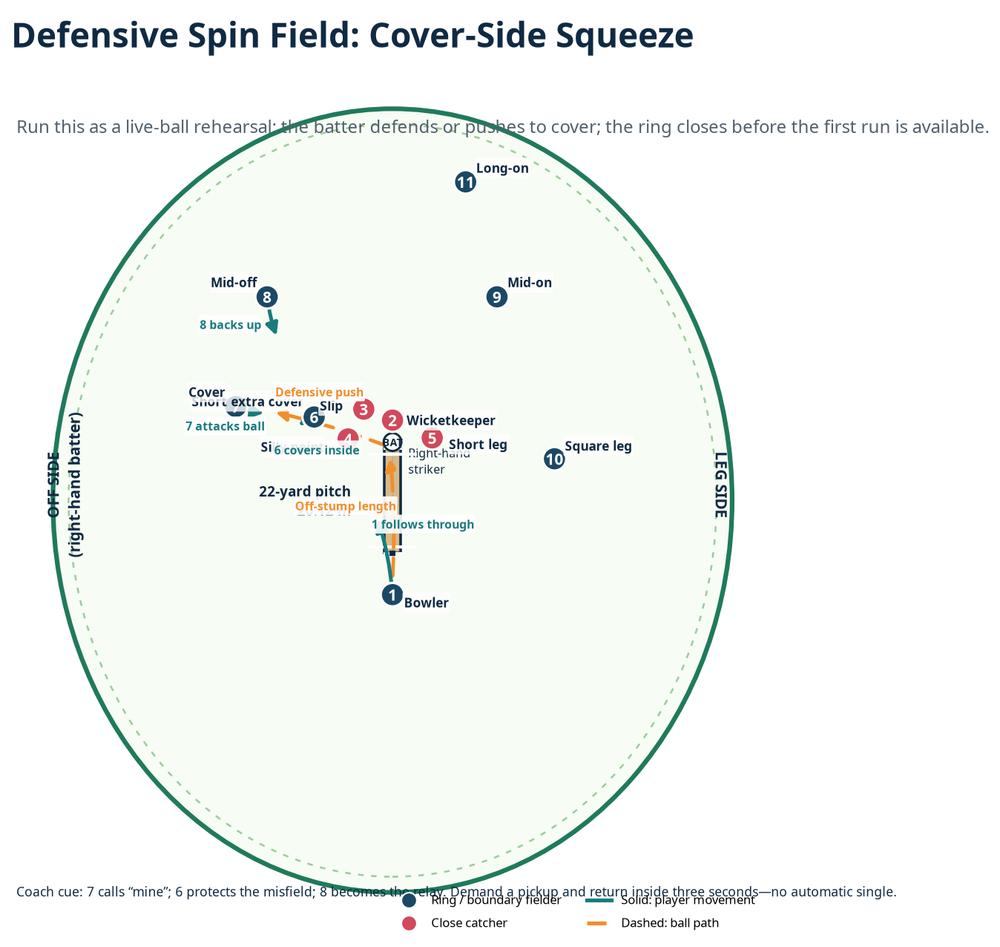
Start the bowler 7–10 m behind the bowling crease, so their approach is repeatable. Put the wicketkeeper 1.5–2 m behind the stumps for a medium-paced spinner; bring them up only if they are technically ready and protected. Set the close ring before the first ball: slip (3) at 4–6 m behind and 4–5 m to off side, silly point (4) 3–4 m on the off side, short leg (5) 3–4 m on the leg side, and short extra cover (6) 8–12 m from the bat. Cover (7) sits 18–25 m out, mid-off (8) and mid-on (9) 28–38 m out, square leg (10) 25–35 m out, and long-on (11) 50–60 m out depending on the ground.
| No. | Position | Starting responsibility |
|---|---|---|
| 1 | Bowler | Attack a tight off-stump line; finish ready to field. |
| 2–5 | Wicketkeeper, slip, silly point, short leg | Create catching pressure and call immediately. |
| 6–8 | Short extra cover, cover, mid-off | Shut down the front-foot push on the off side. |
| 9–11 | Mid-on, square leg, long-on | Prevent the release through midwicket, sweep and straight hit. |
Step-by-Step Instructions
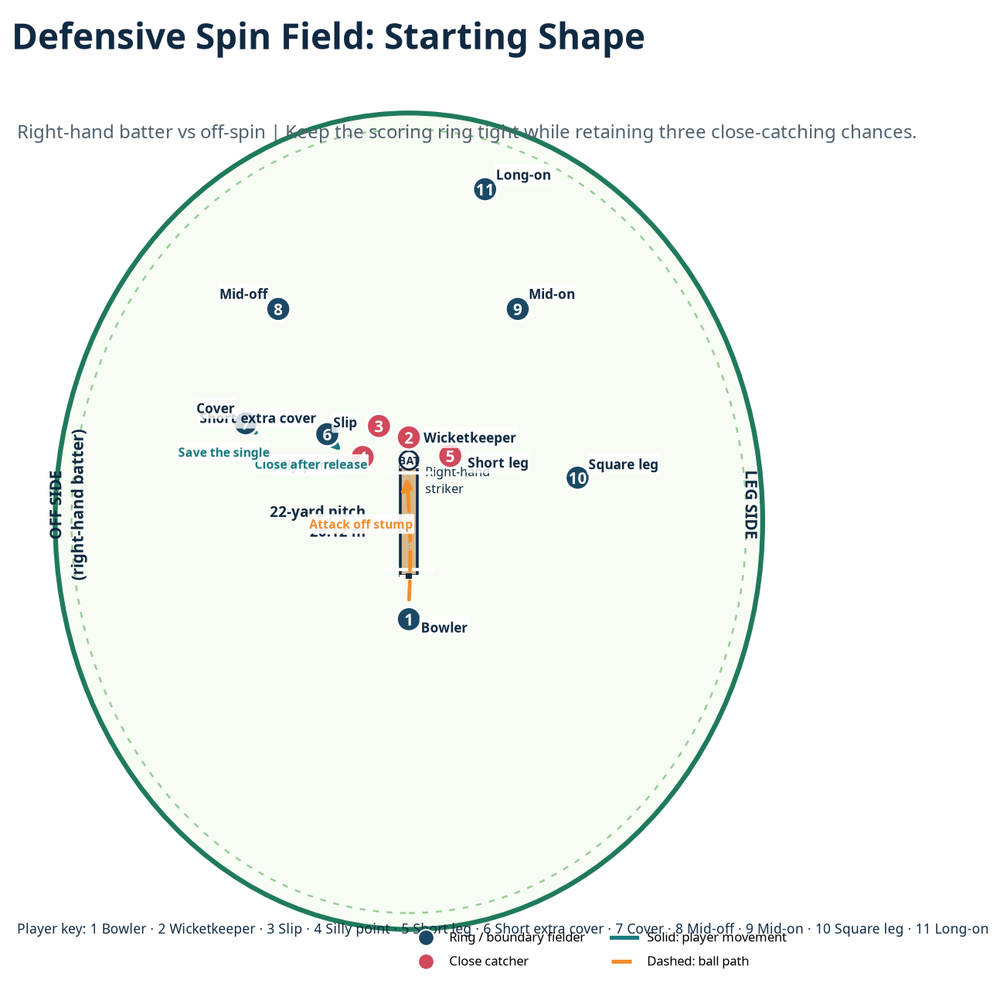
Brief the intent before you place a cone. Tell the group: “One boundary is not the crisis; three soft singles are.” The bowler’s default plan is a controlled off-stump length, with enough flight to bring bat-pad and outer-edge chances into play. Name the one ball the field is built for: a defensive push into cover.
Walk the fielders into their starting lanes. Stand behind the bowler’s end stumps and check the picture. The wicketkeeper, slip, silly point and short leg form the pressure box. Short extra cover is the insurance fielder: close enough to stop the checked drive, deep enough to cover a ricochet. Keep cover and mid-off staggered rather than in one straight line.
Rehearse the delivery and first two seconds without a batter. On the coach’s “go”, the bowler completes the action, short extra cover takes two small steps in after release, and cover comes forward on the ball. The bowler must finish balanced and move down the pitch only after release; no fielder may pre-move in a way that materially changes position before the ball reaches the striker.2 Freeze the group at two seconds and correct spacing.
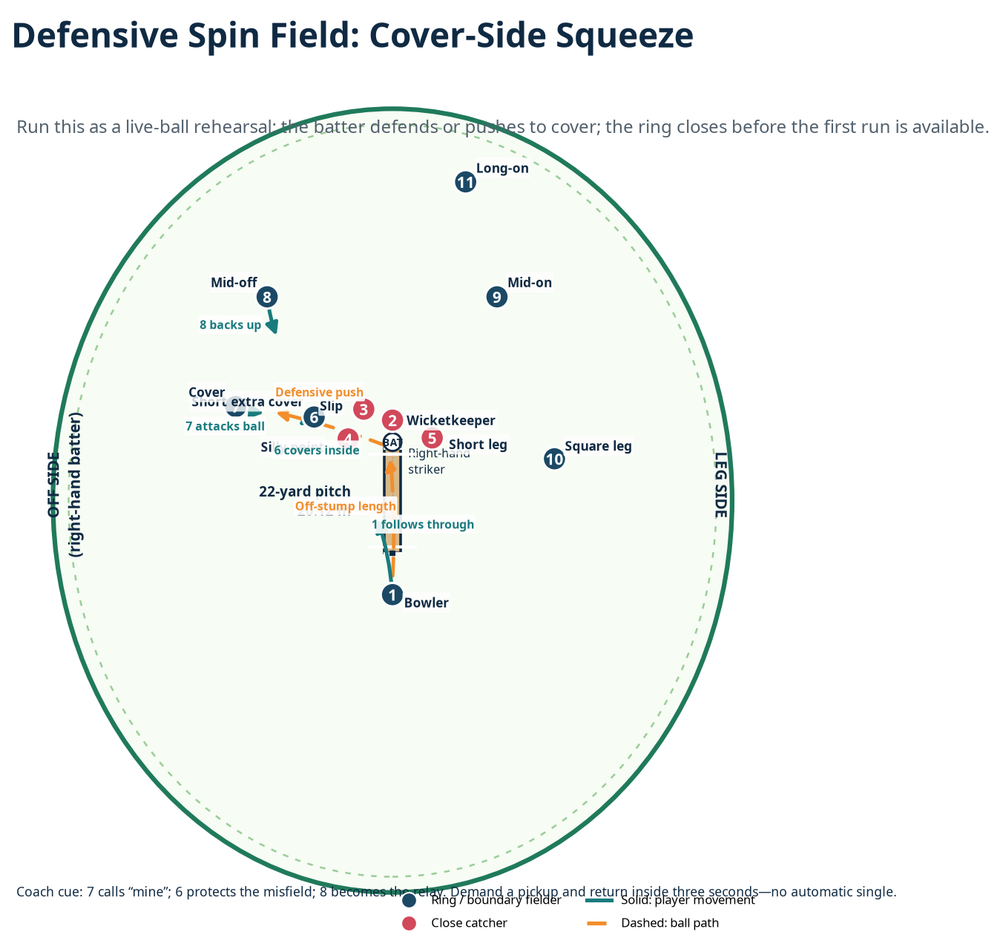
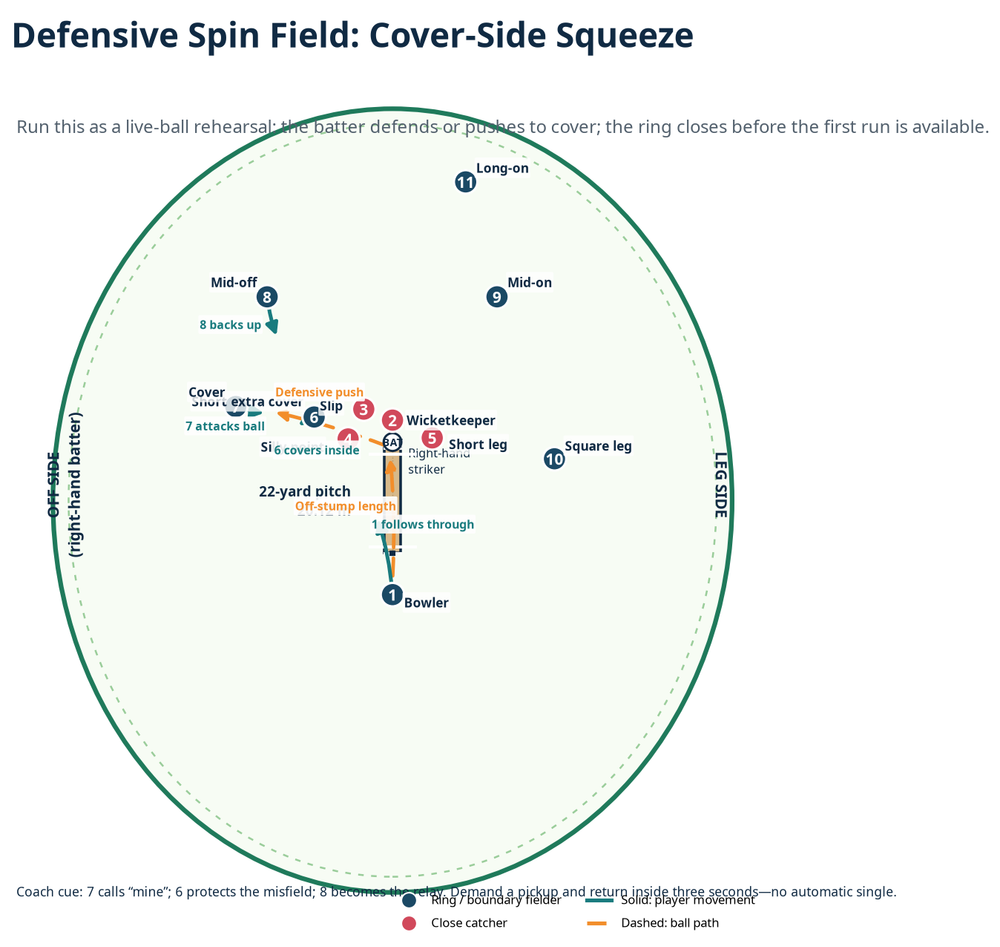
Add a defensive push to cover. Feed a ball on middle-to-off stump. The batter plays a controlled push towards cover. Player 7 calls “mine”, attacks the ball in a low athletic shape, and sends it to the wicketkeeper or bowler-side target within three seconds. Player 6 protects the inside line for a misfield; player 8 backs up 4–6 m behind the play. The coaching outcome is a dot ball or a run that feels risky, not a spectacular throw.
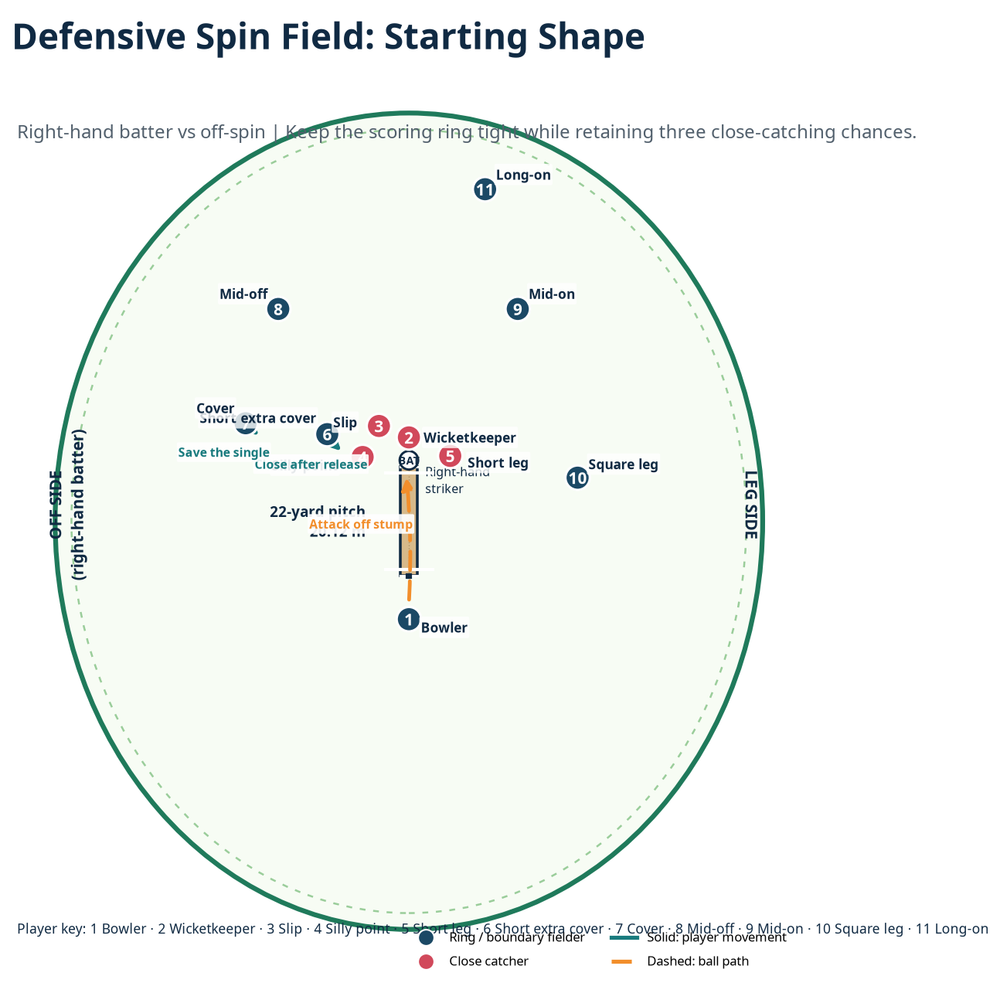
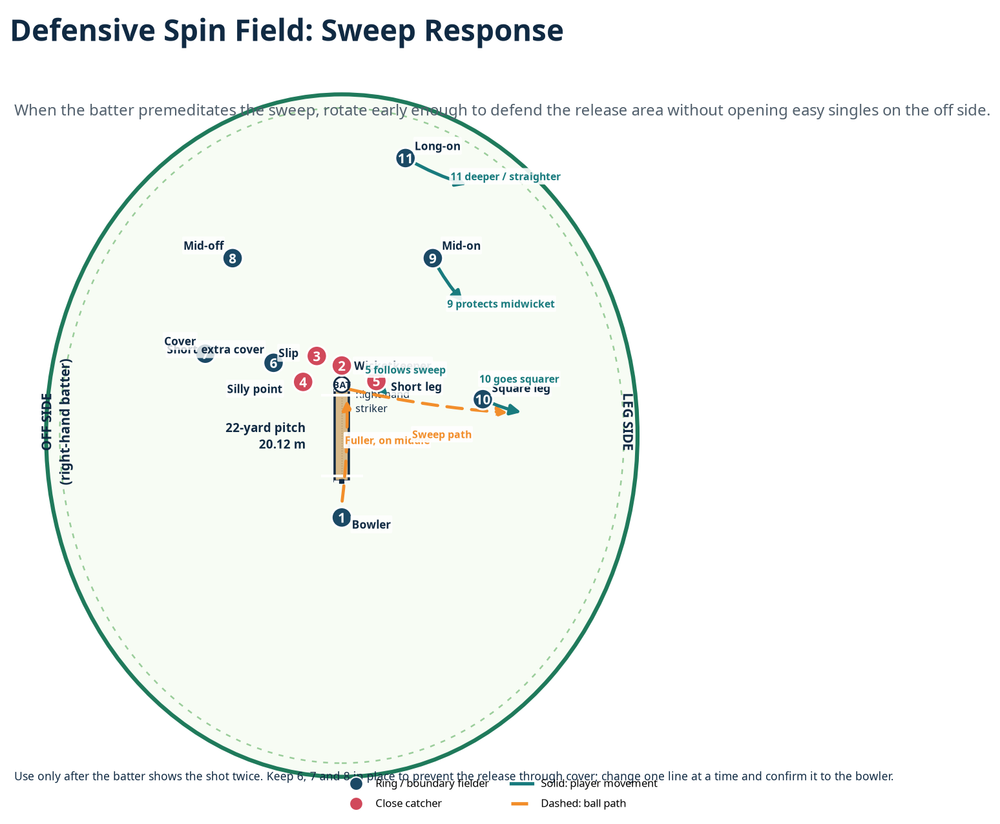
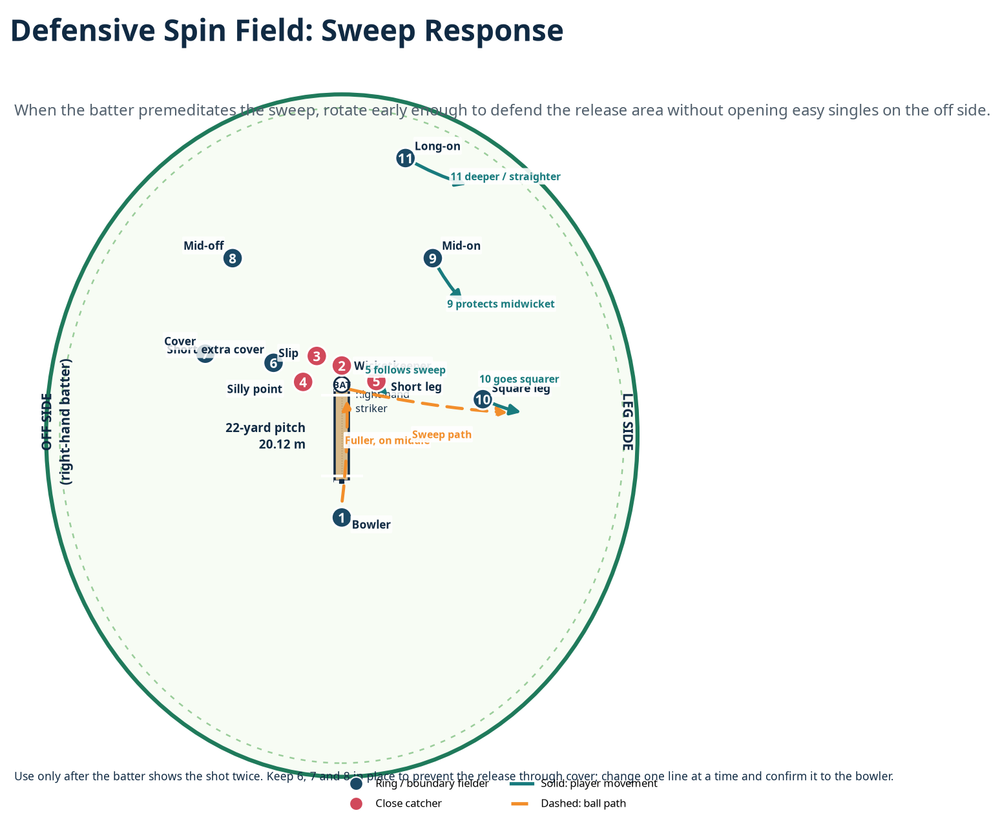
Add the leg-side release rehearsal. Deliver the same ball, then call “sweep” just before release. Player 10 moves squarer to protect the conventional sweep, player 9 closes to midwicket, player 11 adjusts deeper and straighter, and short leg tracks the bat’s path only after the stroke begins. Keep cover, short extra cover and mid-off in place: moving all three creates the easy off-side single you are trying to remove.
Run a six-ball over with consequences. Score the fielding team one point for a dot, two points for a wicket chance created, and minus one for a soft single or misfield. Rotate the bowler every over and change the batter after 12 balls. The captain must call every change before the bowler begins the run-up.
Key Coaching Points
- Build the field around the bowler’s best ball, not around a generic diagram. If the spinner cannot land the off-stump line, pull short extra cover back and reduce the close ring until control returns.
- Protect the inner circle first. The nearest fielder attacks; the next fielder covers the mistake; the third fielder is the relay. Give each player one job, not three.
- Use quiet, early communication. “Mine”, “wait”, “two”, and the bowler’s confirmation of the plan should be heard before the batter settles.
- Coach movement from the release, not anticipation. Fielders may make minor stance adjustments before the striker plays, but significant early movement can be unfair; rehearse the legal trigger of ball release and batter intent.2
- Keep close catchers switched on for every ball. Hands are in front of the body, weight is forward, and players protect themselves according to local safety requirements. No casual standing behind the bat.
- Review the batter’s scoring map every six balls. If the batter is repeatedly beating one gap, alter one fielder and one message—not the whole field.
Common Mistakes
| Mistake | What the coach sees | Immediate correction |
|---|---|---|
| The ring is too deep | Easy singles from soft pushes | Bring 6 and 7 in by 3–5 m; repeat three pickups. |
| Everyone chases the ball | Gaps and overthrows | Assign attacker, cover and relay before the ball. |
| Close catchers drift | The spinner loses wicket threat | Reset the pressure box and use a one-ball focus cue. |
| Field changes happen during the run-up | Confusion and illegal early movement risk | Captain confirms the shape; no change after the bowler turns. |
| The field is set for sweep before it is shown | Cover-side singles open up | Use the sweep rotation only after two clear cues. |
Variations & Progressions
Progression 1 — Guided read. Start with the coach calling “block”, “push” or “sweep” before the bowler begins the run-up. This lets younger or newer fielders learn their movement lane without guessing.
Progression 2 — Batter decision. Remove the call. The batter chooses defence, push, paddle or sweep after the bowler releases. Award the batting pair two points for any single taken without a clear fielding challenge; the fielding side must now read the bat and react.
Variation — Left-hander or left-arm orthodox. Mirror the close catchers and the scoring ring. Briefly walk the whole field across rather than asking players to “remember the mirror”; this avoids the usual error of leaving short extra cover on the wrong side.
Variation — Boundary-protection finish. With 12 balls remaining, move long-on to the stronger hitting arc and add a deep square-leg only if the game format allows it. Keep one close catcher in place so the bowler still has a wicket plan.
Age Adaptations
For Under 8–Under 10, use a reduced pitch and soft ball under local junior rules. Remove slip and short leg, use only a wicketkeeper plus a three-player ring, and coach “stop–pick up–return” before introducing sweep responses. Give every player a coloured cone lane.
For Under 12–Under 14, retain the base diagram but place close catchers only where protective equipment, ability and supervision make it appropriate. Start with an underarm or sidearm feed if the spinner is not yet consistent. Make the response target 4–5 seconds, then reduce it as handling improves.
For Under 16 and open-age players, use full game intensity, live spin and a scoring sheet. Ask the captain to change one fielder from evidence after each over, explain the reason to the bowler, and defend that choice for the next six balls. This turns a field setting into tactical leadership rather than cone-moving.
Coach’s Finish
End with a 60-second huddle. Ask what shot was protected, who covered the misfield, and what would trigger the sweep response. Three clear answers mean the field is now a shared plan, not a picture on a board.
References