

Cricket
Spin Bowling Variations Drill: Three-Ball Pressure Over
A 45-minute, field-aware spin-bowling practice that teaches bowlers to land off-spin, top-spin and an arm ball from one repeatable action while captains learn to create wickets rather than merely contain runs.

What you need
1 regulation or age-appropriate cricket ball, 2 complete sets of stumps, 3 flat landing-zone markers or target hoops, 12-16 fielding cones, batting helmet, pads and gloves, wicketkeeping gloves and pads, coach clipboard or scoring sheet, optional phone or tablet for side-on video feedback
Overview
This is an intermediate, game-realistic spin-bowling drill for coaches who want more than loose net variations. The spinner delivers stock off-spin, top-spin and an arm ball from one repeatable action, while captain, keeper and ring learn to turn pressure into wickets. Use it after a warm-up rhythm and before a full tactical scenario.
The drill uses a six-ball over: three bowler-called technical balls, then three batter-led decisions. Use a full 22-yard pitch whenever possible; on a junior square, reduce run-up rather than bowler-to-batter distance. Control comes first: every variation needs a target, field reason and wicket option.
Session snapshot
| Item | Coach’s prescription |
|---|---|
| Group | 1 spinner, 1 batter, wicketkeeper and 9 fielders; rotate the batting pair every two overs |
| Duration | 45 minutes: 8-minute set-up and rehearsal, 24-minute main drill, 8-minute competitive finish, 5-minute review |
| Primary objective | Land three variations from a stock action and connect each ball to a field plan |
| Scoring | 2 points for a prescribed landing zone, 1 for a false shot, 3 for a wicket or stumping chance; minus 1 for a wide or long hop |
Setup
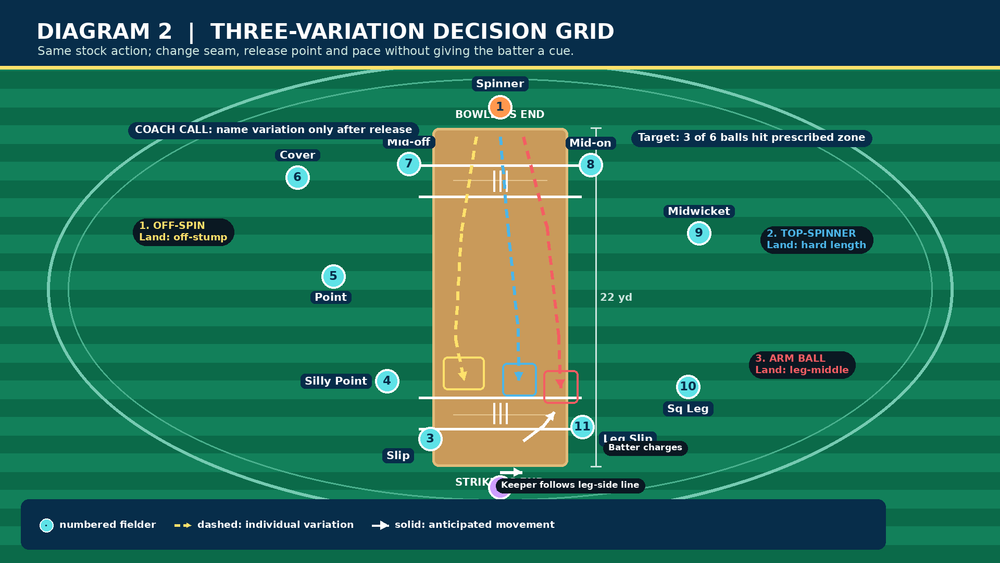
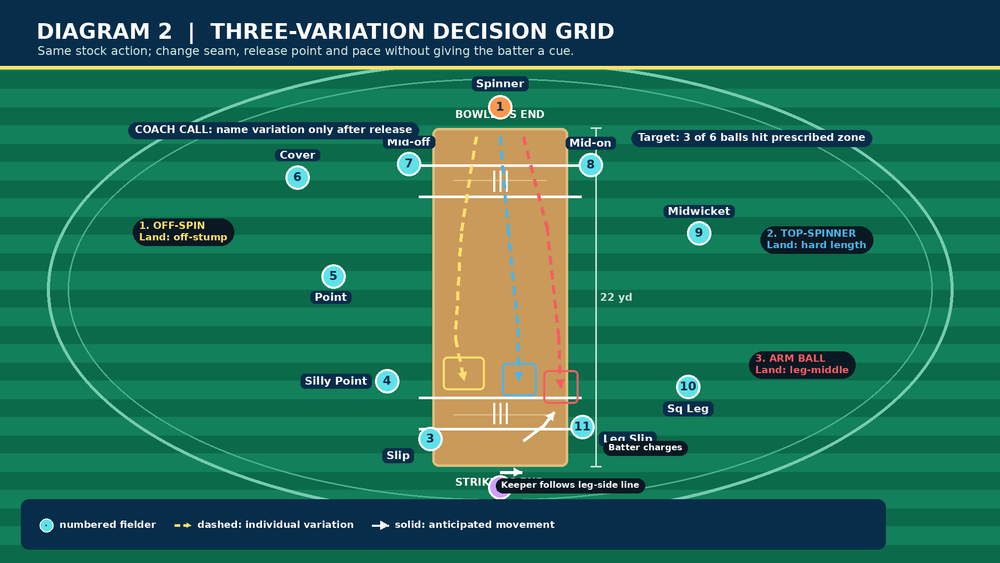
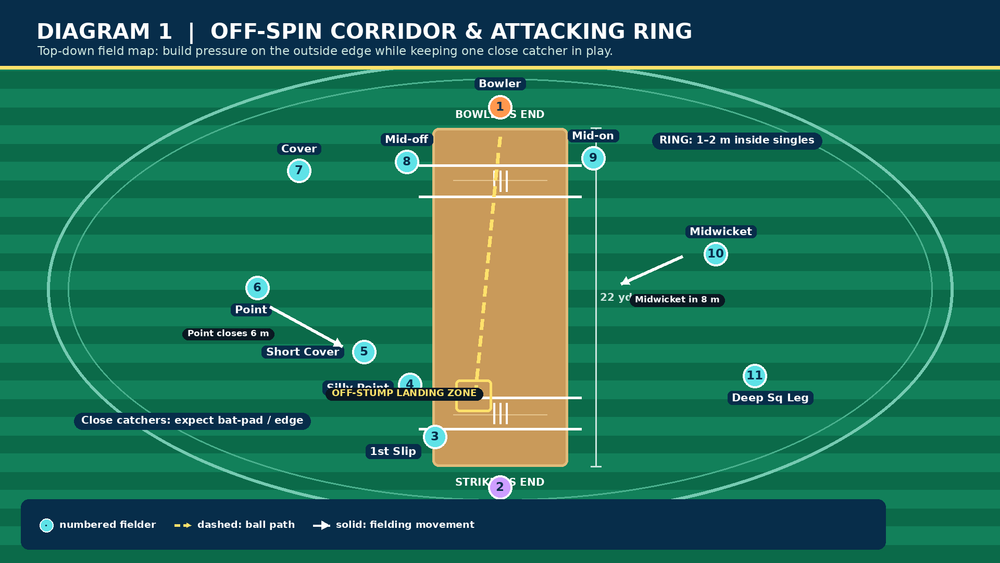
Mark a full 22-yard pitch with stumps at each end and a visible return/crease line. Place three flat marker targets at the striker’s end: an off-stump corridor roughly 40 cm wide, a hard-length top-spin box 2.5–3.5 m from the batting crease, and a leg-middle fuller box for the arm ball. Put a cone 6 m in front of point and another 8 m in front of midwicket to show the ring’s squeeze positions. Use a white ball or a distinctly coloured practice ball if younger players need help seeing rotation.
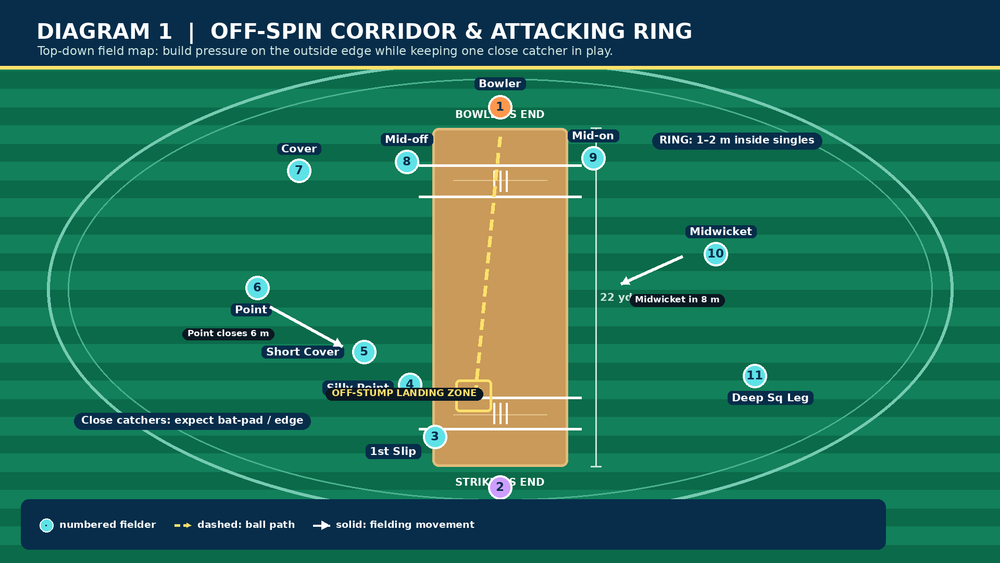
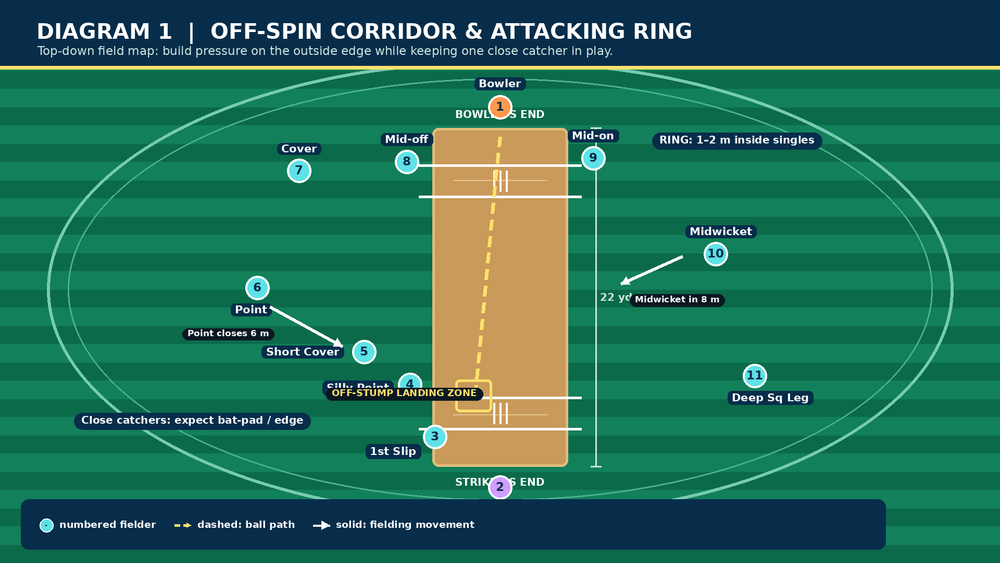
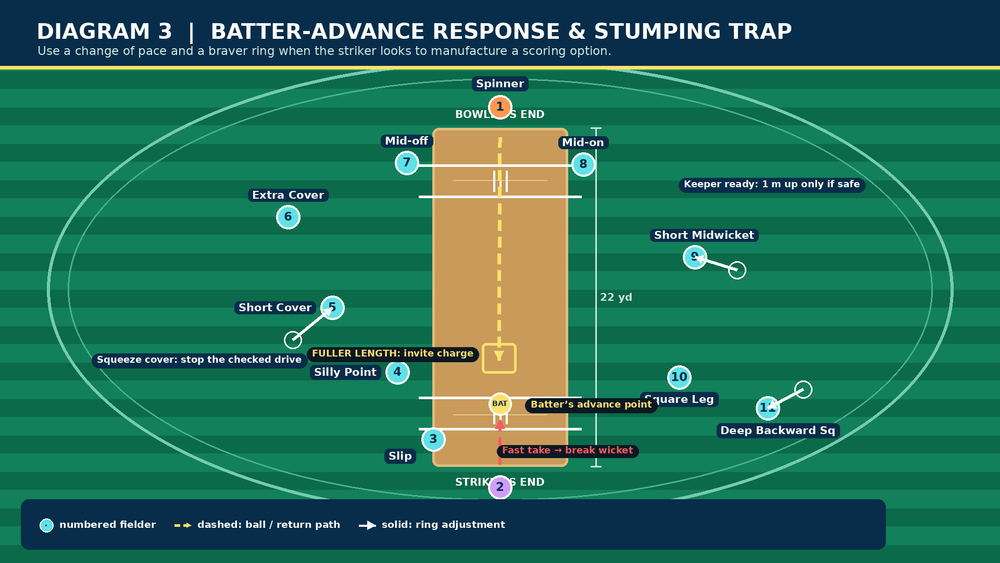
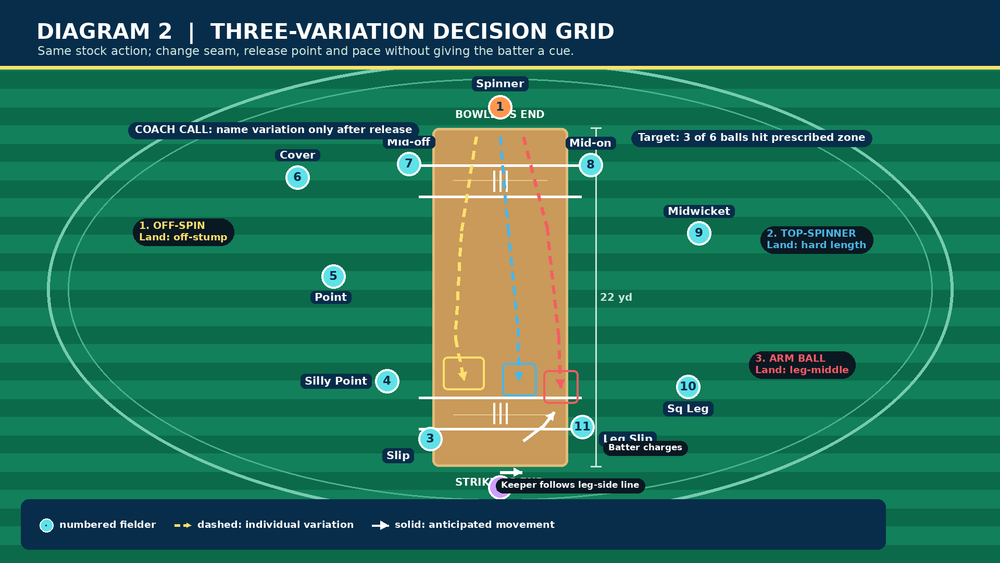
Number the field exactly as shown on the diagrams: 1 Bowler, 2 Wicketkeeper, 3 Slip, 4 Silly Point, 5 Point/Short Cover, 6 Cover/Extra Cover, 7 Mid-off, 8 Mid-on, 9 Midwicket, 10 Square Leg and 11 Leg Slip/Deep Backward Square. The batting player is additional to the numbered fielding side. Start with the close catcher and slip in place only when the ball is being landed consistently; safety and reaction time always take priority over a fashionable attacking field.

Diagram 1 is the stock-ball field. For a right-arm off-spinner to a right-handed batter, use the yellow corridor to pitch just outside off stump and invite the outside edge, bat-pad or checked drive. Keep the main ring one or two strides inside the easy single, not so close that a clean push races past them.
Step-by-Step Instructions
Rehearse the stock action for six balls. The bowler delivers only off-spin at 70–80% effort. The coach stands square of the wicket, watching the bowling hand and front foot. Demand a minimum of four balls in the off-stump corridor before introducing a variation. The keeper calls “length” immediately after bounce; the coach records target hits, not just outcomes.
Add the three-ball variation set. Ball 1 is stock off-spin to the yellow corridor. Ball 2 is top-spin to the blue hard-length box; the bowler should aim for a noticeably higher bounce without a visible change in run-up or arm speed. Ball 3 is an arm ball to the red leg-middle fuller box, delivered with the same intent to spin but released to hold its line. The batter plays normal cricket shots but cannot advance down the pitch in this learning phase.
Coach the field as the ball is selected, not after it is hit. Before each delivery, ask the spinner for one sentence: “What is my ball, what is my wicket?” The keeper repeats the plan quietly, then gets set. For off-spin, retain slip and silly point if the batter is tentative. For top-spin, bring short cover alert for a bat-pad or mis-hit. For the arm ball, make sure leg slip or square leg is alive to the inside edge.
Run the reactive three-ball set. The batter now has licence to sweep, use the feet or stay deep. The spinner chooses the variation after reading the batter’s set-up. If the batter steps out early, the bowler may go fuller with the arm ball or hold the length with top-spin; do not reward a premeditated charge with a half-volley. The coach pauses only after the third ball, keeping feedback concise and specific.
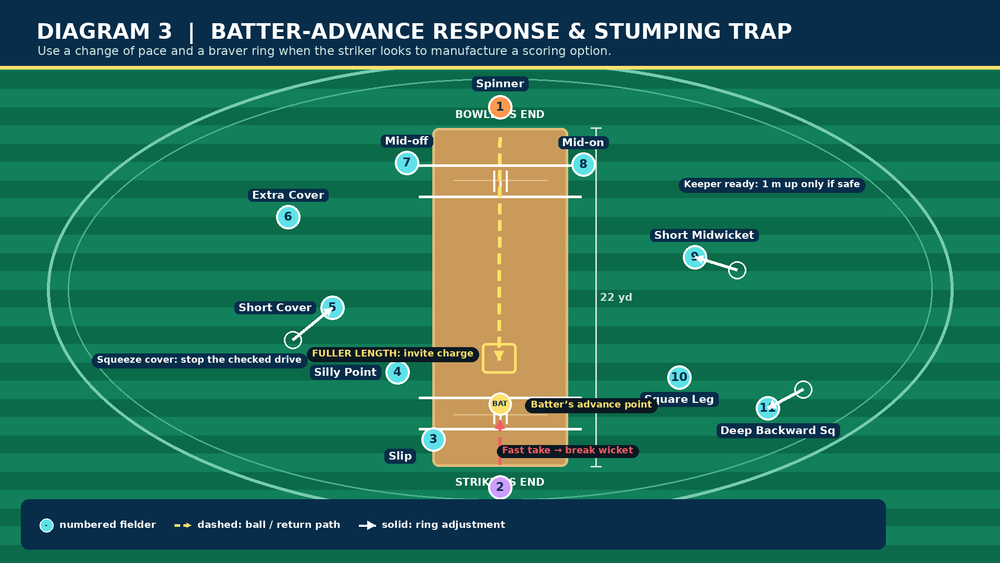
Build the stumping trap. When the striker advances twice in an over, tighten short cover and short midwicket by 4–6 m, keep the keeper balanced and challenge the spinner to bowl a fuller ball that drops before the batter can reach it. The keeper’s cue is hands soft, head still and movement only after the line is read. A clean take to the stumps is scored as a wicket chance even if the batter makes ground.
- Finish with two competitive overs. The batting pair needs 12 runs to win. The fielding side wins with a wicket, a stumping chance, or by keeping the pair below 12. After each over, rotate one fielder through a close-catching role and change the spinner or batting pair. End with a 60-second bowler debrief: identify the variation that produced the best false shot and the technical cue that made it repeatable.
Key Coaching Points
| Focus | What the coach should look and listen for |
|---|---|
| Stock-action disguise | The approach tempo, load-up and bowling-arm speed look alike on all three deliveries; variation comes from fingers, seam and release—not a slower arm. |
| Stable base | The front foot lands aligned and balanced. A collapsing front knee or falling-away head makes the release point drift and removes control. |
| Clear intention | Every ball has one landing zone and one dismissal picture. “Spin it hard” is not a plan; “top-spin at the hard length to rush the pull” is. |
| Use of the crease | Let the bowler work from middle, then a small shift wider on the crease only after stock control is secure. The change must alter angle, not create a no-ball risk. |
| Keeper–spinner partnership | The keeper calls bounce and pace honestly, stays quiet through release, and is ready for the leg-side line of the arm ball. |
| Fielding anticipation | Ring players are on the balls of their feet before release and move on the batter’s contact, not after the ball has passed them. |
Common Mistakes
The most common error is chasing variation before earning stock-ball control. Correct it by returning to a six-ball stock set and refusing to count a variation that misses its zone by more than a bat width. A second error is a visible change of pace through the arm; film from side-on if possible and ask the batter whether they could pick the variation before bounce. Third, coaches often leave the close catchers static. Give slip and silly point a precise job—hands low for bat-pad, eyes on the leading edge, one attacking step at contact. Finally, do not let the arm ball become a leg-side drag: set the red box on leg-middle and insist the seam hand finishes down the intended line.
Variations & Progressions
Make the entry version easier by using a tennis ball or softer training ball, removing the batter’s licence to sweep, and awarding a point for any ball that lands on the correct half of the pitch. For the standard version, retain the three target boxes and ask the spinner to declare the ball only after release, so the coach can judge disguise. For an advanced version, remove the coloured targets, give the batter a scoring map, and require the spinner and captain to reset the field after every two deliveries without stopping the over.
Use a two-spinner duel against right- and left-hand batters, requiring each bowler to explain the stock-ball field change. A powerplay simulation with only two boundary fielders then tests whether the spinner can protect straight while retaining a close-catching chance.
Age Adaptations
For Under-10s, use an 8–12 m shortened batting area only when facility safety demands it, a softer ball, one stock variation and very large target hoops. Prioritise grip, balance and a fun “hit the island” game over tactical field detail. For Under-12s, use a full or near-full pitch, introduce stock off-spin and top-spin, and station only keeper, slip, point, cover, mid-off, mid-on and square leg. For Under-14s, retain the full 22 yards, add the arm ball, and teach the keeper’s stumping movement. For Under-16s and open-age players, use the full field, decision-led reactive sets, scoring pressure and a short video review of release-point consistency.
Finish every age group with one question: “Which ball gave us a genuine wicket chance, and which field position made that chance possible?” That link between execution and fieldcraft is the habit this drill is designed to build.
