

Football
Mastering the Final Third: A Dynamic Crossing and Finishing Drill
A comprehensive guide for coaches to develop elite crossing and finishing skills, focusing on realistic movement patterns, timing, and clinical execution in the final third.

What you need
Footballs, Cones, Full-size goal
1. Overview
This drill is designed to develop the critical relationship between wide players and strikers, focusing on the quality of delivery from wide areas and the intelligence of movement in the penalty box. It creates a high-volume, high-intensity environment for players to refine their crossing technique and finishing under pressure. It is best used in the attacking phase of a session when players are physically and mentally sharp, allowing for maximum focus on technical execution and tactical understanding.
2. Setup
Equipment:
- 1 full-size goal
- A large supply of footballs (at least 10-15)
- Cones or markers
Pitch Setup:
- Use one half of a standard 11v11 pitch (approx. 50-55m in length).
- Place a supply of balls with a server (coach or player) near the halfway line.
- Set up a cone to mark the starting position for the wide player, roughly 35-40m from the goal line and wide near the touchline.
Player Positions:
- 1 Goalkeeper (GK)
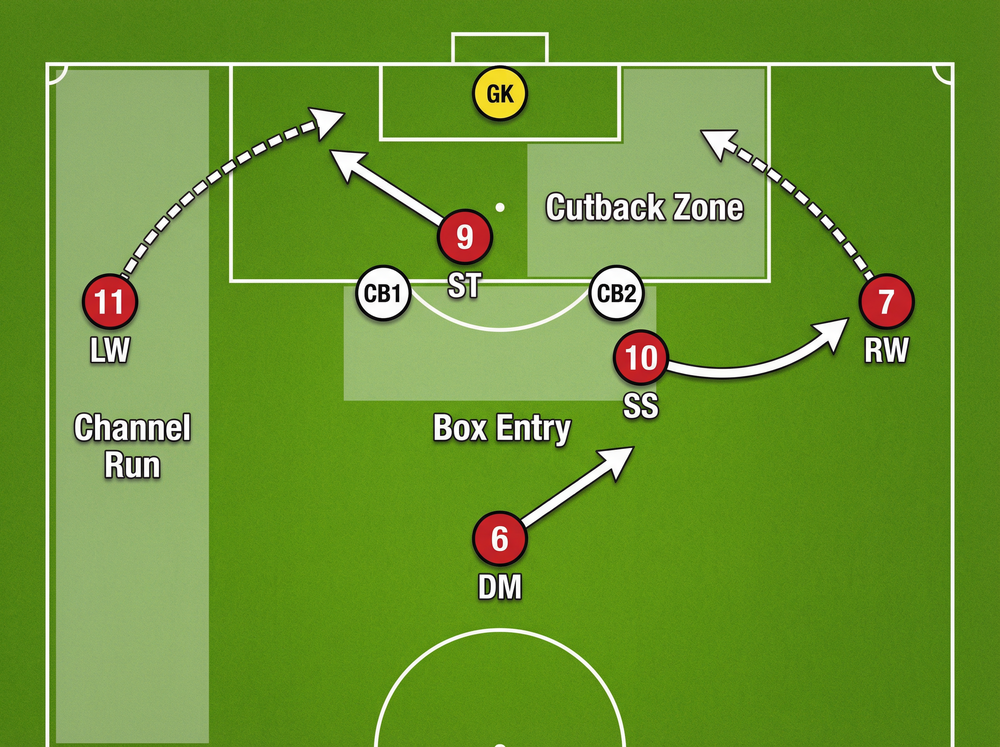
- 1 Wide Player (Winger, e.g., #7 or #11)
- 2 Strikers (#9 and #10)
- 1 Server (S)
- (Optional) Additional players to rotate into attacking roles.

3. Step-by-Step Instructions
- The drill begins with the Server (S) playing a firm pass into the path of the Winger (#7) who starts their run from the cone.

- As the pass is played, the two Strikers (#9 and #10) begin their coordinated movements into the penalty area.
- The Winger takes a positive first touch down the line, assesses the runs of the strikers, and delivers a cross into a dangerous area.
- Striker Runs:
- The #9 striker makes an aggressive run towards the near post or central area, aiming to attack the space in front of the goalkeeper.
- The #10 striker makes a delayed, arcing run towards the far post or penalty spot, providing a secondary option.
- The strikers attempt to finish on goal with a first-time shot.
- The players reset to their starting positions and the drill is repeated from the same side for a set number of repetitions before switching to the opposite flank.
4. Key Coaching Points
- Quality of Delivery: The winger must focus on the technique of the cross. Are they choosing the right type of delivery for the situation? (e.g., driven, floated, cutback). Emphasize head up to see the runs and the space.

- Timing and Angle of Runs: Strikers must not go too early. Their movement should be explosive and timed to meet the ball at pace. Runs should be varied and disguised to unbalance potential defenders.
- Finishing Technique: Encourage a first-time finish where possible. Focus on body shape, connection with the ball (side foot for placement, laces for power), and composure. Aim for the corners.
- Communication: Strikers should communicate with the crosser, using verbal cues or hand signals to indicate where they want the ball delivered.
- End Product: Every repetition must end with a shot on goal. Reinforce the importance of creating a goal-scoring opportunity from every cross.
- Second Balls: Attackers should follow in every shot, anticipating rebounds or saves from the goalkeeper.
5. Common Mistakes
- Poor Cross Selection: Wingers repeatedly playing the same type of cross, regardless of the strikers' movements or the goalkeeper's position.

- Mistimed Runs: Strikers arriving in the box too early (becoming static targets) or too late (missing the window of opportunity).
- Rushed Finishing: Strikers snatching at the chance, failing to connect cleanly due to a lack of composure.
- Lack of Movement: Strikers running in straight lines, making them easy to mark. Encourage crossover runs and movements that create separation.
- Winger Plays with Head Down: The crosser fails to look up to assess the situation before delivering the ball, resulting in a hopeful cross rather than a precise delivery.
6. Variations & Progressions


- Progression 1: Add Passive Defenders: Place one or two defenders in the box who can provide a physical obstacle but cannot tackle. This forces strikers to be more intelligent with their movement to find space.
- Progression 2: Introduce Active Defenders: Progress to a 2v1 or 2v2 scenario in the box. This creates a game-realistic environment and challenges attackers to make decisions under pressure.
- Variation 1: Cutback Cross: Change the starting position of the winger to be closer to the byline. The winger dribbles towards the goal before cutting the ball back towards the penalty spot for an arriving midfielder or striker.
- Variation 2: Two-Sided Attack: Set up wingers on both flanks who attack simultaneously. This increases the cognitive load for the strikers and goalkeeper and works on their ability to react to multiple threats.
7. Age Adaptations
- Under 8/10: Simplify the drill. Use a smaller goal and reduce the distance of the cross. Focus on the basic technique of striking a moving ball. The coach can be the server, rolling the ball in for a simple finish.

- Under 12: Introduce the concept of varied runs (near and far post). The cross can be delivered from a closer, less-pressured position. Focus on the quality of the strike and making a clean connection.
- Under 14: This drill is ideal for this age group. All elements can be coached as described. Introduce the 2v1 progression with an active defender to start developing tactical awareness.
- Under 16/Senior: Increase the complexity and pressure. Demand a higher tempo, add more defenders (e.g., 2v2 or 3v2), and challenge the winger to deliver different types of crosses under pressure from a recovering full-back.
