Football Free Kick Wall Manipulation and Far-Post Delivery Play
Coach a legal, repeatable direct free-kick routine that fixes the wall, times delayed runs, and delivers a high-quality far-post chance.

Equipment Needed
Overview
This Free Kick Wall Manipulation and Far-Post Delivery Play gives your team one repeatable answer from a direct free kick 24–26 m from goal, slightly right of centre for a right-footed taker. The objective is not simply to beat the wall. It is to force the goalkeeper and wall to protect the near-post shot, then deliver a curling ball into the far-post corridor for a late runner. Use it after your team has earned a central or half-space free kick in the attacking third, particularly when the opposition uses a four-player wall and leaves a zonal defender protecting the six-yard line.
The legal picture matters. Defenders must remain at least 9.15 m from the ball until it is in play; where the defending wall has three or more players, attackers must remain at least 1 m from that wall until the ball is in play 1. Coach the screen as a legal run across a marker’s line, never as a player parked against the wall. On a standard full-size pitch of 100–110 m × 64–75 m, rehearse the routine in the final 40 m.

Setup
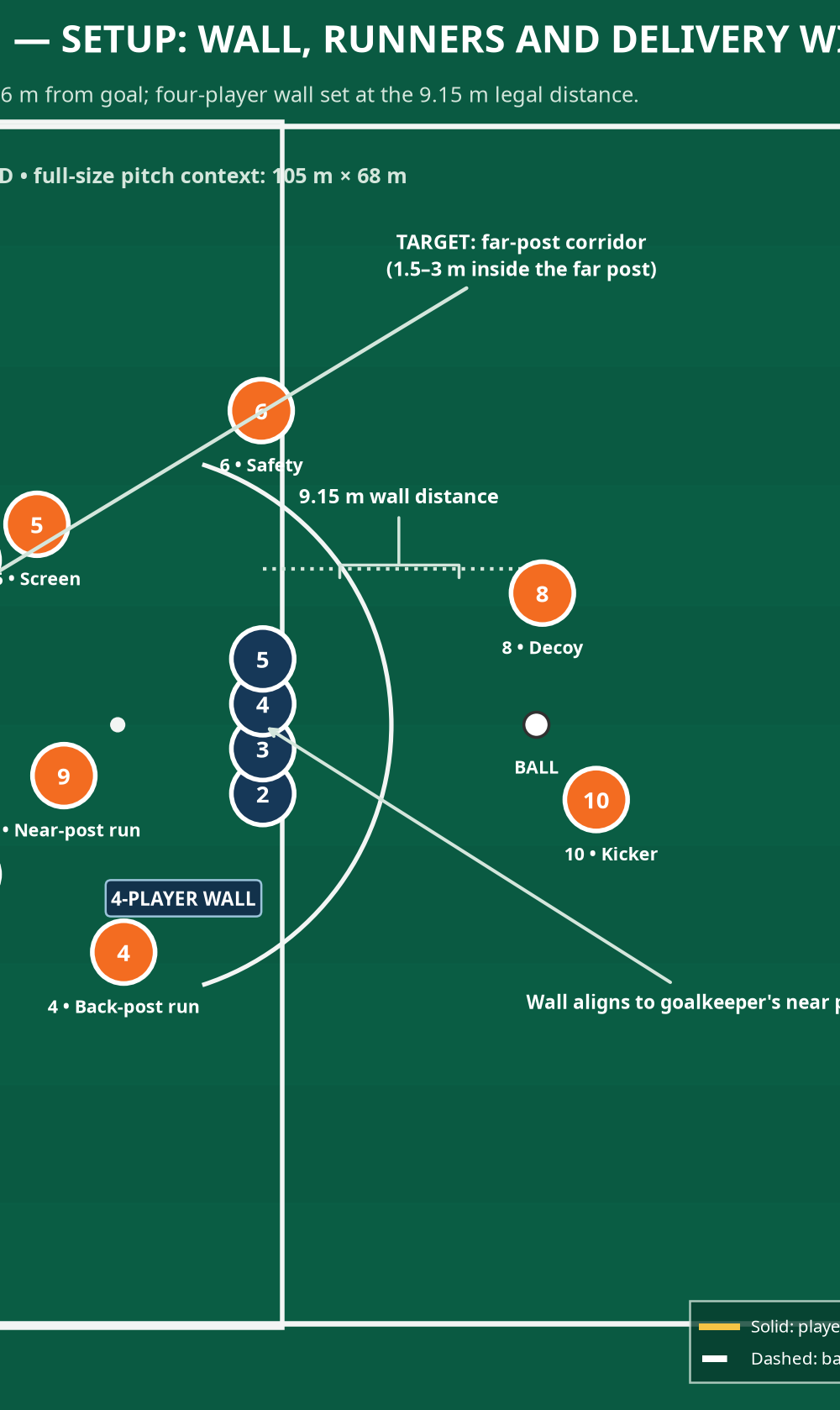
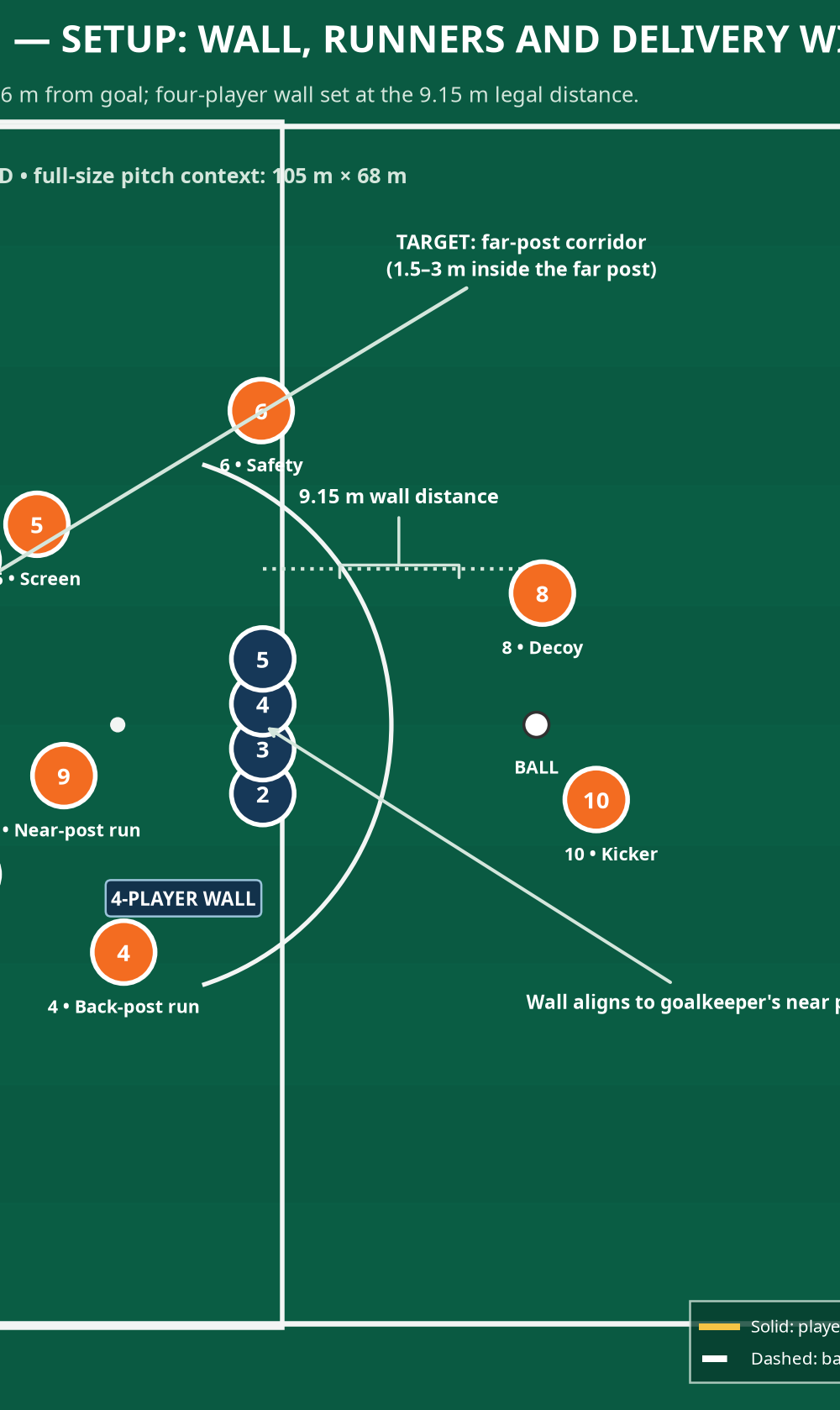
Set the ball 24–26 m from the centre of goal, 3–6 m to the right of the central line. Use one full-size goal, 14 players at minimum, and then add live transition players as the practice develops. Player 10 is the nominated right-footed taker; 8 is the decoy and short-option player; 4 attacks the far-post arrival zone; 9 makes the near-post run; 5 makes the legal screening run across a defender; and 6 protects the counter-attack 8–10 m outside the penalty arc. The defending unit uses a goalkeeper, a four-player wall, two zonal defenders and a recovery defender.
| Element | Coaching instruction | Measurable detail |
|---|---|---|
| Ball and taker | 10 stands 2–3 m behind and slightly left of the ball, body opened toward the far post. | Ball is 24–26 m from goal. |
| Wall | The goalkeeper owns the near-post line and directs the wall’s outer player. | Wall begins 9.15 m from the ball. |
| Far-post runner | 4 starts blind-side of the deepest zonal defender, then curves toward the back-post corridor. | Finish 1.5–3 m inside the far post. |
| Decoy | 8 stands 3–4 m from the ball, high enough to offer the short trigger. | First movement is only 1–2 m. |
| Rest defence | 6 stays goal-side of the ball, centrally connected to the two centre-backs. | Do not enter the box until the ball travels. |
Use flat discs to mark the ball spot, wall line, far-post corridor and #6’s safety position. A cone can show the attacking exclusion zone while players learn it.
Step-by-Step Instructions
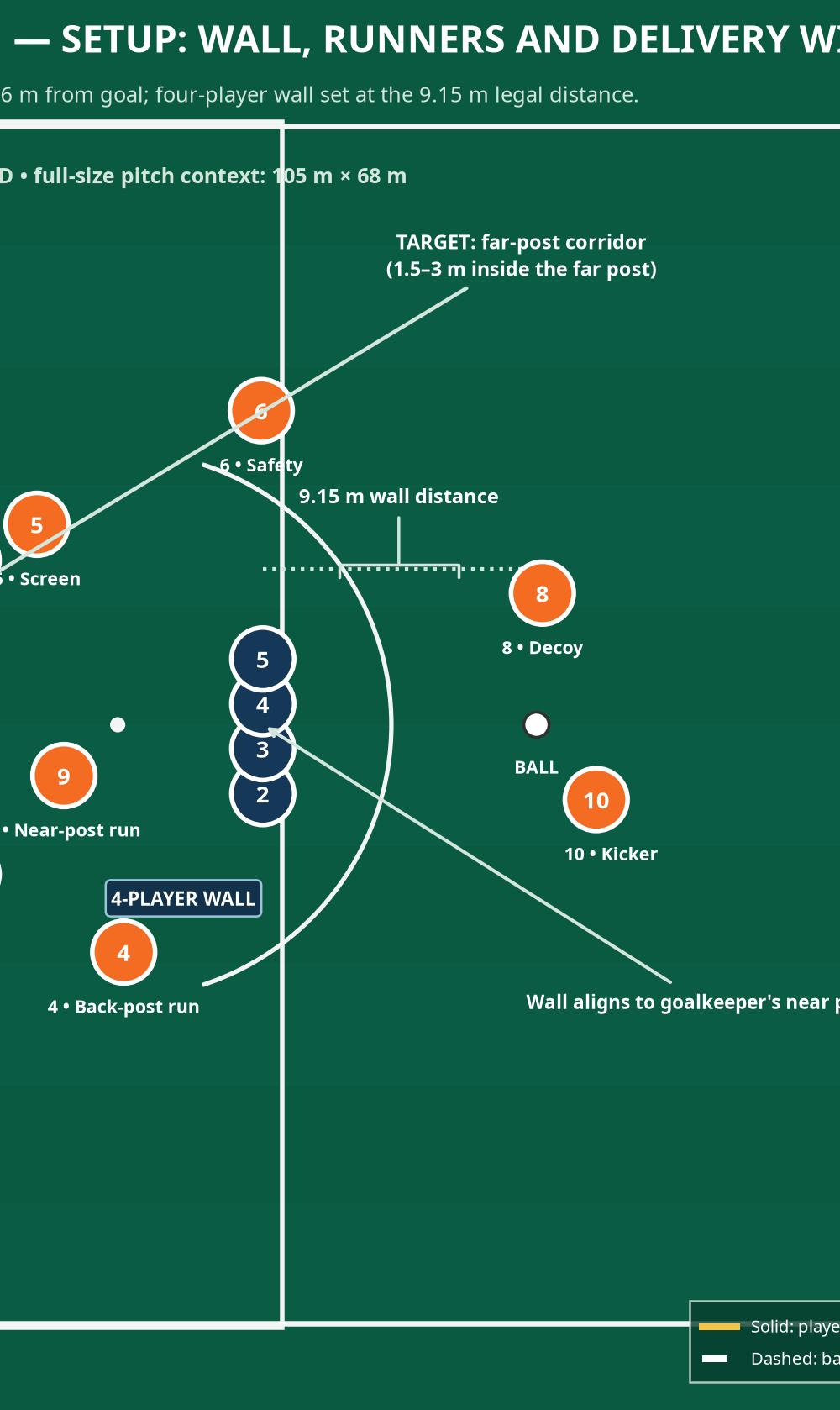
Call the picture early. As soon as the foul is awarded, 10 says “wall” and 8 answers “set.” The group moves into its starting positions before the referee has finished organising the wall. 4 and 9 arrive calmly; do not reveal the intended run by sprinting early.
Fix the wall. The goalkeeper will normally set the wall to cover the nearer side. 8 approaches the ball as if the restart may be rolled short. That extra body narrows the goalkeeper’s visual line and discourages the wall from drifting toward the far-post delivery channel.
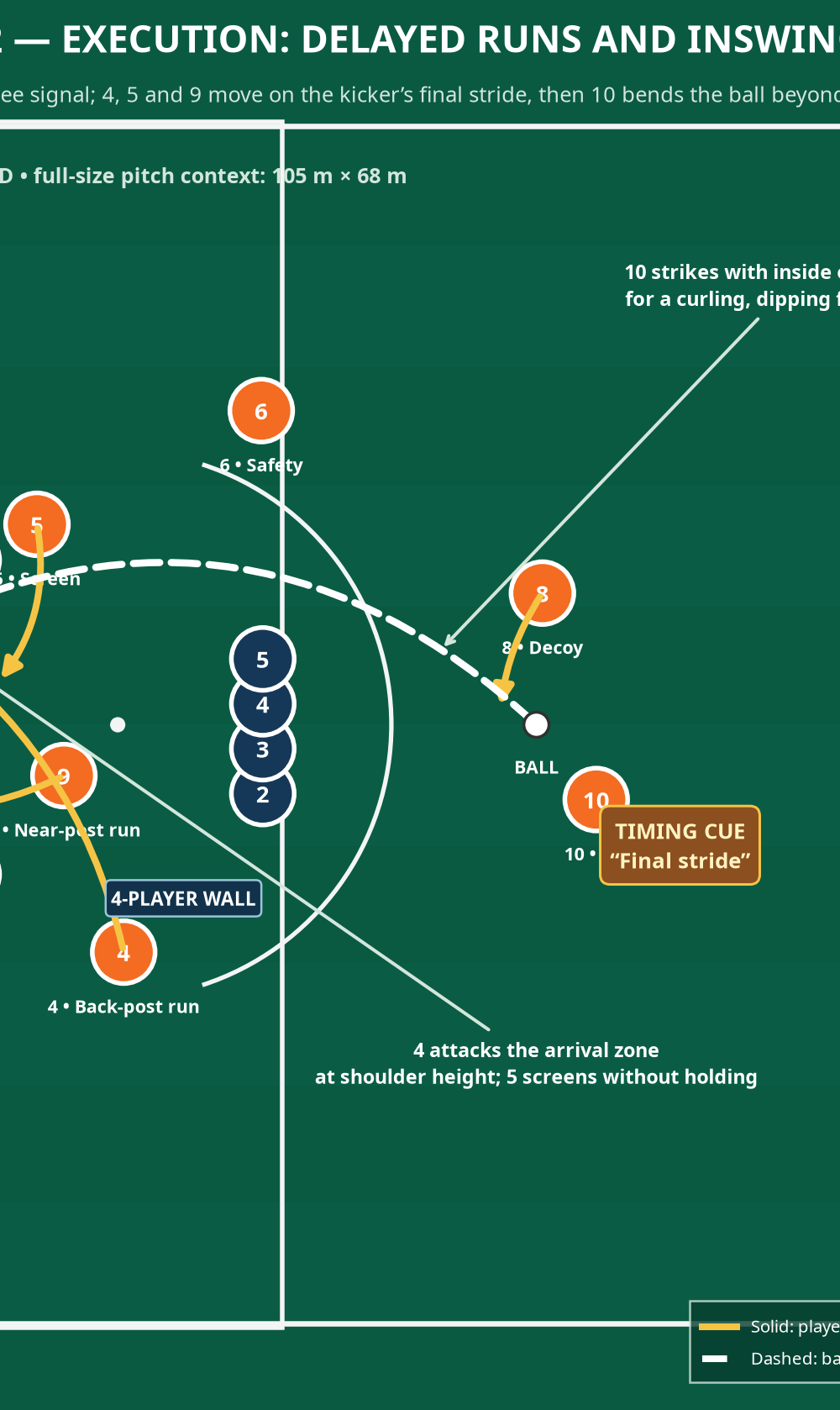
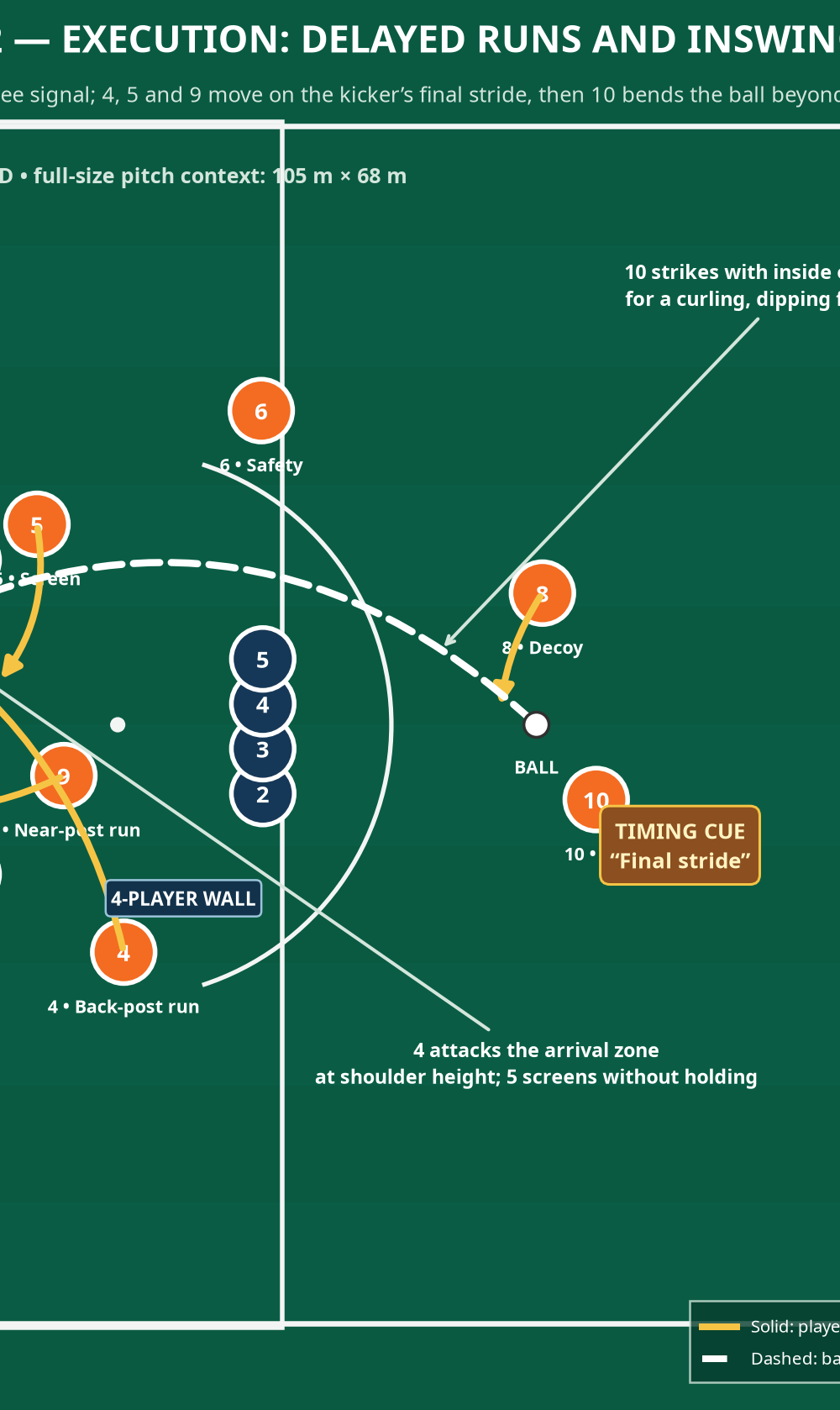
Hold the runners. 4, 5 and 9 remain still until 10 begins the final stride of the run-up. 5 is at least 1 m from the wall and prepares to cross a marker’s path without grabbing, backing in, or blocking the goalkeeper. 6 scans for the opposition’s high outlet and remains outside the congestion.
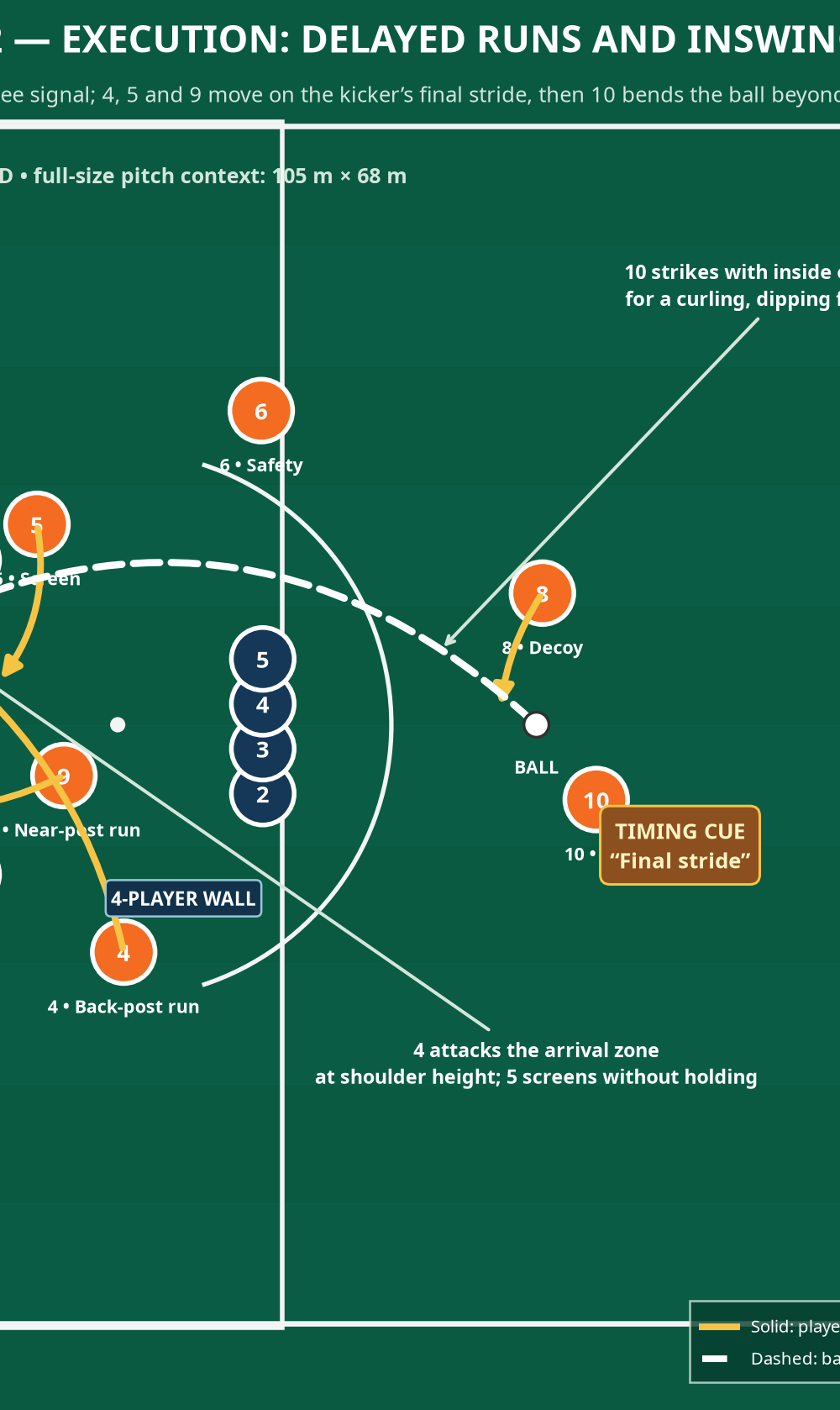
Trigger the movement. On 10’s final stride, 9 darts toward the near-post channel, dragging the nearest zonal defender. At the same moment, 5 crosses the recovery defender’s line legally, and 4 delays half a beat before curving sharply to the far-post corridor. That half-beat is the critical separation: if 4 runs too soon, the marker can track him square-on.
Deliver the ball. 10 strikes across the centre-lower half of the ball with the inside of the right foot. The intended flight rises over the wall, bends away from the goalkeeper’s starting line and drops between the six-yard box and penalty spot at the far side. The target is not the goalkeeper; it is 4’s path, arriving at shoulder-to-head height.
Finish and react. 4 attacks the ball forward and across goal, aiming a first contact down, across the goalkeeper, or into the far side-netting. 9 continues beyond the near post for a ricochet. 5 releases immediately after the delivery, while 8 secures the edge for a second ball. If possession is lost, 6 calls “lock” and protects the central counter lane.
Key Coaching Points
| Coaching focus | What the coach should demand |
|---|---|
| Role clarity | Name a permanent taker, decoy, far-post runner and safety player. Rehearsal speeds up when each player owns one cue. |
| Delayed acceleration | The runners move on the final stride, not the whistle. The late burst beats ball-watching more reliably than a longer run-up. |
| Delivery window | Ask 10 to hit a 2 m-wide, 4 m-deep far-post corridor. Reward a playable ball over a spectacular but unreachable strike. |
| Legal screening | 5 runs across a defender, hands down and body moving, and stays at least 1 m from the wall before the ball is in play. |
| Goalkeeper picture | The delivery should pass beyond the outer edge of the wall and fall away from the goalkeeper’s first step. |
| Rest defence | 6 is non-negotiable. A set play that creates a shot but exposes the centre circle is not complete. |
Common Mistakes
The most common fault is that 4 starts early and arrives in the six-yard box before the ball is struck. Stop the repetition, reset the trigger to the final stride and insist on a visible half-beat delay. Secondly, coaches often accept a wall-adjacent “screen.” Correct it immediately: #5 must be 1 m from a three-plus player wall until the ball is in play, and must screen a defender’s route rather than wrestle for space. Thirdly, 10 may overhit the direct shot because the target is vague. Place a 2 m gate in the far-post corridor and score only balls that cross it. Finally, teams forget #6; if the ball is cleared and the next pass reaches the opposition’s striker cleanly, repeat the phase with #6 held centrally until the second action is complete.
Variations & Progressions
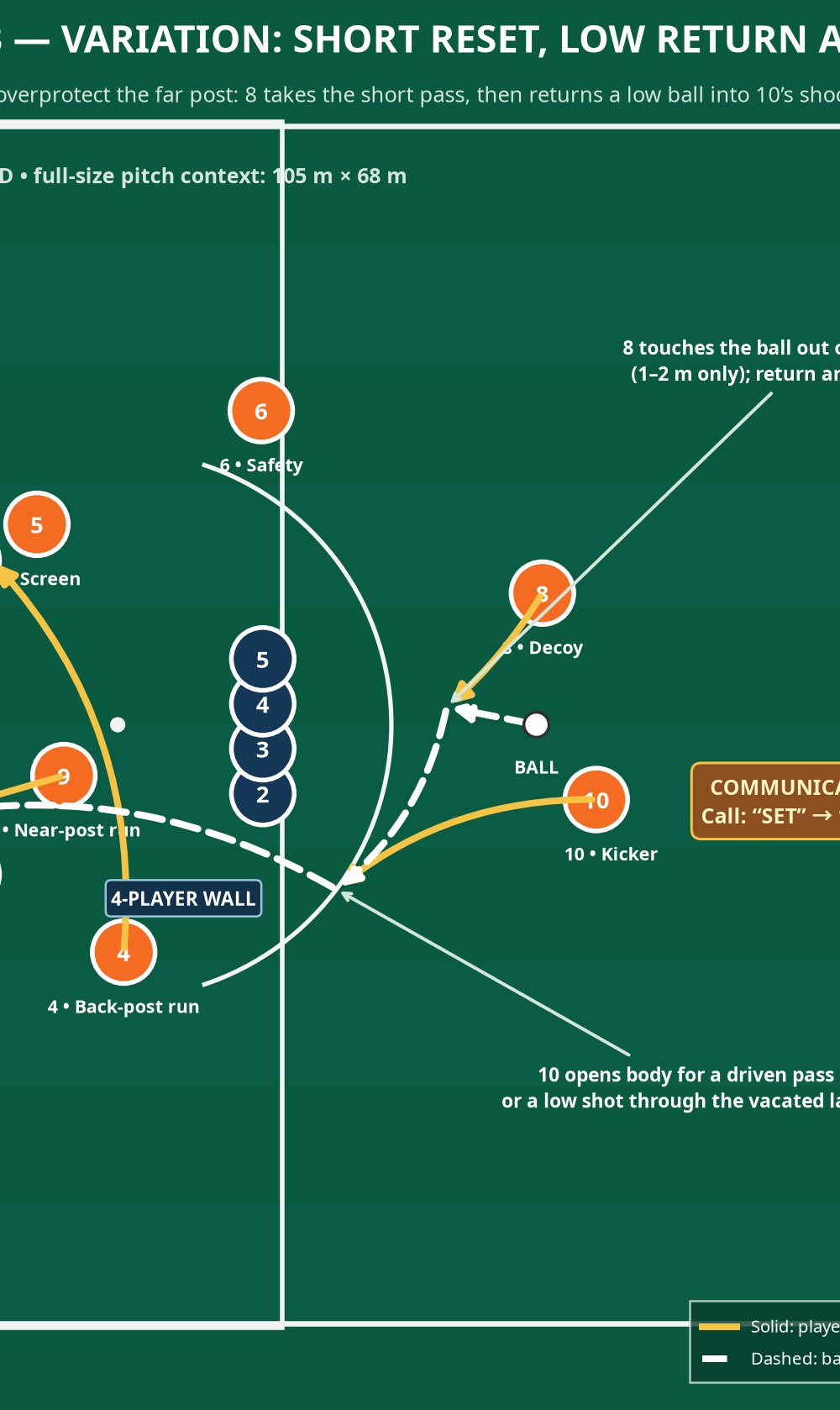
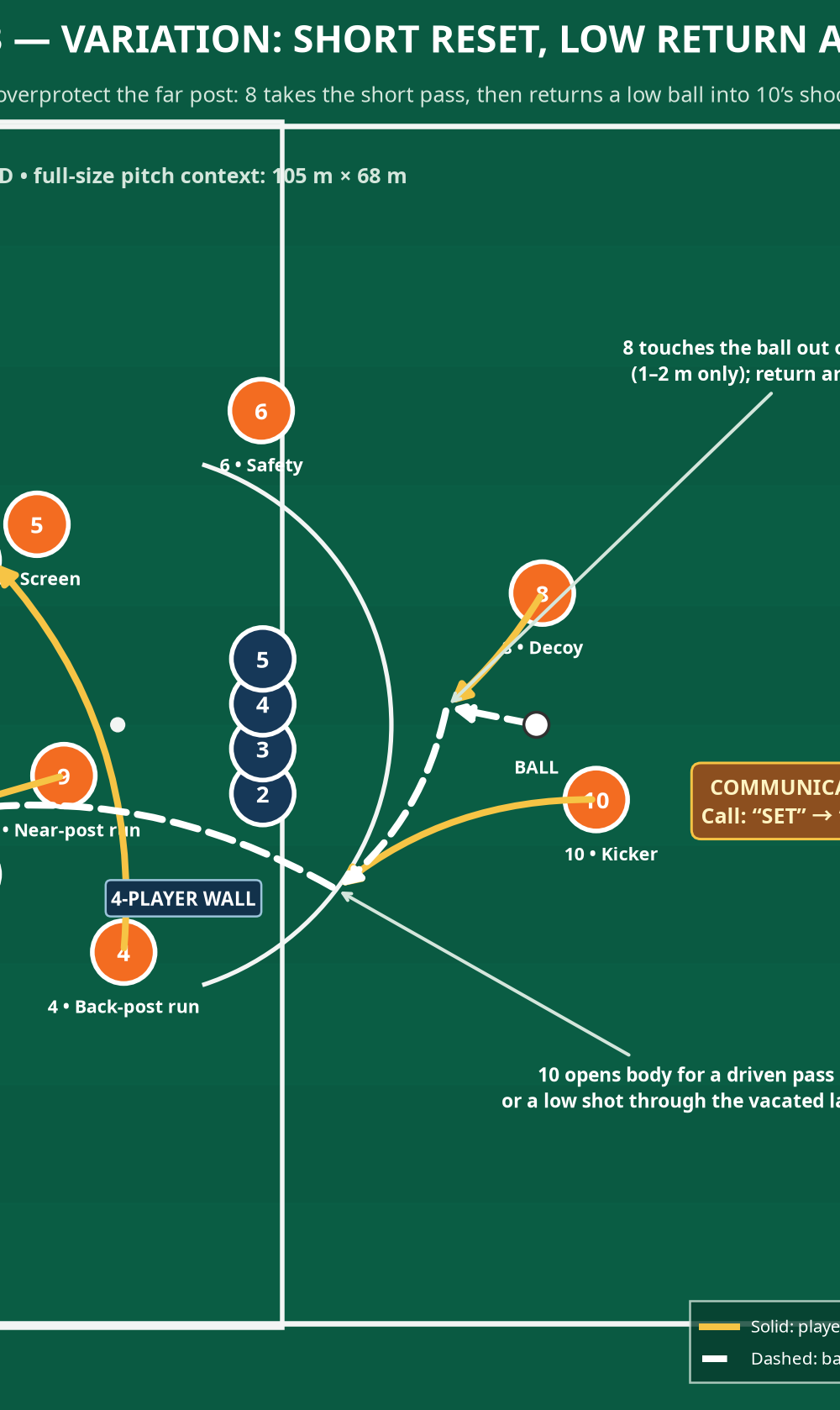
The first variation is a short reset. If the wall and goalkeeper start leaning toward the far post, 8 rolls 1–2 m out of the wall’s line and returns the ball first time into 10’s open body. 10 then drives a low pass or shot through the lane the wall has vacated. Use the calls “set” and “roll” so the variation is recognised without eye contact.
For a second progression, move the ball 4–6 m wider and replace the curling delivery with an inswinging ball toward the penalty spot. Keep 4 as the late runner but ask 9 to run across the goalkeeper’s sightline without contact. For an advanced game-realistic progression, begin with a live 7v7 plus goalkeeper in the final 40 m. Award the attacking side one point for reaching the far-post corridor, three for a first-contact shot on target, and five for a goal; if the defending side clears and completes three passes, they earn two points. This rewards both delivery quality and counter-press discipline.
Age Adaptations
For Under-8 and Under-10, use a 20–24 m shooting area, a two-player wall, and a wide mini-goal or marked target instead of demanding bend. Remove screening and coach the three essentials: wait, run late, and pass into space. For Under-12, use a 7.32 m goal if available, a three-player wall, a 7–9 m coaching distance, and one far-post runner; introduce the legal 1 m attacking clearance as a habit. From Under-14 upward, use the full 9.15 m distance, the four-player wall, the safety player and a live recovery phase. At Under-16 and open age, give the goalkeeper full authority to place the wall and require the attack to read whether the far-post delivery, direct strike or short reset is the best option.
Session Organisation and Review
Run this as a 30-minute block: six minutes unopposed, eight minutes against a passive wall, eight minutes against live zonal defenders and eight minutes of the scoring progression. Rotate 10, 8 and 4 after two sets of four repetitions. Finish by asking: Did we move on the final stride? Did the ball enter the far-post corridor? Was #6 connected for the clearance? Those answers tell you whether the routine is ready for matchday.