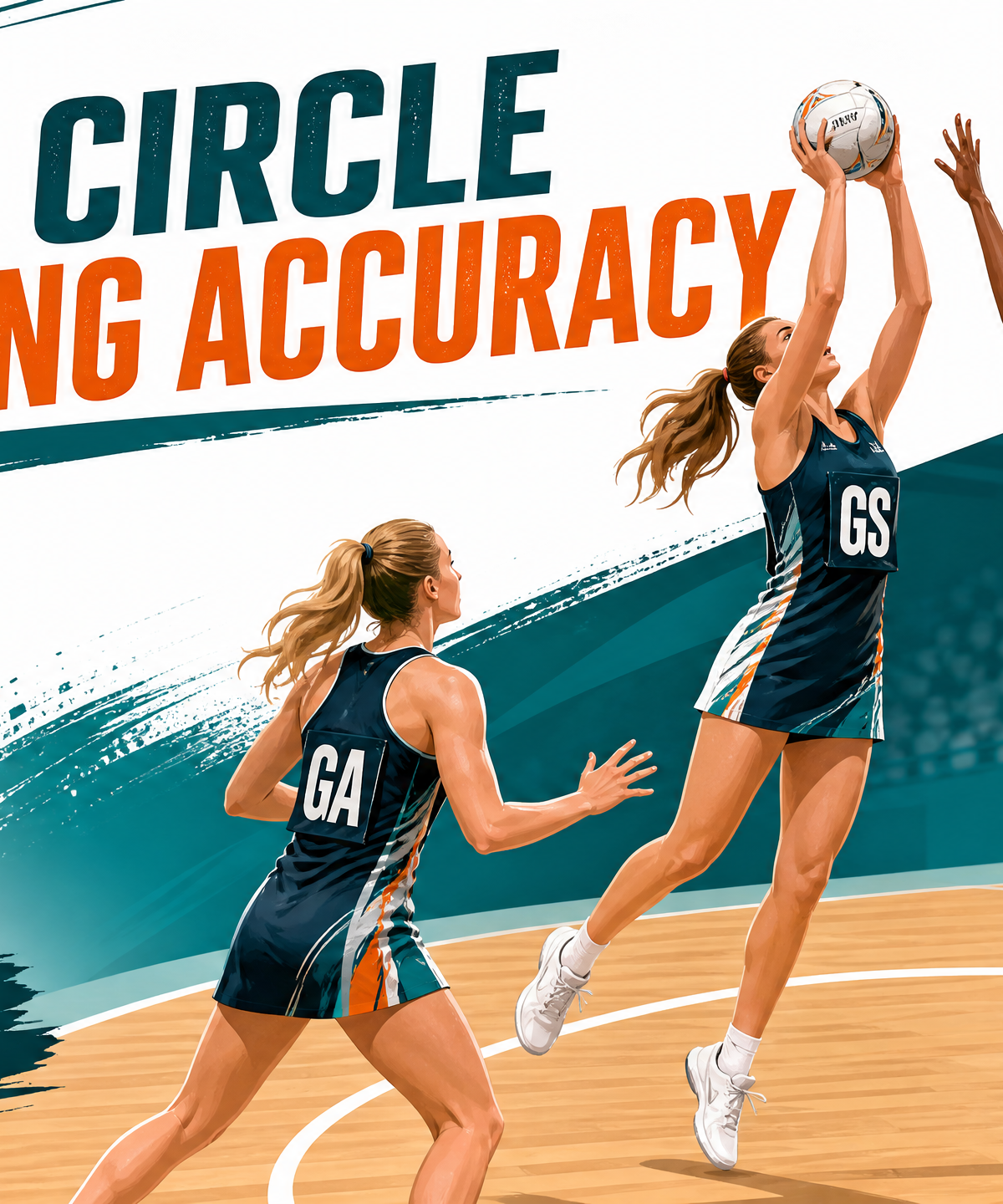
Mastering the Goal Circle: High-Pressure Shooting Accuracy Drill
Equip your Goal Shooters and Goal Attacks with the accuracy, composure, and dynamic movement needed to convert under match pressure.
Equipment Needed
Overview
Shooting accuracy in Netball isn't just about technique; it's about executing that technique consistently under physical fatigue and defensive pressure. This comprehensive drill session is designed to build volume, improve spatial awareness within the 4.9m goal circle, and develop the crucial GS/GA combination play. By progressing from static technique to dynamic, pressure-loaded scenarios, coaches can effectively bridge the gap between practice and match-day performance.
Use this session when your shooting statistics are dropping late in quarters, or when your attackers are struggling to find rhythm and optimal positioning against a tight, physical defensive unit.
Setup
To run this session effectively, you will need a standard goal third of a netball court (30.5m x 15.25m total court size) with clear goal circle markings and a regulation 3.05m goal post.
Equipment Needed:
- 3-4 regulation Netballs (Size 5)
- 5 marker cones (preferably flat dots to avoid tripping)
- Stopwatch or timer app
- Position bibs (GS, GA, WA, C, GD, GK)
Player Allocation:
- Primary Focus: Goal Shooter (GS) and Goal Attack (GA)
- Support/Opposition: 1-2 Feeders (WA/C), 1-2 Defenders (GD/GK), and 1-2 Rebounders (can be rotating squad members).
Step-by-Step Instructions
This resource is broken down into three progressive drills, starting with foundational accuracy and building up to match-intensity pressure.
Drill 1: The 5-Spot Shooting Rotation
This initial drill focuses on volume, muscle memory, and finding range from different areas of the goal circle.
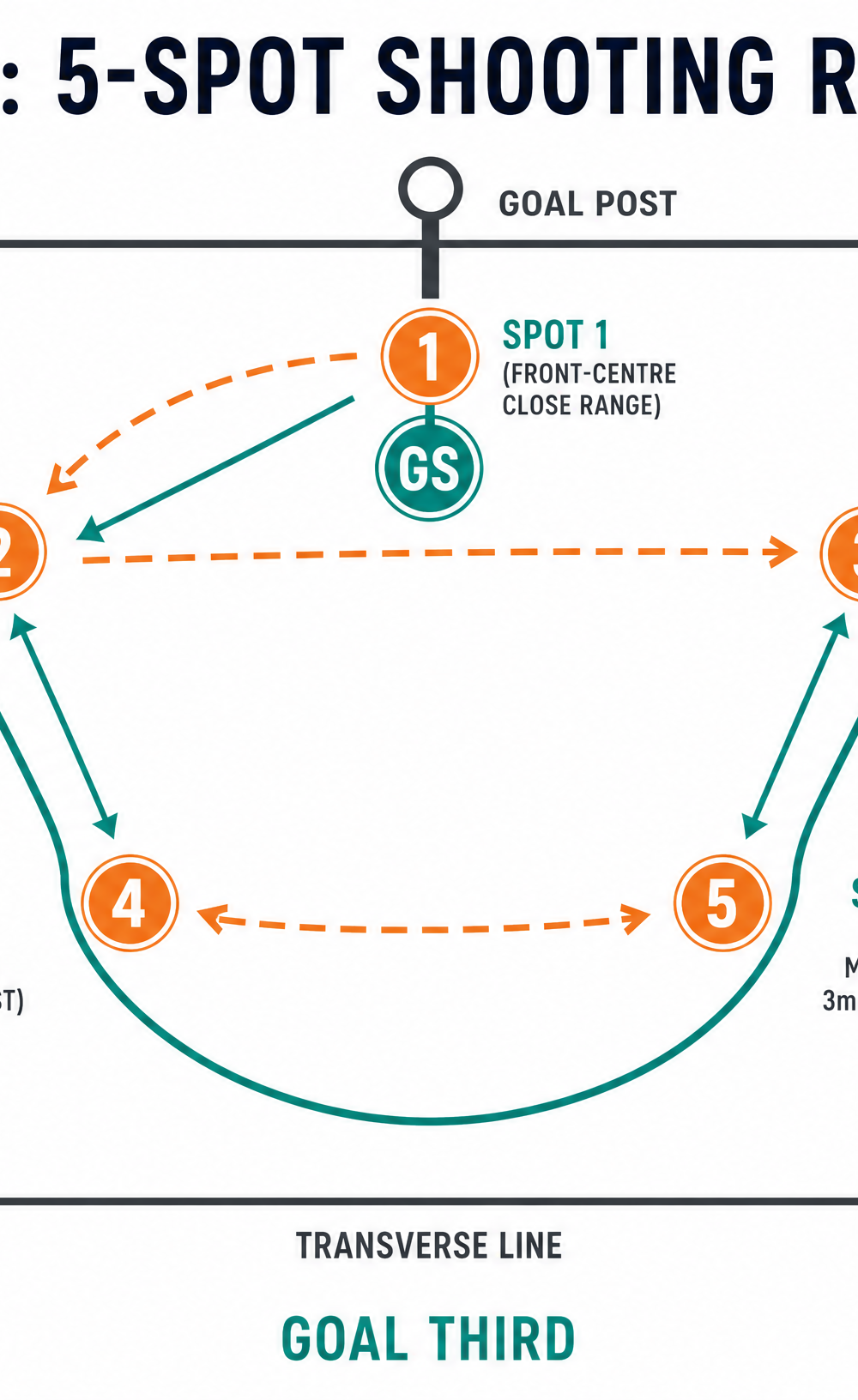
- Set the Spots: Place five flat marker cones within the goal circle as shown in Diagram 1. Spot 1 is front-centre close range (approx. 1m from the post). Spots 2 and 3 are on the left and right close-range arcs. Spots 4 and 5 are on the left and right mid-range arcs (approx. 3m from the post).
- The Execution: The shooter starts at Spot 1. They must successfully sink two consecutive shots before moving to Spot 2.
- The Rotation: Once two shots are made at Spot 1, the shooter moves to Spot 2, then Spot 3, Spot 4, and finally Spot 5, requiring two consecutive successful shots at each location.
- Rebounding: Have a dedicated rebounder collecting the ball and feeding it back to the shooter immediately to maintain a high tempo.
- Completion: The drill is complete when the shooter has successfully navigated all five spots.
Drill 2: GS-GA Combination Shooting
Netball requires seamless cooperation between the GS and GA. This drill introduces movement, feeding, and basic defensive pressure.
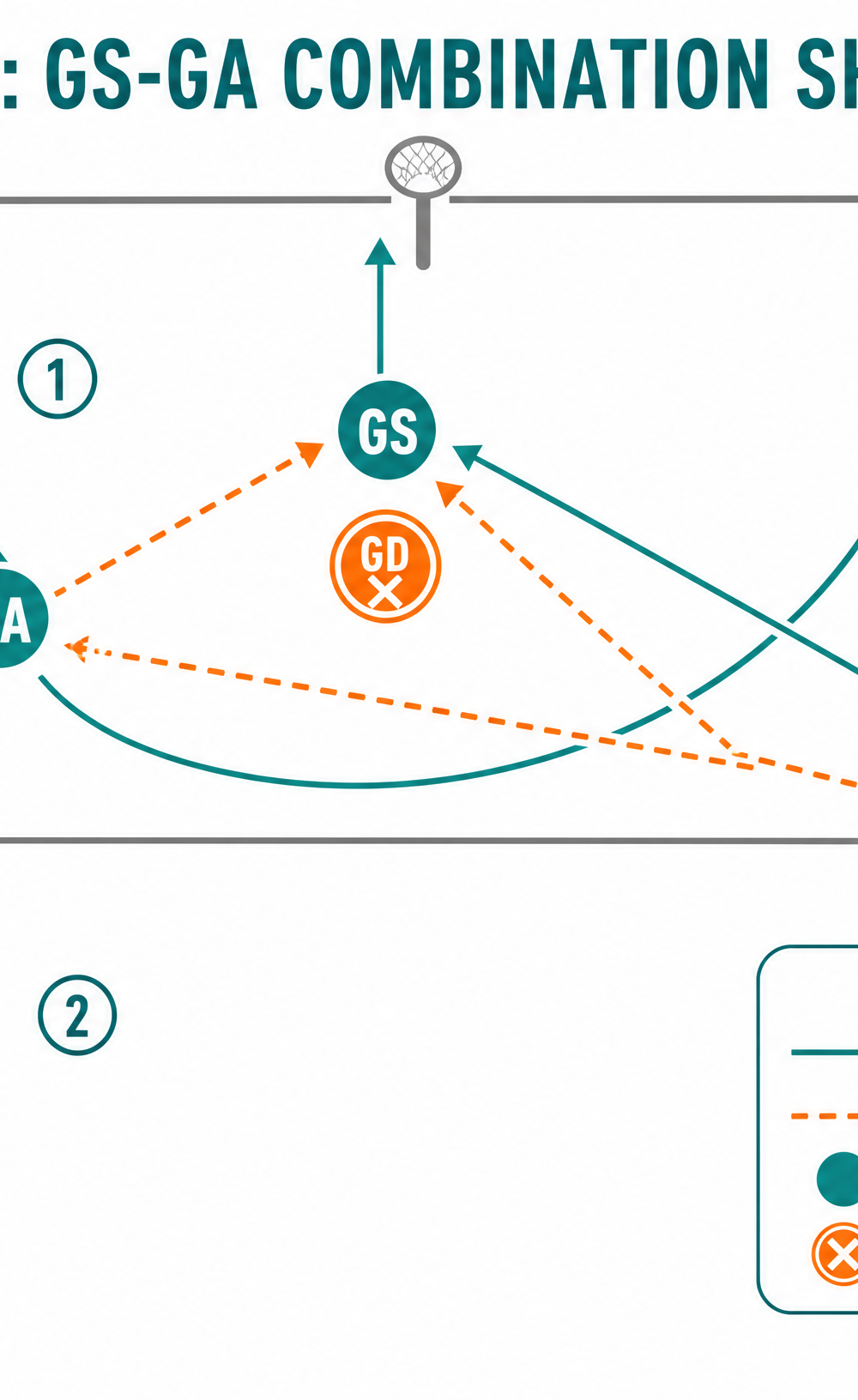
- Starting Positions: Position the GS near the post and the GA out on the goal circle edge. Place a Feeder (F) just outside the circle near the transverse line. Introduce a passive Defender (GD) marking the GS.
- The Feed: The Feeder initiates the play by passing to the GA on the circle edge.
- The Drive: As the GA receives the ball, the GS must make a strong, decisive drive to lose the defender and create a clear passing lane.
- The Pass and Shot: The GA feeds the GS, who must balance quickly and take the shot.
- Alternative Option: The Feeder can also bypass the GA and feed directly to the GS on a strong baseline drive.
- Rotation: Rotate the roles of GS and GA after 10 attempts to ensure both players practice feeding and shooting under light pressure.
Drill 3: Pressure Relay Shooting
This final progression simulates the physical and mental fatigue of the fourth quarter, demanding rapid movement and immediate composure.
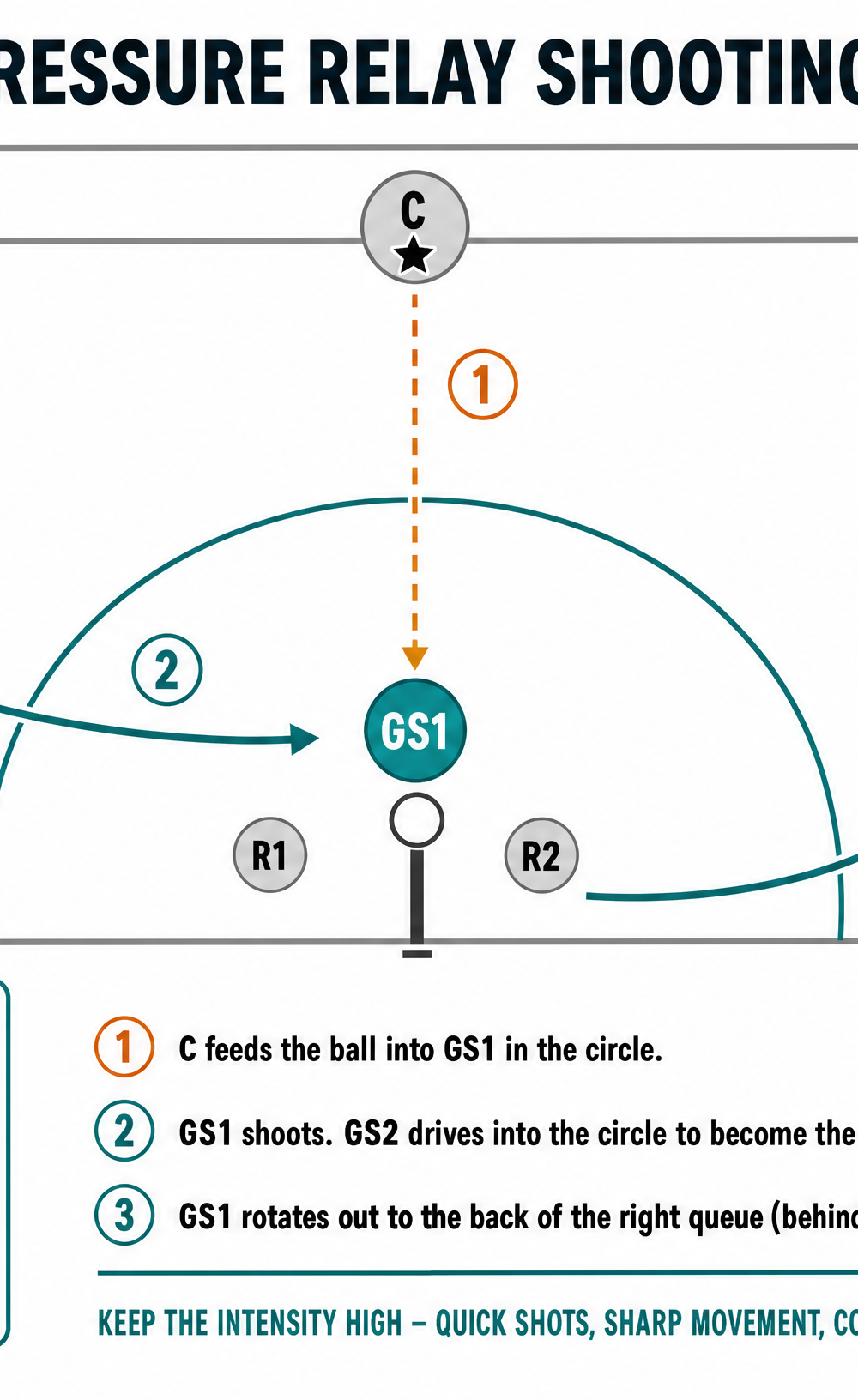
- The Setup: Form two queues of shooters just outside the goal circle, one on the left and one on the right. A Coach or Feeder stands near the transverse line with a ball. Two rebounders stand near the post.
- The Action: The Coach feeds the ball to the first shooter (GS1) who has driven into the circle. GS1 must catch, balance, and shoot as quickly as possible.
- The Rotation: Immediately after releasing the shot, GS1 sprints out of the circle and joins the back of the opposite queue.
- Continuous Flow: As soon as the ball leaves GS1's hands, the next shooter (GS2) drives in from the opposite side to receive the next feed from the Coach.
- The Challenge: Set a timer for 60 seconds. The squad must collectively score a target number of goals (e.g., 15 goals) within the time limit. If they fail, they run a court sprint.
Key Coaching Points
- B.E.E.F Principle: Constantly reinforce the fundamentals: Balance (feet shoulder-width apart), Eyes (focused on the back of the ring), Elbow (tucked in and pointing at the post), Follow-through (flick the wrist and hold the release).
- Strong Base: Ensure shooters establish a solid, still base before initiating the shooting motion. Stepping into the shot leads to inaccuracy and potential stepping calls.
- High Release Point: Encourage players to release the ball at the highest point of their extension to clear the defender's reach and create a better trajectory.
- Rebound Readiness: The shooter's job isn't done when the ball leaves their hands. They must immediately anticipate the rebound and position themselves accordingly.
- Communication: In the combination drills, demand loud, clear communication between the GS, GA, and Feeders.
Common Mistakes
- Rushing the Shot: Players often panic under pressure and throw the ball rather than executing their technique. Correction: Enforce a "one-second hold" where the player must balance and look at the post before shooting.
- Dropping the Elbow: A dropped elbow flattens the arc of the shot, reducing the chance of it dropping through the net. Correction: Have players practice shooting one-handed close to the post to isolate and strengthen the elbow extension.
- Lack of Follow-Through: Pulling the hand back immediately after release affects the ball's backspin and trajectory. Correction: Instruct shooters to "leave their hand in the cookie jar" until the ball hits the net.
- Static Positioning: Shooters waiting flat-footed for the ball are easy to defend. Correction: Demand dynamic preliminary movements (dodges, rolls) before receiving the feed.
Variations & Progressions
- Make it Easier: Remove the defenders entirely. Allow players to shoot from their preferred spots rather than mandated locations. Decrease the target score in the pressure relay.
- Make it Harder: Introduce active, physical defenders who contest every shot and block the vision of the shooter. Add a fatigue element (e.g., 5 burpees before entering the circle for the pressure relay).
- Conditioning Focus: In the 5-Spot Rotation, if a player misses a shot, they must sprint to the transverse line and back before attempting the spot again.
Age Adaptations
- Under 8 / Under 10: Lower the goal posts if possible. Use a smaller Size 4 netball. Focus entirely on basic technique (B.E.E.F) from close range (Spots 1, 2, and 3). Ignore the pressure relay and focus on fun, repetitive shooting games.
- Under 12 / Under 14: Introduce the combination plays but keep defensive pressure passive. Emphasize the importance of the GA supporting the GS.
- Under 16 / Open: Run the drills exactly as written, maximizing defensive pressure and demanding high shooting percentages (80%+) even under fatigue.