

Netball
Centre Pass Set Play: The Overload Cut
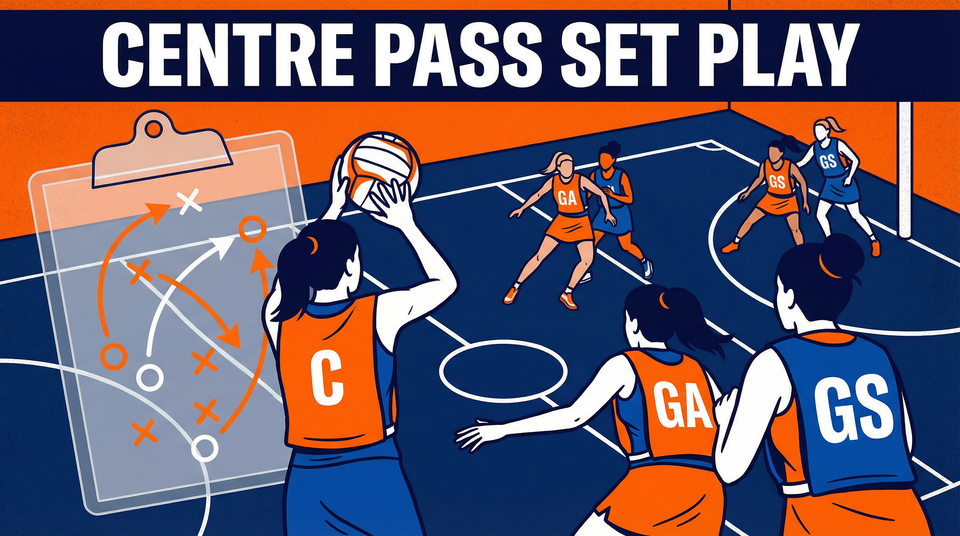
A dynamic centre pass set play designed to overload one side of the court, creating space for a fast diagonal cut to the goal circle.
What you need
Netball, Bibs, Court
Overview
The 'Overload Cut' is an attacking centre pass set play designed to quickly transition the ball from the centre third directly to the edge of the goal circle. By initially drawing the defence to one side of the court, this play creates open space on the opposite side for a hard, diagonal drive. It is highly effective against a rigid, one-on-one defensive structure and relies on precise timing and strong, flat passes.
Setup
Equipment Needed:
- 1 Netball
- Full netball court (30.5m x 15.25m)
- Minimum 4 attacking players (C, WA, GA, GS)
Player Positions:
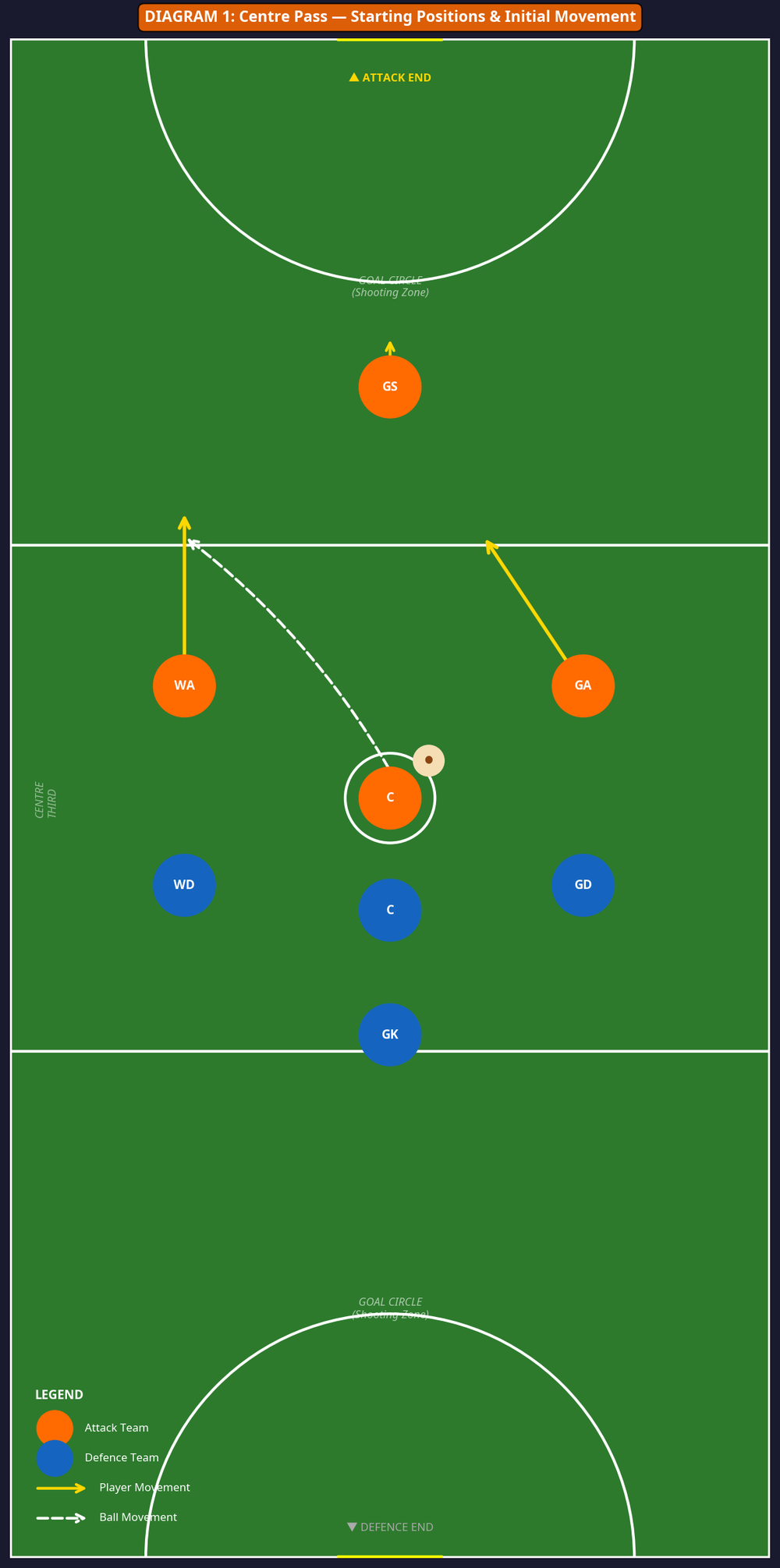
- C (Centre): Inside the centre circle with the ball.
- WA (Wing Attack): Positioned on the left side of the transverse line, ready to drive straight or slightly wide.
- GA (Goal Attack): Positioned on the right side of the transverse line, setting up the initial decoy or secondary drive.
- GS (Goal Shooter): Positioned deep in the goal circle, ready to hold or drop back to create space.
Step-by-Step Instructions
Phase 1: The Initial Drive
- On the whistle, the WA makes a strong, straight drive down the left channel, drawing the WD with them.
- The C delivers a sharp, flat pass to the WA just as they cross the transverse line.
- Simultaneously, the GA takes a slight step back or wide to pull the GD out of the central corridor.
Phase 2: The Diagonal Cut
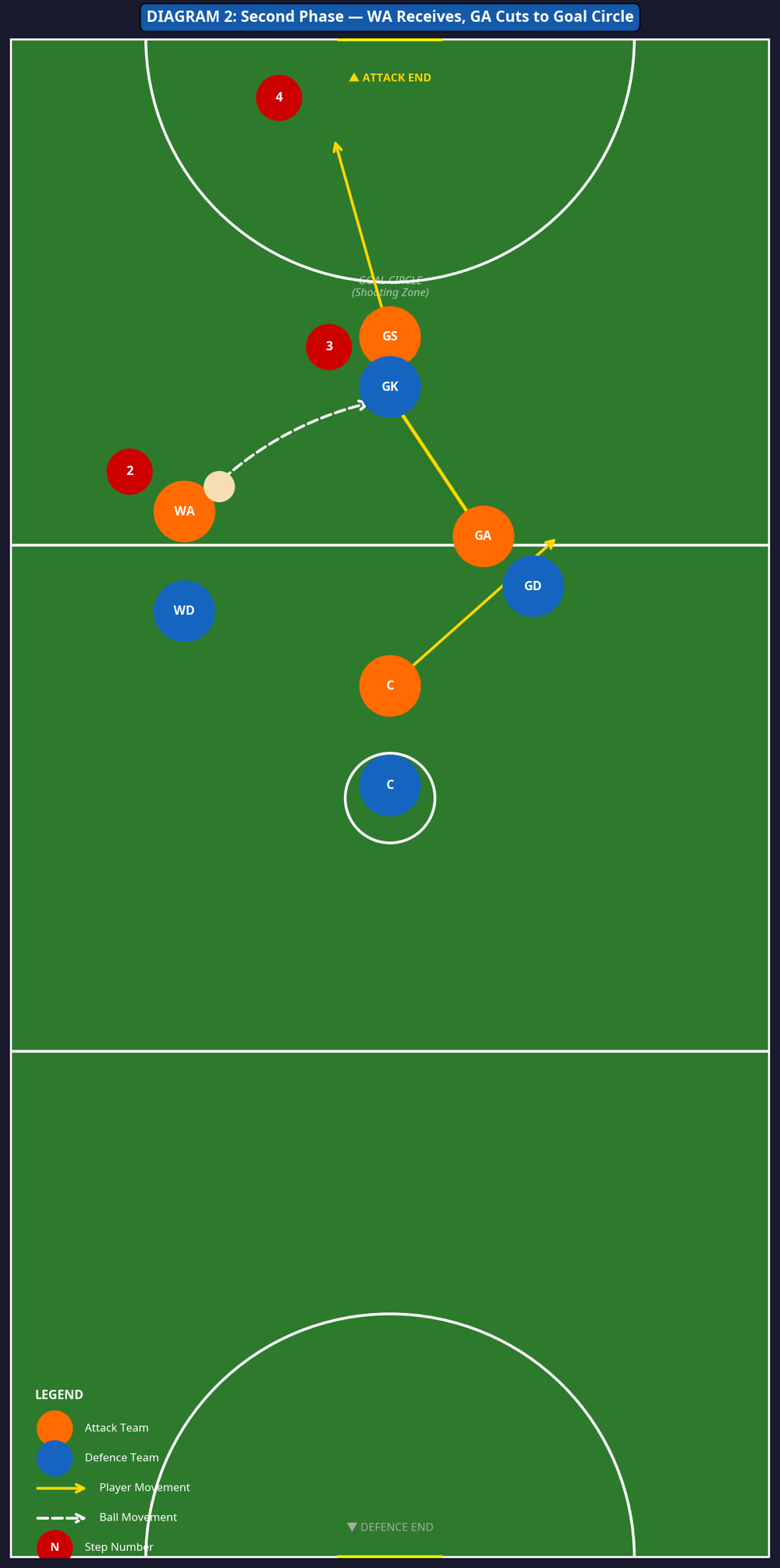
4. As the WA receives the ball, the GA immediately changes direction, pushing off hard to make a sharp diagonal cut across the centre of the court toward the top of the goal circle.
5. The WA turns fully upon landing and delivers a quick, direct pass into the space ahead of the driving GA.
6. The C follows up their initial pass, moving into the space vacated by the GA to offer a reset option if the forward pass is blocked.
Phase 3: The Finish
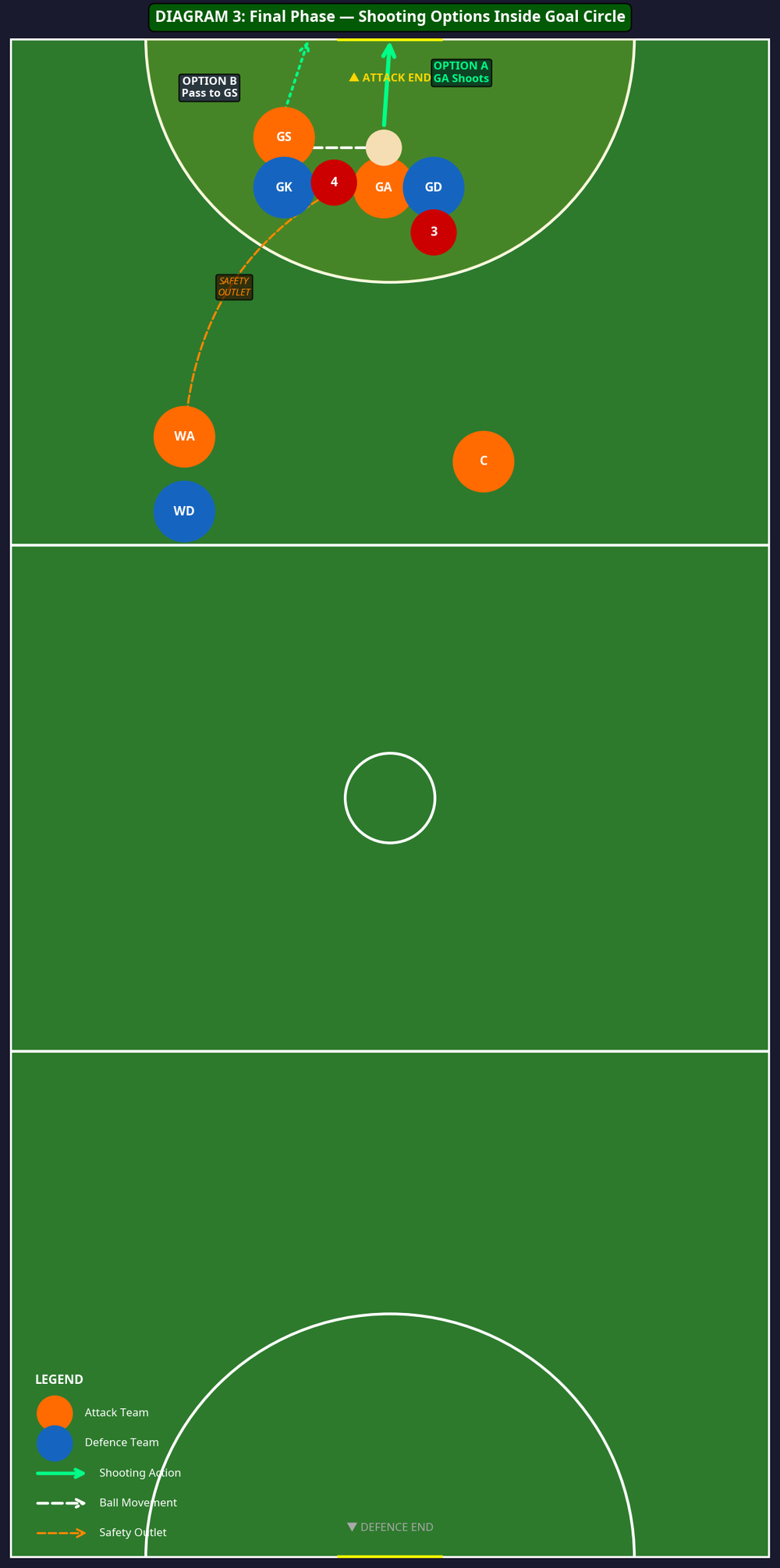
7. The GA receives the ball at the top of the goal circle. From here, they have two primary options:
- Option A: If the GD has not recovered, the GA turns and shoots.
- Option B: If the GK steps out to challenge the GA, the GS rolls off the back of the GK to receive a quick feed under the post for an easy shot.
Key Coaching Points
- Timing is Everything: The GA must not start their diagonal cut until the WA has secured the ball. Moving too early will crowd the space and allow the GD to intercept.
- Pass Quality: The pass from C to WA, and WA to GA, must be flat and hard. Loopy passes give the defence time to recover.
- Strong Change of Direction: The GA must sell their initial decoy movement. A hard push-off is required to beat the GD on the diagonal cut.
- Court Vision: The WA must land, turn fully, and look into the goal circle immediately to spot the GA's drive.
Common Mistakes
- Drifting: Players drifting into the space rather than making sharp, angled cuts.
- Looking Away: The WA turning their back to the goal circle upon receiving the ball, delaying the second pass.
- Crowding: The GS moving too high up the goal circle, blocking the space for the GA's drive.
Variations & Progressions
- The Switch: Have the GA make the initial drive to receive the centre pass, with the WA making the secondary diagonal cut. This keeps the defence guessing.
- The Fake: The WA receives the ball, fakes the pass to the cutting GA, and instead passes back to the C who has driven to the top of the circle.
Age Adaptations
- Under 10s / Beginners: Focus purely on the timing of the first pass to the WA and ensuring they land without stepping. The secondary cut can be simplified to a straight drive.
- Under 14s / Intermediate: Introduce the decoy movements. Emphasize the speed of the pass from WA to GA.
- Open / Advanced: Incorporate complex defensive scenarios (e.g., zone defence) and require the players to read the defence and choose the appropriate variation on the fly.
