

Netball
Penalty Pass Advantage: Wide Release to Circle Split
A coach-ready attacking-third set play that turns a penalty pass into a controlled wide release, a two-option circle split, and a disciplined scoring chance.

What you need
1 regulation netball, 8 flat cones or court markers, 7 position bibs: C, WA, GA, GS, WD, GD, GK, whistle, stopwatch
Penalty Pass Advantage: Wide Release to Circle Split
Overview
This is an attacking-third penalty-pass pattern for converting the moment when a defender must stand out of play into a clean first release and a composed circle feed. The objective is not simply to take a fast pass; it is to use the brief numerical advantage to move the ball away from the penalised defender, force the remaining circle defenders to choose, and give the Goal Attack (GA) and Goal Shooter (GS) contrasting leads. The preferred finish is a safe feed to the front-leading GA or, when Goal Defence (GD) commits, a second pass to GS on a late back-space lead.
Run it when the penalty is awarded between the attacking transverse line and the goal circle, particularly after a Wing Defence (WD) or GD has been beaten on the outside. It is most effective when your players can recognise the whistle, set their spacing without discussion, and release the ball within one to two seconds. It is not a licence to force a speculative feed. If the defensive picture closes, the play deliberately includes a reset through Centre (C). The interpretation of sanctions remains subject to the competition rules and umpire; World Netball’s current Rules of Netball and local guidance must take precedence. 1
Coach’s cue: “Mark, width, split, read.” The players must know that the advantage comes from spacing and timing, not from speed alone.
Setup
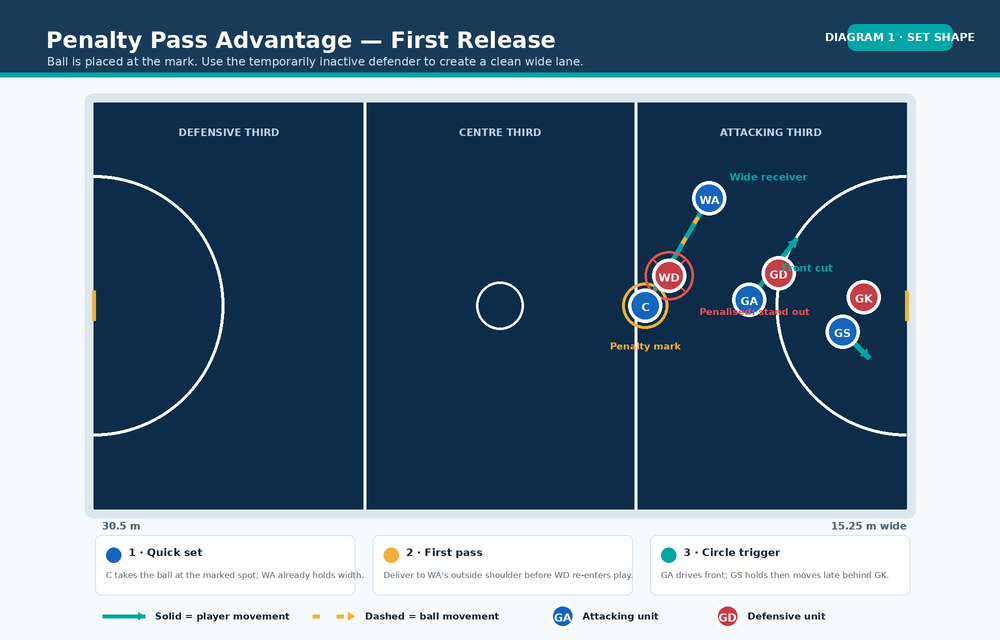
Use the attacking third of a regulation 30.5 m × 15.25 m court. Place a flat marker at the likely penalty mark, ideally 2–4 m inside the attacking third and 3–5 m from the ball-side sideline. Use cones to indicate the wide receiver lane and the two circle leads. Begin with the working unit of four attackers against three defenders: C, WA, GA and GS against WD, GD and GK. In early learning, appoint an umpire or coach to whistle the penalty and require the penalised defender to stand out correctly.
| No. | Position | Starting reference | Primary job |
|---|---|---|---|
| 1 | Centre (C) | At the marked penalty position, outside the circle | Takes the sanction quickly and sees the first safe option. |
| 2 | Wing Attack (WA) | 3–4 m wide and 2–3 m forward of C, near the sideline channel | Creates width, receives on the outside shoulder and delivers the first circle pass. |
| 3 | Goal Attack (GA) | 1–1.5 m outside the goal-circle edge, on the ball side | Drives hard to the front space and shows a strong hand target. |
| 4 | Goal Shooter (GS) | 1–1.5 m inside the circle, behind the initial GA line | Holds the keeper, then leads late into the opposite space. |
| 5 | Wing Defence (WD) | Starts in C/WA’s channel and is penalised on the first rep | Stands out until the ball is released; then recovers legally. |
| 6 | Goal Defence (GD) | Between GA and the circle, slightly goal-side | Chooses whether to front GA or protect the GS space. |
| 7 | Goal Keeper (GK) | On GS, inside the circle | Holds the shot space and communicates the defensive switch. |

Step-by-Step Instructions
Call and set. On the umpire’s whistle, C immediately identifies the mark and presents for the ball. WA moves to the outside lane, not towards C; maintain 3–4 m lateral separation. GA stays patient at the circle edge. GS holds the keeper for a count of one. The first teaching standard is that everyone is set before the ball is released.
Take the penalty cleanly. C receives or places the ball at the instructed position and lands balanced, with the outside foot free to open towards WA. Do not drift into the circle or step across the mark. WD must stand out until release; the attack should use that temporary absence rather than crowd it.
Release to width. C delivers a flat, catchable pass to WA’s outside shoulder. WA should receive while moving forward, around 2.5–3 m clear of C. This movement takes the ball beyond the original defensive channel and forces GD and GK to reassess their circle coverage.
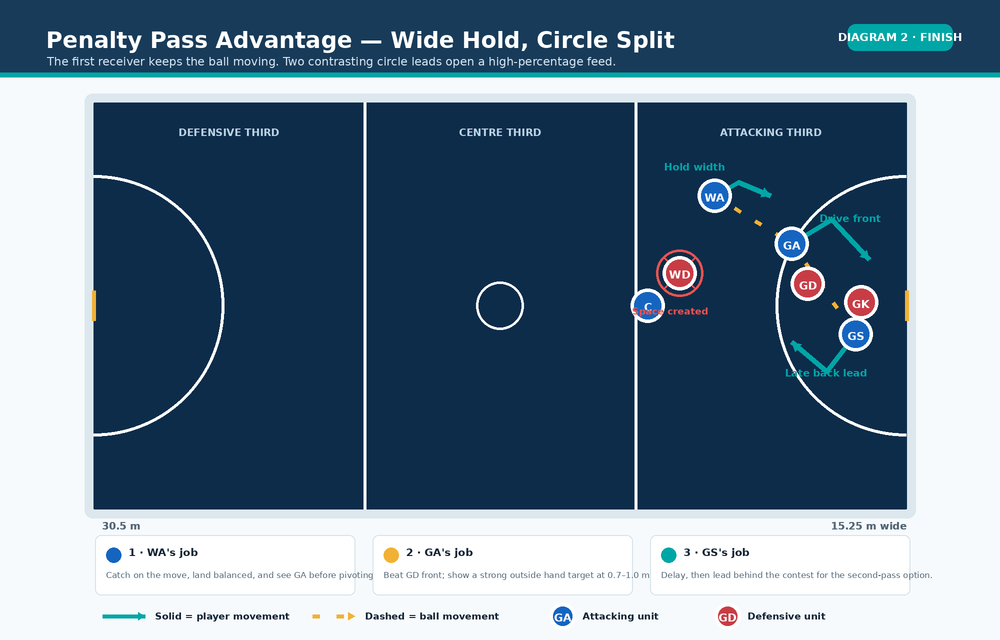
Trigger the circle split. As WA catches, GA plants and drives front across GD’s body toward the high, ball-side edge of the circle. GA’s lead should travel 3–4 m and finish with hands early, chest and eyes facing WA. At the same moment GS delays, then moves 2–3 m into the back or opposite pocket. The contrast—GA early and high, GS late and low—is the key to the split.
Make the first read. WA lands with a balanced stance, eyes up and ball protected. If GD is a half-step behind GA, WA feeds GA’s outside hand with a direct shoulder pass. GA should take the ball through the circle with feet organised for a shot or a short, safe pass to GS. Do not feed between GD and GK if neither attacker has separation.
Use the second option. If GD fronts GA or GK leaves GS to intercept the first feed, WA holds the ball and looks for GS’s delayed lead. The feed should arrive into GS’s space, not at the defender’s body. Call “back” early so GS knows the ball is coming across the circle line.
Reset, do not force. If both circle lanes close, WA returns the ball to C, who has re-offered two to three metres behind play and square to the pass. C then feeds the opposite-side GS lead or begins normal attacking play. Treat a reset as a win: the penalty has still shifted the defence and retained possession.
Key Coaching Points
| Focus | What to coach on court |
|---|---|
| Fast organisation | The whistle is the trigger to set shape, not a signal to panic. Players should reach their reference spaces within two seconds. |
| Genuine width | WA must keep a 3–4 m lateral lane. If WA steps towards C, the defence can recover into a single intercept lane. |
| Timed, contrasting leads | GA leaves first and high; GS leaves second and low or behind. Two players leading to the same ball destroys the advantage. |
| Passing discipline | C’s first pass is flat to WA’s outside shoulder; WA’s feed is to a hand target in front of the receiver. |
| Defender recognition | Teach WA to name the cue: “GD front”, “GK leave” or “both tight”. This promotes a read rather than a pre-programmed pass. |
| Legal execution | Reinforce footwork, obstruction distance and the umpire’s sanction procedure at your level. Stop and correct a technically illegal fast play. |
Common Mistakes
The most common error is WA coming towards C, which collapses the outside lane and invites WD back into play; reset WA at the sideline cone and demand an outside-shoulder catch. Next, GA and GS lead together. Rehearse GA’s lead on WA’s catch and GS’s lead on GA’s second step. Also stop players who rush the mark or land illegally before adding tempo.
Correct WA staring only at GA: the scan is “GA, GS, C”. If GD has won the front and GK covers the back, coach the return to C rather than a forced circle pass.
Variations & Progressions
Start with a guided variation: use only C, WA and GA against passive WD and GD, with the coach calling the feed. This gives younger or developing players time to learn spacing and the outside-shoulder pass. The next variation is the GS priority call: the coach signals “front” before the whistle, GD fronts GA, and the pattern must finish via GS’s delayed back lead.
For game realism, make all three defenders live as C releases and allow switches, intercept attempts and recovery. Score one point for a clean shot inside six seconds or a secure reset; deduct one for an illegal or forced pass. Alternate the penalty mark between sides so the play must be mirrored.
Age Adaptations
| Group | Adjustment | Coaching outcome |
|---|---|---|
| Under 8–10 | Use C, WA and GA only, shorten spacing to 2–3 m, remove live defence and allow the coach to call the target. | Builds visual awareness, safe catching and a simple outside release. |
| Under 12 | Add GS and one defender, use a marked three-second decision window, and rehearse one clear GA/GS timing cue. | Introduces scanning and coordinated circle movement without overload. |
| Under 14–16 | Use the full seven-player unit, live recovery, a legal stand-out, and the C reset. | Develops tactical reading, pressure passing and discipline under sanction. |
| Open | Add a second recovery defender, randomise the penalty location and score the quality of the decision rather than only goals. | Demands game-speed communication and adaptable execution. |
Finish the session by running three consecutive repetitions from each side: one GA-first score, one GS counter, and one mandatory reset. Ask players to state which defender’s movement created the next pass. That short reflection turns the pattern from a memorised movement into a usable match-play read.
