Wing Attack Wide-to-Front Feeding Patterns
A progressive attacking drill that teaches the Wing Attack to create width, win the front shoulder and deliver composed feeds into the shooting circle.
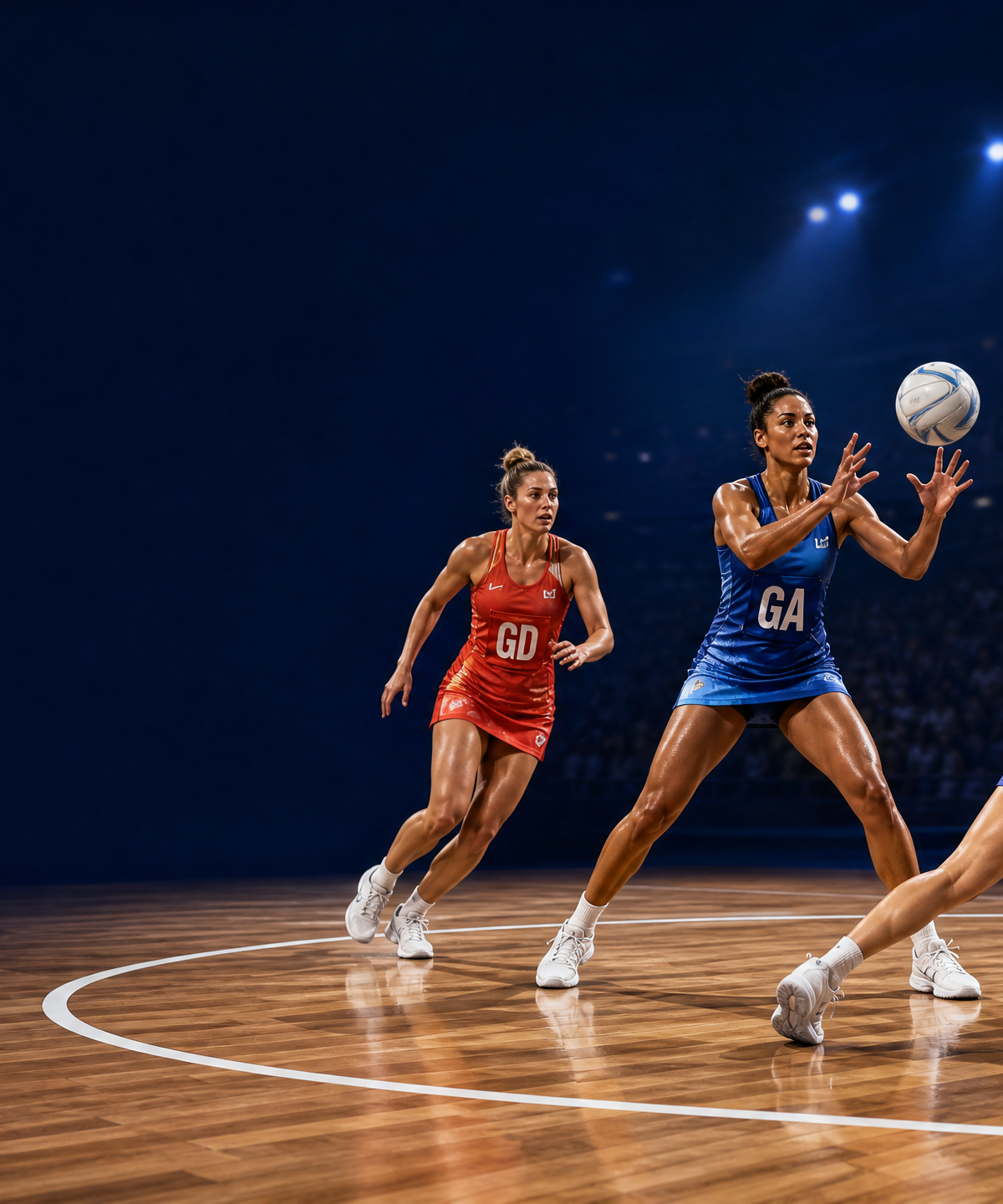
Equipment Needed
Overview
This WA feeding patterns drill develops the most valuable attacking habit a Wing Attack can own: arriving into the goal-third feed with purpose rather than simply presenting for the ball. The WA learns to use a wide drift, a sharp front cut and, when the first option is closed, a hard reset into a second-wave feed. The result is a cleaner passing lane to GA, better timing around the shooting circle and a calmer attacking unit under defensive pressure.
Use this after a passing-and-catching warm-up and before conditioned circle work. It is ideal when WA is receiving flat or GA is taking contested balls at the circle edge. Begin unopposed for technique, then add WD and GD pressure. The full court measures 30.5 m x 15.25 m and is divided into three equal thirds.1
| Session outcome | What success looks like |
|---|---|
| WA movement | WA creates width, then changes pace to win the front shoulder. |
| Ball delivery | The feeder passes into space, not at a stationary teammate. |
| Circle connection | GA receives side-on or front-on with room to turn, shoot or release. |
| Attacking resilience | If the first lane is denied, WA clears, re-offers and feeds on the second wave. |
Setup
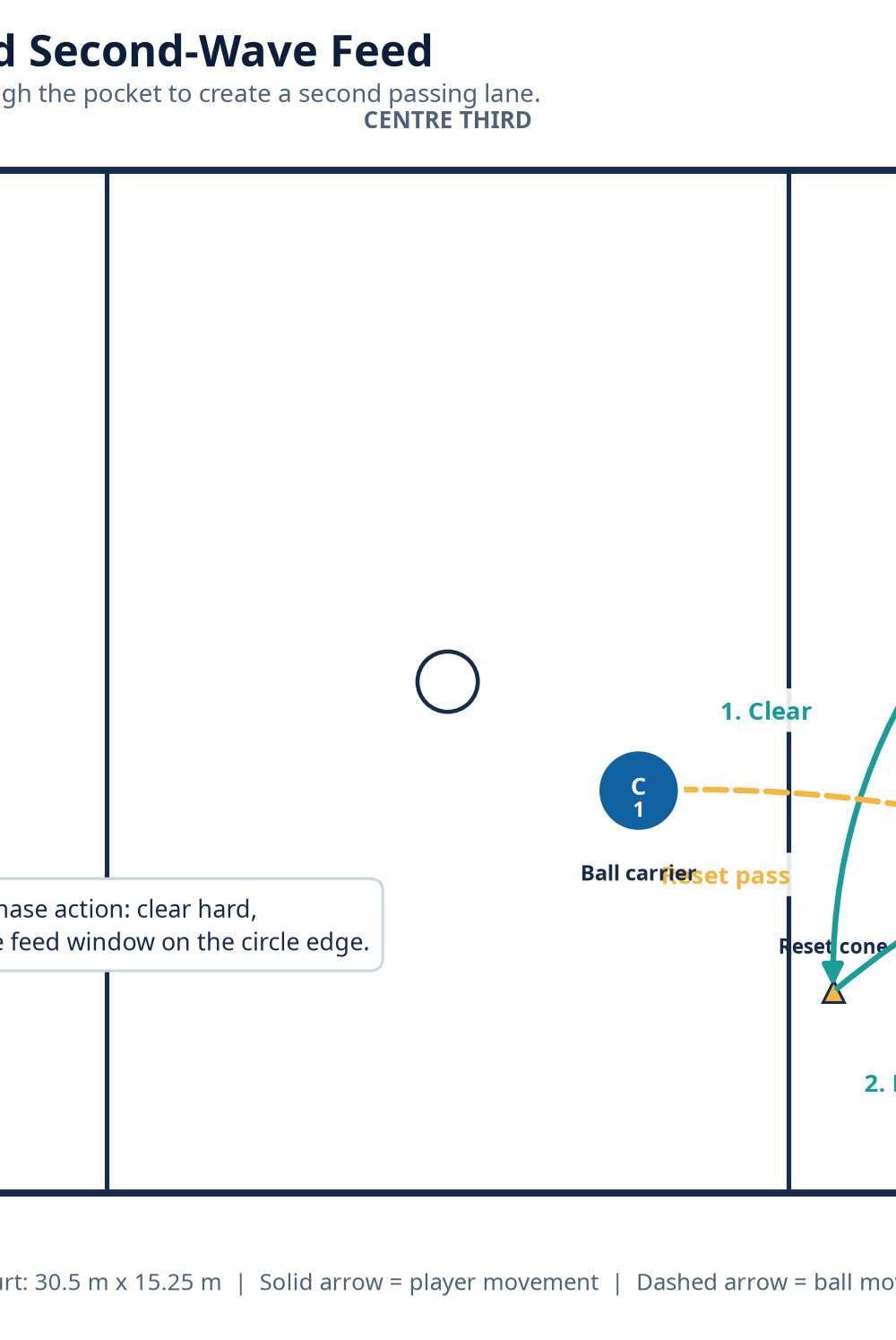
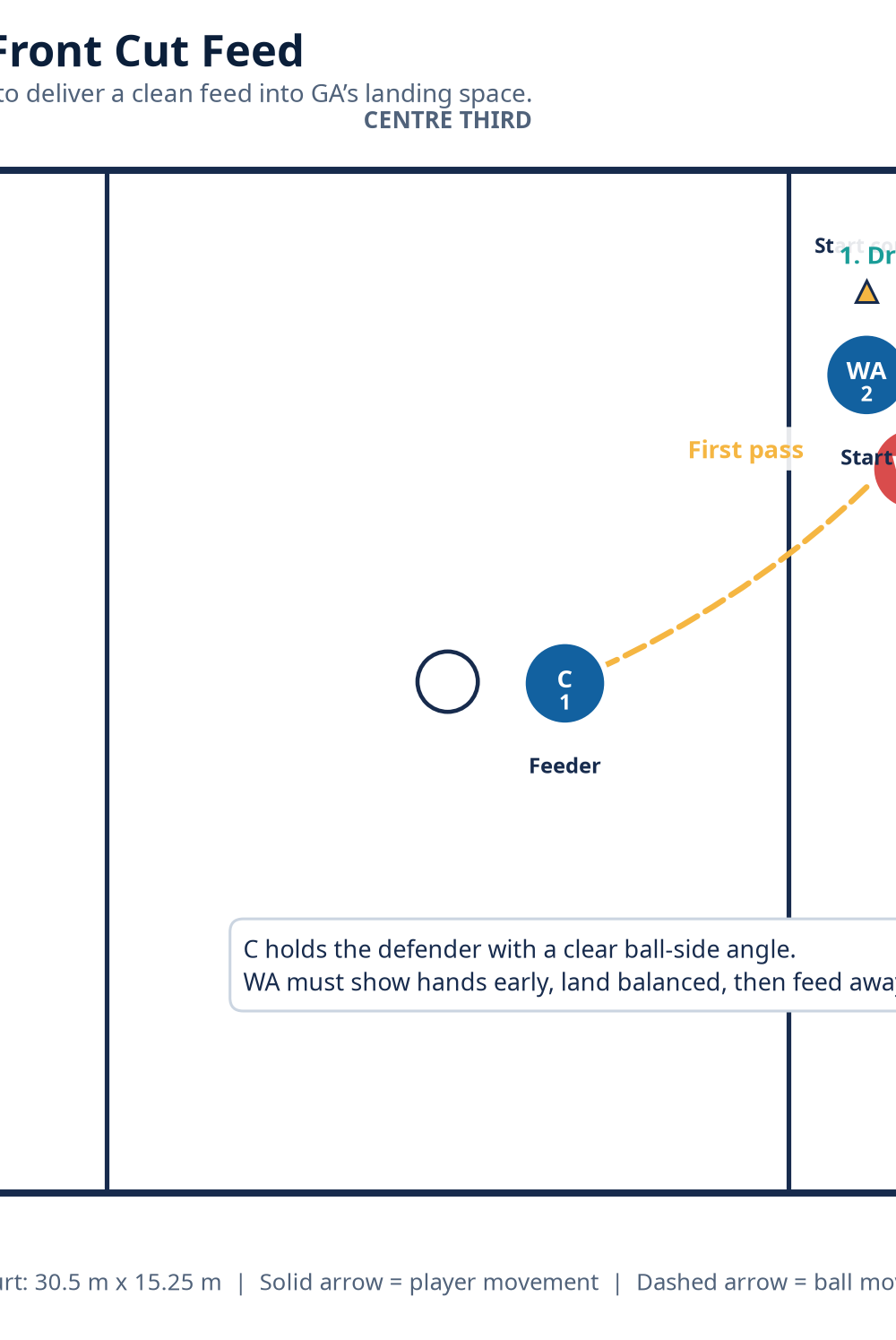
Set up in the attacking third. Put a start cone 2.0 m in from the sideline and 2.5 m above the transverse line, a wide cue 2.5 m farther out, a front-cut cue 3.5 m toward the circle and a reset cone 3.0 m below the transverse. Keep cones only until players can run the route confidently.
Start C (player 1) just inside the centre third, approximately 3 m from the transverse line, with the ball. WA (player 2) begins at the start cone. GA (player 3) starts on the circle edge, 1.5–2 m outside the goal circle, positioned to offer a high target. GS (player 4) stays high on the far side of the circle to hold space. In the defended progression, add WD (player 5) on WA’s inside shoulder and GD (player 6) between WA and GA. Two spare players can act as passers, rotate in or replace defenders.
| Item | Quantity | Coaching use |
|---|---|---|
| Netballs | 2 | Keep a second ball ready so repetitions stay sharp. |
| Flat cones | 8–10 | Mark the start, wide drift, front cut, reset and feed window. |
| Bibs | 6 | Distinguish attack from defence immediately. |
| Whistle and stopwatch | 1 each | Run focused 60–90 second work blocks. |
Step-by-Step Instructions
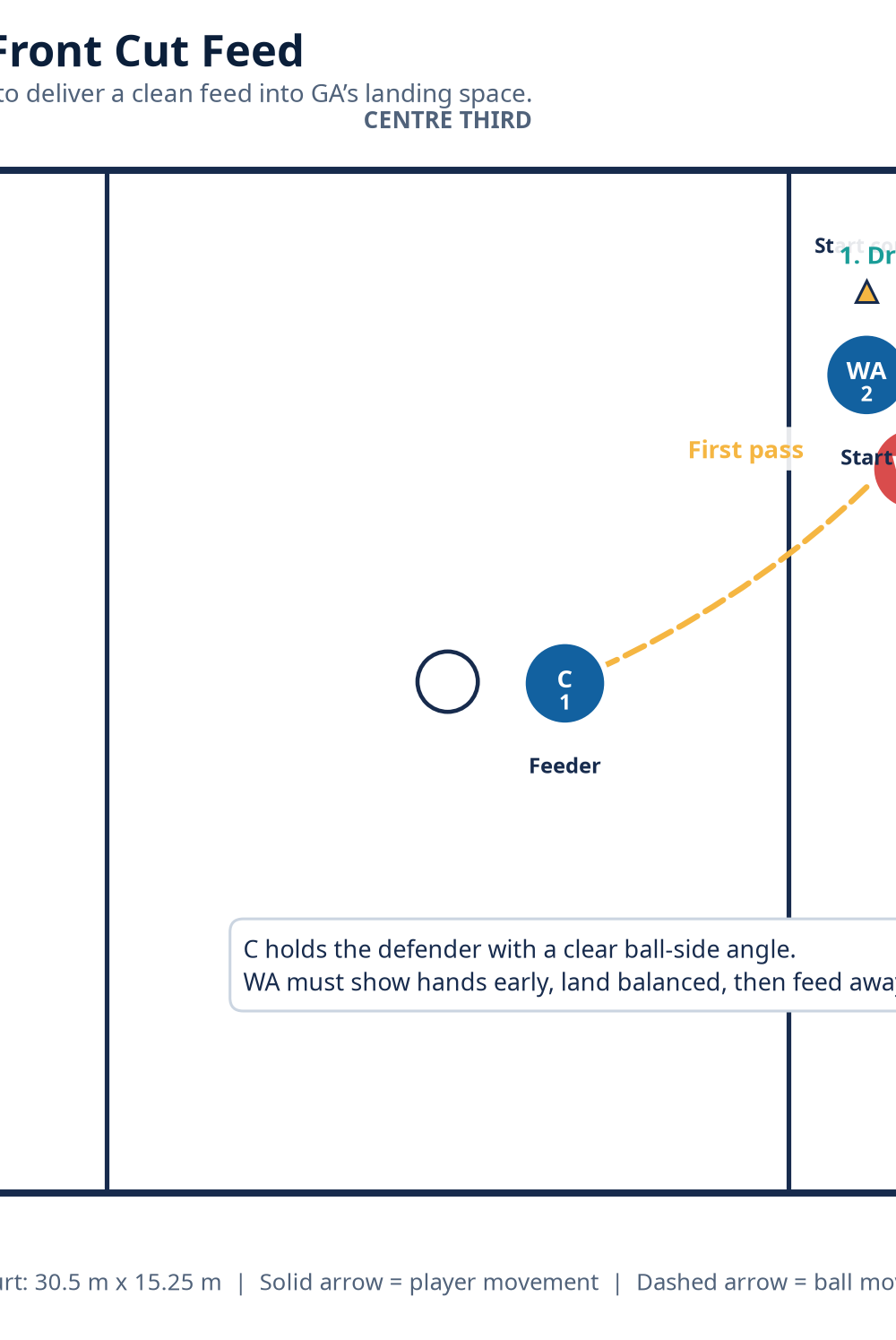
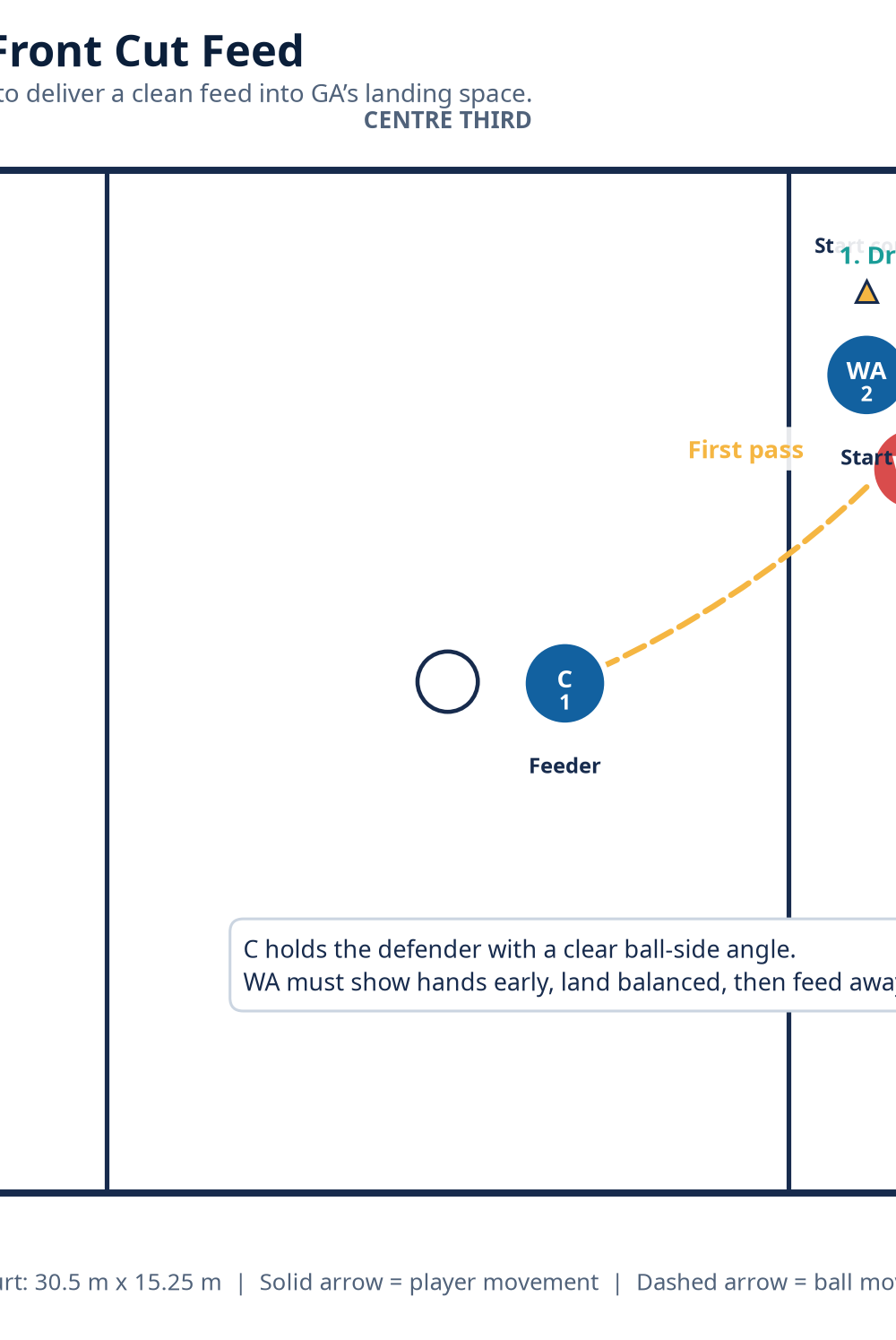
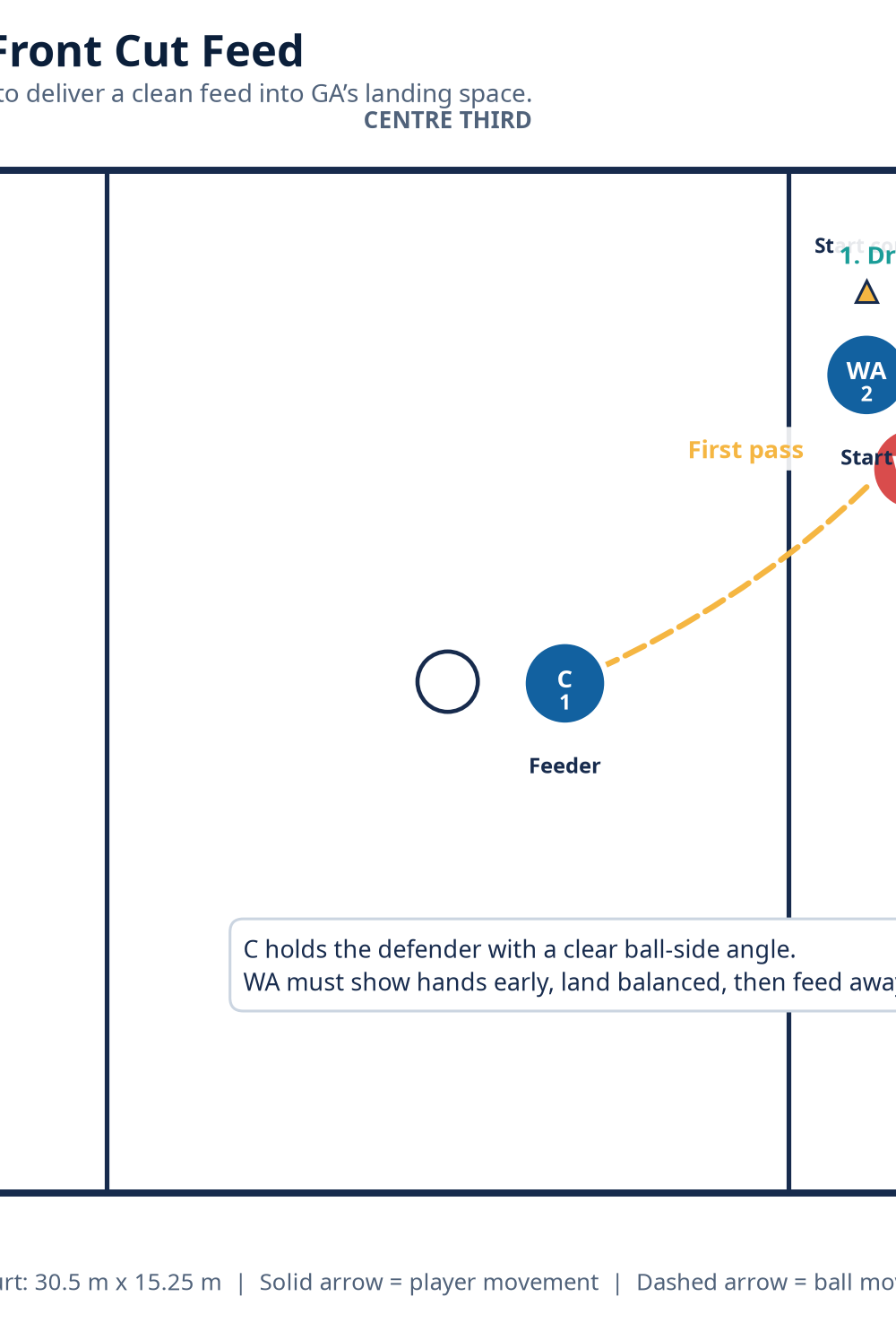
Brief the picture. WA drifts wide, plants on the outside foot and accelerates across the defender’s front shoulder. C passes into WA’s next movement line. Complete two walk-throughs, then one at three-quarter speed.
Run the wide-to-front pattern. On C’s visual cue, WA moves from the start cone to the wide cue cone. C delivers the first pass as a soft, leading ball into WA’s path. WA catches two-handed, lands balanced and turns her head early toward GA; do not allow her to stop square to the sideline.
Create the feed window. Immediately after catching, WA drives through the front-cut cue. GA holds a strong high target around the circle edge, showing hands early and keeping a 1.0–1.5 m separation from GD. WA feeds to GA’s outside shoulder or into the space in front of GA, never through GD’s hands. GA catches and either shoots, if inside the circle, or returns the ball to the spare feeder.
Repeat for volume. Work in 75-second blocks, aiming for 8–10 quality feeds per WA before rotating C, WA and GA. Give one focus per block: change of pace, leading pass or GA’s high target.
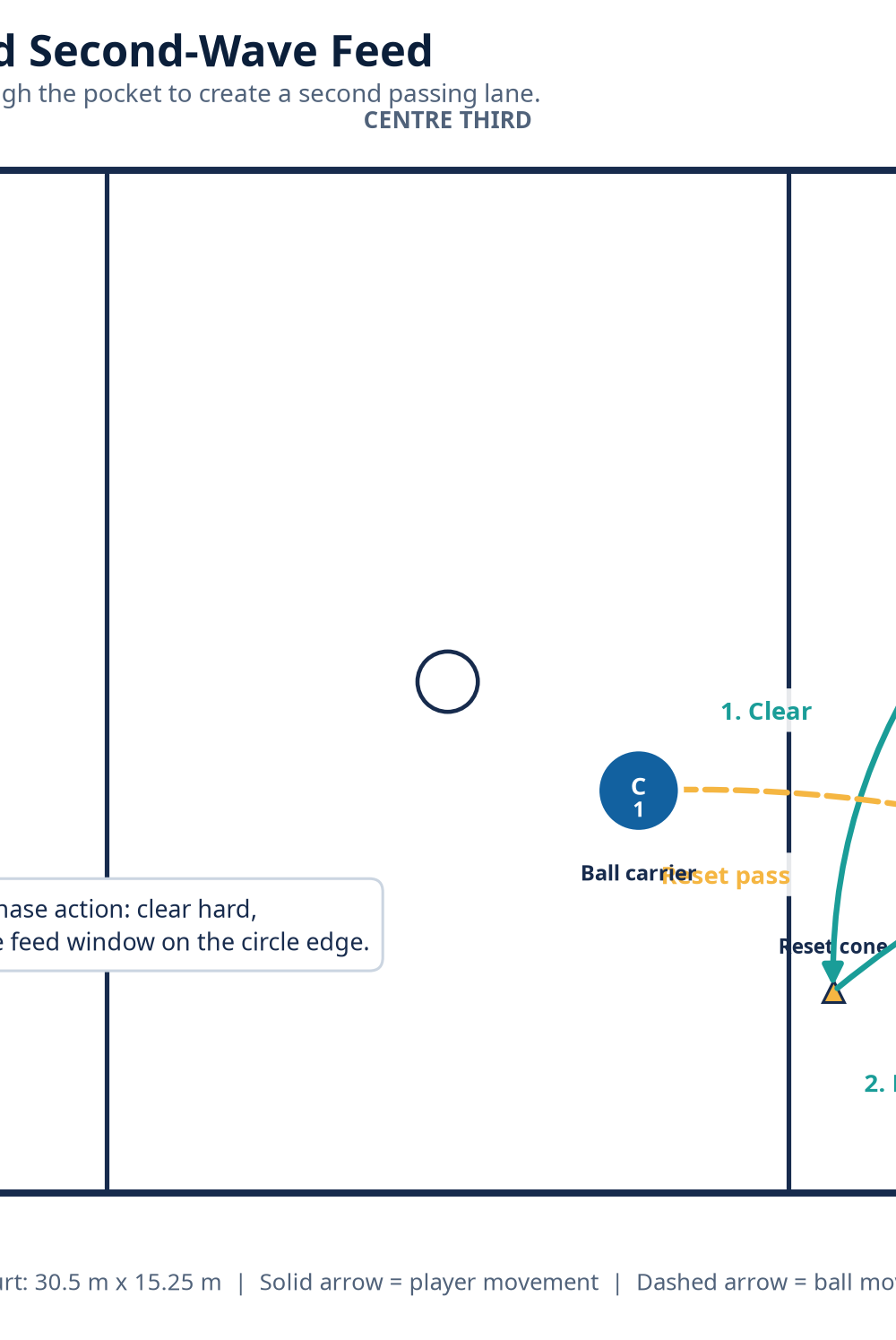
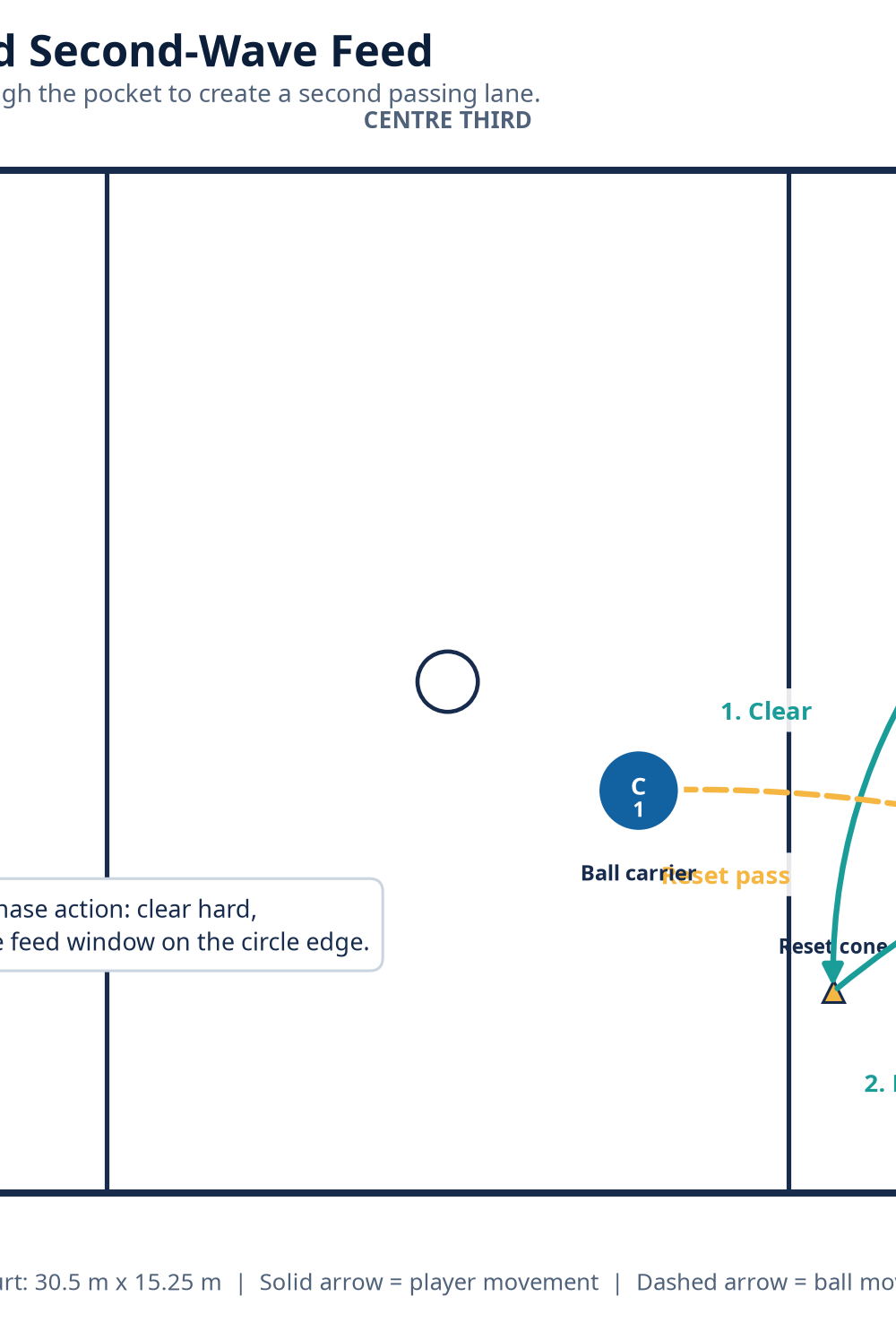
Add the denied-first-option reset. On the coach’s call of “closed”, WD shades across and prevents the front cut. WA must not force a ball. She clears hard to the reset cone, turns early to see C, re-offers through the pocket and drives into the second feed zone. C uses the reset pass, and WA feeds GA on the second wave. This is where the habit becomes game-real rather than choreographed.
- Condition the final phase. Play four 45-second possessions. Award one point for a clean WA-to-GA feed that receives a clear circle-edge target and two points if it comes after a deliberate reset. Defence earns a point for an intercept, a forced backwards pass or a held-ball turnover. Reset the ball immediately after an error so the work rate remains high.
Key Coaching Points
| Coaching focus | What to say and observe |
|---|---|
| Width before depth | “Show the sideline first; make WD choose.” WA’s initial drift must be wide enough to open a genuine front shoulder. |
| Change of pace | “Float, plant, explode.” The cut is won by acceleration after the plant, not by running a long predictable curve. |
| Timing with the ball | “Arrive as the ball arrives.” C releases when WA begins the next movement, not after WA has stopped. |
| Body shape on receipt | “Catch side-on, eyes up.” WA lands with hips and shoulders able to see GA and the circle edge immediately. |
| Feed selection | “Pass to the safe shoulder.” Feed away from GD, with enough air and width for GA to own the landing space. |
| Second effort | “If it is not on, clear with intent.” The reset must be a hard re-offer, not a slow retreat. |
Common Mistakes
The first mistake is a flat WA start. If WA begins too central, WD can sit on the front cut. Move the start cone 0.5–1 m nearer the sideline and demand a visible wide drift before the cut. The second is an early, stationary pass from C. Correct it by having C call “move” only when WA plants; this teaches the passer to lead the runner.
A third error is WA catching square and losing sight of GA. Rehearse a side-on landing and early circle scan. Fourth, GA can drift into WA’s lane; hold GA at the circle edge until WA turns and use GS to keep the far side clear. Finally, reward the reset so players do not force a closed first feed.
Variations & Progressions
| Option | Adjustment | Coaching purpose |
|---|---|---|
| Easier: guided lanes | Keep cones in place, remove defenders and allow WA four seconds after the catch. | Builds footwork, scanning and passing shape without decision overload. |
| Harder: live WD | Start WD on WA’s inside shoulder and allow a full 0.9 m marking distance. | Forces WA to read body position and win the correct shoulder. |
| Advanced: live GD and scoring | Add GD, limit WA to three seconds, and require a feed after a reset before the shot. | Demands timing, deception and realistic circle connection under pressure. |
Age Adaptations
For under-10s, use only C, WA and GA in a 10 m x 8 m marked channel within the attacking third. Give WA a clear “wide, then in” verbal cue, use a softer ball if needed and celebrate a balanced catch before you judge the feed. Keep blocks to 45 seconds with frequent demonstrations.
For under-12s, use a passive WD who shadows rather than contests. Rotate every 4–5 repetitions and add the reset after six clean first-phase feeds.
For under-14 and under-16, use live WD and GD with 45-second possessions. Ask WA to name the cue she read after every two repetitions. For open players, remove cones and vary GA and GS circle movements so WA identifies the safest feed in real time.
Coaching Finish
Finish with a 60-second debrief while the pattern is fresh. Ask: “What told you the front cut was on?” and “When did you choose the reset?” Your key message is simple: WA creates the lane first, then feeds the space with composure. When that movement is connected to C’s pass timing and GA’s high target, the shooting circle receives the ball on the front foot rather than under pressure.