The Overload Cross: Dynamic Wide Area Penetration & Finishing
Develop ruthless efficiency in wide areas with this high-tempo crossing and finishing drill that trains timing, varied delivery, and coordinated box runs.

Equipment Needed
1. Overview
This drill focuses on creating high-quality goalscoring opportunities from wide areas by emphasizing the timing of runs, the quality of the delivery, and the coordination between attackers in the penalty area. Crossing is often ineffective if the delivery and the runs are disconnected. This session bridges that gap, teaching wingers how to assess the box before crossing and training forwards to attack specific zones (near post, penalty spot, and far post) with intent.
It is highly effective when used as a functional practice leading into a phase of play or small-sided game, particularly for teams that utilize overlapping full-backs or aggressive wingers to break down compact defensive blocks.
2. Setup
- Pitch Dimensions: Attacking half of a standard pitch (approx. 50m x 68m).
- Players: 8–12 players (1 Goalkeeper, 2 Wingers/Full-backs, 2–3 Central Attackers/Midfielders, and 2–3 Defenders for progressions).
- Equipment: 1 full-size goal, 6–8 cones (to mark starting positions and crossing zones), and an ample supply of footballs (10+) positioned near the wide starting areas to maintain a high tempo.
3. Step-by-Step Instructions
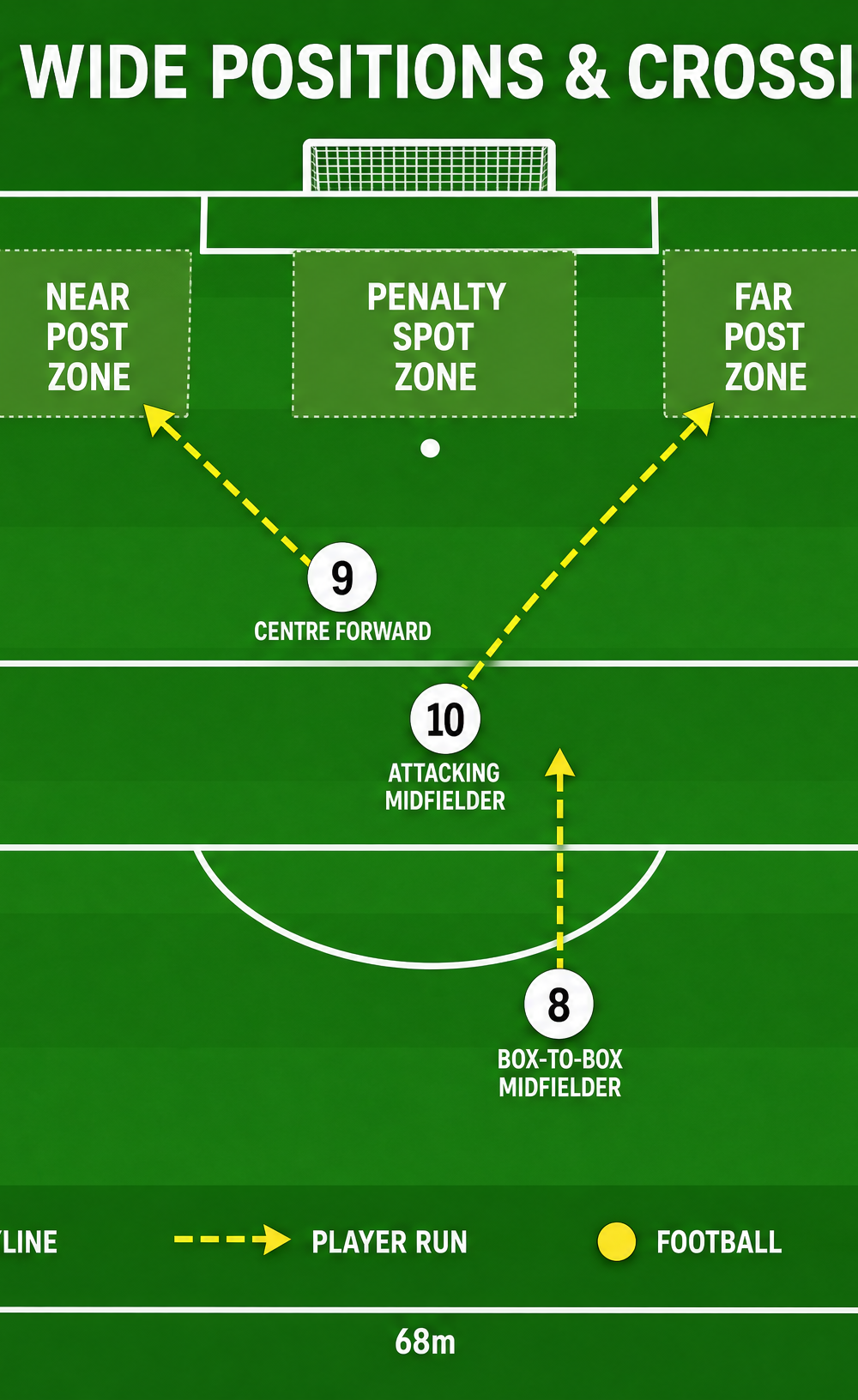
- Initial Positioning: Set up the wingers (7 & 11) wide on both flanks, approximately 30–35 metres from the byline. Position the central attackers (9 & 10) and a supporting midfielder (8) centrally, around 35–40 metres from goal.
- The Trigger: The coach or a central server plays a firm pass out wide to the right winger (7).
- The Drive: The winger takes an aggressive first touch down the line, driving into the designated crossing zone (marked by cones near the edge of the penalty area).
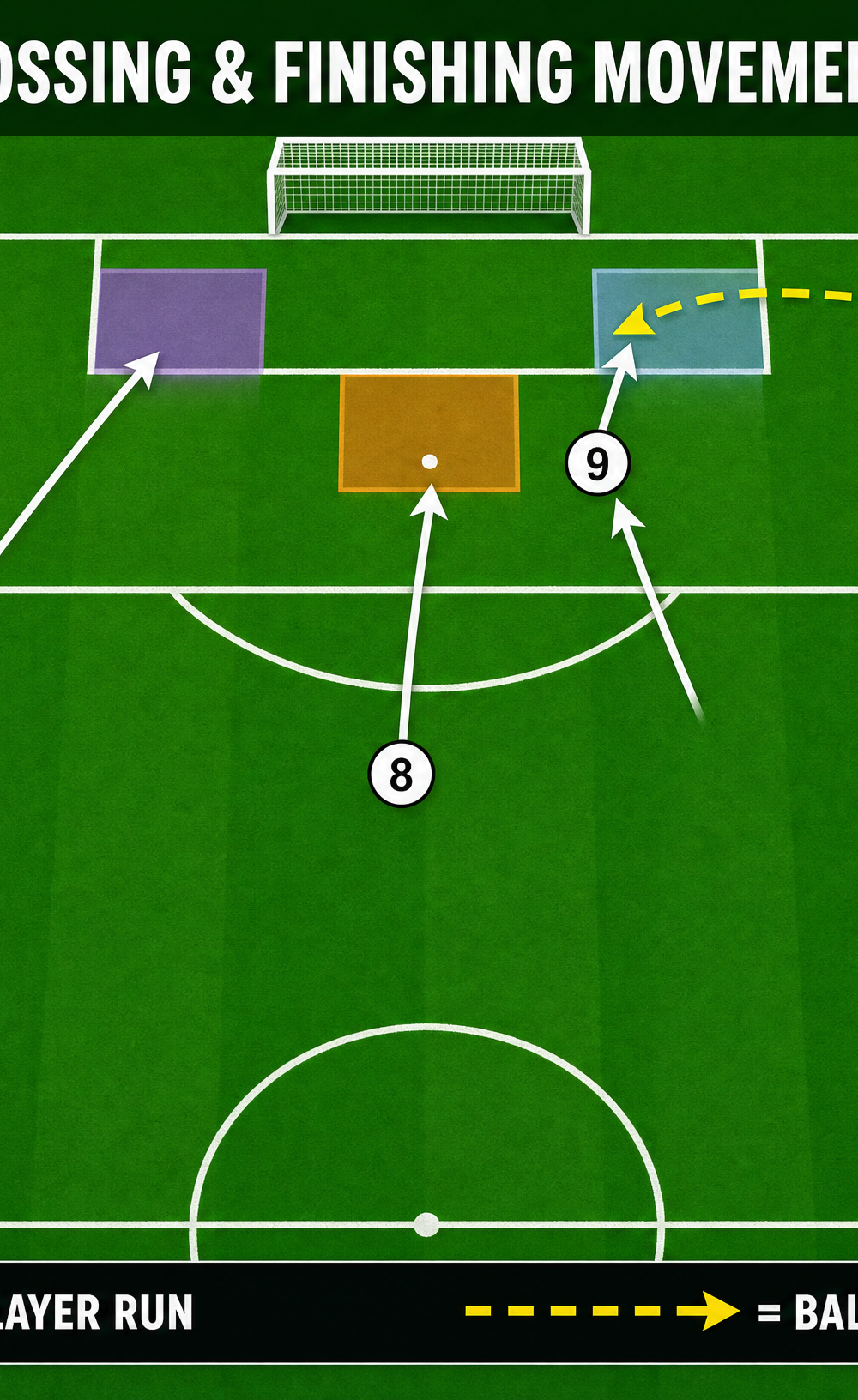
- The Runs: As the winger prepares to cross, the central players initiate their runs. The Centre Forward (9) attacks the near post. The Attacking Midfielder (10) attacks the far post. The Box-to-Box Midfielder (8) holds their run slightly, arriving late at the edge of the penalty area/penalty spot zone.
- The Delivery: The winger delivers a cross into one of the three targeted zones.
- The Finish: The attackers attempt to score with a first-time finish (header or volley).
- Reset and Alternate: As soon as the phase concludes, immediately repeat the sequence on the opposite flank with the left winger (11).
4. Key Coaching Points
- Quality of the First Touch: The winger's first touch must be out of their feet and aggressive, allowing them to get their head up and assess the box before delivering the cross.
- Types of Delivery: Encourage variation. A driven, low cross across the six-yard box is often more dangerous than a floated, high cross. The winger must select the right cross for the run.
- Timing is Everything: Attackers must not arrive in the box too early. They should time their runs to arrive as the ball is delivered, attacking the ball with momentum rather than waiting for it flat-footed.
- Staggered Runs: Ensure attackers do not make the same run. The near post, far post, and cut-back zones must all be occupied to maximise the chance of scoring or capitalising on rebounds.
- Ruthless Finishing: Demand focus and technique on the finish. Players should prioritise accuracy and keeping the ball down over raw power.
5. Common Mistakes
- Crossing Without Looking: Wingers putting their head down and blindly hitting the ball into the box, rather than picking out a specific zone or run.
- Arriving Too Early: Forwards making their runs too soon, resulting in them standing still in the box waiting for the cross, making them easy to mark and reducing their power on headers.
- Congesting One Zone: Multiple attackers making the exact same run (e.g., everyone running to the near post), leaving the rest of the box empty.
- Poor Body Shape: Attackers failing to open their bodies to the cross, resulting in awkward, off-target finishes.
6. Variations & Progressions
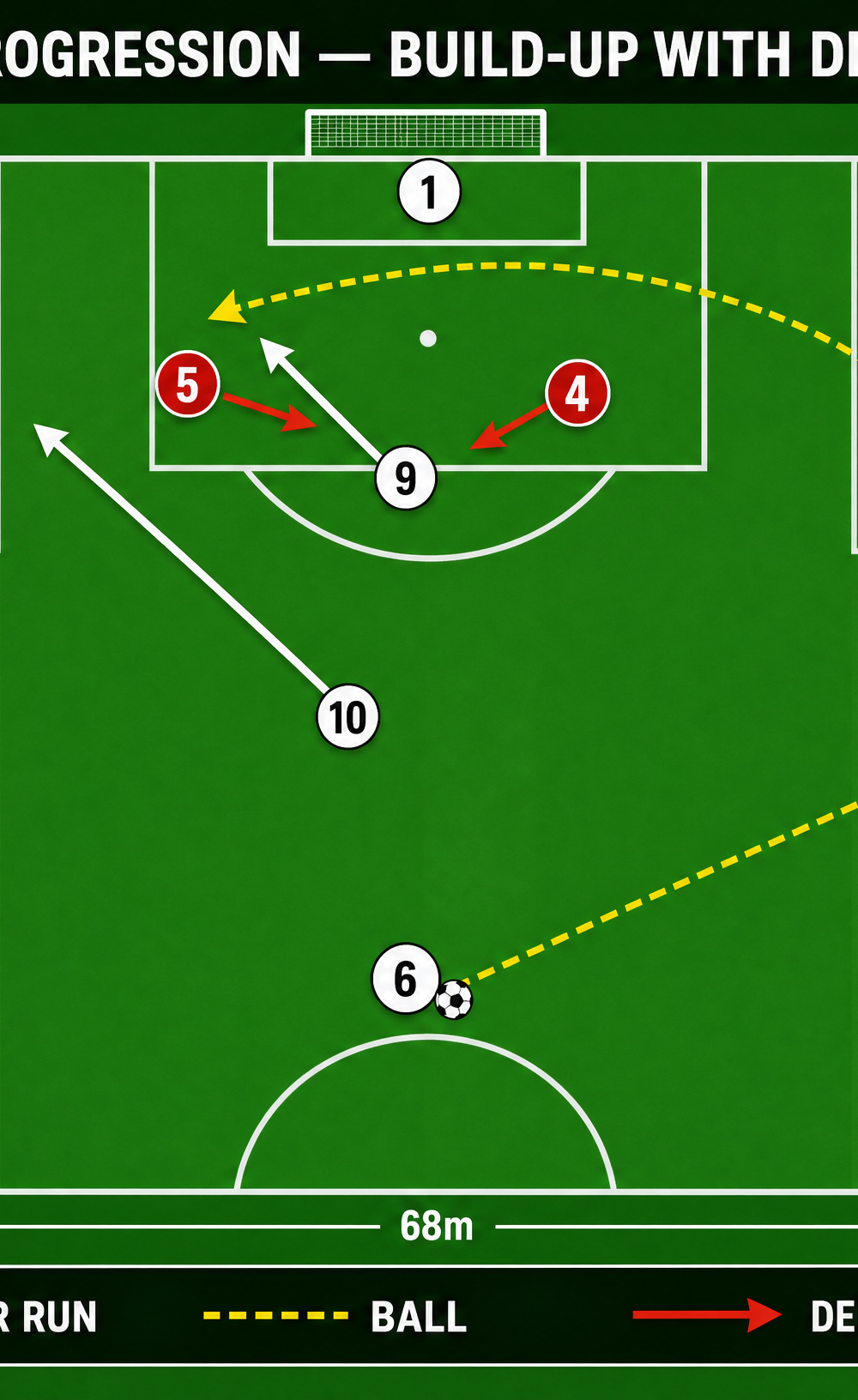
- Progression 1: Add Passive Defenders. Introduce two central defenders (4 & 5) who start in the box but are only allowed to intercept the cross, not tackle the attackers. This forces the winger to deliver a more precise cross and the attackers to make more aggressive runs.
- Progression 2: Active Defending & Build-up. Start the drill deeper with a central midfielder or centre-back (6). They play the ball wide, and the drill goes 'live'. Add a recovering full-back (2) to pressure the winger, forcing quicker decision-making.
- Variation: The Overlap. Instead of the winger driving down the line, have a full-back make an overlapping run. The winger cuts inside, drawing the defender, and slips the ball to the overlapping full-back for the cross.
7. Age Adaptations
- Under-8 to Under-10: Focus purely on the technique of striking a moving ball and basic coordination. Remove the complex runs and just have one player crossing and one player finishing unopposed. Use a smaller pitch and smaller goals.
- Under-12 to Under-14: Introduce the concept of specific zones (near post/far post). Add passive defenders to increase the challenge slightly. Focus heavily on the timing of the run.
- Under-16 to Open/Senior: Run the full drill with active defenders and progressions. Demand high tempo, game-realistic intensity, and varied, disguised deliveries. Introduce complex overlapping and underlapping patterns in the wide areas.